• Welcome to Photrio!
    Registration is fast and free. Join today to unlock search, see fewer ads, and access all forum features.
    Click here to sign up

Densitometer V channel value

Coburg Street

A
Coburg Street

  • 0
  • 0
  • 0
Jesus

A
Jesus

  • 0
  • 0
  • 8

Recent Classifieds

Forum statistics

Threads
201,729
Messages
2,829,208
Members
100,916
Latest member
mikenickmann99
Recent bookmarks
0

bernard_L

Member
Allowing Ads
Joined
Feb 17, 2008
Messages
2,131
Format
Multi Format
I use a Macbeth TR1224 densitometer to measure grey patches on a test B/W film. Transmission mode, A status. Densitometer displays four values, R, G, B, and V.
I understand that "V" stands for "visual". Knowing the CIE photopic response, I would expect the V response to be close to G, maybe a little broader. I am surprised to see displays such as (example):
R: 1.19 G 1.16 B 1.14 V 1.22
So not only V is not close to G, but it is outside the range of RGB, i.e. it cannot be a weighted average of RGB, at least not with positive coefficients.

Could an expert please explain?

Background information. Neopan 400. Non-staining developer (D-76 1+1). Intended for printing on multicontrast B/W paper.
 

Mr Bill

Member
Allowing Ads
Joined
Aug 22, 2006
Messages
1,524
Format
Multi Format
Hi, I wouldn't say that I'm an expert, just have more-than-average knowledge. The (V)isual response, as I recall, IS similar to the CIE photopic response. Offhand, I don't think I have any hard specs, but it ("V") is pretty broad, spectrally.

Status A, on the other hand, has three separate, and fairly narrow, spectral responses. From an old post I had made somewhere, they are centered on roughly 440, 530, and 620 nm.

It's possible that your film has some sort of "color density," or stain, in spectral areas where status A is "blind," but I think it may be just as likely that your instrument is just not giving the exact correct values. My recollection from my younger days is that a typical (whatever that is) b&w film gave nearly identical readings for all of the channels. How are you setting the calibration? Are you using an official check plaque or just something that is an approximation? This could be part of the issue.
 
Last edited:
OP
OP
bernard_L

bernard_L

Member
Allowing Ads
Joined
Feb 17, 2008
Messages
2,131
Format
Multi Format
@Mr Bill. Thank you for responding.
It's possible that your film has some sort of "color density," or stain, in spectral areas where status A is "blind
Sure, when subsuming a spectral response into just three numbers, this (some form of metamerism) is always a possibility, in principle. I'm aware of that as an astronomer (spectroscopy versus spectrophotometry). But (a) b/w film is fairly neutral; (b) as I wrote, the V value is outside the range of the RGB values.
How are you setting the calibration?
As per the manual. (1) measure air. (2) measure a "known" density and adjust the reading (up/down) to agree with known value. My known standard is a Stouffer calibrated step wedge. Once the calibration is done, the measurements of the other steps of the Stouffer step wedge agree with the Stouffer data within basically 0.01D.
Status A, on the other hand, has three separate, and fairly narrow, spectral responses. From an old post I had made somewhere, they are centered on roughly 440, 530, and 620 nm.
Indeed status A is relevant for color film, but I should repeat the experiment with status M, which I understand has broader response.
 

Mr Bill

Member
Allowing Ads
Joined
Aug 22, 2006
Messages
1,524
Format
Multi Format
Indeed status A is relevant for color film, but I should repeat the experiment with status M, which I understand has broader response.

No, I think that the spectral width of status M response is not much different than status A; perhaps a little wider, but not much. Both have a sensitive range, from each color, of about 40nm wide, according to the old post I had referred to (I'm sure I was working from pretty good data at the time). Fwiw, as I recall, status A is for color photography that is human-viewed - transparency or print, whereas status M is for color neg.

Once the calibration is done, the measurements of the other steps of the Stouffer step wedge agree with the Stouffer data within basically 0.01 D.

I've never used the Stouffer wedges, always calibrating densitometers with the formal densitometer standards. But Kodak step wedges followed the pattern you mention, where a given density patch would have R=G=B=Vis, generally within about 0.01 or 0.02, or so. I guess that one might presume the Stouffer wedges would likely follow the same pattern. But it might be worth confirming, perhaps Stouffer makes a statement to this effect. (Note: I'm presuming that your calibrated Stouffer wedge lists only a single value for each step, not a set of tricolor values.)

My take on the situation is that you are essentially comparing the relative "color neutrality" of two different films, and finding that they are significantly different with respect to the R=G=B=Vis situation. So if one is spectrally "flat," then this means the other film cannot also be so.

Now, unless Stouffer has supplied tri-color density data I don't think you can be certain that the RGBVis values ARE flat. Meaning, for example, that if you had decided to use a Neopan step wedge as the calibration standard, then it (Neopan) would have had R=G=B=Vis, and the Stouffer wedge would appear to have the problem.

If I were in your shoes, and presuming no access to another (independently calibrated) densitometer, etc., I'd probably take tricolor + vis readings on several different b&w films, looking to see if the Neopan is the oddball. Or, if I was under the gun to get some work done, perhaps I would calibrate and use only the Vis response. I dunno. Best of luck with it.
 
OP
OP
bernard_L

bernard_L

Member
Allowing Ads
Joined
Feb 17, 2008
Messages
2,131
Format
Multi Format
Or, if I was under the gun to get some work done, perhaps I would calibrate and use only the Vis response. I dunno. Best of luck with it.
Indeed I'll just proceed with the V values. My question was more out of curiosity than necessity. What aroused my attention was a dicrepancy at maybe 5% level.
My goal is to establish development times and sensitivities for 3 films with my developer, my tap water, my thermometer, my agitation. A 5% global (consistent) error in the density scale causes something like shifting a 0.55 contrast index to 0.58. Not completely negligible, but not a major effect either. Or, seen differently, the difference between a 1.0 and a 1.05 density range in a given negative, About 1/4 of the difference between the ranges of paper grades 2 and 3.
I have other issues with that sensitometry, being resolved. Thank you for your attention and your advice.
 

ic-racer

Member
Joined
Feb 25, 2007
Messages
16,719
Location
USA
Format
Multi Format
Oh, did I mention in post #3 above that I was using a Stouffer calibrated step wedge, To be precise, a T3110C.
And, T1015 http://www.stouffer.net/TransPage.htm#transmission step
has a max D 1.40, insufficient.
Sorry maybe I misunderstood but if you are concerned about the RGB values, what I meant is to ignore them unless you calibrated them with the step wedge. I can't tell if that is your case or not because the Stouffer does not (as far as I know) list the RGB values. Unlike the calibration step shown here.
Densitometer Switch 3.jpg
 
Last edited:
OP
OP
bernard_L

bernard_L

Member
Allowing Ads
Joined
Feb 17, 2008
Messages
2,131
Format
Multi Format
@ic-racer. I'm quite prepared to admit that a "gray" patch will not be perfectly gray according to densitometer "X" (and probably yet other values as seen by densitometer "Y". That is not the issue I raised in my OP.
In the example you show, the values written along the short edge (V??) are equal to the G value, plain and simple.
In the example I quoted from the Macbeth TR1224, the V value is clearly an outlier with respect to RGB. That was my question, and mostly out of curiosity, as stated in post #5.
Thank you for taking the time to provide the picture of your calibration patches.
 

ic-racer

Member
Joined
Feb 25, 2007
Messages
16,719
Location
USA
Format
Multi Format
Maybe I really did not get the message in the first post. I think it says "my machine is not calibrated on the color channels because the green does not match the V"

Response is "A three-color calibration patch is needed to do the correct 4-chanel calibration, this might be hard to find, I got one with my densitometer but I don't see that Stouffer sells that, so use just any Gray Stouffer calibrated patch and only use the V channel."

Yes? or still misunderstanding something? Or do you mean "I can't calibrate all 4 channels of my denstometer due to its design, it is a little off, I'm curious why."

I can't find the PDF for that machine so I don't know how it is calibrated.
 
Last edited:

Prof_Pixel

Member
Allowing Ads
Joined
Feb 17, 2012
Messages
1,917
Location
Penfield, NY
Format
35mm
Let's not forget that there are internal - non-user - adjustments that are required for a full calibration of a densitometer.
 

Chan Tran

Subscriber
Allowing Ads
Joined
May 10, 2006
Messages
7,147
Location
Sachse, TX
Format
35mm
Maybe I really did not get the message in the first post. I think it says "my machine is not calibrated on the color channels because the green does not match the V"

Response is "A three-color calibration patch is needed to do the correct 4-chanel calibration, this might be hard to find, I got one with my densitometer but I don't see that Stouffer sells that, so use just any Gray Stouffer calibrated patch and only use the V channel."

Yes? or still misunderstanding something? Or do you mean "I can't calibrate all 4 channels of my denstometer due to its design, it is a little off, I'm curious why."

I can't find the PDF for that machine so I don't know how it is calibrated.
My Xrite densitometer uses gray patch to calibrate all 4 color channels.
 

Bill Burk

Subscriber
Allowing Ads
Joined
Feb 9, 2010
Messages
9,461
Format
4x5 Format
After you set the V channel to agree with the Stouffer step, did you cycle through each other color and zero them?

That’s what the instructions tell me to do on my TR524.
 
OP
OP
bernard_L

bernard_L

Member
Allowing Ads
Joined
Feb 17, 2008
Messages
2,131
Format
Multi Format
ic-racer, Prof_Pixel, Chan Tran, Bill Burk, Thank you for your comments.
When following the instructions for calibration, I had the opportunity to calibrate just one value (well, two: air and density standard). Right now I'm heading for work. Tonight I'll double-check and report.
Then again, it's not a real problem for me. After my simple calibration, the V readout agrees (±0.02 iirc) with the steps of the Stouffer wedge The slightly discordant RGB values are just a minor annoyance. The flare on the three darkest steps of the Kodak reflection chart is a more substantial issue (solved). I also need to actually measure the shutter speeds and verify their stability. Someday, I'll build myself a sensitometer; someday.
I use the TR1224 for control of b/w development, as a slight improvement over the "read-newsprint-through-film-reader" method.
 
OP
OP
bernard_L

bernard_L

Member
Allowing Ads
Joined
Feb 17, 2008
Messages
2,131
Format
Multi Format
Rather than trying to document what I do (of course, I am doing wrong) I refer you to the TR1224 Operator Manual. See pp 18-22 (original page numbering) corresponding to pp 14-16 of the scanned pdf document. Only V channel is calibrated.
 

Attachments

  • Macbeth_TR-1224_Operators_Manual.pdf
    910.8 KB · Views: 536

ic-racer

Member
Joined
Feb 25, 2007
Messages
16,719
Location
USA
Format
Multi Format
ic-racer, Prof_Pixel, Chan Tran, Bill Burk, Thank you for your comments.
When following the instructions for calibration, I had the opportunity to calibrate just one value (well, two: air and density standard). Right now I'm heading for work. Tonight I'll double-check and report.
Then again, it's not a real problem for me. After my simple calibration, the V readout agrees (±0.02 iirc) with the steps of the Stouffer wedge The slightly discordant RGB values are just a minor annoyance. The flare on the three darkest steps of the Kodak reflection chart is a more substantial issue (solved). I also need to actually measure the shutter speeds and verify their stability. Someday, I'll build myself a sensitometer; someday.
I use the TR1224 for control of b/w development, as a slight improvement over the "read-newsprint-through-film-reader" method.
Did you see the sensitometer threads here and here. Somewhat of a review of common sensitometers. There also have been a few 'build a sensitometer' threads. When I did that thread those ESECO sensitometers were going for $25 each on ebay.
I searched today and the sensitometer market for buyers is still very good. Many units available for less than $100.

If you really want to build, look at this, for $25 you get the physical unit that may or may not work. You can gut it and put whatever light source you want in side it. Seems like 90% of sensitometer construction is making the box.
Screen Shot 2018-09-29 at 10.25.44 AM.png
 
Last edited:

ic-racer

Member
Joined
Feb 25, 2007
Messages
16,719
Location
USA
Format
Multi Format
Rather than trying to document what I do (of course, I am doing wrong) I refer you to the TR1224 Operator Manual. See pp 18-22 (original page numbering) corresponding to pp 14-16 of the scanned pdf document. Only V channel is calibrated.
Thanks for the link to the manual.
Indeed it only calibrates on the V channel. Like any piece of vintage electrical gear the thing can get out of spec so I'm curious, if you really re-calibarte it every time the power goes off, how far off is it? Is it always off by the same amount every time you turn it on, or is it random? One of my Tobais units drifted a lot. I traced it down to a faltering power supply connection and that fixed it. Nice thing about the Tobias is that it came with the schematic and service manual. It is USA made with discrete components on the printed circuit boards.
 
OP
OP
bernard_L

bernard_L

Member
Allowing Ads
Joined
Feb 17, 2008
Messages
2,131
Format
Multi Format
Did you see the sensitometer threads here and here. Somewhat of a review of common sensitometers. There also have been a few 'build a sensitometer' threads. When I did that thread those ESECO sensitometers were going for $25 each on ebay.
I searched today and the sensitometer market for buyers is still very good. Many units available for less than $100.

If you really want to build, look at this, for $25 you get the physical unit that may or may not work. You can gut it and put whatever light source you want in side it. Seems like 90% of sensitometer construction is making the box.

Sure, $25 is a sweet deal. And I could replace the flash with an LED, accurately timed. But apparently the cheapest deal currently on the auction site is:
https://www.ebay.fr/itm/X-RITE-INC-...280073?hash=item363b4f32c9:g:NegAAOSw8A1abbKf
45$ plus almost much shipping (I reside in Yurp).
Come to think of it, I think I'll continue the tedious way with the Kodak reflection patches, until I have established ISO speed and dev times for a few combinations. After that, process control is a different business and can be done with a minimal procedure, like expose zones II, V, VIII. And, purchasing a sensitometer raises two issues: (1) how consistent is the exposure (old flashtube, capacitor); (2) how to connect the sensitometer exposure scale with in-camera exposures (LightValue+f-stop+shutter).

Nevertheless, I'll go through the two threads that you pointed out, and anything that a "sensitometer+construction" search might reveal. And thank you for the information.
 

Bill Burk

Subscriber
Allowing Ads
Joined
Feb 9, 2010
Messages
9,461
Format
4x5 Format
Since I put in a new CR2032 (IIRC, anyway a 3V Li battery) the calibration is preserved after power off/on.

... (1) how consistent is the exposure (old flashtube, capacitor); (2) how to connect the sensitometer exposure scale with in-camera exposures (LightValue+f-stop+shutter).

Cool.

1 and 2 are both non-issues.

1. I have found even my old Vivitar 283 produces consistent results according to flash meter.

2. Any sensitometer exposure that gives you a bunch of steps with measurable densities is going to allow you to measure contrast. When you do find a test that "hit the ASA parameters"... you can walk backwards and assume the exposure where you got 0.1 density is the same as what the manufacturer would have seen when they got the ASA/ISO speed in the first place. So taking that as ASA speed, you can get your in-camera exposures.

Here is another fun thread...
https://www.photrio.com/forum/threads/enlarger-sensitometer.92518/
 
OP
OP
bernard_L

bernard_L

Member
Allowing Ads
Joined
Feb 17, 2008
Messages
2,131
Format
Multi Format
1. I have found even my old Vivitar 283 produces consistent results according to flash meter.
Point taken; I might check since I have a couple 283's around.
I quite like the pic of the innards of your sensitometer: https://www.photrio.com/forum/threads/enlarger-sensitometer.92518/page-4#post-1234373. Must be easier to repair than SMD construction.
2. Any sensitometer exposure that gives you a bunch of steps with measurable densities is going to allow you to measure contrast. When you do find a test that "hit the ASA parameters"... you can walk backwards and assume the exposure where you got 0.1 density is the same as what the manufacturer would have seen when they got the ASA/ISO speed in the first place. So taking that as ASA speed, you can get your in-camera exposures.
I beg to disagree; If I read you correctly, you use your measurements (sensitometer+densitometer) to measure/adjust the CI, or G-bar, or whatever, and then assume that the ISO point is the box value. Irrespective of what developer you use? And what about films like Ferrania P30, where the buyer, under his/her own responsibulity, assumes P30 means Scheiner 30°, DIN 20°, ISO 80, until it slowly dawns upon him/her that maybe ISO 40 is more like it. Having invested the time to expose, develop, and measure a test film, I would like to have for my efforts an independent determination of C.I. and speed point.

To me this means either of these, that allows to connect sensi+densi-tometry to actual ISO without assumptions:
  1. A densitometer with a "continuous" light source, meaning, e.g. a LED that is "on" for several milliseconds or tens of milliseconds, and whose illumination in the film plane can be measured with a photodiode (with appropriate transimpedance amplifier, not an iphone hack), that will in a second step measure the light pulse in the focal plane of a known good SLR. Allowing to tie in sensitometry with real-world scenes+cameras.
  2. In-camera exposure, using a reflective target, controlled lighting, and a known good SLR (or hand meter, plus camera with known good shutter, and pleeez no zoom lens with unknown transmission factor).
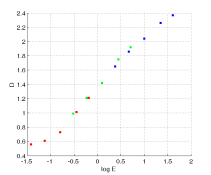
Just to introduce some element of concreteness into the discussion of this thread so far, here is (graph below) what I obtain with the following:
Kodak gray patches in the Professional Photoguide; I measured the reflection densities instead of trusting the marked values, leading to a significant improvement of the quality of the final graph; used a Nikon FG20 (electronically timed shutter) with 50/1.8 and +2d lens (no exposure correction required for close focus); measured on Kodak 18% gray card (that can of worms is strictly off-topic for this thread, pleeez). Three exposures spaced 3EV apart. Dropped the data from the three darkest patches (D 1.6, 1.9; 2.2) that appear to be affected by flare from specular reflection despite my efforts for oblique-only lighting.
The resulting graph might, maybe, be improved by measuring the actual shutter speeds (so far assumed accurate). Just for fun, this is 1+ year old D-76 in a half-full bottle; quite usable IMHO.
Neopan400-03-r.png
 

Bill Burk

Subscriber
Allowing Ads
Joined
Feb 9, 2010
Messages
9,461
Format
4x5 Format
Well I setup the “system” with D-76 and fresh Kodak film. Once the system is stable, then I am free to check an unknown combination (I have an expired bulk roll of Plus-X for example. Then I won’t take the speed point as ASA, I would check to see if it still holds at 125.)
 
OP
OP
bernard_L

bernard_L

Member
Allowing Ads
Joined
Feb 17, 2008
Messages
2,131
Format
Multi Format
Relative or direct calibration. I guess it is a matter of taste, or opinion. Whatever works. And I agree with you re: keep it simple, with the goal: having adequate technique to support picture-taking.
 

ic-racer

Member
Joined
Feb 25, 2007
Messages
16,719
Location
USA
Format
Multi Format
No need for an electrical 'sensor' at the film plane; film will work.
For any scene all that is needed is a negative of that scene with the shadows you determine important exposed to yield a density that is on the toe where the slope of the toe is 1/3 the slope of the straight part.
If you do trial exposures of your scene and look to see if the shadows are 0.1log D when the film is processed to the ASA triangle gamma, you are good. The ISO/ASA standard (to use 0.1log D) to approximate the work of Jones' 0.3G is a boon to all of us and makes things manageable and is also validated in the scientific literature.
 
OP
OP
bernard_L

bernard_L

Member
Allowing Ads
Joined
Feb 17, 2008
Messages
2,131
Format
Multi Format
Preliminary comment. While I make some statements that differ from those of other posters, Bill Burk, ic-racer, or others, I respect their opinions and I think this is a constructive and instructive discussion. I make this statement after having seen so many forum discussions derail into personal arguments.

I disagree with using film to tie the sensitometer data into the "real" sensitivities as defined by known good meters, whether in-camera or hand-held.
(1) Taking the specific example given by ic-racer. Assume your densitometry is good to 0.02D. Assume your normal development is to G=0.55. And assume the speed point is effectively at 0.3G. This means that the slope of D-logE, at the point used for inter-calibration, is 0.3x0.55=0.165. Meaning that the 0.02 error bar on D translates to 0.02/0.165=0.12, between 1/3 and 1/2 stop.

Error budget. Sure, an exposure error of 1/2 stop is (except for slides, outside the scope of the present discussion) tolerable, if taken alone. The emphasis is the key point. There are multiple causes of error. Shutter inaccurate. Calibration error of the light meter. Arbitrariness of metering a contrasty scene. Processing variations. And more... If you want to be confident in the overall process to translate your vision of a scene into a nice negative, you cannot allow a single factor to claim most of the error budget, with the excuse "but the resulting error is less than what is allowed". (Which is not to say that good pictures cannot be made with casual procedures).

Electronic sensor. I believe that with a silicon photodiode in zero-bias mode, suitable electronics totaling less than 20$/€, and a slightly modified soundcard (0$€ from surplus) one can measure the integrated exposure E to better than 5% (and that is pessimistic). Note that I do not claim to measure absolute lux-seconds, just interconnect the exposure plane of the sensitometer with the film plane of a known good camera. 5% is 0.021 in log units, 1/14 of an f-stop. Which takes us to the next point.

Measurement equipment must be significantly better calibrated than target user accuracy. What is "significantly"? I've heard more than once engineers claim this means a factor of 10; exaggerated, IMO, these guys should be made to design and build the measurement equipment. But at least a factor of 2.

Speed point is less important than contrast index. Which downplays my above arguments. With emulsions such as FP4 or 400TX, there is in most situations a large latitude for overexposure. So it's easy to play safe. But the contrast index must be about right.
 
Photrio.com contains affiliate links to products. We may receive a commission for purchases made through these links.
To read our full affiliate disclosure statement please click Here.

PHOTRIO PARTNERS EQUALLY FUNDING OUR COMMUNITY:


Ilford ADOX Freestyle Photographic Stearman Press Weldon Color Lab Blue Moon Camera & Machine
Top Bottom