1. I have found even my old Vivitar 283 produces consistent results according to flash meter.
Point taken; I might check since I have a couple 283's around.
I quite like the pic of the innards of your sensitometer:
https://www.photrio.com/forum/threads/enlarger-sensitometer.92518/page-4#post-1234373. Must be easier to repair than SMD construction.
2. Any sensitometer exposure that gives you a bunch of steps with measurable densities is going to allow you to measure contrast. When you do find a test that "hit the ASA parameters"... you can walk backwards and assume the exposure where you got 0.1 density is the same as what the manufacturer would have seen when they got the ASA/ISO speed in the first place. So taking that as ASA speed, you can get your in-camera exposures.
I beg to disagree; If I read you correctly, you use your measurements (sensitometer+densitometer) to measure/adjust the CI, or G-bar, or whatever, and then assume that the ISO point is the box value. Irrespective of what developer you use? And what about films like Ferrania P30, where the buyer, under his/her own responsibulity, assumes P30 means Scheiner 30°, DIN 20°, ISO 80, until it slowly dawns upon him/her that maybe ISO 40 is more like it. Having invested the time to expose, develop, and measure a test film, I would like to have for my efforts an independent determination of C.I.
and speed point.
To me this means either of these, that allows to connect sensi+densi-tometry to actual ISO without
assumptions:
- A densitometer with a "continuous" light source, meaning, e.g. a LED that is "on" for several milliseconds or tens of milliseconds, and whose illumination in the film plane can be measured with a photodiode (with appropriate transimpedance amplifier, not an iphone hack), that will in a second step measure the light pulse in the focal plane of a known good SLR. Allowing to tie in sensitometry with real-world scenes+cameras.
- In-camera exposure, using a reflective target, controlled lighting, and a known good SLR (or hand meter, plus camera with known good shutter, and pleeez no zoom lens with unknown transmission factor).
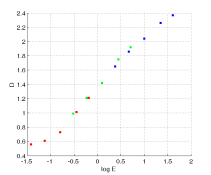
Just to introduce some element of concreteness into the discussion of this thread so far, here is (graph below) what I obtain with the following:
Kodak gray patches in the
Professional Photoguide; I measured the reflection densities instead of trusting the marked values, leading to a significant improvement of the quality of the final graph; used a Nikon FG20 (electronically timed shutter) with 50/1.8 and +2d lens (no exposure correction required for close focus); measured on Kodak 18% gray card (that can of worms is strictly off-topic for this thread, pleeez). Three exposures spaced 3EV apart. Dropped the data from the three darkest patches (D 1.6, 1.9; 2.2) that appear to be affected by flare from specular reflection despite my efforts for oblique-only lighting.
The resulting graph might, maybe, be improved by
measuring the actual shutter speeds (so far
assumed accurate). Just for fun, this is 1+ year old D-76 in a half-full bottle; quite usable IMHO.