• Welcome to Photrio!
    Registration is fast and free. Join today to unlock search, see fewer ads, and access all forum features.
    Click here to sign up

Densitometer V channel value

Forum statistics

Threads
201,236
Messages
2,820,961
Members
100,606
Latest member
l_peti
Recent bookmarks
0

ic-racer

Member
Joined
Feb 25, 2007
Messages
16,695
Location
USA
Format
Multi Format
The 0.1 log d measurement is from a negative exposed in the camera. Not exposed from the sensitometer. The sensitometer is used to expose identical film to make the control strip for processing to the "ASA Triangle" specifications. That way you know how much development to give the negative exposed in the camera. This may or may not be the development to match your enlarger and printing paper which is not covered here. This is the practical method of EI determination and it has been tried and true for decades.

Using a sensitometer for speed determination can ONLY be for RELATIVE comparison. RELATIVE to a STANDARD of some entity. That standard could be another film, another sensitometer or a luminosity standard.

There are a hundred ways to use a sensitometer and densitometer, just be careful you draw the correct conclusions from your tests.
 

Attachments

  • Sensitometer Calibration.pdf
    565.6 KB · Views: 173
Last edited:

Bill Burk

Subscriber
Allowing Ads
Joined
Feb 9, 2010
Messages
9,455
Format
4x5 Format
Do I understand you plan to contact print the T3110C to film eventually but just now you don't have the setup to do that?

You're going to get very nice results when you do, that's for sure. The camera tests you did already is okay (but lots of caveats).

You could make sensitometric exposures and camera exposures on the same film and graph them together. I hope to sway you to my way of thinking on this, that the sensitometer, however crafted, is the superior test method.

Please share your numbers, the density measurements from your grayscales and your film densities. The more numbers you share, the more graphs we can draw.

Here's an example of something I was able to put together from tests a Photrio user did a few years ago.

I like the fact you measured the steps and apply that to make smoother graphs (you can see swmcl didn't do that because the steps zigzag)...

http://beefalobill.com/images/swmclfp4.jpg
 

ic-racer

Member
Joined
Feb 25, 2007
Messages
16,695
Location
USA
Format
Multi Format
One final thought. Please don't take any of my posts as discouraging. I'd encourage you to make a sensitometer and experiment.
I treat a sensitometer like a mass balance. That is, one needs to place something on each side of it to be of any use; it is for comparative analysis.

Screen Shot 2018-10-02 at 9.26.23 AM.png
 

Bill Burk

Subscriber
Allowing Ads
Joined
Feb 9, 2010
Messages
9,455
Format
4x5 Format
I want to advertise my resource "Divided Attention" though I wish I had called it "The Zone System is a Beast" because I think it would have gotten wider circulation.

It (and the Delta-X add-on in the discussion) tells all the stories I am liable to re-iterate in this thread, so I will leave it as an exercise for the reader.

https://www.photrio.com/forum/resources/divided-attention.77/

And one more harp on the idea of sensitometer and locking exposure to film... and then I'll try to leave it alone.

I don't have a "calibrated" sensitometer. You can tell from the threads that I got the "wrong" calibration sheet with the EG&G that Stephen Benskin sold me..

But I followed the thought outlined in ic-racer's PDF Sensitometer Calibration.pdf, I calibrate to Kodak's sensitometers.

For you see, they have sensitometers calibrated to NIST. They have very tight manufacturing tolerances. The ASA/ISO film speed is printed on the box and Kodak has to make it very close to the speed printed on the box, or else they would have to print new boxes. (Back in the day, I used to get Ektachrome Professional where they rubber-stamped the batch ASA which I think was 50 on a 64 box.) So Kodak makes their film very close to the ASA/ISO speed... and all you have to do is develop in D-76 to meet the ASA criterion (the ASA triangle) within +/- 0.05... (Kodak would retest until they hit it exactly of course)...

Then you look at where the 0.1 speed point falls and from there, straight-away, you just say it's box speed. Because you call it out as box speed, you know the meter candle seconds that hit that point on the curve. (For 400 speed film, the film was struck by 0.002 meter candle seconds).

[+] From that you know exactly how bright your light was because you know the time of exposure (you will use an accurate shutter in your sensitometer I am sure) and you know the density of the step wedge* over that point of film (you have a calibrated Stouffer T3110 traceable to NIST).

So you do not have to make your light any certain brightness. You can figure it out from the graph results later. Focus your attention on making the light a really good quality (like an incandescent bulb with 80B filter or electronic flash), and your shutter speed a really good speed** (Like somewhere between 1/1000 to 1/100 second).

*Using the graph you extrapolate the the point on the x-axis, 0.1 will probably fall between two steps.
**Actually consistency of overall exposure is what counts, the shutter speed could be arbitrary and the light intensity can be arbitrary as long as taken together the amount of light is consistent because you will find a combined value "meter candle seconds" and you do not "need" to break them apart into intensity and time separately.

There are Zone VI enlarging lights and timers which approach the idea two different ways, there is a light stabilizer which uses a photocell to feedback voltage to the bulb to try to hold the intensity steady. Then you can use a regular timer for enlarging. The other is a compensating enlarging timer which uses a photocell to passively measure the light intensity and varies the real time of exposure to give a dialed-in time equivalent. Either approach is good - make the light constant or change the time in response to the light.

[+] After reading the claim in this paragraph, it doesn't quite add up. You don't know exactly how bright the light is. You know exactly how many meter candle seconds reached the film.
 
Last edited:

Bill Burk

Subscriber
Allowing Ads
Joined
Feb 9, 2010
Messages
9,455
Format
4x5 Format
bernard_L,

I hope I haven’t put you off by voicing my opinion too firmly. You can test any way you like. You can dream up any system you want. Whatever you do, you can use what’s been said as a sanity check.
 

Serg Lavrenchuk

Member
Allowing Ads
Joined
Jun 23, 2008
Messages
105
Location
Kiev, Ukraine
Format
Multi Format
I would like to revive this as was surprised today to check the contract by ISO triangle points for the BW film made with 21 step target on Xrite 810 with G channel and newly bought Xrite 310 with V channel.
The difference in the same film test strip was 0.53 (G) and 0.57 (V). So now I stumble at what reference to use since now. Have been using 810 on G channel for all BW and colour film processing.

Same fields read 310(V)vs810G 1 -> 0.33 vs 0.30D and 21->1,67Dvs1.57.

Any ideas on how to live on now with information? :smile:
 

Serg Lavrenchuk

Member
Allowing Ads
Joined
Jun 23, 2008
Messages
105
Location
Kiev, Ukraine
Format
Multi Format
Just to add, Xrite 810 got good trust due to the fact that used with c41 for few years with normal chemistry always showed contrast 0.60-0.61 for the G channel and sensitometer in G mode.
So till today theory was close to practice. And now Xrite 310 made me thinking if I was under developing all my BW films.
 

Bill Burk

Subscriber
Allowing Ads
Joined
Feb 9, 2010
Messages
9,455
Format
4x5 Format
If you have a calibrated step wedge from Stouffer, you can compare each reading with your Xrite 810 to the calibrated step nearest. For example if you have a calibrated step 0.18 and you read 0.17 off the step then you add 0.01 to any test sample step reading in the vicinity of 0.10 to 0.20, I do this when reading other people's test samples because I want to give them the best evaluation. For my own purposes I just take what the densitometer reads and ignore the deviation. I don't believe it's significant for me, not to the extent that I would get 0.57 when I thought I was getting 0.62. Your issue seems quite different.

If you will share all your readings and the densities of your step wedge as read by your Xrite 810 in both modes, we could talk about how significant your results are.
 

Bill Burk

Subscriber
Allowing Ads
Joined
Feb 9, 2010
Messages
9,455
Format
4x5 Format
Same fields read 310(V)vs810G 1 -> 0.33 vs 0.30D and 21->1,67Dvs1.57.

What's your base and base+fog?

Do you give a low enough exposure so that step 1 reads under 0.10 above base+fog (so you can find where the curve crosses 0.10)?
 

Serg Lavrenchuk

Member
Allowing Ads
Joined
Jun 23, 2008
Messages
105
Location
Kiev, Ukraine
Format
Multi Format
If you have a calibrated step wedge from Stouffer, you can compare each reading with your Xrite 810 to the calibrated step nearest.

Sorry for the late response. Had c41 chemistry problems that left no time for densitometer.
To tell the true till I got X-rite 361T i was using calibrated Stouffer 21 to calibrate my XRite-810. I was using 3.05 field for all 3 channels buy actually only G was measured in real work (BW and C41).

With Xrite-361 I have got original xrite calibration target and used it for the calibration.

If you will share all your readings and the densities of your step wedge as read by your Xrite 810 in both modes, we could talk about how significant your results are.

HP5+ test strip made by G-sensitometer channel.
Measured with Xrite 810 (G-channel data), calibrated on Stouffer #21 field 3.05 (my notes say "ISO" CI = 0,49)

0 0,30
1 0,32
2 0,33
3 0,35
4 0,38
5 0,41
6 0,46
7 0,52
8 0,60
9 0,67
10 0,74
11 0,83
12 0,91
13 1,00
14 1,08
15 1,17
16 1,25
17 1,34
18 1,44
19 1,52

Same HP5+ film strip measured with Xrite 361 (V-channel) - (ISO triangle CI = 0,53)

0 ---
1 0,3
2 0,31
3 0,34
4 0,37
5 0,40
6 0,47
7 0,53
8 0,61
9 0,70
10 0,78
11 0,87
12 0,96
13 1,04
14 1,12
15 1,21
16 1,30
17 1,39
18 1,48
19 1,57

After this measurement I measured Stouffer #21 and #8 fields and got 3.07 (vs 3.05) and 1.11 (vs.1,09) in G channel. What I think is rather OK.
---------------------------------------------------------------------------

I think that either my Stouffer is not 3.05 any more in the #21 filed or my 361 calibration target is not 3.01/3.76 in dense fields.

If I calibrate 361T with original 3.76D.REF getting 3.77 (V) on it and then measure my Stoufer #21 field I get 3.17 instead of 3.05D.REF (too big error).
Stoufer #8 field I get 1.18 instead of 1.09D.REF

If I calibrate 810 with Stouffer #21 filed with 3.05 density and then measure 361T target I have 2.92 in G instead of 3.01D (optical/V) or 2.91D (in U-violet mode).REF.
So actually U mode is closer to G channel than V mode?

If I calibrate 810 with 3.01 field from 361T target (instead of densest 3.77 field) using VIS mode (instead of RGB). Reread it as 3.01 (V). Then read #21 and #8 Stouffer's (3.05 and 1.09) in VIS mode and get 3.13 and 1.14.
So looks like both 361 and 810 in VIS mode calibrated by 361t's original target tend to give higher values than mentioned on Stouffer calibrated target #21 and #8 fields.
I don't think that Stouffer could miss so much with the calibration of own target and don't think target could get density with time (I think It could loose density with time).

-----------------------------------------------------------------------------

I have calibrated 810 in VIS mode with 361REF target (field 3.01) and then measured again the same HP5+ strip. (ISO triangle CI = 0,52)

0 0,33
1 0,34
2 0,35
3 0,36
4 0,39
5 0,42
6 0,48
7 0,54
8 0,62
9 0,7
10 0,79
11 0,87
12 0,96
13 1,03
14 1,12
15 1,21
16 1,27
17 1,37
18 1,45
19 1,53
-----------------------------------------------------------------------------
Looks like in VIS mode in density range up to 1.60 both devices 361 and 810 give very close results.

I think I need some new 21 step Stauffer measured/calibrated with trusted 810 device in RGB mode to exclude difference in RGB / Visual modes.

My fog level is 0.30 in RGB mode and 0.33-34 in Visual.

 

Serg Lavrenchuk

Member
Allowing Ads
Joined
Jun 23, 2008
Messages
105
Location
Kiev, Ukraine
Format
Multi Format
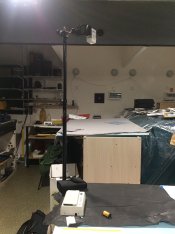
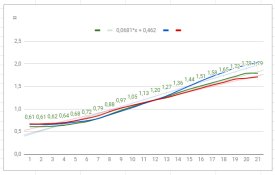
Today I got also very strange densitometric results with Kodak Color Plus exposed with Nikon SB800 flash and upper part of NuclearAssosiates sensitometer.
That was my experiment to get "color sensitometer" in order to implement "color strips" analysis in our C41 processing.

Especially I was interested to measure real color shifts ("HD-LD").

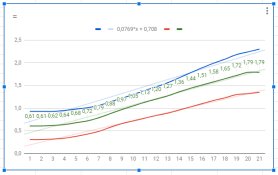
It was big surprise for me to see that characteristic curves for the Kodak Color Plus made with this setup are less dense / contrasty then one made with Esseco sensitometer with G channel (0.61).

DENS.DATA: R G B (Xrite 810, SB800 flash (4800К?), 115cm distance to film, M-1/128, zoom14mm (with milk reflector) ).
CI (G) = 0.53

1 0,31 0,61 0,93
2 0,31 0,61 0,93
3 0,32 0,62 0,93
4 0,34 0,64 0,95
5 0,38 0,68 0,98
6 0,43 0,72 1,01
7 0,49 0,79 1,06
8 0,58 0,88 1,14
9 0,66 0,97 1,22
10 0,72 1,05 1,3
11 0,78 1,13 1,39
12 0,84 1,20 1,47
13 0,89 1,27 1,56
14 0,96 1,36 1,67
15 1,03 1,44 1,78
16 1,10 1,51 1,89
17 1,17 1,58 1,99
18 1,23 1,65 2,08
19 1,30 1,72 2,18
20 1,32 1,79 2,24
21 1,35 1,79 2,3

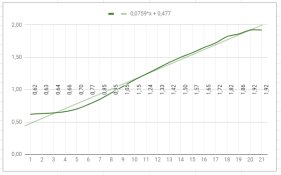
DENS.DATA from G channel made by G. LED in Esseco sensitometer:
CI (G) = 0.60

1 0,62
2 0,63
3 0,64
4 0,66
5 0,70
6 0,77
7 0,85
8 0,95
9 1,05
10 1,15
11 1,24
12 1,33
13 1,42
14 1,50
15 1,57
16 1,65
17 1,72
18 1,82
19 1,86
20 1,92
21 1,92

So strip exposed with green led has more contrast.
I took apart wedge from NationalAssosiates sensitometer and in measured very close to one in Esseco.
Also I see on graphs that even G channel is reaching shoulder.

Please help me to guess what could be the problem and what CI to consider as correct? Made with G LED or with "full" spectrum Flash?
What type of source is used when Kodak make their PDF for their other film (for Color Plus it do not exist as we know)?

Might colimated light help in getting the same contrast results with "full" spectrum source and narrow LED ?

IMG_8733 копия.jpg Kodak Color Plus Charachter.Curve.jpg Kodak Color Plus Charachter.Curve 2.jpg Kodak Color Plus Charachter.Curve 3 (G.LED Esseco).jpg
 

Bill Burk

Subscriber
Allowing Ads
Joined
Feb 9, 2010
Messages
9,455
Format
4x5 Format
I disagree with using film to tie the sensitometer data into the "real" sensitivities as defined by known good meters, whether in-camera or hand-held.
(1) Taking the specific example given by ic-racer. Assume your densitometry is good to 0.02D. Assume your normal development is to G=0.55. And assume the speed point is effectively at 0.3G. This means that the slope of D-logE, at the point used for inter-calibration, is 0.3x0.55=0.165. Meaning that the 0.02 error bar on D translates to 0.02/0.165=0.12, between 1/3 and 1/2 stop.

Error budget. Sure, an exposure error of 1/2 stop is (except for slides, outside the scope of the present discussion) tolerable, if taken alone. The emphasis is the key point. There are multiple causes of error. Shutter inaccurate. Calibration error of the light meter. Arbitrariness of metering a contrasty scene. Processing variations. And more... If you want to be confident in the overall process to translate your vision of a scene into a nice negative, you cannot allow a single factor to claim most of the error budget, with the excuse "but the resulting error is less than what is allowed". (Which is not to say that good pictures cannot be made with casual procedures.
I never checked this error estimate.

It’s quite possible that the error is as large as a third stop.
 

Bill Burk

Subscriber
Allowing Ads
Joined
Feb 9, 2010
Messages
9,455
Format
4x5 Format
Looks like a fun weekend project to poke through some of your numbers Serg, I avoid color in my home darkroom so I may skip the analysis of what’s going on with your color film.
 
OP
OP
bernard_L

bernard_L

Member
Allowing Ads
Joined
Feb 17, 2008
Messages
2,115
Format
Multi Format
Update to my OP. I dis-assembled the TR1224 densitometer down to the filter wheel. Some filters were strongly degraded, apparently the interference filters, made by vacuum deposits, did not age well. I cleaned them as best I could. Now the R, G, B, V values agree a lot more closely when reading a silver film of a Stouffer wedge. Previous to cleaning, the V values, once calibrated, agreed with the calibrated Stouffer tablet to within 0.02D, so I did not worry too much, my main use being for B/W negs and regular printing.
 

Serg Lavrenchuk

Member
Allowing Ads
Joined
Jun 23, 2008
Messages
105
Location
Kiev, Ukraine
Format
Multi Format
Looks like a fun weekend project to poke through some of your numbers Serg, I avoid color in my home darkroom so I may skip the analysis of what’s going on with your color film.
:smile: ok. I think I would make it a separate post by "Codak Color Plus Char.curve"
 
Photrio.com contains affiliate links to products. We may receive a commission for purchases made through these links.
To read our full affiliate disclosure statement please click Here.

PHOTRIO PARTNERS EQUALLY FUNDING OUR COMMUNITY:


Ilford ADOX Freestyle Photographic Stearman Press Weldon Color Lab Blue Moon Camera & Machine
Top Bottom