• Welcome to Photrio!
    Registration is fast and free. Join today to unlock search, see fewer ads, and access all forum features.
    Click here to sign up

Delta 400 & 720 Filter!

Two Horses

A
Two Horses

  • 2
  • 1
  • 10
Billboard, Cork city 1977

H
Billboard, Cork city 1977

  • Tel
  • Mar 17, 2026
  • 0
  • 0
  • 19

Recent Classifieds

Forum statistics

Threads
202,799
Messages
2,845,690
Members
101,539
Latest member
UwBouwMeester
Recent bookmarks
0
Thank you Andrew. Very informative. Just a question, would delta 3200 be more ir senitive? I just purchased a 720 for my RB 67, so now I have something to try.
 
I just looked at the d-3200 wedge spectrum chart and it looks like it goes to 700 nm. Harmon (yep the new name) shows 2856K for their light source for the wedge spectrum and if IIRC Kodak uses 5600K if that makes a difference.
 
Thank you Andrew. Very informative. Just a question, would delta 3200 be more ir senitive? I just purchased a 720 for my RB 67, so now I have something to try.

It should work fine... just be sure to give 5 stops for the filter, and then some. Even my 24 minutes exposures could have benefited with a bit more...and don't forget reciprocity correction.
 
I worked in the infrared electro-optics for several decades in my career and I would never expect any non IR film to do well with the 720 filter. I use HIE when I can find it, Rollei IR 400 shot at ISO 400 and Konica IR film. Since the exposures are so much longer for Delta 400 with the 720 filter, I will stick with my IR films especially since they are relatively available and cheap.
 
Last edited:
Interesting video, Andrew. If you asked Photrio before you had done this I wonder how many "give it a go" replies you would have got?

I actually did what you did last winter in Winnipeg using 45 mins. I did it from a heated car. It was a picture of the wife in a park using a head and neck harness to stop movement. It worked fine but was expensive due to the airfare when I went back in May to pick the wife up after she'd thawed out😁

pentaxuser
 
Interesting video, Andrew. If you asked Photrio before you had done this I wonder how many "give it a go" replies you would have got?

I actually did what you did last winter in Winnipeg using 45 mins. I did it from a heated car. It was a picture of the wife in a park using a head and neck harness to stop movement. It worked fine but was expensive due to the airfare when I went back in May to pick the wife up after she'd thawed out😁

pentaxuser

Is she still frosty to you?
 
I worked in the infrared electro-optics for several decades in my career and I would never expect any non IR film to do well with the 720 filter. I use HIE when I can find it, Rollei IR 400 shot at ISO 400 and Konica IR film. Since the exposures are so much longer for Delta 400 with the 720 filter, I will stick with my IR films especially since they are relatively available and cheap.

The 720 filtered Delta 400 had such a unique look, even compared to the infrared films that I use, that I will use it sometimes, but... I'm not saying it's a substitute for an infrared film. By the way, I use all those films you listed (except for Konica when I ran out) in 120 to 4x5, as well as Efke in both 4x5 and 8x10. I also have a box of HIE in 4x5 (precious) that gets pulled out only on special occasions. Delta 400 & 720 will never be a substitute for my IR films.
 
I worked in the infrared electro-optics for several decades in my career and I would never expect any non IR film to do well with the 720 filter.

Quite the eye-opener, eh!
 
I worked in the infrared electro-optics for several decades in my career and I would never expect any non IR film to do well with the 720 filter.

Quite the eye-opener, eh!

But I cannot talk about it except for my work at the Jet Propulsion Laboratory.
 
Looking at the graphs of the film's spectral sensitivity and the filter's spectral response, I would have thought that you'd get nothing.

It reminds me of when I was choosing LEDs for a safelight project. I looked at the paper's response graph (mainstream VC), and the LED's spectral output graph and said to myself "this is going to work, I'll have a bright and safe working environment."

Wrong. Even though I had redrawn the LED graph to be logarithmic units not just percentages in order to properly make the comparison, it was obvious that the graphs cover only the majority of the data, not all of it.
 
Makes me wonder if maybe the film has a small spike past 720 and Harman thought it was insignificant and cut the graph at 650.
 
Makes me wonder if maybe the film has a small spike past 720 and Harman thought it was insignificant and cut the graph at 650.

I think not. It is not shown since its sensitivity is low. Look at the exposure times.
 
Yes, I did look at his exposure times, 5 stops down or ei 12 maybe 6 looking at the negatives, plus correction for reciprocity. So either the film has some sensitivity or his filter is not cutting off at 720 or a little of both. The OP is also north of the 49th so has less ir than I do at the 32nd. Inquiring minds want to know.
 
I tried Tmax 100 behind a IR720 filter a few years back. A daylight landscape scene needed 5 minutes at f4 to deliver a useable negative. The print showed a black sky but the green vegetation did not show the glowing Wood effect. I figured that no infrared radiation was actually involved and the picture was made out of the tiny amount of ordinary red light that leaked through the IR720 filter.

It is possible, just, to see a bright scene through a IR720 filter but I doubt it is down to eye sensitivity to infrared radiation; imperfect filter cut-off probably. Yesterday, just for fun, I shone a green laser through IR680, IR720, and IR950 filters. Yes, the light gets through and it's colored red which suggests that the filter cut-off numbers are well short of absolute.
 
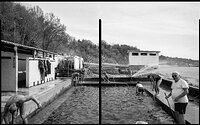
Played around with this combination for a good junk of my Summer. Take a look at my results!


Really enjoy your videos Andrew. You’re very likable, your experiments are always interesting and the videos are well made.

Most of us wondered in silence about exactly what you did here, when Delta 400 extended red sensitivity was discussed a few months back.
You actually did something about it and was fairly rigorous about it.

It’s going to be interesting to try D3200 with R72.
It might not actually be faster.

I really don’t know how much faith we should put in the spectral sensitivity graphs from film manufacturers.
They are not very ambitious, precisely defined or demarcated and most of them appear to be smoothed and rounded off.

Any source for better independent curves?
 
Really enjoy your videos Andrew. You’re very likable, your experiments are always interesting and the videos are well made.

Most of us wondered in silence about exactly what you did here, when Delta 400 extended red sensitivity was discussed a few months back.
You actually did something about it and was fairly rigorous about it.

It’s going to be interesting to try D3200 with R72.
It might not actually be faster.

I really don’t know how much faith we should put in the spectral sensitivity graphs from film manufacturers.
They are not very ambitious, precisely defined or demarcated and most of them appear to be smoothed and rounded off.

Any source for better independent curves?

Thank you, Helge. That means a lot coming from you. I've too have often wondered about the accuracy of manufacturer's sensitivity graphs. I guess we have to trust them...I'm tempted to see what happens with a film like HP5, which seems to have a typical red response, similar to most conventional films (650nm). In fact, I think I will try it. I will definitely give D3200 a go, though. I was going to start it off at EI 800, since that is how I use it unfiltered. Then add the 5 stops for the filter... then bracket for more exposure. I've got about 6 rolls in the fridge waiting...beckoning me.... Aaaaaannndyyyyyyyyy..... 🙄 It's the same with doughnuts.....😕
 
In some of my examples, especially the one of all trees, the foliage is rendered white. That tells me that there is more going on than just extended exposure. It is very doubtful that this will happen to a film sensitised up to 650nm. The next sunny day, I'll go out with some HP5 and prove it.
 
In some of my examples, especially the one of all trees, the foliage is rendered white. That tells me that there is more going on than just extended exposure. It is very doubtful that this will happen to a film sensitised up to 650nm. The next sunny day, I'll go out with some HP5 and prove it.

It makes good sense for high speed films to have extended red sensitivity as a common use case is at sundown or in tungsten balanced light.

It makes you wonder if HP5 plus (as introduced in 89) was designed more for use cases such as tele and wides stopped way down in daylight and extending the range and possible diffusion with flash photography, rather than “incidental” light photography.
 
I too have d 3200 calling me. It is nearing it's exp date and it is a lot like milk in the refrigerator. I think I will dunk it in DK-50 be damned the grain full speed ahead! Now I have to decide what camera I will use. Koni Omegas?
 
Yes, I did look at his exposure times, 5 stops down or ei 12 maybe 6 looking at the negatives, plus correction for reciprocity. So either the film has some sensitivity or his filter is not cutting off at 720 or a little of both. The OP is also north of the 49th so has less ir than I do at the 32nd. Inquiring minds want to know.

I use 5 stops and that works well for me, 6 stops is too much.
 
.............It’s going to be interesting to try D3200 with R72.
It might not actually be faster. .........
Thanks Helge for that intriguing idea.

I had a couple of spare frames at the end of a roll of Ilford Delta 3200 in my Mamiya RB67 so I did a series of stepped exposures by moving the dark slide in between clicks. The lens was the127mm f3.8 and it had my IR720 infrared filter on it. The subject was a front lit landscape on a clear sunny day.

Result: Good printable negative density and adequate shadow detail emerged with an exposure of 480 seconds at f6.7 (half stop between f5.6 and f8). If Ilford's reciprocity correction exponent for Delta 3200 is 1.33 as claimed this would imply a metered exposure of 105 seconds (105 exp 1.33 = 480).

I'll do more tests but at least I seem to have an adequate starting point.
 
Photrio.com contains affiliate links to products. We may receive a commission for purchases made through these links.
To read our full affiliate disclosure statement please click Here.

PHOTRIO PARTNERS EQUALLY FUNDING OUR COMMUNITY:



Ilford ADOX Freestyle Photographic Stearman Press Weldon Color Lab Blue Moon Camera & Machine
Top Bottom