• Welcome to Photrio!
    Registration is fast and free. Join today to unlock search, see fewer ads, and access all forum features.
    Click here to sign up

Delta 3200 developed by lab - question

Recent Classifieds

Forum statistics

Threads
202,920
Messages
2,847,608
Members
101,536
Latest member
takesama2001
Recent bookmarks
0

calico

Member
Allowing Ads
Joined
Oct 20, 2020
Messages
359
Location
USA
Format
Medium Format
Hello,

I’m going to contact my lab about this, but I thought I’d get some input here first from people who develop their own film. (I haven't developed my own film in many years.)

I shot some Delta 3200 for the first time recently. I read that a lot of people rate it at 1600 and then develop normally. I think Ilford recommends this, too.

I went down to 1250 to give it even a little more exposure.

So I told my lab I shot it at 1250 but wanted it developed normally.

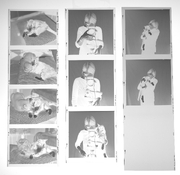
My question is — why does the acetate of the negs look so grey? See the area around images and the first frame where there is no image (I had hit the shutter accidentally) in attached jpeg.

The Delta 3200 is the strip on the right.

For comparison, I included an HP5 strip (middle) and Tmax 400 strip (left) where the acetate is basically clear as usual. I photographed the negs on a light table and tried to make tones in jpeg match the negs as much as possible.

Does the greyness of the acetate tell you anything about how the Delta 3200 was developed? Does Delta 3200 always look like that?

The images aren’t too bad, but I don't see much detail in the shadows -- the sweater is black and parts of the cat are black -- which would suggest underexposure. But I exposed at 1250 (used handheld light meter).

The lab has told me in the past they use Ilford DD which is made for replenished dip and dunk processing at labs.

They charge extra for 3200 ISO film developing.

When I contact them, I can get more info about how they developed the Delta 3200 (time, temp, etc).

Just wondering what you think the greyness of acetate indicates or if you have any other thoughts.

Thanks.
 

Attachments

  • Negs 1500w.jpg
    Negs 1500w.jpg
    889.2 KB · Views: 144
I have shot two rolls of Delta 3200, and the rebate / base of your Delta 3200 film looks about the same as mine. So based on my very limited experience, I would say your gray rebate looks normal enough to me. Both of my rolls were metered at EI 1600 and processed for the recommended times in XTOL (first one with the lantern), and Microphen (second one).
Screenshot 2026-01-25 at 8.43.43 PM.png
Screenshot 2026-01-25 at 8.44.12 PM.png

Your example does look a bit underexposed. When you say, "I exposed at 1250 (used handheld light meter)" -- how exactly did you meter? Was that a reflected reading from the scene, or incident, or ? Is your handheld meter known to be reliable?
 
If it's worth anything, I shoot Delta 3200 at 800 whenever I can get away with it.
 
I'm not sure that "develop Delta 3200 normally" is particularly clear - when it comes to film like Delta 3200.
But your conversation with the lab might have been clearer due to some more context.
 
Just wondering what you think the greyness of acetate indicates
How old was the film?

What I see mostly is a lack of shadow detail, which is indicative of underexposure. You mention you exposed this at EI1250, but I wonder how you metered and/or controlled the light (flash/strobes?) I notice a large light-colored backdrop; might his have affected your meter readings? (Basically same question & concern as @runswithsizzers above)

Either way, I don't see any signs of a lab/processing error.
 
Your example does look a bit underexposed. When you say, "I exposed at 1250 (used handheld light meter)" -- how exactly did you meter? Was that a reflected reading from the scene, or incident, or ? Is your handheld meter known to be reliable?
How old was the film?

What I see mostly is a lack of shadow detail, which is indicative of underexposure. You mention you exposed this at EI1250, but I wonder how you metered and/or controlled the light (flash/strobes?) I notice a large light-colored backdrop; might his have affected your meter readings? (Basically same question & concern as @runswithsizzers above)

Either way, I don't see any signs of a lab/processing error.

That roll of film had August 2026 expiration date.

I was using a constant light (monolight-style LED with umbrella, 5600 color temp).

I use a Sekonic L-358 incident meter as I have for decades. Not concerned about my exposure per se, I am good at choosing exposure. But I am concerned about my exposure in relation to how the film was developed.

I'm not sure that "develop Delta 3200 normally" is particularly clear - when it comes to film like Delta 3200.
But your conversation with the lab might have been clearer due to some more context.

Agree, thought about this afterwards. What does "develop normally" mean for Delta 3200 if Ilford themselves say it is really a 1600 speed film?

I was thinking the film would be developed as if I exposed at 3200, which would mean I was intentionally overexposing when I shot at 1250.

In my note to the lab, when I asked that they develop the film normally, I did mention that I had read that Ilford said Delta 3200 should be shot at 1600 but then developed normally and also that I shot at 1250 for a little extra exposure. So I assumed they would be developing for 3200.

But maybe they did a development time for 1250 or 1600, and that's why it looks kind of underdeveloped.

runwithsizzors: The rebate in your Delta 3200 does look kind of grey like mine.

I've never had rebate area in b&w negs look grey (HP5, FP4, Tmax 100 and 400). Would underdevelopment cause this?

Thanks for your input. Will contact lab.

BTW, I know I should develop my own film so I can have more control :smile: On my list of things to do.....
 
Hello,

I’m going to contact my lab about this, but I thought I’d get some input here first from people who develop their own film. (I haven't developed my own film in many years.)

I shot some Delta 3200 for the first time recently. I read that a lot of people rate it at 1600 and then develop normally. I think Ilford recommends this, too.

I went down to 1250 to give it even a little more exposure.

So I told my lab I shot it at 1250 but wanted it developed normally.

My question is — why does the acetate of the negs look so grey? See the area around images and the first frame where there is no image (I had hit the shutter accidentally) in attached jpeg.

The Delta 3200 is the strip on the right.

For comparison, I included an HP5 strip (middle) and Tmax 400 strip (left) where the acetate is basically clear as usual. I photographed the negs on a light table and tried to make tones in jpeg match the negs as much as possible.

Does the greyness of the acetate tell you anything about how the Delta 3200 was developed? Does Delta 3200 always look like that?

The images aren’t too bad, but I don't see much detail in the shadows -- the sweater is black and parts of the cat are black -- which would suggest underexposure. But I exposed at 1250 (used handheld light meter).

The lab has told me in the past they use Ilford DD which is made for replenished dip and dunk processing at labs.

They charge extra for 3200 ISO film developing.

When I contact them, I can get more info about how they developed the Delta 3200 (time, temp, etc).

Just wondering what you think the greyness of acetate indicates or if you have any other thoughts.

Thanks.

So did they charge extra when you told them to develop normally? By normally do you mean that you wanted the film developed as if it was a 400 speed film

I wouldn't developer D3200 as if it were a 400 film unless I had set the film speed dial on the camera to 400. So IMO the film was not developed at the right speed and that makes a difference to the resulting negatives


pentaxuser
 
If it's worth anything, I shoot Delta 3200 at 800 whenever I can get away with it.

So maybe the bit of underexposure isn't related to the development time/temp at all -- just means this film needs to be exposed at 800. (I exposed at 1250.) Thanks.
 
Agree, thought about this afterwards. What does "develop normally" mean for Delta 3200 if Ilford themselves say it is really a 1600 speed film?

I was thinking the film would be developed as if I exposed at 3200, which would mean I was intentionally overexposing when I shot at 1250.
Where does Ilford say that D3200 is a 1600 film? That is not my understanding. Common consensus is that it is probably 1000

pentaxuser
 
Not concerned about my exposure per se, I am good at choosing exposure. But I am concerned about my exposure in relation to how the film was developed.

The main thing I can see in the negatives you've posted is that they are underexposed. Development is largely unrelated from this; more development would not have created significantly more details in the presently blank shadows. Development does of course control gamma (contrast) to a large extent although with Delta3200 this only goes so far because it's strongly self-compensating, due to which highlights will not run away even if development is extended, as the film is intended to use that way. The highlights I see here and there (i.e. the paws of the animal) look pretty normal in terms of density.

So the main problem I see here is exposure being on the low side; development looks OK. Btw, the strip in the middle also looks a little lean on the exposure; the one on the left looks more like what I'd aim for. It's personal of course; if the large areas of shadow that presently have little to no detail are intended to drop away into black, all is OK.
 
I use a Sekonic L-358 incident meter as I have for decades. Not concerned about my exposure per se, I am good at choosing exposure. But I am concerned about my exposure in relation to how the film was developed.
Yet, we both agree, lack of shadow detail in your example suggests your negative was, in fact, underexposed, right?

If I understand correctly, no change in development will compensate for lack of shadow detail due to underexposure. Remember the maxim is, "Expose for the shadows and develop for the highlights" -- and not "develop for the shadows"
 
Where does Ilford say that D3200 is a 1600 film? That is not my understanding. Common consensus is that it is probably 1000

pentaxuser
You are correct. 1000 per Ilford's spec sheet, and they note how to develop, too (see below).

I must've gotten the "Ilford says to expose at 1600" idea from a secondary source.

EXPOSURE RATING

The recommended meter setting for DELTA 3200 Professional is EI 3200/36, but good image quality can also
be obtained at meter settings from EI 400/27 to EI 6400/39. It can be used in all types of lighting.

DELTA 3200 Professional is particularly recommended for exposing in the range EI 1600/33 to EI 6400/39.
It can be exposed at ratings up to EI 25000/45, but it is important to make test exposures first to ensure the
results will be suitable for the intended purpose.

DELTA 3200 Professional has an ISO speed rating of 1000/31° (1000ASA, 31 DIN) to daylight.
The ISO speed was measured using ILFORD ID-11 developer at 20°C/68°F with intermittent agitation in a
spiral tank.

It should be noted that exposure index (EI) range recommended for DELTA 3200 Professional is based on a
practical evaluation of film speed and is not based on foot speed, as is the ISO standard"

 
The main thing I can see in the negatives you've posted is that they are underexposed. Development is largely unrelated from this; more development would not have created significantly more details in the presently blank shadows. Development does of course control gamma (contrast) to a large extent although with Delta3200 this only goes so far because it's strongly self-compensating, due to which highlights will not run away even if development is extended, as the film is intended to use that way. The highlights I see here and there (i.e. the paws of the animal) look pretty normal in terms of density.

Good point. Development time would not have helped details in shadows if image underexposed. So I am on wrong track by focusing on development. I also noticed the highlights (white in cat's paws) do seem to have detail.
So the main problem I see here is exposure being on the low side; development looks OK. Btw, the strip in the middle also looks a little lean on the exposure; the one on the left looks more like what I'd aim for. It's personal of course; if the large areas of shadow that presently have little to no detail are intended to drop away into black, all is OK.
Agree, the middle strip looks a bit underexposed, too. I was using the LED light w/umbrella there, too. I rarely use artificial light. Maybe I need to expose a little differently for that. The strip on left was natural light from window.

Thanks for your help.
 
Yet, we both agree, lack of shadow detail in your example suggests your negative was, in fact, underexposed, right?

If I understand correctly, no change in development will compensate for lack of shadow detail due to underexposure. Remember the maxim is, "Expose for the shadows and develop for the highlights" -- and not "develop for the shadows"

Agree. Thanks.
 
Even though Ilford says Delta 3200 has an ISO speed rating of 1000, I find it odd that they do not give any recommended processing time for that rating. Their chart shows times for EI 400, 800, 1600, 3200, 6400, and 12500.

So if someone exposes Delta 3200 at EI 1000 or 1250, they are going to have to either:
a. Do testing to determine what development time works best for you (as recommended by Delta), or
b. Pick Delta's recommended development time for either EI 800, or 1600, or
c. By interpolation, pick some time in between those given for EI 800 and EI 1600
 
You're welcome. I'd expect 5000K LED to behave similarly enough to daylight to not have to account for it in metering. Artificial light can sometimes be a little tricky because it's so local, so if really have to ensure that metering is representative for the illumination of the subject - and different parts of it, at that. For instance if you have the light + umbrella set up fairly high, light will still fall off quite steeply (depending on the size of the umbrella) towards the bottom of the subject. The gradient can be quite steep. It takes a lot of light to approximate what you normally get with available light.
 
So did they charge extra when you told them to develop normally? By normally do you mean that you wanted the film developed as if it was a 400 speed film

I wouldn't developer D3200 as if it were a 400 film unless I had set the film speed dial on the camera to 400. So IMO the film was not developed at the right speed and that makes a difference to the resulting negatives
They charge $5 extra to develop 3200 speed film -- on their price list that way. It wasn't a charge for pushing the film. Sorry, I should've explained that at outset.

I suppose the extra charge is because it has to be developed differently than most of the other film they get.
 
You're welcome. I'd expect 5000K LED to behave similarly enough to daylight to not have to account for it in metering. Artificial light can sometimes be a little tricky because it's so local, so if really have to ensure that metering is representative for the illumination of the subject - and different parts of it, at that. For instance if you have the light + umbrella set up fairly high, light will still fall off quite steeply (depending on the size of the umbrella) towards the bottom of the subject. The gradient can be quite steep. It takes a lot of light to approximate what you normally get with available light.

Agree, the color of the 5600K LED shouldn't have affected exposure but how the light fell on image area -- the steep falloff, as you say. When I'm using natural light, the light is usually more even (I try to choose subjects in more even areas of light).

Thanks for your thoughts.
 
Even though Ilford says Delta 3200 has an ISO speed rating of 1000, I find it odd that they do not give any recommended processing time for that rating. Their chart shows times for EI 400, 800, 1600, 3200, 6400, and 12500.

So if someone exposes Delta 3200 at EI 1000 or 1250, they are going to have to either:
a. Do testing to determine what development time works best for you (as recommended by Delta), or
b. Pick Delta's recommended development time for either EI 800, or 1600, or
c. By interpolation, pick some time in between those given for EI 800 and EI 1600

Hmm....very confusing. I will contact lab and try to correlate how I expose to how they develop Delta 3200.

I guess if they will always develop it the way they did for the roll in question, I know I need to give a bit more exposure. I should also shoot a roll without the artificial light which was affecting how I was metering/exposing, too. Possible the 1250 would work in more even lighting.

Or expose at 1000 as Ilford suggests. This fits with my slightly underexposed 1250 exposure.

Thanks.
 
Last edited:
Hmm....very confusing.
It doesn't have to be.
If you tell the lab nothing, they will assume you shot the film at the speed indicated on the box. So 3200 in this case.
If you give them Delta 3200 and you'll tell them you exposed at EI1250 (or whathaveyou), the lab will pick a development time they judge will work for that EI. Assuming that the lab actually picks any time instead of just processing everything for the same time, regardless. You'd be surprised how often that happens.

So there's very little you need to correlate or discuss. Just indicate what EI you shot the film at and leave it to the lab. If they look at you sheepishly, find a better lab.
 
Interesting that they charge more to develop fast films.
There are two reasons why this would make sense:
1: They run all fast film in a custom run that's longer than their standard B&W run. This assumes they basically only use a limited number of development times regardless of the variety of film they receive, which is actually quite a plausible situation. The longer run for the faster film might be a smaller one, depending on the volume of film they receive across different speed brackets.
2: Some films, and Delta 3200 is most definitely one of them, pose a heavier load on the developer and thus necessitate higher replenishment rates esp. for the developer.

There's of course a third possible reason, which is that if you can find any option, extra or add-on you can somehow charge the client for, it'll boost revenues and profitability.
 
Photrio.com contains affiliate links to products. We may receive a commission for purchases made through these links.
To read our full affiliate disclosure statement please click Here.

PHOTRIO PARTNERS EQUALLY FUNDING OUR COMMUNITY:


Ilford ADOX Freestyle Photographic Stearman Press Weldon Color Lab Blue Moon Camera & Machine
Top Bottom