

Remember that most of today's color film is processed at 38°C/100°F, and nobody complains about their performance. Also remember that good film prehardening is very high tech (think: how do you coat something that is hardened, or how do you harden something that has already been coated and contains important but soluble compounds), and older films were not well hardened. This means that a few decades ago film may have had severe problems with 38°C/100°F processing, and some less sophisticated current emulsions may still have these problems, but film from the big three should hold up well under these conditions.Interesting point about temp. I wonder what the scientific evidence is about temperature and negative quality.
-
Welcome to Photrio!Registration is fast and free. Join today to unlock search, see fewer ads, and access all forum features.Click here to sign up
You are using an out of date browser. It may not display this or other websites correctly.
You should upgrade or use an alternative browser.
You should upgrade or use an alternative browser.
Delta 3200 & 6400 in ID-11?
-
A
- Thread starter ericdan
- Start date

Recent Classifieds
-
Want to Buy 12x20 Film and Film holder
- Started by stray227
-
Free NuArc Vacuum Frame
- Started by Roger Thoms
-
For Sale Copal Press no.1 shutter (CLA'd)
- Started by OAPOli
-
For Sale Bronica ETR 2.8/50 lens cells
- Started by OAPOli
-
For Sale Polaroid SX-70 bargain
- Started by darinwc
Forum statistics

I don't think any modern black and white films are going to have problems with any reasonable temperature (possible exception - Foma is rather delicate stuff and it might if temps get too high, but I do run it at 75F as well with no issues. I wouldn't worry about even Foma unless it was pushing 80F or more...)
More important is that all solutions including wash be as close as possible to the same temperature. I've argued this before because people can't seem to find a reason it would be true, but empirically my tests showed more apparent grain if temperatures vary much. I did those in the 80s though so it's possible film has changed enough since that it might no longer be true. It still seems best practice though.
And of course development time (for most developers anyway - Diafine doesn't care over a pretty wide range for example) will need to be varied accordingly.
More important is that all solutions including wash be as close as possible to the same temperature. I've argued this before because people can't seem to find a reason it would be true, but empirically my tests showed more apparent grain if temperatures vary much. I did those in the 80s though so it's possible film has changed enough since that it might no longer be true. It still seems best practice though.
And of course development time (for most developers anyway - Diafine doesn't care over a pretty wide range for example) will need to be varied accordingly.
I'm not sure if Fuji B&W films will work either. Fuji recommends fixers with hardener and in Japan they only sell fixer with hardener, since their emulsions are on the soft side.

I'm not sure if Fuji B&W films will work either. Fuji recommends fixers with hardener and in Japan they only sell fixer with hardener, since their emulsions are on the soft side.
Fixing is the last stage of processing so if a film is too sensitive the damage is already done at the developing stage, but Fujifilm recommend processing up to 26C/79F.
I cannot think of any 'reason' why an elevated temperature would actually enhance the performance of any developer or indeed film in any way, in fact it probably increases the opportunity of 'error' by becoming more active and 'shortening' the development time.
But Mr.Cole makes an important point...make sure all the chemicals and the wash are as near as possible in temperature.....but in saying that reticulation is very rare in modern manufactured film.
I have seen many references in terms of elevated temperatures to do with toning prints, but I am no expert whatsoever in that area, the logic is that you would get more activity in a shorter space of time, I have been guilty of the reverse in the past.... of diluting dev, or having the processing dish in a cold water bath to extend out dev times when processing multiple prints at the same time...not unusual in the old days to have 50 or 100 prints in the dev and top to bottoming them....but you could'nt do that now as you need ( and should ) use tongs or gloves.
Simon ILFORD Photo / HARMAN technology limited :
But Mr.Cole makes an important point...make sure all the chemicals and the wash are as near as possible in temperature.....but in saying that reticulation is very rare in modern manufactured film.
I have seen many references in terms of elevated temperatures to do with toning prints, but I am no expert whatsoever in that area, the logic is that you would get more activity in a shorter space of time, I have been guilty of the reverse in the past.... of diluting dev, or having the processing dish in a cold water bath to extend out dev times when processing multiple prints at the same time...not unusual in the old days to have 50 or 100 prints in the dev and top to bottoming them....but you could'nt do that now as you need ( and should ) use tongs or gloves.
Simon ILFORD Photo / HARMAN technology limited :

I think the recommendations relating to higher temperatures are directed to people who have ambient temperatures that are already high - in essence they are permissive, rather than directive.
Or for people with (semi) automated processors, like the Phototherm Sidekick, which are oriented toward higher temperatures (24C?), to permit faster throughput.
Or for people with (semi) automated processors, like the Phototherm Sidekick, which are oriented toward higher temperatures (24C?), to permit faster throughput.
That's exactly why I use 75F - my ambient temperatures in my basement darkroom are around that or a degree or two higher (but open unheated liquids will always be slightly cooler than ambient air temp) and my "cold" water comes out of the tap in summer as warm as 80F at times. I would need ice or a chiller to get solutions below about 75F at times but my Jobo will warm to that easily even in winter.
Sent from my iPhone via Tapatalk using 100% recycled electrons. Because I care.
Sent from my iPhone via Tapatalk using 100% recycled electrons. Because I care.

Well, it turns out I didn't fire a singe shot at the dinner. So much for that. Instead I tried it out in the rain at night @6400 developed for 12800 in Microphen. The negatives still came out really thin.
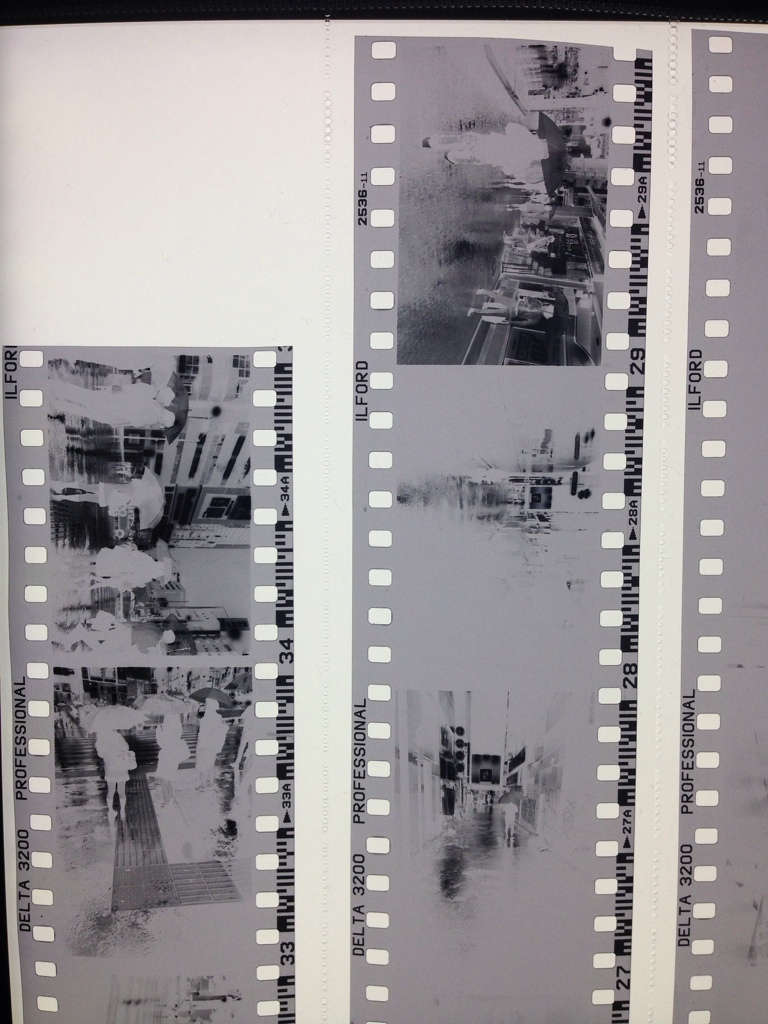
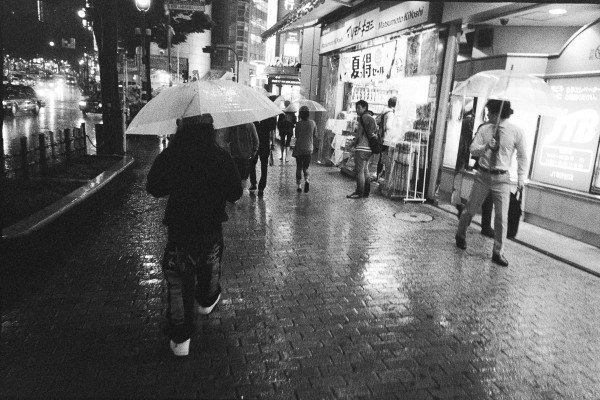

The negatives still came out really thin.
Of course they came out thin, they were underexposed by several stops, still you've compensated the lack of exposure by prolonged development with which you've managed to gain enough contrast so that the blacks look good. I would say the film came out pretty well.

I would say they look good. My personal taste is to print it or scan it at higher contrast so the blacks are blacker. After all, you were taking photos at night and nights are dark. But it's all a matter of taste.
Thanks.
none of these are worth printing really. I usually do a quick scan to see which I like and then decide if I print. I just can't judge negatives that well yet.
I have another roll loaded and it's still raining. This time at 1600, so I'll probably have to stick to the lit areas near store fronts or vending machines.
@nuff i liked your karaoke shots on this film.
none of these are worth printing really. I usually do a quick scan to see which I like and then decide if I print. I just can't judge negatives that well yet.
I have another roll loaded and it's still raining. This time at 1600, so I'll probably have to stick to the lit areas near store fronts or vending machines.
@nuff i liked your karaoke shots on this film.
Those are really good for EI 6400. You have more density in those than in my TMZ at 6400 I posted the print from (on RA4 paper) above. That's just how available light pushed negatives look.
Thanks Eric! You have pushed it one more stop than I did. Also I like my blacks black and whites white. It's not called grey film for a reason IMHO.
I think the guy with mike works pretty well. Try pushing contrast and see what you get.
I think the guy with mike works pretty well. Try pushing contrast and see what you get.
I don't use either. But develop it for 3200 times.
Microphen
Sent from my iPhone via Tapatalk using 100% recycled electrons. Because I care.
Sent from my iPhone via Tapatalk using 100% recycled electrons. Because I care.
Thanks. I developed it in stock Microphen for EI3200 (shot 1600). I think for EI1600 I like both Tri-X and HP5+ better. Which I also develop in the cheaper ID-11.
Still, delta 3200 is a very interesting film.
It was raining in one part of Tokyo on Friday:

Still, delta 3200 is a very interesting film.
It was raining in one part of Tokyo on Friday:
| Photrio.com contains affiliate links to products. We may receive a commission for purchases made through these links. To read our full affiliate disclosure statement please click Here. |
PHOTRIO PARTNERS EQUALLY FUNDING OUR COMMUNITY:  |