
• Welcome to Photrio!
    Registration is fast and free. Join today to unlock search, see fewer ads, and access all forum features.
    Click here to sign up

Definitive FX-4 recipe?

Cemetery Chapel

H
Cemetery Chapel

  • 2
  • 0
  • 34
2 bath test

A
2 bath test

  • 3
  • 0
  • 55

Recent Classifieds

Forum statistics

Threads
202,771
Messages
2,845,343
Members
101,515
Latest member
Floflo
Recent bookmarks
0

craigclu

Subscriber
Joined
Sep 8, 2002
Messages
1,331
Location
Rice Lake, Wisconsin
Format
Multi Format
I was just now brushing up my developer recipe spreadsheet and I've found 3 different variants of the FX-4 recipe on the net. They're all from normally reliable sites. It's listed with and without the borax, with and without the potassium bromide, listed with both in another. What is the correct, Crawley formula?
 
Source: The British Journal of Photography Annual 1974
Editor: Geoffrey Crawley

FX-4 formula (page 197)

Metol 1.5 grams
Phenidone 0.25 grams
Hydroquinone 6 grams
Sodium Sulphite anhydrous 100 grams
Borax 2.5 grams
Potassium Bromide 0.5 grams

Water to 1 liter
 
Crawley described FX-3 as a Phenidone variant of the Adox (i.e. Adox M-Q Borax) and ASA evolution 0f D-76.

Crawley described FX-4 as a further variant giving higher film speed and more compensation.
 
There seems to be two Crawley versions.As well as that given above,which was also given in BJP Annual 1986,the original given in BJP Jan 61 was:
Metol 1.5g,Phenidone0.5g,Hydroquinone5g,Sodium sulfite100g,Borax2.5g,Pot Bromide0.5g.This version was also published in BJP Annual 1962.
It looks like the later version was an improvement.
 
Yes and the BJP Annual 1965, page 70 has Metol 1.5g,Phenidone 0.25g,Hydroquinone 5g,Sodium sulfite anhyd 100g,Borax2.5g,Pot Bromide 0.5g.

the BJP Annual 1970 also shows 5 grams of hydroquinone:

Metol 1.5 grams
Phenidone 0.25 grams
Hydroquinone 5 grams
Sodium Sulphite anhydrous 100 grams
Borax 2.5 grams
Potassium Bromide 0.5 grams

the BJP Annual 1973, page 227, shows 6 grams of hydroquinone:

Metol 1.5 grams
Phenidone 0.25 grams
Hydroquinone 6 grams
Sodium Sulphite anhydrous 100 grams
Borax 2.5 grams
Potassium Bromide 0.5 grams
 
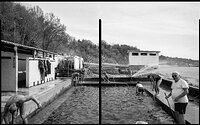
i mixed up some FX-4 today to try with some outdated Kodak Tri-X 35mm found in the fridge, of unknown date as cassettes were not in original boxes ( but film was ;Free' !) and I used the one with Phenidone 0.5 Gram and Hydroquinone 5.0 Grams for 10 mins at 1+1 dilution with a 'Fish-Eye' attachment. Some negs were 'thin' probably due to sky but i did try to set 'Manual Exposure' on most test frames on my 'Saved From The Dump' 1985 era CONTAX RTS II Quartz + Yashica ML 28mm f2.8 lens. The 'Thin'negs scanned with huge grain.
Fish Eye 01.jpg
Fish Eye 02.jpg
Fish Eye 04.jpg
 
Finding ONE definitive formula is made difficult by the fact that Crawley was constantly experimenting, I would go with a later version since there may be errors in earlier versions he later corrected or he may have tweaked the original offering for reason's known only to him.
 
The original formula was published in 1960/61.

The discrepancy from 1972 onwards is probably Typos as the incorrect weights match those in the previous column for FX3. It's highly unlikely Crawley changed the formula and the early articles were much more detailed.

Ian
 
Full story according to Crawley 1960/61

In FX4 (see formulary at the end of this paper), the Metol-Phenidone-hydroquinone combination is used. This reduces overall contrast and allows the shadows to increase in contrast more than in FX3 by the time normal gammas are reached; speed increase over D.76 is now 50-60%, roughly equivalent to Microphen. The presence of Metol also assists discrimination in the highlights, which in some P.Q. developers are liable, the author finds, to 'run away'.

Few developers in the FX series have any benefits over developers like ID-11/D76 or ID-68/Microphen.

Ian
 
.................. The presence of Metol also assists discrimination in the highlights, which in some P.Q. developers are liable, the author finds, to 'run away'.....

Ian

This seems like a reasonable raison d'être to me.
 
Metal Man.jpg
Reflection.jpg
Shadows.jpg
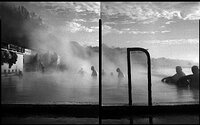
I have done some MORE TESTS on the 1961 FX-4 Formula and found a development time of 13 mins @ 20oC 1+1 dilution gave much denser negs -- I could have rated my Old Tri-X easily at 400 ASA in the dull winter light. The 'Fog Level' seemed the same as negs done for 10 mins and 11.5 mins. I got much better prints on some Old 'Jessops VC Glossy ' processed in Home-Made D72 Formula 1+1 with a few drops of 1% Benzotriazole added. I used a MINOLTA Dynax 4.
Metal Man.jpg
Reflection.jpg
Shadows.jpg
 
View attachment 213978 View attachment 213979 View attachment 213980 I have done some MORE TESTS on the 1961 FX-4 Formula and found a development time of 13 mins @ 20oC 1+1 dilution gave much denser negs -- I could have rated my Old Tri-X easily at 400 ASA in the dull winter light. The 'Fog Level' seemed the same as negs done for 10 mins and 11.5 mins. I got much better prints on some Old 'Jessops VC Glossy ' processed in Home-Made D72 Formula 1+1 with a few drops of 1% Benzotriazole added. I used a MINOLTA Dynax 4.
View attachment 213978 View attachment 213979 View attachment 213980

How heavy was the base fog in the 13 minute development negatives? I find with outdated Tri-X that I have (admittedly it’s from 1986) that going for denser negatives also creates a local of age-related fog.
 
OK -- I just held up negative strips from both the 'thin' 10 minute development and the 13 minute development and without a 'Densitometer' I can see the 13 minute strip is 'slightly' more foggy but not much.
 
I was just now brushing up my developer recipe spreadsheet and I've found 3 different variants of the FX-4 recipe on the net. They're all from normally reliable sites. It's listed with and without the borax, with and without the potassium bromide, listed with both in another. What is the correct, Crawley formula?
Well, what do you call correct?the first, the one that works for you? I would go with the darkroom cookbook or whatever Ian cites as 'correct and then see if I like it.n In any event, I'm from the school of thought that image characteristics is most ly in film and paper and only slightly influenced by developers.
 
Yes Ralph -- next 'mix' I will try the Later Version with less Phenidone and more Hydroquinone.
 
Photrio.com contains affiliate links to products. We may receive a commission for purchases made through these links.
To read our full affiliate disclosure statement please click Here.

PHOTRIO PARTNERS EQUALLY FUNDING OUR COMMUNITY:


Ilford ADOX Freestyle Photographic Stearman Press Weldon Color Lab Blue Moon Camera & Machine
Top Bottom
