

• Welcome to Photrio!
    Registration is fast and free. Join today to unlock search, see fewer ads, and access all forum features.
    Click here to sign up

Date this HP3

High Street

A
High Street

  • 0
  • 0
  • 11
Plato's Philosophy.

A
Plato's Philosophy.

  • 2
  • 2
  • 85

Recent Classifieds

Forum statistics

Threads
201,869
Messages
2,831,444
Members
100,992
Latest member
bob531
Recent bookmarks
0

Athiril

Subscriber
Allowing Ads
Joined
Feb 6, 2009
Messages
3,062
Location
Tokyo
Format
Medium Format
Can someone date this can of HP3 and the original speed? And any developing times for it? I assume it's a 125 version?

I'm looking for original developing times.

I want to treat it with halogen gas, bracket around the original speed and use an original developing time as an experiment.

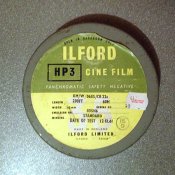
eil1km.jpg
 

steven_e007

Member
Allowing Ads
Joined
Mar 13, 2007
Messages
826
Location
Shropshire,
Format
Multi Format
By fortunate coincidence I dug out some information Ilford sent me a few years ago to answer another question on the forum about HP4. I still have it in front of me.

It tells me that HP3 was introduced in 1941 and it's replacement, HP4, was introduced in 1960.

The speed was 400 ASA (allowing for the fact that speed was calculated a bit differently in those days).

I've got some times for ID-11 and Microphen, but these are for 35mm , not sure if they apply to cine film?

HP3 400 ASA 35 mm:
ID-11 Normal contrast 9 mins. High Contrast 15:00 mins.
Microphen Normal contrast 7 mins. High Contrast 13:00 mins.
 
OP
OP
Athiril

Athiril

Subscriber
Allowing Ads
Joined
Feb 6, 2009
Messages
3,062
Location
Tokyo
Format
Medium Format
The first release 125, then 200 then 400 in HP3 iirc. But that's as much as a I have.

According to http://www.photomemorabilia.co.uk/Ilford/Chronology.html
"Ilford HP3 Roll & 35mm Film first appeared. Initially 125ASA (250ASA post-1960). Around 1952-53 it became 200ASA (post 1960 the 200ASA emulsion was revised to 400ASA but there was no actual speed increase, it was in recognition that with better exposure determination methods at that time, there was no longer need for all film manufacturers to include an exposure safety margin. This 2x speed increase applied to all black&white films of all makes)."

So it would be 250 or 400 I guess in todays terms.

I guess I'll just have to test with those starting times given.. convert them to Xtol perhaps.

I want to do a before and after test of the treatment and evaluate a useable speed.

I also did just find this - http://www.vurt.co.uk/2009/04/02/ilford-hp3-panchromatic-found-film/
 
Last edited by a moderator:

ozphoto

Subscriber
Allowing Ads
Joined
Apr 2, 2006
Messages
1,920
Location
Adelaide, SA, Australia
Format
Multi Format
The first release 125, then 200 then 400 in HP3 iirc. But that's as much as a I have.

According to http://www.photomemorabilia.co.uk/Ilford/Chronology.html
"Ilford HP3 Roll & 35mm Film first appeared. Initially 125ASA (250ASA post-1960). Around 1952-53 it became 200ASA (post 1960 the 200ASA emulsion was revised to 400ASA but there was no actual speed increase, it was in recognition that with better exposure determination methods at that time, there was no longer need for all film manufacturers to include an exposure safety margin. This 2x speed increase applied to all black&white films of all makes)."

So it would be 250 or 400 I guess in todays terms.

I guess I'll just have to test with those starting times given.. convert them to Xtol perhaps.

I want to do a before and after test of the treatment and evaluate a useable speed.

I also did just find this - http://www.vurt.co.uk/2009/04/02/ilford-hp3-panchromatic-found-film/

I landed some of this film today, dated December 12 1961.
Yet to open to see if it is indeed the full 200ft; will be an interesting exercise if it is spooling-wise!

Would it be best to cut some short rolls and test at 400 and 250?

I've got D76 and Atomal FF developer on hand any suggestions for a starting time?
 

Attachments

  • IMG_1455.jpg
    IMG_1455.jpg
    242.5 KB · Views: 160

MartinP

Member
Allowing Ads
Joined
Jun 23, 2007
Messages
1,569
Location
Netherlands
Format
Medium Format
The cassette loading need not be a problem. I have used a 200' roll of FP4 cine-film with no accidents, though the same method can easily be used with any bulk 135 film.

The most practical arrangement I came up with was to put two small nails in a length of wood, 64" apart, then hook a perforation over one nail and pull to the other nail (right at the end of the wood strip) and hook the film over that too. I then stuck a piece of masking tape from the side of the reel over the perimeter 'edge', to stop the reel unwinding, and cut the film just after the nail. This gave a 36-exp. length of film which was then fixed to the cassette-core, using a piece of tape pre-cut for the job, and rolled up with the loose end of film still being held by the nail to avoid mad spirals of film flapping about. All of this in the dark, obviously.

The main thing is to be organised with the necessary bits and pieces, especially the bits of tape for the spool - and to avoid dropping the film(!). In practice it proceeds very smoothly after the first few rolls and you don't get the annoying piece of exposed film at the end of the roll, like you do with daylight-loaders.
 

Xmas

Member
Allowing Ads
Joined
Sep 4, 2006
Messages
6,398
Location
UK
Format
35mm RF
Athirils HP3 may be early judging from packaging which I don't recall - I was Kodak until 1960.

The easy way to deal with cine even if you have a dark room.

Spool the cine from 1000 or 400 foot core to a small cine/surveillance camera spool.
It is easy to do this in a small changing bag.
You leave the 1000 feet flat in its half can.
The spools will fit a Watson style teardrop daylight loader.
The spools also came with most Fuji and some Agfa bulk 100 foot packages.
One chum managed to drop 1000 foot of cine into a bath tub just like black spaghetti...
 
Last edited by a moderator:

ozphoto

Subscriber
Allowing Ads
Joined
Apr 2, 2006
Messages
1,920
Location
Adelaide, SA, Australia
Format
Multi Format
I do have a bulk loader - a Watson teardrop style; I'll need to see if I can find another core to wind some onto so I can wind off what I need. Had several cores for many years, but tossed them after not using them for anything, and as is the norm, now I could really use one! :D

In the mean time, I'll manage with Martin's suggestion for a few starter rolls - have plenty of nails around the place.
 

Molli

Member
Joined
Dec 28, 2009
Messages
1,023
Location
Victoria, Australia
Format
Multi Format
HP3 Original Data Sheets

Hi Athiril and Nanette, Hopefully there might be some information of use to you both in the attached files. [Mr. Galley, please let me know if I'm infringing on a copyright by posting original data sheets from old glass plate and film packages!]. I'm also attaching developing formulas from around 1937 collected from a magazine of that era. The pdf files are low res for the sake of quick downloads, but I do have higher resolution scans if you want them to print out.
 

Attachments

  • Ilford FP3 and HP3 Sheet Film Data [1953] Low Res - Ilford.pdf
    532.9 KB · Views: 1,416
  • Ilford HP3 Plate Data [1960] Low Res - Ilford.pdf
    472.3 KB · Views: 423
  • Ilford Negative Developers [Circa 1937] Low Res - Ilford.pdf
    217.6 KB · Views: 378
  • Ilford R.40 Rapid Process Panchromatic Plates Data [1964] Low Res - Ilford.pdf
    434.4 KB · Views: 370
  • Ilford Selochrome Pan 160, FP3 125, HP3 400 Films Exposure Guide 1963 - Ilford.pdf
    265.2 KB · Views: 339
Photrio.com contains affiliate links to products. We may receive a commission for purchases made through these links.
To read our full affiliate disclosure statement please click Here.

PHOTRIO PARTNERS EQUALLY FUNDING OUR COMMUNITY:


Ilford ADOX Freestyle Photographic Stearman Press Weldon Color Lab Blue Moon Camera & Machine
Top Bottom
