• Welcome to Photrio!
    Registration is fast and free. Join today to unlock search, see fewer ads, and access all forum features.
    Click here to sign up

Darkroom Wall Color - Portrait of an Obsessive Maniac.

Recent Classifieds

Forum statistics

Threads
203,295
Messages
2,852,544
Members
101,768
Latest member
nataliearich
Recent bookmarks
0

Sparky

Member
Allowing Ads
Joined
Jun 19, 2005
Messages
2,096
Location
Los Angeles
Format
Multi Format
Hey Folks... yes, I'm new here - so please excuse any china which I might knock over in the course of this post.

Anyway - I'm in the stages of finishing a 5'x8' 'exposing room'. Not a darkroom replete with chemistry and water PER SE. But only to hold my (very first! - a devere 504) enlarger and associated equipment. So here is the background to the question: I'd been thinking for the longest time (in my iconoclastic way) that the best colour (I'm canadian so I'm allowed to spell it that way!) for a darkroom wall is GENERALLY white. Since there's no light anyway, right? Though this was not really in consideration of enlarger light spill which MAY (at least subliminally/potentially) fog paper when the walls are white.

So - in thinking about this specific problem in greater detail, I'd come up with the idea that it would be a good idea to enshroud the area around the enlarger with a 'light baffle' - horizontal, wedge shaped (pointed edge necessary because it has little surface area to reflect light) strips vertically distributed between max. height of head and lowest possible baseboard position (this range being about 8 ft. in my case!). Kind of like the interior of a camera.

THEN - it occurred to me that these 'strips' or baffles have properties which are good properties for shelves to have too. So I'm thinking - "okay - well, why don't I just build some black shelves - then I can hold all these lenses, focussing aids, etc. etc...?" So that's sort of where I'm at. Though the shelves, containing objects which will undoubtedly COMPROMISE the reflection situation, aren't the IDEAL - I think it's pretty good.

So here's the question... what colour for the REST of the walls?? I read about the guy that painted his room RED. Nifty solution. But I MAY install a colour processor at some point... so I'm a BIT concerned about that colour. I'm thinking white or grey for everything else... any objections or thoughts??

Thanks for your time readling through this lengthy bit.

Jonathan
 
Well, look at it this way:

If there is NO light, you can paint them hot pink.

Fact is, there is some light in there, always, once the enlarger is turned on. I think you are a little on the obsessive side (which I can completely relate to - so it was not intended as an insult by any means) - so I can't see how anything other than flat black will do. Black, is scientifically speaking the absence of all colour, which means that no visible part of the spectrum is reflected off of a surface that is actually, truly black. Of course few things are, but I guess its a good start to go with black primer. Unless you want to wall paper a black painted room with black velvet crumpled into ridges... but that is a bit excessive, isnt it?

And there is never aneed to apologize for spelling something correctly :wink:
 
Good Morning, Jonathan,

Your thinking seems to be basically in line with the common approach. The area around the enlarger (don't forget the ceiling) is often painted a very flat, dead black to absorb the inevitable light leaks from the enlarger. Most people find it easier on the eyes to use white or light gray for the rest of a darkroom; a completely black darkroom will have extreme contrast between the safelight(s) and the rest of the environment, making for a high-contrast situation which can be uncomfortable to work in.

Konical
 
Wouldn't matte red do ? Afterall it's a safelight color.
regards Søren
 
Sorry. I didn't all of your post :smile: please disregard my reply
Søren
 
I appreciate the contrast comment. I think that's valid and something to REALLY consider. So is dust, too. So that's why I think I'll avoid a matte paint. I was considering using some sort of plastic laminate for the walls/ceiling for this reason. Though an epoxy paint may do. Forget tiles. Too hard (haptically and acoustically). I'll be sure to post photos of the final arrangement. But in the meantime... keep the ideas coming!

Thanks.
 
Mine is painted lagune blue. Nice colo(u)r and far from the depressing look of flat black.

I would not advice the use of plastic (as you mention) as, even if it were black, the surface will reflect any light.

G
 
I painted mine pure matte black!
 
Last edited by a moderator:
my walls are grey and the ceiling is white to help with the safelight light distribution. Rather than paint the walls dark around the enlarger I just taped some black paper around the leaky part of the enlarger and it seems to work fine..
 
Sean and I are on the same page. I did exactly the same thing. And just to be cool i used 18% gray as the color! (u), i'm not sure where to put it. :D

S.
 
My walls are the colour of the cheapest good quality paint i could find at Home Depot. I got a gallon of 'oops' paint for 5.00usd original price was well over 20.00.

It is kind of a stylish mushroom colour.

Dead Link Removed
 
The problem as I see it is that when you're in the darkroom, most of the time you want it bright to do the things in preparation of loading film, unloading film, mixing/brewing chemistry, enlarger set up, etc. The total time spent in the darkroom when it is actually dark is small compared to the time spent in the light. So the axiom 'Paint for the highs and mask for the shadows' seems appropriate.
:smile:
 
Early on, I experienced significant fogging issues. These were caused by a Thomas safelight and enlarger light leaks. To resolve these, I replaced the Thomas and painted the walls and ceiling adjacent the enlarger a flat black. I also used copious amounts of black gaffer's tape to eliminate the light leaks in my Saunders VCCE enlarger.

Fogging is an insidious problem that many are fighting without even knowing it. After you have done everything you can to prevent problems, do a fogging test with your safelight and enlarger (cap over the lens) on. You will save yourself frustration and paper! :smile: Follow the Kodak safelight test procedure. The coin-on-the-paper test or its variants is worthless! The Kodak test is available at this link:

http://www.kodak.com/global/en/consumer/products/pdf/k4.pdf
 

Attachments

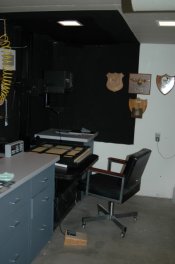
  • DSC_0017.jpg
    DSC_0017.jpg
    44.1 KB · Views: 289
Mine's kind of a peach colour :smile: on 3 walls & ceiling (Hey, it came with the building) and about a zone 2 on the 4th wall!
 
White on the wet side and a deep purple around the enlargers. It's almost black, but more interesting.
 
I have also put black plastic around the part of my enlarger where light leaks will occur and have had no problems
 
mrcallow said:
My walls are the colour of the cheapest good quality paint i could find at Home Depot. I got a gallon of 'oops' paint for 5.00usd original price was well over 20.00.

It is kind of a stylish mushroom colour.

Dead Link Removed
mrcallow
Do they still execute people with these things in your State ? :smile:

Phill
 
philldresser said:
mrcallow
Do they still execute people with these things in your State ? :smile:

Phill

My wife is considering it...
 
Same color as the safelight. The 2 colors will cancel each other out. I learned this one day when looking for print on a box that I knew was red and I couldn't find/read it. When I turned the lights on, I realized the safelight and the print were the same color and for some reason, it cancelled each other.

Don't know if that is scientific. But as other's pointed out, its darn dark in there so it don't matter :smile:
 
I'm the one that talked about the red coloured walls. In fact, they're not painted red, the tiles are red coloured. I've painted the ceiling red, though. You can see pictures of it in the "Darkroom portraits" thread. It's pleasant to work in (very bright with the safelights on) and I've not experienced any paper fogging yet. If I ever wanted to do colour work (although I doubt it) the dark green safelight colour would not be reflected by the red tiles. Any light leak from the enlarger would turn red and cause fogging, though.
The sound quality from the Luxman amp and B&W speakers (Bowers & Wilkins, not black and white) is quite good and the tiles don't seem to cause any problems. The space is filled with objects that absorb the sound and don't let it echo on the tiles. What disturbs me most is the noise from the air exhaust system that covers the moments of silence or the pianissimo parts of the music.
 
George, the way to solve that is by switching to Rock and Roll!

Throw some rolling stones in there.

S.
 
shyguy said:
George, the way to solve that is by switching to Rock and Roll!
Throw some rolling stones in there.
S.

That will bring nothing but confusion when listening to my analog darkroom clock, counting seconds...

eric said:
Same color as the safelight. The 2 colors will cancel each other out. I learned this one day when looking for print on a box that I knew was red and I couldn't find/read it. When I turned the lights on, I realized the safelight and the print were the same color and for some reason, it cancelled each other.

Don't know if that is scientific. But as other's pointed out, its darn dark in there so it don't matter :smile:

I know that is true for sound waves. If this effect is the same for colours, don't ask me.
The principle is used at airports to reduce noice from takeoff and landing of airplanes. Equal waves cancel each other, or better, reduce. 100% effect is never acquired.

G
 
The old wisdom was to paint every thing flat black to reduce any stray reflected light. When I taught a course in the mid 80's a student ask why not just paint the darkroom the same color as a safelight so any reflected light becomes safe. I experimented with my own darkroom and found that amber colored walls and ceiling worked just fine and it is much brighter than the standard flat black. You can also build a cubical around your enlarger and paint the interior of the cubical flat black.
 
One thing to remember (with safelight) is that it's effect on paper will be proportional to the intensity of the light TIMES the length of exposure.

If you were to effectively reflect all the safelight from the walls and other surfaces in the darkroom (rather than absorbe it) you will be, in effect, increasing the level of exposure.

I have always used dark, nonreflective walls in the darkroom - I'd rather have a brighter work environment but I KNOW everything being flat black greatly minimizes the chance of anything getting fogged.
 
Paint it your favorite colour. Then do as suggested above and run the Kodak safelight test. If you don't like the figures you get: say, under 10 minutes to fogging, then either mask around the enlarger light leaks if the problem is fogging from there or, more likely, reduce the safelight brightness.

I can't imagine working in a matt black or red walled room with the lights on... My ceiling and two walls are cream (I bounce the sodium safelight off the ceiling - too bright otherwise) and the other two walls are a pale purple (so, I like purple: sue me! :tongue: ).

Seriously, paint it whatever colour you like and then test and adapt until you get the safelight time you want - I'd say at least 10 minutes; 20 would be nice just to give you that nice feeling that that you don't ever need to even think about it (until you test again 3 months later).

Bob.
 
Photrio.com contains affiliate links to products. We may receive a commission for purchases made through these links.
To read our full affiliate disclosure statement please click Here.

PHOTRIO PARTNERS EQUALLY FUNDING OUR COMMUNITY:


Ilford ADOX Freestyle Photographic Stearman Press Weldon Color Lab Blue Moon Camera & Machine
Top Bottom