
Darkroom Progress - Now building my Processing/Wet station

Its about the light

D
Its about the light

  • 3
  • 0
  • 25
Untitled

A
Untitled

  • 8
  • 0
  • 81

Recent Classifieds

Forum statistics

Threads
201,031
Messages
2,817,913
Members
100,487
Latest member
Luis Costa
Recent bookmarks
0

arespencer

Member
Allowing Ads
Joined
Nov 27, 2025
Messages
30
Location
California
Format
Medium Format
Hello

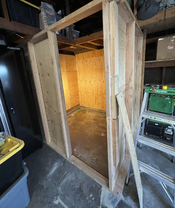
So I had some questions and concerns in the next step of my darkroom build. I just finished building an enclosed room in my garage where I will be exposing/enlarging my prints and loading them into drums. Since I know people will ask, there is no ventilation built into that room since its just a dry room for exposing and loading paper. I'm now starting to buy supplies and figure out my workflow for developing the prints and I'm hoping some people here can provide some help and information.

First here are my needs

I mostly print on 10x12 DPII paper (comes cut in that size from London)
I would be printing 11x14 if I cannot source that paper and need to buy cut sheets from Fuji in the states. So 11x14 is the max print size I'm concerned with being able to make.

I'm pretty set on drums workflow. Trays would be an absolute last resort if I had to go that route, but I'm really really trying to avoid that. I need stable and consistent results (for a working professional) from drum developing.

I plan on doing things one shot (for added consistency) with Silver Pixel Developer Replenisher chemistry ($110) with their Bleach-Fix and Replenisher from freestyle photo ($100). I'll hold to see if I need to do a pre wet/pre wash or not and a stop bath. the Dev and Blix make 20 Liters each so with a 1 shot (2840 uses 120 ml) (2850 uses 200 ml) I should get 100-166 prints with those tanks. I also read that I can use the small extender from the 2840 to use on its own to processing small test stripes since that is the same thing as a 2820 (40 ml) just without the label. So in theory if it takes me 4 test strips and 2 full 11x14 prints to get to a final print I'm looking at 400 ml of chemicals, working out to being $4.20 to make a print (not including paper)


So my main overall question is, in peoples opinion on drum processing which route would be the most stable, repeatable and convenient, as well as relatively easy to find and source the products? I need to decide on which brand/style of tanks I want to use and which roller method/device I want to use to get consistent results.

I found a Jobo 2840 regular lid and a 2850 with cog lid on eBay that I ordered on a whim because it seems quite hard to find print processing drums in 11x14 size. So at the moment I'm going to be using jobo drums but I have no problem switching to something else if it's easier to work with and gives me better results. For starters I'm looking at the Jobo manual roller which says for use of all 1500 and 2500 tanks. Would that roller work for the 2800 tanks or what roller systems are available to roll those size tanks? These roller also looks interesting to me if they could work with the 2840 size tank.

Since I want ease of use and consistency I am looking at getting the Jobo CPE-3 with lift processor, and buy a cog lid for the 2840 I have coming. My thought process for this is, I would get the most consistent results with this and I can use the 3000 drums since those are readily available (just expensive). Is this over kill if I'm just processing prints and would hand rolling or some other cheaper roller work with the 2840 tank and give me accurate results? I don't mind spending the money on the CPE-3 if I needed to for best results but if I can get the same results rolling by hand or rolling with a cheap automatic rolling machine I'd love to not spend the $2000.

Any help you guys could provide in getting me setup with a solid RA4 Drum Processing setup would be much appreciated.


Edit also adding that I found a Cinestill temp control system for cheap that I will use to make a warm water bath. I have some of the 1000ml air reduction bottles ordered and the 600ml bottles ordered. I'll use these to hold my mix chemistry for the printing session and use smaller measuring tubes to measure out final amounts for each print process.
 

Attachments

  • darkroom.jpg
    darkroom.jpg
    951.9 KB · Views: 29

koraks

Moderator
Moderator
Joined
Nov 29, 2018
Messages
25,915
Location
Europe
Format
Multi Format
I mostly print on 10x12 DPII paper (comes cut in that size from London)
See if you can get Maxima. If you're a professional printer/artist, it's really the way to go given the enhanced longevity of the prints. It's not a fake story either; the paper really is better protected both against UV and aerial pollutants.

As to chemistry, I'd consider replenished blix for sure, and potentially also replenishing the developer. Yes, oxidation rates will be higher when using drums than a RT processor, but you can still do replenishment if you compensate a bit for the higher oxidation. Use something like half a gallon of developer and take a bit from that for each run, then pour back into the bottle and replenish the bottle every few prints.

Can't help you on the drum choice as personally I vehemently hated doing RA4 in drums, with all the cleaning it involved and the problems with droplet marks/runners if you somehow missed a droplet clinging to a lid etc. I found trays far more convenient to use. I can't comment on your concern of consistency since I don't know what the problem is supposed to be with trays; if there's one, I never ran into it. YMMV. If you do get drums, I'd get half a dozen or so so that you can clean & dry them batch-wise. It'll be slightly more efficient than circulating a single drum throughout a session.

If you're using drums, you don't really need a temp-controlled Jobo machine; you can do lower temp processing just as well with a longer development time and get pretty much the same results. Filtration will be slightly different, but as long as you keep the developing temperature more or less constant, you will automatically compensate for that anyway, so don't worry about it. I don't put much stock in a Jobo with lift; in fact, I'd very strongly recommend NOT going that route as you're inviting disaster due to contaminating your developer with blix. This may not be a problem if you do use your developer one shot (expensive + wasteful, your call).

A sous vide stick (Cinestill or a cheaper brand, it really doesn't matter IMO) in a tub of water will be just fine for tempering your chemistry. Evidently if you use a rotating drum, the temperature will drop during development; do some test runs where you measure in/out temperature so you know the average and go by that. Note that all RA4 developers can be used at lower temperatures; there's no such thing as "low-temperature RA4 chemistry". It's all optimized for official process temperatures and at the same time it will all get the job done at a lower temperature as well. You will need to empirically determine a suitable development time for your chemistry + paper; use a time that gives you convincing/solid black, but don't go overboard with it as at some point you get cross-contamination of the color channels. It's not super critical though; if you're e.g. working at 30C, you probably have a margin of 15-30 seconds or so that will yield virtually indistinguishable results.

If you do a lot of RA4 printing, especially at modest sizes as you describe, keep your eyes open for an RT processor as it'll make your life infinitely easier in the darkroom. You'll never look back. The main problem is that they're rare and expensive these days.
 
OP
OP

arespencer

Member
Allowing Ads
Joined
Nov 27, 2025
Messages
30
Location
California
Format
Medium Format
See if you can get Maxima. If you're a professional printer/artist, it's really the way to go given the enhanced longevity of the prints. It's not a fake story either; the paper really is better protected both against UV and aerial pollutants.


I have a box of maxima in 12x16 sheets that I haven’t touched. I’ve heard that maxima of even more saturated and contrast-y compared to DPII? If that’s the case DPII might be preferred for that reason. At the moment I’m not too concerned about archival quality. I print to scan the prints for my final file and then deliver to either an editorial client, commercial client, or use those files for zine and book projects. So my darkroom prints aren’t really being seen in print form. However in the future, exhibiting and selling hand prints of my personal work would be cool, so I may look more into that.

I also need to make sense of the American naming Fuji papers so that I can buy rolls and trim them down my self. Buying cut sheets from UK is too expensive. I think I might try out super CN, from my research that might be the closest to DPII.


As to chemistry, I'd consider replenished blix for sure, and potentially also replenishing the developer. Yes, oxidation rates will be higher when using drums than a RT processor, but you can still do replenishment if you compensate a bit for the higher oxidation. Use something like half a gallon of developer and take a bit from that for each run, then pour back into the bottle and replenish the bottle every few prints.


Great to know, replenished blix sounds like a good idea and I’ll look more into some version of relishing developer. I was curious if you could use more chemicals than needed in the drums. Would there be any draw backs? In my mind I’m thinking, if the drum needs 200ml and I use 600ml could I just recycle that 600ml for 3 or 5 prints and then toss it? Without losing any consistency?


Can't help you on the drum choice as personally I vehemently hated doing RA4 in drums, with all the cleaning it involved and the problems with droplet marks/runners if you somehow missed a droplet clinging to a lid etc. I found trays far more convenient to use. I can't comment on your concern of consistency since I don't know what the problem is supposed to be with trays; if there's one, I never ran into it. YMMV. If you do get drums, I'd get half a dozen or so so that you can clean & dry them batch-wise. It'll be slightly more efficient than circulating a single drum throughout a session.
This was my thought process too, I’d have 3 drums I can do a quick stretch of prints and then bulk wash and dry. Or if I could make a air drying rack system that would dry them by the time I do the next 2 prints.


If you're using drums, you don't really need a temp-controlled Jobo machine; you can do lower temp processing just as well with a longer development time and get pretty much the same results. Filtration will be slightly different, but as long as you keep the developing temperature more or less constant, you will automatically compensate for that anyway, so don't worry about it. I don't put much stock in a Jobo with lift; in fact, I'd very strongly recommend NOT going that route as you're inviting disaster due to contaminating your developer with blix. This may not be a problem if you do use your developer one shot (expensive + wasteful, your call).

That’s great I was hoping I could do just fine with a roller base and manually spinning it by hand. In your expertise would spinning by hand be close enough for consistent agitation (assuming I’m really focusing on what speed and rotation, etc I use)?

Is it theoretical that I can develop and blix at any (room temp) and it will just adjust the develop time. Is there a middle ground that works best, slight warmed chemicals to extend the dev time so that loading and emptying chemicals have less of an impact on overall time?


A sous vide stick (Cinestill or a cheaper brand, it really doesn't matter IMO) in a tub of water will be just fine for tempering your chemistry. Evidently if you use a rotating drum, the temperature will drop during development; do some test runs where you measure in/out temperature so you know the average and go by that. Note that all RA4 developers can be used at lower temperatures; there's no such thing as "low-temperature RA4 chemistry". It's all optimized for official process temperatures and at the same time it will all get the job done at a lower temperature as well. You will need to empirically determine a suitable development time for your chemistry + paper; use a time that gives you convincing/solid black, but don't go overboard with it as at some point you get cross-contamination of the color channels. It's not super critical though; if you're e.g. working at 30C, you probably have a margin of 15-30 seconds or so that will yield virtually indistinguishable results.

Can you control contrast of some sorts by modifying your develop times? Or is that not really a thing?


If you do a lot of RA4 printing, especially at modest sizes as you describe, keep your eyes open for an RT processor as it'll make your life infinitely easier in the darkroom. You'll never look back. The main problem is that they're rare and expensive these days.

I definitely would love to have a processor but I am a bit turned off by how expensive they are and for the fact that you could pay $3k for something that isn’t completely tested, may need constant fixing, replacing and could just go out one day. There is a Fujimoto CP-31 for sale in Colorado that I would need to drive to pick up. It looks pretty clean and is semi tested but not fully. It’s $3,000 but I have been tempted to consider grabbing it. But that’s a lot of money to spend on something that may not work or be a pain getting up and running and maintaining, and I still don’t get dry to dry. I’ve convinced myself that drums really aren't all that bad and the only hang ups are just washing and drying the drums in between prints. If there were a new desktop processor that did 16” or even 12” being manufactured I would have no problem spending like $5k on that.

So yes I would love to have a processor if an opportunity makes sense, or even be able to find a colenta ecoline 56. But not sure how much those actually cost all in but I was assuming they were like $10k-$15k, not sure where I got that number from though.
 

MattKing

Moderator
Moderator
Allowing Ads
Joined
Apr 24, 2005
Messages
54,596
Location
Delta, BC Canada
Format
Medium Format
FWIW, and keeping in mind that when I use tubes it is with black and white printing, I find that if I have at least three tubes, something set up for air drying, and a reasonably plentiful set of old linen towels for quick wipe-downs before air drying, the drying burden isn't bad.
That is with easily assembled/disassembled Cibachrome tubes.
 

koraks

Moderator
Moderator
Joined
Nov 29, 2018
Messages
25,915
Location
Europe
Format
Multi Format
DPII is a good paper, but if you're going to sell prints (in which case buyers will expect you've done everything possible to enhance archival stability) I'd definitely go with Maxima. Give it a try; the image-wise differences are pretty subtle.

if the drum needs 200ml and I use 600ml could I just recycle that 600ml for 3 or 5 prints and then toss it? Without losing any consistency?
I'd really commend replenishing the developer in that scenario and not re-using it several times before tossing. In principle there's nothing wrong with using a larger volume of chemistry in the tank. Re-using the developer will work to a point, but the problem is determining where the point is that consistency does suffer visually. With paper you have a whole lot more leeway than with film, and 3 prints across 600ml will likely be fine. But for economy's and consistency's sake, I would consider replenishment.

Is it theoretical that I can develop and blix at any (room temp) and it will just adjust the develop time.
I've done that for years. It works. But you'll have to try for yourself to determine whether you find the results up to your standards. The filter pack will be different if you develop at lower temperature. The prints can still end up very, very close.

Can you control contrast of some sorts by modifying your develop times?
No.

With RT processors, you have to have a bit of luck. It's possible one can find its way to you. The smaller machines (<50cm/20") are easier to get hold of.
 

Pegajoy

Subscriber
Allowing Ads
Joined
May 31, 2024
Messages
42
Location
Germany
Format
Medium Format
I definitely would love to have a processor but I am a bit turned off by how expensive they are
I got a first generation Jobo CPP with a Colordrum 4102 for just 80 Euro. Works still perfect and can process paper up to 11x14.
 
OP
OP

arespencer

Member
Allowing Ads
Joined
Nov 27, 2025
Messages
30
Location
California
Format
Medium Format
I got a first generation Jobo CPP with a Colordrum 4102 for just 80 Euro. Works still perfect and can process paper up to 11x14.

Nice, from what it sounds like I can be fine without a water bath type of roller. I was thinking the jobo base roller since it’s cheap but I think spinning it by hand will get old and I also want repeatable agitation so I need to find a solution that can spin a jobo 2840, which aside from the expensive Jobo units seems like doesn’t exist. Anyone have any recommendations?
 

btaylor

Subscriber
Allowing Ads
Joined
Dec 28, 2010
Messages
2,282
Location
Los Angeles
Format
Large Format
Back in the day I used both Unicolor and Beseler drums, there was no difference in performance between the two. I do recall that they have a cup inside that holds the chemistry while the drum is vertical and they don’t hit the paper until you’ve turned it horizontal and started rolling. That may affect the amount of chemistry you use. But perhaps that’s not an issue- try it and see.
I would process at the elevated (is it 98 degrees f?) temp in drums using a prewash to get the drum up to temp (as instructed by the drum manufacturer) and a tempering bath for the chemistry. Worked fine, as Koraks says consistency is the key in getting it all dialed in. A hair dryer works to dry your test strips so you can check color and density.
For a drum roller have you considered the old Beseler, Unicolor Uniroller or Cibachrome roller bases? Very simple machines and it looks like they go for $50 to $100 on eBay.
 

logan2z

Subscriber
Allowing Ads
Joined
Jan 11, 2019
Messages
3,928
Location
SF Bay Area, USA
Format
Multi Format
Nice, from what it sounds like I can be fine without a water bath type of roller. I was thinking the jobo base roller since it’s cheap but I think spinning it by hand will get old and I also want repeatable agitation so I need to find a solution that can spin a jobo 2840, which aside from the expensive Jobo units seems like doesn’t exist. Anyone have any recommendations?

I use a Beseler motor base with 11x14” Beseler drums and it works well. They’re easily found on eBay for under $100. I assume it would work just fine with the Jobo drums as well.
 

mshchem

Subscriber
Allowing Ads
Joined
Nov 26, 2007
Messages
15,605
Location
Iowa City, Iowa USA
Format
Medium Format
I would echo what Koraks has said. You really don't need a machine to process color prints. It will slow you down. Get a bath set up that will hold 1 L bottles. Prewet (warm up the drum for a minute with plenty of 100-110°F water, dump, pour in your developer 95-100° F, put the tube on those nice Jobo manual rollers and roll for at least a minute, time isn't super critical. Stop, blix wash in tray for 1 minute dry.

You can create a 1L "replenished tank" in a 1 liter bottle use 40ml of fresh to replenish. I did this for years with Cibachrome gives very nice stable results.
 

Pegajoy

Subscriber
Allowing Ads
Joined
May 31, 2024
Messages
42
Location
Germany
Format
Medium Format
I see two options actually, if you do not want the water bath: The Jobo SilverBase for about 430 Eur or the Filmomat light for about 600 Euro. The Filmomat light give you the option with and without water bath and works with all drum types. But I do not know the length and if it fits the Jobo 2840, but I guess so.
 

Pegajoy

Subscriber
Allowing Ads
Joined
May 31, 2024
Messages
42
Location
Germany
Format
Medium Format
Or the eTone roller plus extension unit for less than 200 Euro together. But it is cheap China ware, I do not know if it is worth the price.
On the other hand, also the other products are expected produced on China.
 
OP
OP

arespencer

Member
Allowing Ads
Joined
Nov 27, 2025
Messages
30
Location
California
Format
Medium Format
Back in the day I used both Unicolor and Beseler drums, there was no difference in performance between the two. I do recall that they have a cup inside that holds the chemistry while the drum is vertical and they don’t hit the paper until you’ve turned it horizontal and started rolling. That may affect the amount of chemistry you use. But perhaps that’s not an issue- try it and see.
I would process at the elevated (is it 98 degrees f?) temp in drums using a prewash to get the drum up to temp and a tempering bath for the chemistry. Worked fine, as Koraks says consistency is the key in getting it all dialed in. A hair dryer works to dry your test strips so you can check color and density.
For a drum roller have you considered the old Beseler, Unicolor Uniroller or Cibachrome roller bases? Very simple machines and it looks like they go for $50 to $100 on eBay.


I was starting to look into those roller bases. Will those be able to support the larger jobo 2840 drum? If so I’ll probably go with that. At the very
I use a Beseler motor base with 11x14” Beseler drums and it works well. They’re easily found on eBay for under $100. I assume it would work just fine with the Jobo drums as well.

thats good to know. At the moment it seems hard to find any ilford, Beseler or some of the other brand drums right now. I was able to find jobo so I have 2x 2840s coming in the mail and a 2850 for 16x20s.

I think I’m either gonna try a beseler motor base or just go for the Jobo silver base
 

DREW WILEY

Member
Allowing Ads
Joined
Jul 14, 2011
Messages
14,716
Format
8x10 Format
Where can anyone find Maxima in the US? I'd like to try it, preferably in 30-inch roll fashion, to see if it has a bit wider gamut than the other Fuji papers, more akin to their premium quality Fujiflex Supergloss. But I only come up with dead-end deer-in-the-headlights responses from US distributors.

I wouldn't worry much about relatively minor "archival" differences. Even two generations back of Super C Crystal Archive has proven very satisfactory in display permanence. Now it's Super C II (or Super C- N), perhaps the same thing as Euro DP ii; but it's hard to get straight answers about that either.

Most types of drums are fine for RA4 usage. The cheap old DevTech ones actually work the best among once common brands. To start out, you could just roll the drum gently back and forth along the darkroom sink bed, or a cleanable countertop.
 
Last edited:
OP
OP

arespencer

Member
Allowing Ads
Joined
Nov 27, 2025
Messages
30
Location
California
Format
Medium Format
I would echo what Koraks has said. You really don't need a machine to process color prints. It will slow you down. Get a bath set up that will hold 1 L bottles. Prewet (warm up the drum for a minute with plenty of 100-110°F water, dump, pour in your developer 95-100° F, put the tube on those nice Jobo manual rollers and roll for at least a minute, time isn't super critical. Stop, blix wash in tray for 1 minute dry.

You can create a 1L "replenished tank" in a 1 liter bottle use 40ml of fresh to replenish. I did this for years with Cibachrome gives very nice stable results.

Amazing. I was leaning towards the manual jobo base to spin the drums but I feel like those 45 seconds of manual spinning will get old after a lot of printing so I’m thinking maybe I go for the Jobo silver base just to have ultra consistent agitation. But I’m glad to hear that stable consistent results are easy to achieve with this route I’m looking to go.

I’m still understanding how replenishing works. I’ve read that replenisher is different from developer? Does the process work like this?

First print - use 120ml of fresh developer

Discard into empty 1 liter bottle
Add 40ml of replenisher

Next print - measure out 120ml from the replenished 1 liter bottle, use that to develop the next print.

Discard into the 1 liter bottle and add another 40ml.

Continue this process until done with printing session.

I’m assuming the amount of replenisher you use would vary depending on how much ml is needed for the drum you’re using? So if I was making larger prints that needed 240ml would I also double the relished to 80ml?
 
OP
OP

arespencer

Member
Allowing Ads
Joined
Nov 27, 2025
Messages
30
Location
California
Format
Medium Format
Where can anyone find Maxima in the US? I'd like to try it, preferably in 30-inch roll fashion, to see if it has a bit wider gamut than the other Fuji papers, more akin to their premium quality Fujiflex Supergloss. But I only come up with dead-end deer-in-the-headlights responses from US distributors.

I wouldn't worry much about relatively minor "archival" differences. Even two generations back of Super C Crystal Archive has proven very satisfactory in display permanence. Now it's Super C II (or Super C- N), perhaps the same thing as Euro DP ii; but it's hard to get straight answers about that either.

Most types of drums are fine for RA4 usage. The cheap old DevTech ones actually work the best among once common brands. To start out, you could just roll the drum gently back and forth along the darkroom sink bed, or a cleanable countertop.

The Photolab NYC sells cut sheets of DPII now and in their store they also have 8x10 CN. I’m curious if that means that CN is different from DPII. Their prices for DPII seem really high and with shipping it was a lot cheaper for me to order 300 sheets of 10x12 from the lab in London I order cut sheets from.

I don’t remember where you can get maxima rolls in the US but I thought imaging spectrum or unique photo or the other place Miami “something” (I forget the name) stocked rolls of maxima. But maybe I’m making that up.

Actually I remember recently seeing that B&H stocks rolls of DPII and maxima. Hopefully this is going to be a consistent supply. Other wise I might stock up
 
Photrio.com contains affiliate links to products. We may receive a commission for purchases made through these links.
To read our full affiliate disclosure statement please click Here.

PHOTRIO PARTNERS EQUALLY FUNDING OUR COMMUNITY:


Ilford ADOX Freestyle Photographic Stearman Press Weldon Color Lab Blue Moon Camera & Machine
Top Bottom
