Hello
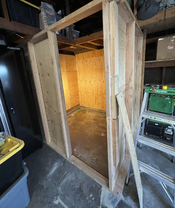
So I had some questions and concerns in the next step of my darkroom build. I just finished building an enclosed room in my garage where I will be exposing/enlarging my prints and loading them into drums. Since I know people will ask, there is no ventilation built into that room since its just a dry room for exposing and loading paper. I'm now starting to buy supplies and figure out my workflow for developing the prints and I'm hoping some people here can provide some help and information.
First here are my needs
I mostly print on 10x12 DPII paper (comes cut in that size from London)
I would be printing 11x14 if I cannot source that paper and need to buy cut sheets from Fuji in the states. So 11x14 is the max print size I'm concerned with being able to make.
I'm pretty set on drums workflow. Trays would be an absolute last resort if I had to go that route, but I'm really really trying to avoid that. I need stable and consistent results (for a working professional) from drum developing.
I plan on doing things one shot (for added consistency) with Silver Pixel Developer Replenisher chemistry ($110) with their Bleach-Fix and Replenisher from freestyle photo ($100). I'll hold to see if I need to do a pre wet/pre wash or not and a stop bath. the Dev and Blix make 20 Liters each so with a 1 shot (2840 uses 120 ml) (2850 uses 200 ml) I should get 100-166 prints with those tanks. I also read that I can use the small extender from the 2840 to use on its own to processing small test stripes since that is the same thing as a 2820 (40 ml) just without the label. So in theory if it takes me 4 test strips and 2 full 11x14 prints to get to a final print I'm looking at 400 ml of chemicals, working out to being $4.20 to make a print (not including paper)
So my main overall question is, in peoples opinion on drum processing which route would be the most stable, repeatable and convenient, as well as relatively easy to find and source the products? I need to decide on which brand/style of tanks I want to use and which roller method/device I want to use to get consistent results.
I found a Jobo 2840 regular lid and a 2850 with cog lid on eBay that I ordered on a whim because it seems quite hard to find print processing drums in 11x14 size. So at the moment I'm going to be using jobo drums but I have no problem switching to something else if it's easier to work with and gives me better results. For starters I'm looking at the Jobo manual roller which says for use of all 1500 and 2500 tanks. Would that roller work for the 2800 tanks or what roller systems are available to roll those size tanks? These roller also looks interesting to me if they could work with the 2840 size tank.
Since I want ease of use and consistency I am looking at getting the Jobo CPE-3 with lift processor, and buy a cog lid for the 2840 I have coming. My thought process for this is, I would get the most consistent results with this and I can use the 3000 drums since those are readily available (just expensive). Is this over kill if I'm just processing prints and would hand rolling or some other cheaper roller work with the 2840 tank and give me accurate results? I don't mind spending the money on the CPE-3 if I needed to for best results but if I can get the same results rolling by hand or rolling with a cheap automatic rolling machine I'd love to not spend the $2000.
Any help you guys could provide in getting me setup with a solid RA4 Drum Processing setup would be much appreciated.
Edit also adding that I found a Cinestill temp control system for cheap that I will use to make a warm water bath. I have some of the 1000ml air reduction bottles ordered and the 600ml bottles ordered. I'll use these to hold my mix chemistry for the printing session and use smaller measuring tubes to measure out final amounts for each print process.
So I had some questions and concerns in the next step of my darkroom build. I just finished building an enclosed room in my garage where I will be exposing/enlarging my prints and loading them into drums. Since I know people will ask, there is no ventilation built into that room since its just a dry room for exposing and loading paper. I'm now starting to buy supplies and figure out my workflow for developing the prints and I'm hoping some people here can provide some help and information.
First here are my needs
I mostly print on 10x12 DPII paper (comes cut in that size from London)
I would be printing 11x14 if I cannot source that paper and need to buy cut sheets from Fuji in the states. So 11x14 is the max print size I'm concerned with being able to make.
I'm pretty set on drums workflow. Trays would be an absolute last resort if I had to go that route, but I'm really really trying to avoid that. I need stable and consistent results (for a working professional) from drum developing.
I plan on doing things one shot (for added consistency) with Silver Pixel Developer Replenisher chemistry ($110) with their Bleach-Fix and Replenisher from freestyle photo ($100). I'll hold to see if I need to do a pre wet/pre wash or not and a stop bath. the Dev and Blix make 20 Liters each so with a 1 shot (2840 uses 120 ml) (2850 uses 200 ml) I should get 100-166 prints with those tanks. I also read that I can use the small extender from the 2840 to use on its own to processing small test stripes since that is the same thing as a 2820 (40 ml) just without the label. So in theory if it takes me 4 test strips and 2 full 11x14 prints to get to a final print I'm looking at 400 ml of chemicals, working out to being $4.20 to make a print (not including paper)
So my main overall question is, in peoples opinion on drum processing which route would be the most stable, repeatable and convenient, as well as relatively easy to find and source the products? I need to decide on which brand/style of tanks I want to use and which roller method/device I want to use to get consistent results.
I found a Jobo 2840 regular lid and a 2850 with cog lid on eBay that I ordered on a whim because it seems quite hard to find print processing drums in 11x14 size. So at the moment I'm going to be using jobo drums but I have no problem switching to something else if it's easier to work with and gives me better results. For starters I'm looking at the Jobo manual roller which says for use of all 1500 and 2500 tanks. Would that roller work for the 2800 tanks or what roller systems are available to roll those size tanks? These roller also looks interesting to me if they could work with the 2840 size tank.
Since I want ease of use and consistency I am looking at getting the Jobo CPE-3 with lift processor, and buy a cog lid for the 2840 I have coming. My thought process for this is, I would get the most consistent results with this and I can use the 3000 drums since those are readily available (just expensive). Is this over kill if I'm just processing prints and would hand rolling or some other cheaper roller work with the 2840 tank and give me accurate results? I don't mind spending the money on the CPE-3 if I needed to for best results but if I can get the same results rolling by hand or rolling with a cheap automatic rolling machine I'd love to not spend the $2000.
Any help you guys could provide in getting me setup with a solid RA4 Drum Processing setup would be much appreciated.
Edit also adding that I found a Cinestill temp control system for cheap that I will use to make a warm water bath. I have some of the 1000ml air reduction bottles ordered and the 600ml bottles ordered. I'll use these to hold my mix chemistry for the printing session and use smaller measuring tubes to measure out final amounts for each print process.