OK, I worked hard within the past 24 hours in order to prove my point. 'My point' is really an attempt to remove some misconceptions about metol/HQ ratios. They are not all that important and, yes, 'universal' developers (optimized to develop prints in their respective formulations) are just as good for film. Yes, they really are, including Dektol.
Dektol's 'bad aspect' is its reduced life in an open tray, compared with D-76. However, when stored properly (glass or PET plastic with no air space), Dektol will last indefinitely, just like D-76 will.
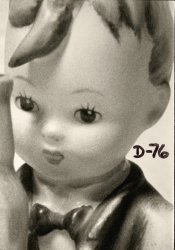
I photographed an old (damaged, but subsequently repaired) Hummel. The full portrait is from the D-76 negative. The 20x enlargements are (indicated) from separate negatives developed either in D-76 (1+1) or Dektol (1+19). There is no apparent difference between the two. No, Dektol does NOT lead to more grain. The misconception is due to the fact that when diluted far less, it becomes extremely difficult to develop to only a normal extent. Overdevelopment with any developer (made much easier to do with Dektol) will lead to more pronounced grain. The increased alkalinity of D-72 (Dektol) does NOT lend itself to more grain. If I had used Dektol full strength but was able to accurately develop my negative to the proper gamma (probably after 30 seconds!) the grain would be the SAME.
Again, Dektol can be readily used as a normal negative developer. The economy is rather profound with a one liter size making 20L of working solution, handily developing at least 80 36-exp rolls of film.
My Dektol dilution is not cut in stone, but merely done to approximate normal development times. I use ambient temps (in my case 80F) so dilute more or less as your desired times indicate. There is no inherent difference with grain, acutance, or contrast. (My contrasts/ densities might be slightly off due to slight deviations in development times. If the D-76 neg actually looks a tiny bit grainier, it is because it was developed a bit more than it should have been. ) As importantly, there is absolutely no difference in shadow threshold: both negatives show equal exposure, about EI 25.
The film used was 35mm Pan F+ (rebadged by Freestyle as Arista 50, bought ten years ago.) - David Lyga