
• Welcome to Photrio!
    Registration is fast and free. Join today to unlock search, see fewer ads, and access all forum features.
    Click here to sign up

Cyanotype whites not clearing

Kulwulton River in Flood

A
Kulwulton River in Flood

  • sly
  • Feb 5, 2026
  • 1
  • 0
  • 13
MV Shirley

A
MV Shirley

  • 2
  • 0
  • 17

Recent Classifieds

Forum statistics

Threads
202,174
Messages
2,836,260
Members
101,150
Latest member
Ioannes
Recent bookmarks
0

cirwin2010

Member
Joined
Jan 3, 2021
Messages
249
Location
Massachussetts
Format
Analog
I'm using Mike Ware's cyanotype formula and mixed it per his instructions. I am omitting the dichromate from the formula.

I've been careful to mix the solution under an incandescent bug light to prevent fogging of the solution and I'm using distilled water.


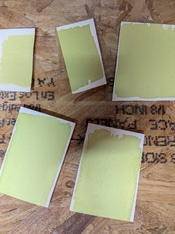
My solution is emerald green in the bottle and my coated paper is a strong yellow-green color. This is at odds with Mike Ware's description of lemon yellow when coated on the paper.


If I coat the paper then attempt to clear it immediately upon drying with no exposure to blue or UV light, I still get some blue in the paper that does not completely clear out.

I've gotten this result with Arches Aquarelle cold press, Hahnemühle Platinum Rag, and Legion Revere Platinum. The Arches Aquarelle is the worst of the three. I've added a drop of 40% citric acid per milliliter of solution per Christina Anderson's Cyanotype book. This does not seem to yield any change.

What could I be doing wrong here?
 

Attachments

  • PXL_20251217_212459245.jpg
    PXL_20251217_212459245.jpg
    1.8 MB · Views: 41
  • PXL_20251217_213246121.jpg
    PXL_20251217_213246121.jpg
    593.3 KB · Views: 39

koraks

Moderator
Moderator
Joined
Nov 29, 2018
Messages
27,459
Location
Europe
Format
Multi Format
Mike Ware's cyanotype formul

New Cyanotype or Simple? I guess the former. It's very picky with regard to the paper you use and I find it takes a dilute mineral acid to clear it. I use very dilute hydrochloric/ muriatic acid. You may have to neutralize any carbonate buffer in the paper if the whites don't clear.
Overall, the plain old classic cyanotype formula is the most dependable and easiest to use.
 

nmp

Member
Allowing Ads
Joined
Jan 20, 2005
Messages
2,101
Location
Maryland USA
Format
35mm
I'm using Mike Ware's cyanotype formula and mixed it per his instructions. I am omitting the dichromate from the formula.

I've been careful to mix the solution under an incandescent bug light to prevent fogging of the solution and I'm using distilled water.


My solution is emerald green in the bottle and my coated paper is a strong yellow-green color. This is at odds with Mike Ware's description of lemon yellow when coated on the paper.


If I coat the paper then attempt to clear it immediately upon drying with no exposure to blue or UV light, I still get some blue in the paper that does not completely clear out.

I've gotten this result with Arches Aquarelle cold press, Hahnemühle Platinum Rag, and Legion Revere Platinum. The Arches Aquarelle is the worst of the three. I've added a drop of 40% citric acid per milliliter of solution per Christina Anderson's Cyanotype book. This does not seem to yield any change.

What could I be doing wrong here?
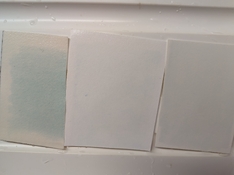
From look of the things, that does not bode well for the sensitizer. Somehow it might have been compromised while you were making it. I don't know if you want to mess with this or make a new batch. Potentially if there was any ferrous formed in the sensitizer, it can be reverted by addition of hydrogen peroxide.

:Niranjan.
 
OP
OP

cirwin2010

Member
Joined
Jan 3, 2021
Messages
249
Location
Massachussetts
Format
Analog
New Cyanotype or Simple? I guess the former. It's very picky with regard to the paper you use and I find it takes a dilute mineral acid to clear it. I use very dilute hydrochloric/ muriatic acid. You may have to neutralize any carbonate buffer in the paper if the whites don't clear.
Overall, the plain old classic cyanotype formula is the most dependable and easiest to use.

New cyanotype per Mike Ware's instructions. I have yet to try a sulfamic acid presoak with the papers or increasing the amount of citric acid added to the sensitizer.
 
OP
OP

cirwin2010

Member
Joined
Jan 3, 2021
Messages
249
Location
Massachussetts
Format
Analog
From look of the things, that does not bode well for the sensitizer. Somehow it might have been compromised while you were making it. I don't know if you want to mess with this or make a new batch. Potentially if there was any ferrous formed in the sensitizer, it can be reverted by addition of hydrogen peroxide.

:Niranjan.

So the new cyanotype sensitizer isn't supposed to be this green? I've watched Bill Schwab's video on youtube (link below) and I think I've mixed my solutions the same way, but with perhaps a bit more heat and precision? The way he heats the solution seems a bit loose.


This is actually my second batch I've made. I thought the same thing, thinking I messed something up since I used tap water and some brighter led lights to illuminate my work space. The second bath I used distilled water and mixed the solutions under an incandescent bug light to ensure it wasn't tap water contamination or my lights exposing the solution. From my testing both the first and second batch appear to be the same.

I'm not really sure how I can mix it any better than I have. I'm using clean beakers and a hot plate. My thermometer is probably not the most suitable, but I figured it should be close enough. At lease closer than how Bill Schwab was doing it.

Still assuming that something is going wrong if even HPR is fogging a little bit.
 

NedL

Subscriber
Allowing Ads
Joined
Aug 23, 2012
Messages
3,430
Location
Sonoma County, California
Format
Multi Format
I ended up using something like Raghu posted ( add a little bit of citric acid or FAC if you get ferric potassium oxalate crystals on the surface of your print ). One thing I noticed about "new" cyanotype was that mine had a little bit of fine prussian blue suspended in it. It caused something like you are noticing on your HPR and RP. Just a guess is that your Aquarelle is not compatible, and that the other two might have a little of this "staining" prussian blue suspended in the solution. I was able to filter it out, but then I got annoyed when more appeared a few days later and now the bottle is still on the shelf! :smile:
 

koraks

Moderator
Moderator
Joined
Nov 29, 2018
Messages
27,459
Location
Europe
Format
Multi Format
New cyanotype per Mike Ware's instructions. I have yet to try a sulfamic acid presoak with the papers or increasing the amount of citric acid added to the sensitizer.
Okay, see how that goes. Don't forget what I said about the rinse after exposure. Citric acid etc. is not sufficient for this in my experience. Try dilute hydrochloric acid.

I don't know what your sensitizer looks like, but what I see mostly is what might be a healthy sensitizer applied to a paper that's just not suitable (without neutralization) for this process.

I'd strongly suggest setting New Cyanotype aside as it's just unnecessarily fussy and problematic. That's just my private opinion though.
 

Andrew O'Neill

Moderator
Moderator
Joined
Jan 16, 2004
Messages
13,036
Location
Coquitlam,BC Canada
Format
Multi Format
Hahnemuhle PR should work right out of the package, with no pre-acidifying required. I abandoned the New Cyanotype, and went back to traditional formula. It was just too finicky. Mix some up and try it. If it works, then there is something wrong with your mixture of New Cyanotype.
 
OP
OP

cirwin2010

Member
Joined
Jan 3, 2021
Messages
249
Location
Massachussetts
Format
Analog
Okay, see how that goes. Don't forget what I said about the rinse after exposure. Citric acid etc. is not sufficient for this in my experience. Try dilute hydrochloric acid.

I don't know what your sensitizer looks like, but what I see mostly is what might be a healthy sensitizer applied to a paper that's just not suitable (without neutralization) for this process.

I'd strongly suggest setting New Cyanotype aside as it's just unnecessarily fussy and problematic. That's just my private opinion though.

I've been using 1% sulfamic acid for the first rinsing bath per Christina Anderson's notes. Hydrochloride acid might be a bit too hazardous for my comfort. I'm also wondering if the omission of ammonium dichromate is making this harder too. Per everything I read it should only be adding contrast and extending the shelf life of the solution, but maybe there is more to it? I have some ammonium dichromate, but I ordered it before learning how hazardous it is and if I don't need it I'd like to avoid using it.

I mostly wanted to try the new cyanotype formula to avoid washout and achieve greater dmax, but that may not be true for every paper.
 
OP
OP

cirwin2010

Member
Joined
Jan 3, 2021
Messages
249
Location
Massachussetts
Format
Analog
I ended up using something like Raghu posted ( add a little bit of citric acid or FAC if you get ferric potassium oxalate crystals on the surface of your print ). One thing I noticed about "new" cyanotype was that mine had a little bit of fine prussian blue suspended in it. It caused something like you are noticing on your HPR and RP. Just a guess is that your Aquarelle is not compatible, and that the other two might have a little of this "staining" prussian blue suspended in the solution. I was able to filter it out, but then I got annoyed when more appeared a few days later and now the bottle is still on the shelf! :smile:

Is there a way to test for prussian blue suspended in the solution?
 
OP
OP

cirwin2010

Member
Joined
Jan 3, 2021
Messages
249
Location
Massachussetts
Format
Analog
So I think I might have found the problem. I'm still waiting on some paper to dry to further validate, but I think it might be my coffee filters causing issues. Per Mike Ware's instructions I filtered the solution through a coffee filter to remove any crystals. Through some more testing and trying to perform more filtering of the solution I noticed that the filter paper was turning blue and after a few passes through the filters that the solution now has a blue hue to it.

Remember I made two batches of this stuff, the one that went through extra filtration is most definitely a different color now when compared to the other.

Per Rahu's suggestion (before he deleted the comment) I mixed up a small amount of solution without heating or filtration. I put a drop of it on the coffee filter and it immediately turned blue around the edges. I'm now waiting for some of this solution to dry on some paper and see if I can clear it. If this does clear I think that is an indication that Prussian blue ended up being formed by my coffee filters and contaminated the solution.

Edit: Oh and the coffee filters I'm using are Melitta Natural Brown Coffee Filters #4. It claims to be chloride and bleach free. But there might be some other components to the filter. They also just aren't great filters in general. I just happened to have these on hand and have been using them to filter the larger sediment from my kallitype developers, but it doesn't capture the small stuff.
 

koraks

Moderator
Moderator
Joined
Nov 29, 2018
Messages
27,459
Location
Europe
Format
Multi Format
I'm also wondering if the omission of ammonium dichromate is making this harder too.
You don't need dichromate for this. If you're concerned about the keeping properties of the sensitizer, I'd just mix up small batches and use them up before they go bad, and discard whatever doesn't make it in time. It's cheap.

I mostly wanted to try the new cyanotype formula to avoid washout and achieve greater dmax
Washout is not really an issue as you can compensate for this in printing. Sure, it's elegant if a chemical reaction is very efficient, but in this case, there's no significant economic penalty to some of the Prussian blue pigment being lost in the first wash. It can contribute to staining, but this depends also on the paper you use and your processing. In terms of dmax it's generally easier to get deeper blues with classic cyanotype since it's less picky about the paper/chemical context in which it's used. When practiced under ideal conditions, I've never found a difference in the dmax between New Cyanotype and the classic sensitizer.

Melitta Natural Brown Coffee Filters #4
That's funny, I think we have the same here! I rarely use them in the darkroom. They're great for making coffee. I honestly doubt the problem with your sensitizer is due to the use of these filters, but hey, who knows!
 
OP
OP

cirwin2010

Member
Joined
Jan 3, 2021
Messages
249
Location
Massachussetts
Format
Analog
You don't need dichromate for this. If you're concerned about the keeping properties of the sensitizer, I'd just mix up small batches and use them up before they go bad, and discard whatever doesn't make it in time. It's cheap.


Washout is not really an issue as you can compensate for this in printing. Sure, it's elegant if a chemical reaction is very efficient, but in this case, there's no significant economic penalty to some of the Prussian blue pigment being lost in the first wash. It can contribute to staining, but this depends also on the paper you use and your processing. In terms of dmax it's generally easier to get deeper blues with classic cyanotype since it's less picky about the paper/chemical context in which it's used. When practiced under ideal conditions, I've never found a difference in the dmax between New Cyanotype and the classic sensitizer.


That's funny, I think we have the same here! I rarely use them in the darkroom. They're great for making coffee. I honestly doubt the problem with your sensitizer is due to the use of these filters, but hey, who knows!

Well I just mixed up another bath. It's cooling now and needs to rest for a few hours. I'm going to just carefully decant this one and bypass using the coffee filter.

At this point I'm somewhat confident that the filters were part of the problem. Again the solution I filtered several times started turning a blue-green rather than yellow-green. But I'll report back with my findings!


I also think the Arches Aquarelle paper I've been wanting to use is just problematic from some of my testing Even with the small amount of fresh solution I made I still got blue staining with no exposure. This only happened when I put it in a 1% sulfamic solution. When I put it in just plain tap water, no blue formed, but the paper base was stained a yellow-tan color and that did not seem to wash out. This stain could be because I didn't process this "test" solution properly for all I know at this point.

I did just try acidifying the paper in a 10% sulfamic acid bath. After holding the wet paper up to the light I see some spots in the paper. I don't know if this is contamination, uneven acidification, or something already present in the paper. I'll see what happens to this paper later with testing.

Per Christina Anderson's notes, this paper should be suitable with some citric acid in the coating solution. If I can't get it to work that would be a shame. The maximum density and color I was able to get during my testing is absolutely spectacular!
 

NedL

Subscriber
Allowing Ads
Joined
Aug 23, 2012
Messages
3,430
Location
Sonoma County, California
Format
Multi Format
...

At this point I'm somewhat confident that the filters were part of the problem. Again the solution I filtered several times started turning a blue-green rather than yellow-green. But I'll report back with my findings!
...

Interesting, and it sounds like you're making progress. FWIW, I used white chemex coffee filters. I don't know if they might have contributed to the small amount of prussian blue suspended in mine.
 

Raghu Kuvempunagar

Member
Allowing Ads
Joined
Jul 28, 2016
Messages
3,140
Location
India
Format
Multi Format
I hope you'll be able to soon make New Cyanotype work for you. However, there are ways to reduce pigment washout in Classic Cyanotype. As discussed recently in a different thread, one can brush coat 5-10% Ferricyanide on an exposed print before developing it to reduce pigment loss. @gealto2 has recommended adding some Citric Acid to Classic Cyanotype sensitiser at the time of coating which is super convenient and has precedent in New Cyanotype (to get a really long scale). Further, there is a variant of Simple Cyanotype called 10/10 (or 1:1) which works much better than Classic Cyanotype in this regard and also gives a longer tonal scale. All these can be explored without rendering a lot of sensitiser waste. And one can also look at Simple Cyanotype if one wants to not have anything with commercial FAC.

Unfortunately, there are probably not many tricks to fix the issues we face with New Cyanotype beyond what Mike Ware has himself investigated and recommended in his writings. But do note that New Cyanotype is commercially available (Zebra Dry Plates, Bostick & Sullivan, LabOldTech, etc) in case one wants to rule out mixing related causes of failure.
 
OP
OP

cirwin2010

Member
Joined
Jan 3, 2021
Messages
249
Location
Massachussetts
Format
Analog
Update: It was the coffee filters...


Something about the composition of the coffee filters I have is chemically disagreeable with the new cyanotype formula. It seems to be producing prussian blue when coming into contact with the filter and that is getting into the solution. The more I use those filters, the more contaminated it gets.

So just decanting the solution instead of filtering it has solved that problem. I now get NO blue stain when using HPR after a thorough washing.

I am getting a very small amount of blue in the whites with my Legion Revere Platinum paper. Not enough to dissuade me from using it. Perhaps more citric acid would eliminate this?

Arches Aquarelle is still an issue. The acidified piece actually made the problem worse! I'm wondering if the sulfamic acid is just causing problems with this paper overall. If I clear it in 1% citric acid, it doesn't turn blue. But the citric acid does not yield as much dmax in my testing.

The next problem I need to solve is uneven coating with the Legion Revere Platinum (light splotches). I am using 1 drop of 10% tween20 per ml, but this doesn't seem to be enough. I'm going to try humidifying the paper first prior to coating and see if that helps. It appears new cyanotype is harder to get an even coating than kallitype.
 

Raghu Kuvempunagar

Member
Allowing Ads
Joined
Jul 28, 2016
Messages
3,140
Location
India
Format
Multi Format
Regarding the choice of paper for New Cyanotype, this is what Mike Ware says in his article:

The best results will be obtained on unbuffered papers such as:
• ‘Buxton’ or 'Herschel' Handmade by Ruscombe Mill
• Weston Diploma Parchment
• Canson Lavis Technique
• Crane’s Platinotype
• Atlantis Silversafe Photostore
• Arches Platine

If buffered papers are unavoidable, such as Fabriano Artistico, Canson Montval, or Whatman Watercolour, they should be pre-treated in a bath of dilute (5% v/v) hydrochloric acid, or 5-10% sulphamic acid, to destroy the chalk, then washed. The new cyanotype sensitizer is a sensitive test of paper quality: any change, in the dark, of the bright yellow coating to green or blue signals impurities or undesirable additives in the paper.
 
OP
OP

cirwin2010

Member
Joined
Jan 3, 2021
Messages
249
Location
Massachussetts
Format
Analog
Another update:

New cyanotype is hard... as everyone has warned me. I've read all that I could on the subject, but still I struggle. The coffee filter contamination was definitely an unexpected problem, but now my issue is with coating, humidity, and exposure.

Christina Andersons various paper tests and other information is based on diluting the new formula 1:1 with water. She states this helps with coating at the cost of dmax. That being said it appears she is getting good dmax per her tests regardless (depending on the paper).

Well I'm stubborn and I like to do things the hard way so undiluted it is! Because I want dmax! Or at least I think I want it...

I have not reached a solid conclusions yet as more testing is needed as I work through my mistakes. That being said, this is what I have found so far.

1. In my cold dry basement (wintertime 30-50% rh) tween20 does not appear to be enough. Pre humidification may be needed to ensure an even coating, otherwise the paper looks splotchy. As a reference point, I do not need to do this for kallitype. This also may be paper dependent.
2. Keeping the paper humid after coating is a must. It reduces exposure time, increases dmax, promotes smoother tones (less grit), and increase contrast. The paper just can't be too damp as it will transfer the sensitizer to the negative.
3. Hahnemuhle Platinum Rag is less problematic than Legion Revere Platinum when it comes to fogging. At this point I will not say it is fog free. I found it will get some slight fogging (which for the most part washes out) if the coated paper is left to humidify for a while.
4. Citric acid added to the coating solution is supposed to reduce fogging of coated paper, but I have not found it to be very effective at the moment. Perhaps it would be a lot worse without it, but needs more testing
5. Sulfamic acid development gives better dmax and needs less exposure than citric acid development. Water development is not worth the time.
6. Citric acid development may be less prone to fogging/staining. Needs more testing.
7. Legion Revere Platinum (LRP) appears to have a more intense color than Hahnemuhle Platinum Rag (HPR). Differences in exposure could be contributing and my sample size is small. Perliminary comparison of color seem to indicate that LRP has a bit more yellow giving a more vivid color. HPR is a more delicate sky blue. Unsure how much the paper base is influencing the color. LRP is more yellow than HPR.

Assuming no contamination or other errors in my process, new cyanotype needs a careful balance of the following variables to achieve "perfect" results (ignoring exposure time and contrast curves). This is where the struggle is currently.

1. Paper choice
2. cyanotype solution dilution
3. cyanotype solution additives - citric acid and tween20
4. amount of cyanotype solution
5. Paper humidity pre-coating
6. Paper humidity pre-exposure

I did order some (green) ferric ammonium citrate so that I could give classic cyanotypes a go. Literature says coating with the classic is a bit harder than the new formulation, but we shall see....
 

koraks

Moderator
Moderator
Joined
Nov 29, 2018
Messages
27,459
Location
Europe
Format
Multi Format
Yeah, it's finicky. If it helps any, my best prints with New Cyanotype did not involve any additional to the sensitizer or pre-soaking the paper. I tried papers until I found something that worked, brush on sensitizer and blast dry with a hairdryer. Expose right away. I would t get too hung up on papers that are "supposed" to work; I've seen too many mentions of such papers still producing problems for some people. Buy / borrow /steal whatever paper you can get your hands on until you find something that works for you.
 
OP
OP

cirwin2010

Member
Joined
Jan 3, 2021
Messages
249
Location
Massachussetts
Format
Analog
I mixed up some of the classic formula today using Christina Anderson's dilutions of 10% FAC and 10% PF. I haven't done much testing yet, but I am starting to further confirm some of my issues have to do with the sulfamic acid 1st bath.

Using information from Christina Anderson's book, I've been using a 1% sulfamic acid 1st bath for new cyanotype and a 0.25% sulfamic acid 1st bath for classic cyanotype. In both cases I am getting some fogging (blue) highlights when using sulfamic acid, but this appears to be reduced or eliminated when using citric acid.

Sulfamic acid is supposed to yield the best dmax and best range of tones. I can attest to the dmax claim, but it just seems to fog everything else I think.

@koraks You said you have used hydrochloric acid for clearing new cyanotypes, yes? What do you use for classic? And do you have a combination of dilution, paper, and clearing solution that you prefer? Assuming you still practice CC and don't mind sharing your secrets :wink:
 

koraks

Moderator
Moderator
Joined
Nov 29, 2018
Messages
27,459
Location
Europe
Format
Multi Format
What do you use for classic?
Citric acid usually. A pinch to a jug of water; I never measure it. When I do a cyanotype session, I'd typically take a jug of ca. 1L of water and add maybe a teaspoon or so citric acid, and use a little of that for each print. Rinse each print once or twice with constant agitation in this; use the solution once and discard. Then wash some more with tap water. The acid wash takes maybe 1-2 minutes.

Presently I mostly use Schut Salland and Schut Laurier papers; don't bother trying to find those in the US! But don't worry about it either; these are fine papers, but they're nothing magical or anything. Just the papers that I could get locally that were affordable, are nice and white without having optical brighteners to enhance whiteness, a fairly fine surface structure (but not hot-pressed), a nice weight and work quite well with most/all processes so far. They are carbonate buffered BTW. I hear good things (and also have good experiences) with low-cost Canson drawing papers. The type I tried performs virtually identically to the Schut papers I mentioned.
 

Raghu Kuvempunagar

Member
Allowing Ads
Joined
Jul 28, 2016
Messages
3,140
Location
India
Format
Multi Format
Sulfamic acid is supposed to yield the best dmax and best range of tones. I can attest to the dmax claim, but it just seems to fog everything else I think.

New Cyanotype is a much longer scale (DR ~2.0) process than Classic Cyanotype. When Sulphamic Acid is used there is not much loss of pigments unlike when Citric Acid is used. If your negative has the density range demanded by New Cyanotype, then developing in Sulphamic Acid should give you both good DMax and nice highlights without any fog. If you're getting fog, it could be due to fog formation in the coated paper before exposure itself. Such a fog would wash out when developed in Citric Acid due to peptisation of Prussian Blue but might not when developed in Sulphamic Acid as peptisation is reduced.
 

KYsailor

Member
Allowing Ads
Joined
Oct 29, 2021
Messages
161
Location
Louisville, KY
Format
Hybrid
Thanks to all in the discussion - I had stepped away from cyanotypes, but recently did a few with the new and classic verions and have encountered some problems with slight staining of highlights. Mostly on Arches aquarelle( with lots of critric added) , and Canson Watercolor... the citric development may help.
 

nmp

Member
Allowing Ads
Joined
Jan 20, 2005
Messages
2,101
Location
Maryland USA
Format
35mm
Thanks to all in the discussion - I had stepped away from cyanotypes, but recently did a few with the new and classic verions and have encountered some problems with slight staining of highlights. Mostly on Arches aquarelle( with lots of critric added) , and Canson Watercolor... the citric development may help.
In general, acid promotes formation of ferric ferrocyanide. So in my opinion, and experience with Classic cyanotype, adding acid, whether at the sensitizer level (I know Mike Ware has mentioned that adding some citirc acid in the sensitizer clears highlights in New cyanotype) or in the developer will increase density - at both ends, higher Dmax and greater propensity for highlight staining. Plain water developing will get cleaner highlights but at the cost of loss of Dmax.

:Niranjan.
 
Photrio.com contains affiliate links to products. We may receive a commission for purchases made through these links.
To read our full affiliate disclosure statement please click Here.

PHOTRIO PARTNERS EQUALLY FUNDING OUR COMMUNITY:


Ilford ADOX Freestyle Photographic Stearman Press Weldon Color Lab Blue Moon Camera & Machine
Top Bottom
