



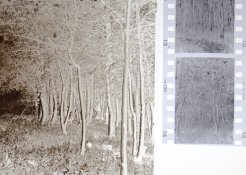
Attached is an image of two negatives on my lightbox.
I've adjusted this picture on my (calibrated) monitor to as close as I can manage to what I see with my naked eye.
Both negatives were exposed a few minutes apart in almost identical lighting.
On the right, a couple of frames of Acros at EI100 developed in D23 1:1 for 12 minutes. This is what I expect a "normal" negative to look like, at least in colour.
On the left, part of a 5x4 sheet of Arista OrthoLitho at EI1½ developed in D23 1:14 for ~10 minutes (developed by inspection). It however has this - to me - rather odd gold or bronzed appearance. I presume the colour is as a result of the size and/or shape of silver particles.
I haven't tried contacting it on normal paper, by the way, as this is part of a few tests towards producing 10x8s for Cyanotypes etc. Cyanotypes made with these "golden" negatives look OK to my unpractised eye.
I've got this effect on all the OrthoLitho I've tried in this developer at this dilution so far, at various EI from 3 to 0.375, fresh film, purchased this year
Fixing for longer or in absolutely fresh fixer or in absolutely fresh fixer for longer doesn't change the colour.
So, the question is, why the peculiar colour of the OrthoLitho?
Or is this "normal" for this film?
Or is it an artefact brought about by the highly dilute developer?
Or what?
No advice is being sought about what film and developer I "ought" to be using, by the way.
I've adjusted this picture on my (calibrated) monitor to as close as I can manage to what I see with my naked eye.
Both negatives were exposed a few minutes apart in almost identical lighting.
On the right, a couple of frames of Acros at EI100 developed in D23 1:1 for 12 minutes. This is what I expect a "normal" negative to look like, at least in colour.
On the left, part of a 5x4 sheet of Arista OrthoLitho at EI1½ developed in D23 1:14 for ~10 minutes (developed by inspection). It however has this - to me - rather odd gold or bronzed appearance. I presume the colour is as a result of the size and/or shape of silver particles.
I haven't tried contacting it on normal paper, by the way, as this is part of a few tests towards producing 10x8s for Cyanotypes etc. Cyanotypes made with these "golden" negatives look OK to my unpractised eye.
I've got this effect on all the OrthoLitho I've tried in this developer at this dilution so far, at various EI from 3 to 0.375, fresh film, purchased this year
Fixing for longer or in absolutely fresh fixer or in absolutely fresh fixer for longer doesn't change the colour.
So, the question is, why the peculiar colour of the OrthoLitho?
Or is this "normal" for this film?
Or is it an artefact brought about by the highly dilute developer?
Or what?
No advice is being sought about what film and developer I "ought" to be using, by the way.
Attachments
Last edited by a moderator:


