• Welcome to Photrio!
    Registration is fast and free. Join today to unlock search, see fewer ads, and access all forum features.
    Click here to sign up

Correct way to pronounce "nikon"?

Tompkins Square Park

A
Tompkins Square Park

  • 8
  • 0
  • 87
Siesta Time

A
Siesta Time

  • 2
  • 1
  • 66

Recent Classifieds

Forum statistics

Threads
202,861
Messages
2,846,718
Members
101,574
Latest member
JRSCollection
Recent bookmarks
0
So, I wonder why is it that folks don't make a similar big deal over the way we've changed the pronunciation of Canon, from 'kah-noan' to 'kyæ-none'. That funny looking ae symbol is called the 'a-e digraph' and is the sound found in the American pronunciation of the word 'graph' for example -- or 'flag', which I believe the Brits pronounce the same as we do. I think it can be argued that the way we Americans pronounce Canon is just as big of a difference as what we've done with Nikon. Not only did we change both vowels, but we added the palatal 'y' to boot.

Ah, but the thing about that one is that in Japanese, Canon is in fact キヤノン ("kyanon").
 
I don't think I hear that palatal-y in "Canon", unless I don't realize it.

Could you give an example of two words having the same consonant+vowel, but a palatial-y is present in one and not the other?

Theo, I guess I should have thought it through a bit further. In my idiolect, I tend to palatalize the first syllable in "Canon," although I can see how not everyone would. Like the word 'camp' I find that my pronunciation tends to be in free variation -- in other words, it can go either way, palatalized or not palatalized. Other words, like 'cat' for example, I almost always palatalize. This is probably more of a regional variance than anything else. I'm from Texas and I freely admit to having somewhat of an East Texas drawl when I speak, and I think you'll find that in other Southern regions, palatalization is very common.
 
Ah, but the thing about that one is that in Japanese, Canon is in fact キヤノン ("kyanon").

Ah, good call, Oren. I wasn't aware of this spelling. So that means that those who don't palatalize are mispronouncing. Interesting.
 
Ah, good call, Oren. I wasn't aware of this spelling. So that means that those who don't palatalize are mispronouncing. Interesting.

I don't have any documentation to support this, but I'd guess that in choosing a romanized name to use internationally, the company intentionally chose the simpler "Canon" on the assumption that it would be pronounced without the "y", and that that would be easier for most non-Japanese to get their mouths around, so to speak.
 
Since we're having fun thinking about the ways that things are different in Japan, I thought I'd toss in one of my favorites: Canon uses the brand "Rebel" for its low-end (D)SLR (and now mirrorless digital) cameras in the United States, but brands those same cameras "Kiss" in Japan. (This dates back to most film-era Rebels too.) There has to be an interesting comparative-culture story about why the company's marketing decision-makers have concluded that the exact same product is best marketed with a masculine theme and target customer in the US, and a feminine theme and target customer in Japan.
 
Ah, but the thing about that one is that in Japanese, Canon is in fact キヤノン ("kyanon").

In the 1930s it was a Kwanon camera. In maybe 1961 I saw one in a camera store with normal and telephoto lens for only $25, and was too dumb to grab it.
 
And Sakura is cherry blossom with the parent company being Konishiroku or Little West Six! :wink:

Etc. Japanese naming is similar to Native American naming in a sense, using names like High Bridge, Rolling Field, Forest Clearing and White Mountain Top.

PE
 
Which syllable is lengthened (stressed) in "asahi", as in Asahi Pentax?
 
Which syllable is lengthened (stressed) in "asahi", as in Asahi Pentax?

I've always known it as "a-sa'-hi", with the middle syllable emphasized but not lengthened (that is, it's not "a-saa'-hi").

EDIT: Although the Asahi Optical company name is/was usually written in kanji (旭光学), it's spelled out phonetically in kana as あさひこうがく, or "asahi koogaku", with a lengthened "koo" sound in "koogaku" but a normal length "sa" sound in "asahi".

To avoid confusion: in this case "oo" means a lengthened "oh" sound, not the long "u" sound that it would be in English.
 
Last edited:
I've always known it as "a-sa'-hi", with the middle syllable emphasized but not lengthened (that is, it's not "a-saa'-hi").
...

Thanks - that's how I thought it was pronounced even though I've heard guessed-at variations from non-Japanese speakers.

Another question: what is the meaning of the -cord suffix, as in Rolleicord, Autocord?
 
Another question: what is the meaning of the -cord suffix, as in Rolleicord, Autocord?

I've wondered about that too. A search just now turned up this - scroll down to patric_dahl_n's first post:

https://www.photo.net/discuss/threads/tlr-names-mat-flex-and-cord.284890/


The Rolleiflex name: "Roll" = rollfilm. "ei" =Heidecke. "flex" = reflex.

Rolleicord: "Roll" = rollfilm. "ei" = Heidecke. "cord" = Record.

Already the Rolleiflex Standard was called "Der Photo-Automat" in ads. An "Automat" is a machine that does something automatic, like an automatic weapon or vending machine.

The Rolleicord was marketed in 1933 as "Der Photo-Rekord". "Rekord" because the high quality, but still an affordable camera. "The peoples camera (Volkskamera), in the truest meaning of the word".
 
Since we're having fun thinking about the ways that things are different in Japan, I thought I'd toss in one of my favorites: Canon uses the brand "Rebel" for its low-end (D)SLR (and now mirrorless digital) cameras in the United States, but brands those same cameras "Kiss" in Japan. (This dates back to most film-era Rebels too.) There has to be an interesting comparative-culture story about why the company's marketing decision-makers have concluded that the exact same product is best marketed with a masculine theme and target customer in the US, and a feminine theme and target customer in Japan.

In Europe there just were EOS 123 ... models. What is this telling about Europe?.
 
Last edited:
"123" means Europeans are simpletons--they have to have something EASY to remember.
 
Which syllable is lengthened (stressed) in "asahi", as in Asahi Pentax?

If you're asking about how the Japanese pronounce this, the correct answer is there is no syllable stress. Japanese does not have syllable stress the way many Western languages do. In Japanese, sometimes stress is indicated by lengthening a syllable, but there is no syllable lengthening in a-sa-hi. So, a-'sa-hi is a Western pronunciation, but incorrect. So is 'mi-tsu-'bi-shi or ka-wa-'sa-ki. One thing I have noticed with the Japanese pronunciation of multisyllable words, such as Mitsubishi and Kawasaki and kamikaze, is a slight rise in pitch on the second syllable. But I don't hear a similar rise in pitch on three-syllable words, such as Asahi or Yamaha or Suzuki or sashimi. But I would hesitate to call this slight rise in pitch stress. It just seems to be more of a feature of multisyllabic words of four or more syllables.

I think it bears repeating an earlier comment I made in that, just because a syllable is geminated, this does not necessarily indicate stress. It's just the way it is. Take Tokyo or Kyoto or Osaka, for example. All three of these cities have geminated syllables. Tokyo: とうきょう, Kyoto: きょうと, Osaka: おおさか. Curiously, Osaka's gemination is a repetition of the お (/o/) character, instead of the more typical おう spelling. Perhaps this is because of the fact that it's a gemination of the pure vowel, rather than a consonant-vowel combination? I dunno.
 
...Osaka: おおさか. Curiously, Osaka's gemination is a repetition of the お (/o/) character, instead of the more typical おう spelling. Perhaps this is because of the fact that it's a gemination of the pure vowel, rather than a consonant-vowel combination? I dunno.

But of course Osaka is 大阪, so the おお comes from the 大, it's not specific to the rendering of Osaka.

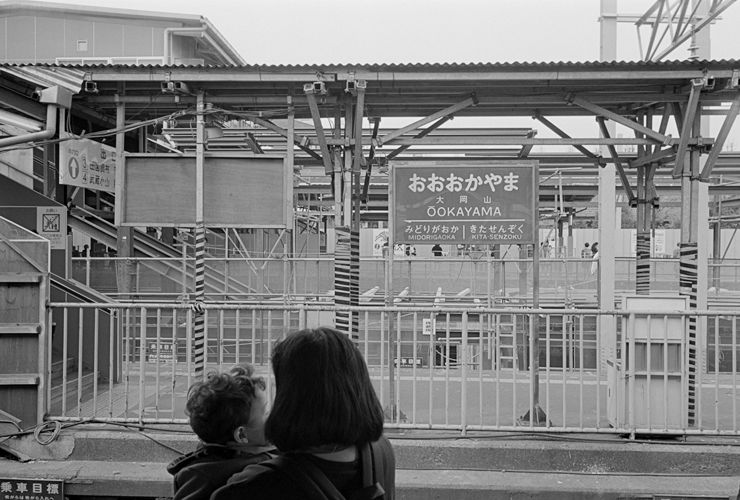
I remember doing a double-take at the Ookayama (大岡山) train station in Tokyo when I first noticed that in kana it starts with the triplet おおお.

EDIT: here's a snapshot from Ookayama station, showing the sign with the name rendered in hiragana.

JM4-2.18.28.jpg
 
Last edited:
At my camera dealer I always say "that thingy", whatever make and model.
Works fine...
 
I pronounce it "nick-on", as does everyone from the UK. Not completely true to the original Japanese pronunciation (which is closer to "knee-kon"), but it's a lot more faithful than the North American "nai-kon".
 
rhenisch: "Dat Dingens"

(High German: "Das Ding")


EDIT
Ron (remark below) is right. Above is still colloquial... True High German indicating "that" would be "Dieses Ding".

If in doubt as native speaker on grammar, ask the non-native speaker: He knows.
 
Last edited:
Essentially all modern, mass-produced Japanese cameras are branded in romaji, even when intended for the domestic market. Romaji is used so extensively in Japan that I think one could argue that it's the fourth character set, along with kanji, hiragana and katakana. Sure, it's used only in very specific ways, but that's true of, say, katakana as well.

I've always considered romanji the fourth alphabet in Japan - it's used so extensively here. When I first moved here I was overwhelmed (and still am, to be honest) about ever being able to read anything, since virtually everything (posters, menus, ads, etc) will have a combination of at least 2, but sometimes all 4, alphabets.
 
I have a copy of several Japanese stories (Momotaro being one) and they are in Japanese script, romaji Japanese and in English. The first is a combination of Kanji and Kana of course.

Yes, I know what you mean.

PE
 
Photrio.com contains affiliate links to products. We may receive a commission for purchases made through these links.
To read our full affiliate disclosure statement please click Here.

PHOTRIO PARTNERS EQUALLY FUNDING OUR COMMUNITY:


Ilford ADOX Freestyle Photographic Stearman Press Weldon Color Lab Blue Moon Camera & Machine
Top Bottom