
• Welcome to Photrio!
    Registration is fast and free. Join today to unlock search, see fewer ads, and access all forum features.
    Click here to sign up

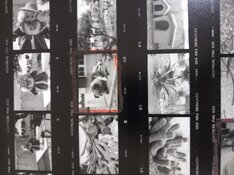
Contact sheets have a "maximum" black inconsinstencies throughout the same 35mm roll:

Autumn

D
Autumn

  • 0
  • 0
  • 8
Sol Infinitus

A
Sol Infinitus

  • 5
  • 0
  • 31

Recent Classifieds

Forum statistics

Threads
203,390
Messages
2,853,900
Members
101,815
Latest member
DorianG
Recent bookmarks
0

Rorystreet91

Member
Allowing Ads
Joined
Dec 26, 2025
Messages
6
Location
Italy
Format
35mm
When making a contact sheet, I aim for maximum black using a strip of negative, but often when exposing the whole roll, the exposure time to get the rebate black is not the same for all 6 strips of cut negative.

The ones that are done using my test strip are matching, but others are more exposed or less exposed.

In these cases, do you dodge and burn the entire strip sections that are not equally exposed?

What is the cause of these exposure inconstancies?
 
Maybe uneven light source, contact sheet frame not placed centrally under the light source, not developing the paper to completion, or other things that can lead to inconsistency are too short an exposure time. It is strange if it's only the black rebate that is inconsistent and not the images themselves.
 
@Rorystreet91 is the problem:
1: That the film base is black on some strips of the full contact sheet, but not on other film strips on the same contact sheet?
2: That the exposure time you determined using one or two strips of film does not match the exposure time you need to get the same level of black for the film base for the full contact sheet?
It's not entirely clear which of these is your issue, but I assume/believe it's #2. Assuming that, three potential issues come to mind. The first is that something has changed in the setup between the test strip exposures and the full sheet exposure; e.g. a different contact printing frame or different distance between lens/light source and print. The second is that consecutive, but separate exposures (e.g. 3 exposures of 1 second each) do not necessarily yield the same overall exposure as a single exposure of the same total duration (e.g. 1 exposure of 3 seconds). A third possible factor is simply density differences in the film itself; e.g. due to trying to contact print strips from separate rolls that were developed separately and that might even have been different types of film.

It would help greatly if you could describe in detail what exactly you are doing to get more clarity on the nature of the problem.
Also, pictures would help a lot.
 
  • MARTIE
  • Deleted
  • Reason: Misunderstanding
@Rorystreet91 is the problem:
1: That the film base is black on some strips of the full contact sheet, but not on other film strips on the same contact sheet?
2: That the exposure time you determined using one or two strips of film does not match the exposure time you need to get the same level of black for the film base for the full contact sheet?
It's not entirely clear which of these is your issue, but I assume/believe it's #2. Assuming that, three potential issues come to mind. The first is that something has changed in the setup between the test strip exposures and the full sheet exposure; e.g. a different contact printing frame or different distance between lens/light source and print. The second is that consecutive, but separate exposures (e.g. 3 exposures of 1 second each) do not necessarily yield the same overall exposure as a single exposure of the same total duration (e.g. 1 exposure of 3 seconds). A third possible factor is simply density differences in the film itself; e.g. due to trying to contact print strips from separate rolls that were developed separately and that might even have been different types of film.

It would help greatly if you could describe in detail what exactly you are doing to get more clarity on the nature of the problem.
Also, pictures would help a lot.

@Rorystreet91 is the problem:
1: That the film base is black on some strips of the full contact sheet, but not on other film strips on the same contact sheet?
2: That the exposure time you determined using one or two strips of film does not match the exposure time you need to get the same level of black for the film base for the full contact sheet?
It's not entirely clear which of these is your issue, but I assume/believe it's #2. Assuming that, three potential issues come to mind. The first is that something has changed in the setup between the test strip exposures and the full sheet exposure; e.g. a different contact printing frame or different distance between lens/light source and print. The second is that consecutive, but separate exposures (e.g. 3 exposures of 1 second each) do not necessarily yield the same overall exposure as a single exposure of the same total duration (e.g. 1 exposure of 3 seconds). A third possible factor is simply density differences in the film itself; e.g. due to trying to contact print strips from separate rolls that were developed separately and that might even have been different types of film.

It would help greatly if you could describe in detail what exactly you are doing to get more clarity on the nature of the problem.
Also, pictures would help a lot.
As you can see the bottom rebate are less exposed.
Maybe I should try to raise the enalarger more so it cover all the baseboard size? Lens is stopped 3 stop...
Of course they are from the same roll and I put a glass on them.
 

Attachments

  • 20260307_125501 (1).jpg
    20260307_125501 (1).jpg
    1.1 MB · Views: 63
Last edited:
I don't really see it, sorry. If you have uneven illumination, then try:
* Raising the enlarger head to project a larger image circle
* Use the focus adjustment to move the lens further away from the light source, which increases coverage
* Stop down 2 stops from wide open on the enlarger lens.
 
I don't really see it, sorry. If you have uneven illumination, then try:
* Raising the enlarger head to project a larger image circle
* Use the focus adjustment to move the lens further away from the light source, which increases coverage
* Stop down 2 stops from wide open on the enlarger lens.

If you look in the first negative strip, the sprocket holes are barely visible from the black of the film rebate, while in the last two of the roll, they are visible (so with less exposure).
I will try to raise the head much more and adjust focus to see if the exposure became consistent across all the strips of the contact.
Thanks!
 
If you use a 50mm enlarging lens to make your contact sheet, make sure the negative holder is in there. That's insurance against light drop-off.
 
All the points above about uneven light are the most likely source for the problem.
I'll just add one question: Are you developing the contact proof print for a sufficiently long time?
More than necessary exposure, plus less than ideal development tends to lead to inconsistency.
 
Photrio.com contains affiliate links to products. We may receive a commission for purchases made through these links.
To read our full affiliate disclosure statement please click Here.

PHOTRIO PARTNERS EQUALLY FUNDING OUR COMMUNITY:


Ilford ADOX Freestyle Photographic Stearman Press Weldon Color Lab Blue Moon Camera & Machine
Top Bottom