• Welcome to Photrio!
    Registration is fast and free. Join today to unlock search, see fewer ads, and access all forum features.
    Click here to sign up

Colour Head Enlarger for B&W Printing

Coburg Street

A
Coburg Street

  • 0
  • 1
  • 39
Jesus

A
Jesus

  • 0
  • 1
  • 41

Recent Classifieds

Forum statistics

Threads
201,731
Messages
2,829,298
Members
100,918
Latest member
PentaconSix
Recent bookmarks
0

mr rusty

Member
Joined
Sep 7, 2009
Messages
827
Location
lancashire,
Format
Medium Format
You are worrying too much. Use the filter settings Ilford give. They will most likely be just fine. Nothing to stop you using under-lens filters with a colour head anyway instead of the built-in filters - just zero the filters or move them out of the path if there is a switch/lever to do this. Or, your enlarger most likely also has a filter drawer where you can use above-lens filters.

Even if exposure time does get altered between grades using the colour head filters, once you have set the grade you want to use, you can always run a test strip to fine-tune exact exposure.

After a bit of experience, you will soon get used to your own rig. If you consistently find that using a particular grade on a particular setting always causes under/over exposure, either increase/decrease the magenta & yellow equally to tweak the grade setting appropriately (increasing both filters will increase exposure time) or make a manual exposure time adjustment to compensate. Sounds complicated, but once you have got the "feel", it will come much easier as you will already have expectations of what the results should be based on experience.
 

grahamp

Subscriber
Allowing Ads
Joined
Mar 2, 2004
Messages
1,771
Location
Vallejo (SF Bay Area)
Format
Multi Format
Source? Supporting Data?

My Beseler heads use Kodak units. None of the published tables for constant exposure will go above grade 4.5, and the filter settings on the heads don't go any higher. For one example, see Way beyond Monochrome, Lambrecht, R. and Woodhouse, C. 2003. Page 72.
 

miha

Member
Allowing Ads
Joined
Feb 15, 2007
Messages
3,032
Location
Slovenia
Format
Multi Format
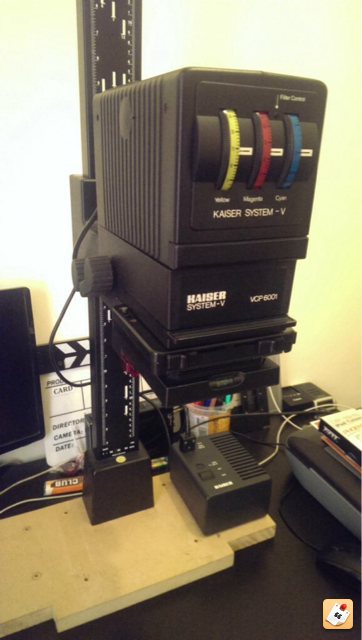
7ydu8edy.jpg


Here she is :smile:


I'm running with both hands...

My enlarger is pretty much the same. It works a treat with Ilford and other VC papers!
 
OP
OP
jaydebruyne

jaydebruyne

Member
Allowing Ads
Joined
Dec 8, 2013
Messages
150
Location
London, UK
Format
35mm
My enlarger is pretty much the same. It works a treat with Ilford and other VC papers!

Fantastic! I just sold one of my smartphones so I could buy the rest of my darkroom equipment :smile: can't wait to start printing!
 

L Gebhardt

Member
Joined
Jun 27, 2003
Messages
2,364
Location
NH
Format
Large Format
You will be fine with the color head for VC paper. You do not need to know the exact grade you are printing on, only whether it's the correct grade. If it's not correct (to your eyes) you need to add or subtract contrast and doing that is very easy with a color head. Every type of enlarger will require you to adjust the exposure after adjusting the contrast to get an optimal print (despite claims to the contrary) since only one tone at the most will stay the same, so needing to do this for a color enlarger isn't really an issue.

To start with I would try to develop film so you get negatives that print perfectly with neither yellow nor magenta filtering. This is about grade 2 for most papers with most light sources. Then you can add a bit of yellow or magenta filtration to get the contrast right. You will quickly learn how much to add of what with a bit of experience. Don't over complicate things at first.
 

RalphLambrecht

Subscriber
Allowing Ads
Joined
Sep 19, 2003
Messages
14,916
Location
K,Germany
Format
Medium Format
I exclusively use color heads for B&Wenlarging and find them to be ideal for that work .they make it easy to fine-tune contrast,which I often do to 1/8 of a gradeafter which I cannot see a difference anymore. I suggest you calibrate your filter settings to ISO gradesand you will enjoy your new enlarger.:munch:
 
OP
OP
jaydebruyne

jaydebruyne

Member
Allowing Ads
Joined
Dec 8, 2013
Messages
150
Location
London, UK
Format
35mm
I've just read the Ilford data sheet on contrast control and the settings to use for various contrast effects. One thing I don't understand is this:

It gives values for single or dual colour filter settings. Is this for heads which only have one, two (or three) colour filters? Does using dual filters have a benefit over using a single filter?

My enlarger has Y, M & C filters.

Cheers
Jay
 
Last edited by a moderator:

Rafal Lukawiecki

Member
Allowing Ads
Joined
Feb 23, 2006
Messages
789
Location
Wicklow, Ireland
Format
Multi Format
The dual approach should, in theory, let you keep the exposure as you change the grades. This is related to the concept of "speed matching," that some VC heads, and filter kits, aim to deliver. The idea is that as you change the contrast, the highlights become whiter, the shadows blacker, but a certain mid-tone (0.60 to be precise) ought to print the same. The single filter setting, however, requires that you adjust the exposure each time you changed the contrast.

In reality, you would need to adjust the exposure in a speed-matched system too, if you wished to keep the highlights from changing as you changed the contrast, however, in a speed-matched system, that exposure change is relatively easy to predict, as it tends to be uniform for each grade step. On the other hand, when using the other, single-filter approach, you could prepare a table of necessary exposure adjustments and refer to it later. This is described in Way Beyond Monochrome 2.

The advantage of using a single setting would, usually, be a faster printing time, and, sometimes, an ability to get a more extreme contrast.
 
Last edited by a moderator:
OP
OP
jaydebruyne

jaydebruyne

Member
Allowing Ads
Joined
Dec 8, 2013
Messages
150
Location
London, UK
Format
35mm
Thanks Rafal.

I'm currently going through Les McLeans book with a list as long as my arm to read afterwards. Unfortunately questions crop up which I haven't covered yet in the books :wink: but thanks for the reference, I'll append the title!

Jay
 

Rafal Lukawiecki

Member
Allowing Ads
Joined
Feb 23, 2006
Messages
789
Location
Wicklow, Ireland
Format
Multi Format
You're welcome, and keep asking questions. Les's book is very good, too. Way Beyond Monochrome 2nd Ed, by the way, was written by no other than the very Ralph Lambrecht, who happened to be posting on this thread, earlier. It is quite an encyclopaedia of current-state B&W knowledge.
 

Mainecoonmaniac

Member
Allowing Ads
Joined
Dec 10, 2009
Messages
6,297
Format
Multi Format
I use a Beseler Dichro 45S for over 30 years and it works great. I've used under the lens filters and they work fine, but if they get dirty or scratched, it might degrade your image.
 

Rolfe Tessem

Subscriber
Allowing Ads
Joined
Jan 16, 2006
Messages
251
Location
Egremont, MA
Format
Multi Format
As others have stated, the problem is that the exposure does not stay constant as you change paper grades. If you can live with that, then there is no disadvantage. When I was using a color head, I found that for a given job I really didn't change grades so it was no big deal. But if you're jumping around from one very dissimilar negative to another, it could get very annoying.
 

Nige

Member
Allowing Ads
Joined
Sep 8, 2002
Messages
2,327
Format
Multi Format
I started with Ilford filters (used in a 2 colour head durst enlarger) and there is some merit in them. Grades 0-3.5 (?.. my memory is fading!) are 'constant' exposure, then you double it for the g4-5 ones. Nice and simple in theory. However, in practice, changing the grade changes the contrast and therefore the 'balance' of the image. Sometimes that alters your exposure as you decide that you want the whole picture lighter or darker. The same thing happens when you make a different sized enlargement, you decide different contrast is required and the overall balance of your image changes again, and you're back on the merry-go-round that printing is.

Currently I print 4x5's using a VC head, and 35mm & 645 with a colour head using single filter adjustments (99% magenta, hardly ever have to use yellow). Whichever one I'm using, I vary my process to suit but it still resolves around making test strips, or test sections (test just a small section of the image, say the highlight only with a 4x5 or smaller piece of paper using just the single expose I want) which I tend to mostly use to zero in on what I want.
 

cwkphoto

Member
Allowing Ads
Joined
Apr 12, 2018
Messages
1
Location
Margate City, NJ
Format
Medium Format
The quote that a colour head is the worst thing for B&W printing is just a load of old tosh and I suggest the author has little of no experience of using them. By using the dichroic filters in the colour head you are not detracting from the quality of a below-the-lens filter which can get easily get marked.

The only word of warning about a colour head is if you use split grade printing as I do, the enlarger must be totally rigid so when you alter the filtration values between steps, the head does not move.

I'm just about to start using the dichroic filters on my Beseler 23cXL - and I have the latest chart for dual color filter settings from Ilford. But I'm confused on how to do split grade. Any tips/help would be appreciated. Thanks!
 

pentaxuser

Member
Joined
May 9, 2005
Messages
20,332
Location
Daventry, No
Format
35mm
I'm just about to start using the dichroic filters on my Beseler 23cXL - and I have the latest chart for dual color filter settings from Ilford. But I'm confused on how to do split grade. Any tips/help would be appreciated. Thanks!
Here it is in a nutshell. Use the max M then the max Y so you are exposing with the most and then the least contrast setting corresponding to grade 5 and grade 00 respectively

if you need to know more then it will help us if you tell us what you already know about split grade printing. Otherwise we end up wasting your time and ours in telling you what you already know and possibly not telling you what you need to know

Worth reading Les McLean's article on his website. Just Google his name

pentaxuser
 

markbau

Member
Allowing Ads
Joined
Apr 16, 2009
Messages
869
Location
Australia
Format
Analog
I'm just about to start using the dichroic filters on my Beseler 23cXL - and I have the latest chart for dual color filter settings from Ilford. But I'm confused on how to do split grade. Any tips/help would be appreciated. Thanks!

The Ilford settings are very good, use them. They keep the exposure constant when changing grades which is a huge time saver in the darkroom.
Split grade printing is really a religion. It's adherents claim that it produces prints unobtainable by any other means which is a lot of rubbish. It's one true claim is that you can get a contrast grade between filters, meaning that using an Ilford grade 2 filter might result in a print that is a bit soft but using an Ilford grade 2 1/2 filter it's a bit too contrasty. Believe me, you will encounter very few negs in your life that need a setting between the filters, and anyhow, if you have a colour head you can get infinite grades. Forget about split grade hocus pocus and just use the Ilford filters or the colour head using the Ilford settings to get constant exposure.
 

Luis-F-S

Member
Allowing Ads
Joined
Sep 19, 2013
Messages
774
Location
Madisonville
Format
8x10 Format
The Ilford settings are very good, use them. They keep the exposure constant when changing grades which is a huge time saver in the darkroom.
Forget about split grade hocus pocus and just use the Ilford filters or the colour head using the Ilford settings to get constant exposure.
Some enlarger manufacturers like LPL (and others) produced variable contrast constant exposure (VCCE) heads exclusively for B&W use. They are a joy to use since the exposure remains constant as you change grades. Other manufacturers like DeVere largely sold Dichroic color heads which could be used for color and B&W. They made dedicated VCCE heads for their 4x5 enlargers but did not make them for their 8x10 (5108 enlargers). These were heavy duty professional enlargers sold largely for commercial printing at photolabs whose majority of work was color. When they needed B&W, they used the same dichroic head and used filter factors. The Cyan filter is used if the light source is too bright, you can dial in equal amounts of Cyan, Magenta and Yellow to decrease the exposure. A setting of 0.3 CMY will decrease the light level by one stop. So, if your Gr3 setting is 23Y and 56M and you wanted to decrease the light output by 1 stop, you would dial in, 30C, 53Y and 86M. Use the ilford settings when printing B&W. If you find that most of your negatives require a Gr 5 filter, you might want to look at your negatives and change either the exposure or development times to give you a negative that prints closer to Grade 2.
 
Last edited:

markbau

Member
Allowing Ads
Joined
Apr 16, 2009
Messages
869
Location
Australia
Format
Analog
Some enlarger manufacturers like LPL (and others) produced variable contrast constant exposure (VCCE) heads exclusively for B&W use. They are a joy to use since the exposure remains constant as you change grades. Other manufacturers like DeVere largely sold Dichroic color heads which could be used for color and B&W. They made dedicated VCCE heads for their 4x5 enlargers but did not make them for their 8x10 (5108 enlargers). Use the ilford settings when printing B&W. If you find that most of your negatives require a Gr 5 filter, you might want to look at your negatives and change either the exposure or development times to give you a negative that prints closer to Grade 2.
For a long time I wanted a VCCE head for my LPL 4x5. I had one many years ago and loved it but "lost it in the divorce" :smile: About 4 years ago I started using Ilford below the lens filters and have been extremely happy with them. If an LPL VCCE module fell out of the sky I would use it but the Ilford filters, below the lens, are just as good!

If someones negs routinely needed grade 5 I think they would seriously need to look at their film development as it would mean their film is being way underdeveloped. A decent neg of a "normal scene" should print well on G2-3.
 

Luis-F-S

Member
Allowing Ads
Joined
Sep 19, 2013
Messages
774
Location
Madisonville
Format
8x10 Format

voceumana

Member
Allowing Ads
Joined
Aug 4, 2004
Messages
896
Location
USA (Utah)
Format
Multi Format
Look at the photographs in Bartlett's book, especially the proof images versus the finished products. I find them overworked and prefer a more subtle look to my images. I am not looking for the kind of images I see on tabloid magazines. I suggest this because I believe you should evaluate anyone's suggestions based on their work product and what you think of that work.

A VCCE enlarger head is easier to use for B&W printing, but a color head will work just fine. It takes a little longer to dial in 2 or 3 filter colors than moving just 1 dial, but I can spare that time--you probably can, too. When printing B&W with a color head, I don't worry about grade, I just am concerned with do I need more or less contrast, and adjust filters appropriately. To get the highest contrast grade you may need to use a separate filter depending upon how high your magenta setting goes, but you can always use a separate filter below the lens for that.

But, if you often need the highest contrast, maybe you are grossly under developing your negatives?

Great photographer have used condensor enlargers. Great photographers have used diffusion enlargers. Great photographers have used cold light. Great photographers have used color heads Great photographers have used VCCE heads.--Use what you have; though I have not used the Kaiser system, it has a good reputation for being a fine enlarger.

In short, use what you have and you'll get good results if you learn how to use it
 

MattKing

Moderator
Moderator
Allowing Ads
Joined
Apr 24, 2005
Messages
55,110
Location
Delta, BC Canada
Format
Medium Format
I use split grade printing a lot, but I rarely use it exclusively.
The part I use a lot is the ability to adjust the contrast in different ways on different parts of the print.
I usually do that by burning different parts of the image with different contrast settings.
Typically I will arrive at one overall contrast setting for the majority of the image - which may also include some dodging - and then add both low and high contrast burns where desired.
Sometimes the easiest way to get there is to mix very low contrast and very high contrast exposures, so I'm happy to do that. More often though my "main" exposure is at something like grade 2.5.
 

jgboothe

Member
Allowing Ads
Joined
May 22, 2010
Messages
41
Format
Medium Format
I used a Kaiser VCP6000 with dichroic colour head for many years for black and white VC printing. It's almost the same as yours. I found it to be an excellent enlarger for this job. I found I never needed additional filters, but if you do, you have an above-lens filter drawer. You can get a copy stand attachment for it if you ever want to do any copy work or film 'scanning' with your DSLR. I have this attachment and use it in copy stand mode at the moment, but if I ever get my darkroom set up again, it will probably do service as an enlarger once more. Happy printing!
 
Photrio.com contains affiliate links to products. We may receive a commission for purchases made through these links.
To read our full affiliate disclosure statement please click Here.

PHOTRIO PARTNERS EQUALLY FUNDING OUR COMMUNITY:


Ilford ADOX Freestyle Photographic Stearman Press Weldon Color Lab Blue Moon Camera & Machine
Top Bottom