• Welcome to Photrio!
    Registration is fast and free. Join today to unlock search, see fewer ads, and access all forum features.
    Click here to sign up

Colour Head Enlarger for B&W Printing

Coburg Street

A
Coburg Street

  • 0
  • 1
  • 39
Jesus

A
Jesus

  • 0
  • 1
  • 41

Recent Classifieds

Forum statistics

Threads
201,731
Messages
2,829,296
Members
100,917
Latest member
spookyphoto
Recent bookmarks
1

jaydebruyne

Member
Allowing Ads
Joined
Dec 8, 2013
Messages
150
Location
London, UK
Format
35mm
I've just bought a Kaiser VCP6001 colour enlarger. I've also just started reading Larry Bartlett's book on B&W printing which states that colour enlargers are the worst thing to use for B&W printing. (I should have read it before I bought the enlarger *slaps head*)

Does anyone else use a colour enlarger for B&W printing and what are your opinions? (Btw, I'm a complete novice in the darkroom and I'm still getting my darkroom set up to do my first prints).

I like quite contrasty images and intend to use variable contrast paper so I'd quite like the full 0-5 range. In the manual for the enlarger it gives settings for the yellow and magenta colour wheels to achieve grades 0-4.5. Does half a grade make a noticeable difference?

The book also states that colour enlargers are fine if you set the light to white and use a below the lens filter system. Is this necessary? Is the filter system which is part of the head OK or not?

Cheers
Jay


I'm running with both hands...
 

Bob Marvin

Member
Allowing Ads
Joined
Sep 7, 2002
Messages
114
Location
Brooklyn, NY
Format
Medium Format
I don't use a color head enlarger, but they're widely used for B&W printing with variable contrast paper. Beware of any technical books that are so prescriptive.
 

jernejk

Member
Allowing Ads
Joined
Jul 5, 2010
Messages
213
Format
35mm
What's the author's reasoning against color head for B&W?
I've used multigrade filters in the past and color head is just so much simpler, plus you can pin-pint the grade as you have all the steps between "standard" grades.
 

BMbikerider

Member
Allowing Ads
Joined
Jul 24, 2012
Messages
3,038
Location
UK
Format
35mm
The quote that a colour head is the worst thing for B&W printing is just a load of old tosh and I suggest the author has little of no experience of using them. By using the dichroic filters in the colour head you are not detracting from the quality of a below-the-lens filter which can get easily get marked.

The only word of warning about a colour head is if you use split grade printing as I do, the enlarger must be totally rigid so when you alter the filtration values between steps, the head does not move.
 

Kawaiithulhu

Member
Allowing Ads
Joined
Sep 20, 2013
Messages
549
Location
Southern Cal
Format
Multi Format
The only problem with color heads is that exposure time is different for each paper grade you dial in, regular filters have a neutral density built into them to keep exposure from changing with different grades. This may be the source of the author's hatred of color heads, or it could be that the author prefers condensers and most color heads are inherently diffuse.

Once you work around the exposure change then there is little to no difference that I've ever read about.
 

snapguy

Member
Allowing Ads
Joined
Jan 1, 2014
Messages
1,287
Location
California d
Format
35mm
If you like a lot of contrast, variable contrast printing paper may not be enough. I don't know if single grade paper is still available in 4 and 5 grades. Ilford, I think, made a grade 6 at one time. Single grade 4 is more contrasty than most anything you will get in a variable grade paper. It is misleading. Some variable grade filters are numbered 1 through 5 and others 1 through 10 but my experience is that you really can't get much more contrasty than grade 3.5 with variable contrast paper.
 
OP
OP
jaydebruyne

jaydebruyne

Member
Allowing Ads
Joined
Dec 8, 2013
Messages
150
Location
London, UK
Format
35mm
What's the author's reasoning against color head for B&W?
He says as there is no direct read out of the grades and the brightness of illumination varies with changing filtration. He goes on to say that a third colour filter is needed to balance the brightness across the range if grades but in doing so decreases the brightness and increases exposure times for common middle grades. Also that colour enlargers lack the full range of grades to obtain the highest contrast grade on variable contrast papers. He ends in saying it's a definite compromise when it comes to B&W work.


I'm running with both hands...
 

jernejk

Member
Allowing Ads
Joined
Jul 5, 2010
Messages
213
Format
35mm
Some variable grade filters are numbered 1 through 5 and others 1 through 10 but my experience is that you really can't get much more contrasty than grade 3.5 with variable contrast paper.

I guess the contrast you get also depends on the color temperature of your lightbulb. In general Multigrade has been designed to work with tungsten bulbs. If you use colder light source, apparently you should add some yellow to begin with, according to Ilford: http://www.ilfordphoto.com/Webfiles/2010628932591755.pdf

Any chance you had a non-standard bulb?

I wonder if modern replacement bulbs still have the same technical characteristics as the older bulbs, specifically in spectrum and color temperature. The problem with color temperature is that it's poorly defined and to my knowledge the same temperature could mean different spectral distribution, which could be a problem with multigrade. Anyway, I've changed my light source to a LED lamp not thinking about the consequences, and so far I'm happy with the change - but of course, the published filtration for my head is off.
 
OP
OP
jaydebruyne

jaydebruyne

Member
Allowing Ads
Joined
Dec 8, 2013
Messages
150
Location
London, UK
Format
35mm
The colour head filters are fine, look on Ilfords website and they list the filtration needed.

IAn

Will do, cheers Ian!

So is Ilford good variable contrast paper for someone learning the craft? I've read that resin coated paper is the easiest to work with as it is easier to process and wash/dry, and shows a better gloss finish when air dried.


I'm running with both hands...
 

jernejk

Member
Allowing Ads
Joined
Jul 5, 2010
Messages
213
Format
35mm
He says as there is no direct read out of the grades and the brightness of illumination varies with changing filtration.

True

He goes on to say that a third colour filter is needed to balance the brightness across the range if grades but in doing so decreases the brightness and increases exposure times for common middle grades.

In "Way Beyond Monochrome", they recommend to mix Y and M in a way which gives a constant exposure. The only issue is, you'd need to calibrate your enlarger for contrast grades with mixing... The book describes how to do it, but it requires some equipment which I don't have :-(

Also that colour enlargers lack the full range of grades to obtain the highest contrast grade on variable contrast papers. He ends in saying it's a definite compromise when it comes to B&W work.

How often do you expect to use it though?

Don't worry too much and enjoy ;-)
 

grahamp

Subscriber
Allowing Ads
Joined
Mar 2, 2004
Messages
1,771
Location
Vallejo (SF Bay Area)
Format
Multi Format
Colour heads are, almost by definition, diffusion light sources. They need a mixing box to blend the colours. That will count against them for some people [can we have the inevitable debate about condenser vs. diffusion in another thread? :cool:].

Generally they do not have enough colour density to make a reliable Grade 5 filter - so use a physical filter.

On the other hand you could calibrate to quarter grades if you wanted to...and it pays to verify the values you dial in make sense on your particular colour head. There are tables of yellow/magenta to grade equivalents available, you just have to know if your head uses Kodak or Durst units, and whether you want to have variable or standardized exposure times.

Bartlett was pretty dogmatic about the methods that worked for him - he was a commercial printer and successful. I'm not really sold on that style myself, but the book made a decent read. He died in 1995.
 

jernejk

Member
Allowing Ads
Joined
Jul 5, 2010
Messages
213
Format
35mm
Will do, cheers Ian!

So is Ilford good variable contrast paper for someone learning the craft? I've read that resin coated paper is the easiest to work with as it is easier to process and wash/dry, and shows a better gloss finish when air dried.


I'm running with both hands...

Ilford has RC as well. At the beginning, you'll be wasting lot's of paper, so definitely go with RC!
 
OP
OP
jaydebruyne

jaydebruyne

Member
Allowing Ads
Joined
Dec 8, 2013
Messages
150
Location
London, UK
Format
35mm
Colour heads are, almost by definition, diffusion light sources.
I'm a bit lost here and maybe getting into stuff I don't need to know yet? :/ I thought my enlarger was a condenser, at least it's what the manual says.

Generally they do not have enough colour density to make a reliable Grade 5 filter - so use a physical filter.
I can't find a Kaiser filter unit, are there universal filter holders available?

...you just have to know if your head uses Kodak or Durst units, and whether you want to have variable or standardized exposure times.
I've read the manual from front to back and it doesn't give me this info anywhere. Will google it to see if I can find out.

Also, my colour head has three colour filters: Cyan, Magenta and Yellow. Does this have any benefit over dual colour heads for B&W printing? And if so, what?

Thanks Grahamp.
Jay
 

ic-racer

Member
Joined
Feb 25, 2007
Messages
16,719
Location
USA
Format
Multi Format
I'm a bit lost here and maybe getting into stuff I don't need to know yet? :/ I thought my enlarger was a condenser, ...

Also, my colour head has three colour filters: Cyan, Magenta and Yellow. Does this have any benefit over dual colour heads for B&W printing? And if so, what?

Thanks Grahamp.
Jay

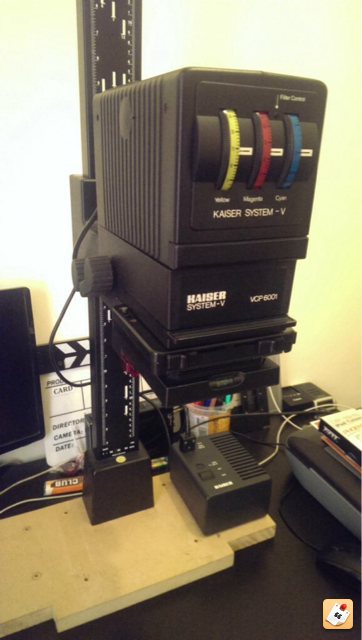
If you can post a picture of your enlarger it can be identified.
It probably is a diffusion color head with dichroic filters and quartz halogen lamp if it is the model with 3 color filters.
For B&W printing on Ilford MG paper use Magenta and Yellow filters. There is a cool trick where if you dial in equal amounts of Yellow and Magenta the paper sees this as neutral density. Using that trick you can make a table of filter values that keep your base print exposure relatively constant as you change contrast.
 

ic-racer

Member
Joined
Feb 25, 2007
Messages
16,719
Location
USA
Format
Multi Format
my experience is that you really can't get much more contrasty than grade 3.5 with variable contrast paper.

Speak for yourself; I think you mean to say "my experience is that I really can't get much more contrasty than grade 3.5 with variable contrast paper [with my equipment and technique]."
 
OP
OP
jaydebruyne

jaydebruyne

Member
Allowing Ads
Joined
Dec 8, 2013
Messages
150
Location
London, UK
Format
35mm
If you can post a picture of your enlarger it can be identified.
It probably is a diffusion color head with dichroic filters and quartz halogen lamp if it is the model with 3 color filters.
For B&W printing on Ilford MG paper use Magenta and Yellow filters. There is a cool trick where if you dial in equal amounts of Yellow and Magenta the paper sees this as neutral density. Using that trick you can make a table of filter values that keep your base print exposure relatively constant as you change contrast.

7ydu8edy.jpg


Here she is :smile:


I'm running with both hands...
 
OP
OP
jaydebruyne

jaydebruyne

Member
Allowing Ads
Joined
Dec 8, 2013
Messages
150
Location
London, UK
Format
35mm
Oh, ignore the baseboard, I'm cutting myself a new one tomorrow :wink:


I'm running with both hands...
 

bdial

Subscriber
Joined
Jan 2, 2005
Messages
7,514
Location
North East U.S.
Format
Multi Format
Ilford's data sheets have a table for Y and M settings that give you equivalent exposure from grade 1 to 3 1/2 or so.
 

MattKing

Moderator
Moderator
Allowing Ads
Joined
Apr 24, 2005
Messages
55,110
Location
Delta, BC Canada
Format
Medium Format
Most likely, your enlarger will work very well with Ilford RC variable contrast paper.

This Ilford data sheet indicates that you should use Durst numbers for your Kaiser colour head: http://www.ilfordphoto.com/Webfiles/2010628932591755.pdf

That link has lots of useful info for you.

But more importantly, you need a bit of perspective, which is a bit hard for a beginner to come by.

Mr. Bartlett's approach makes sense in some ways, but not for everyone.

If you ignore fixed contrast grades, and just use the tables (the two-filter ones) in the link to get a sense of what sort of adjustments are necessary to make meaningful changes, your colour head will serve you very well. As a beginner, you are going to need to redo test strips anyways when you make significant contrast changes.

When you use the two-filter tables, you should understand that they are speed matched for a particular gray - usually a mid gray. Unless that gray happens to be the gray you are most interested in in your print, you will probably have to adjust your exposure a little bit anyways when you change the contrast.

I would advise you to expect to have to make adjustments - just go into this with a mindset expecting that, and an intention to learn from the process. Keeping examples with notes attached will help you a lot.

If you work at this a bit, you will be amazed at how much you will learn in a relatively short period of time. And you will certainly have fun in the process!

In response to two other points:

1) you may get slightly more contrast from a separate #5 filter, but the maximum contrast you will get from the colour head will be close, and most likely more than enough;
2) your enlarger with a condenser head is a condenser enlarger. Once you put on a colour head, it becomes a diffusion enlarger, because the colour heads are diffusion light sources;
3) the extra (cyan) colour filter in the colour head is rarely of use when printing black and white, but it doesn't hurt to have it. It also allows for future colour printing, and mifght be useful if you ever try to print colour negatives on discontinued Panalure paper. A two colour, variable contrast for black and white is simpler in some ways, and might be able to reach slightly higher contrast, but the choice is probably only relevant if you were buying new ($$$$$$$) and choosing from the options available to someone paying full, new equipment processes.

Hope this helps.

EDIT: also, do you realize that two versions of your "running with both hands" phrase show in almost all of your posts - both in the body and in the signature area?
 
Last edited by a moderator:
OP
OP
jaydebruyne

jaydebruyne

Member
Allowing Ads
Joined
Dec 8, 2013
Messages
150
Location
London, UK
Format
35mm
Most likely, your enlarger will work very well with Ilford RC variable contrast paper.
I was looking at the multigrade IV RC paper, a good starting point?

Hope this helps.
Oh yes, thank you so much!

EDIT: also, do you realize that two versions of your "running with both hands" phrase show in almost all of your p;osts - both in the body and in the signature area?
I didn't know this, no. Thanks for the heads up. I changed a setting on the app I use to post now so I hope it's fixed the issue?

Cheers Matt :smile:
 

MattKing

Moderator
Moderator
Allowing Ads
Joined
Apr 24, 2005
Messages
55,110
Location
Delta, BC Canada
Format
Medium Format
I was looking at the multigrade IV RC paper, a good starting point?

It is so good, you may find yourself using it long after you become proficient.

To keep the cost down at first, you may wish to buy a box of 8x10, but cut each sheet into two 5x7 sheets, so as to double the "experience".
 
OP
OP
jaydebruyne

jaydebruyne

Member
Allowing Ads
Joined
Dec 8, 2013
Messages
150
Location
London, UK
Format
35mm
It is so good, you may find yourself using it long after you become proficient.

To keep the cost down at first, you may wish to buy a box of 8x10, but cut each sheet into two 5x7 sheets, so as to double the "experience".

I'll do just that, thanks for the tip :wink:
 
Photrio.com contains affiliate links to products. We may receive a commission for purchases made through these links.
To read our full affiliate disclosure statement please click Here.

PHOTRIO PARTNERS EQUALLY FUNDING OUR COMMUNITY:


Ilford ADOX Freestyle Photographic Stearman Press Weldon Color Lab Blue Moon Camera & Machine
Top Bottom