• Welcome to Photrio!
    Registration is fast and free. Join today to unlock search, see fewer ads, and access all forum features.
    Click here to sign up

Closeup photography with pinhole?

pared_amarilla.jpg

H
pared_amarilla.jpg

  • 0
  • 0
  • 14
December Path

H
December Path

  • 2
  • 0
  • 33

Recent Classifieds

Forum statistics

Threads
201,674
Messages
2,828,363
Members
100,882
Latest member
Photriо
Recent bookmarks
0

NedL

Subscriber
Allowing Ads
Joined
Aug 23, 2012
Messages
3,413
Location
Sonoma County, California
Format
Multi Format
That's about 40-50X -- maybe f4000?!?!?

I'm not home right now so I can't look at my notes... I think it was around f/2000 or f/3000. I think the pinhole was something like 0.08 or 0.09 mm. It was interesting to see how much difference small changes in the distance from the pinhole made. I'm almost sure it would be possible to get part of the face much sharper, but it was 6 hours per try and I was trying to do it on one particular day ( world pinhole photography day ) :smile:

The yellow color on the insect probably didn't help me. I tried to do a honey bee a couple years earlier and the brown color was very difficult for the photo paper!
 

xkaes

Subscriber
Allowing Ads
Joined
Mar 25, 2006
Messages
5,118
Location
Colorado
Format
Multi Format
One more reason to use a flash -- or in this case, a few of them -- or is that against the HOLE-Y Pin-hole Rules?
 

NedL

Subscriber
Allowing Ads
Joined
Aug 23, 2012
Messages
3,413
Location
Sonoma County, California
Format
Multi Format
One more reason to use a flash -- or in this case, a few of them -- or is that against the HOLE-Y Pin-hole Rules?

Not against the rules. That would have been a good idea! Mine are very old. When I get home I'll dig them out and see if they still hold a charge! Have fun!
 

xkaes

Subscriber
Allowing Ads
Joined
Mar 25, 2006
Messages
5,118
Location
Colorado
Format
Multi Format
In case you haven't run across this yourself, I've learned that sometimes old flashes can take hours to recover from the dead. If your flash has a AC/DC adapter, like the Vivitar 283, that can make it easier -- without wasting a set of batteries.
 

sc0rnd

Member
Joined
Jun 29, 2025
Messages
11
Location
United States
Format
Analog
I can't believe that you all responded!! I've read many threads on this site, but this is literally my first time posting. I've learned so much from these pages and I'm floored by your kindness and willingness to engage.

I'm hoping to build one some day soon, I'm inspired by your work posted here. Most specifically this bee photo and the polaroid flower :smile:
I'm not so concerned about centering my subject, but I would like to build a suitable device to capture macro/micro subjects in the way that you have. Some potentially dumb questions from an aspiring pinholer:

-appx how long does your pyramid extend from the face/front of the camera?
-do the specific dimensions of the sides of the pyramids matter?

my eventual aspiration is to take ra4 color reversal macro photos with a pinhole camera. Very excited to experiment.

hope you are all having a great week and thank you so much for your time and patience.
Y

Hi Sc0rnd. I finally did photograph a bee's face for WPPD a couple years ago with that pyramid camera. Well, it was a yellow jacket but same idea :smile:

View attachment 401789

this is almost a "pinhole microscope" because it is much more than 1:1... the negative is on 5x7" photopaper and the face is maybe 1/8" wide. It's difficult to light the subject when it is close to the camera, and the pyramid shape helped a lot with that. This image took 6 or 7 hours with two bright reading lights on either side. Getting it centered in front of the pinhole was difficult. I tried a few times and one time the little hairs on top of the thorax were well defined in the image ( those are tiny! ). I'm certian this image could have been much better if I'd spent more time on it... the pinhole size was a bit too big. I was intent on making the face fill the photo paper.

In macro photography with a lens thin depth of field is a problem. A similar but less extreme thing happens with pinhole. For example, the magnification factor for a plane 1/4" from the pinhole is twice as much as the plane 1/2" from the pinhole. That makes a big difference in the "optimal" pinhole, enough that it matters to the percieved sharpness of the image.

Best thing to do is build a simple camera and give it a try! For more normal macro, like 1:1 or larger, it can do surprisingly well and the pinhole size is not so critical.

Have fun!
 

Donald Qualls

Subscriber
Allowing Ads
Joined
Jan 19, 2005
Messages
12,532
Location
North Carolina
Format
Multi Format
The further your pinhole is from the film, the more distance you can have between pinhole and subject for a given magnification. That is, if you have a 50 mm projection distance, 1:1 will put your pinhole only 50 mm from the subject -- but if your projection distance is 100 mm, you can be 100 mm from the subject for the same image size.

I have a pinhole camera made from an old Polaroid electron microscope camera (designed to capture the phosphor screen image), and it's got about 135 mm projection distance -- comparable to the lens on my Speed Graphic. If I shoot something less than about 5 1/2 inches away, it'll be near 1:1 on the 4x5 film -- but for more distant subjects, the field of view is much like that of my Speed.
 

NedL

Subscriber
Allowing Ads
Joined
Aug 23, 2012
Messages
3,413
Location
Sonoma County, California
Format
Multi Format
Donald has it right. It's the distance between the pinhole and film/paper that matters, and that distance also affects the optimal pinhole size ( the Prober-Wellman paper has a formula for the pinhole size ). I don't remember exactly what that "focal length" is on the pyramid camera, maybe 9 or 10 inches.
 

sc0rnd

Member
Joined
Jun 29, 2025
Messages
11
Location
United States
Format
Analog
thank you so much ned and donald, I am really so touched by your responses and that you took the time to answer my incredible n00by comments. Will research my remaining questions on my own!! Praying for some free time in the coming months to experiment. a good pinhole exposure would do wonders for me :smile:
Hope you are all having a great summer
(well if you're in the northern hemisphere)!!!
 

Donald Qualls

Subscriber
Allowing Ads
Joined
Jan 19, 2005
Messages
12,532
Location
North Carolina
Format
Multi Format
FWIW, my avatar image here is a pinhole photo, shot at arm's length with a modified Polaroid 210 on Fuji FP3000b. Exposure time in full sun ran under a quarter second...
 

sc0rnd

Member
Joined
Jun 29, 2025
Messages
11
Location
United States
Format
Analog
wow that's amazing!!! is it old or do you still have some fp3000b? I miss those pull apart films so much, they were the first instant film stock I fell in love with (and still the ones I have the most affinity for)

FWIW, my avatar image here is a pinhole photo, shot at arm's length with a modified Polaroid 210 on Fuji FP3000b. Exposure time in full sun ran under a quarter second...
 

Donald Qualls

Subscriber
Allowing Ads
Joined
Jan 19, 2005
Messages
12,532
Location
North Carolina
Format
Multi Format
is it old or do you still have some fp3000b

It's old, but I do have a couple packs of FP3000b and FP300b45, as well as one or two of FP100C. Now if I could just find my 4x5 Graflok mount Polaroid backs (in the camera box I haven't seen since I moved ten years ago...
 

sc0rnd

Member
Joined
Jun 29, 2025
Messages
11
Location
United States
Format
Analog
Hi Sc0rnd. I finally did photograph a bee's face for WPPD a couple years ago with that pyramid camera. Well, it was a yellow jacket but same idea :smile:

View attachment 401789

this is almost a "pinhole microscope" because it is much more than 1:1... the negative is on 5x7" photopaper and the face is maybe 1/8" wide. It's difficult to light the subject when it is close to the camera, and the pyramid shape helped a lot with that. This image took 6 or 7 hours with two bright reading lights on either side. Getting it centered in front of the pinhole was difficult. I tried a few times and one time the little hairs on top of the thorax were well defined in the image ( those are tiny! ). I'm certian this image could have been much better if I'd spent more time on it... the pinhole size was a bit too big. I was intent on making the face fill the photo paper.

In macro photography with a lens thin depth of field is a problem. A similar but less extreme thing happens with pinhole. For example, the magnification factor for a plane 1/4" from the pinhole is twice as much as the plane 1/2" from the pinhole. That makes a big difference in the "optimal" pinhole, enough that it matters to the percieved sharpness of the image.

Best thing to do is build a simple camera and give it a try! For more normal macro, like 1:1 or larger, it can do surprisingly well and the pinhole size is not so critical.

Have fun!

I'm so appreciative of your feedback and help. I'm going to try something out. No idea if it'll succeed whatsoever but I might as well try!! thanks for all the encouragement, you are a huge inspiration!!
 

sc0rnd

Member
Joined
Jun 29, 2025
Messages
11
Location
United States
Format
Analog
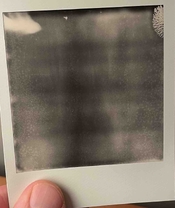
I tried making my own pinhole
It has a 20cm focal length
and I used a .5mm wire to make the actual pinhole

I had this bw polaroid film that I used to test it and ended up with this. Any thoughts on what happened. Is my hole too big? focal length too long? Or is this the sign of a light leak or an additional light source?

thanks in advance for your patience and experience.
 

Attachments

  • IMG_3851.jpg
    IMG_3851.jpg
    410.5 KB · Views: 54

Donald Qualls

Subscriber
Allowing Ads
Joined
Jan 19, 2005
Messages
12,532
Location
North Carolina
Format
Multi Format
Looks like bad film/chemical pod and/or dirty rollers in the Polaroid back to me.
 

Greg_E2

Member
Allowing Ads
Joined
Sep 19, 2025
Messages
53
Location
Usa
Format
Medium Format
Somewhere I have an image of a dandelion in seed that was about 1:1, this was with an 80mm, I think .3 pinhole, and a Mamiya 645 film back. Unfortunately I'm not sure where I stored it. Might be visible on the wayback machine in the f295 forums under user Greg_E. It resolved OK, I think there was some work to be done. Kind the same as getting a spiderweb with pinhole (proven to be possible).
 

Larry Bullis

Subscriber
Allowing Ads
Joined
May 23, 2008
Messages
1,265
Location
White Rock, B.C. Canada
Format
Multi Format
From the original post back in 2008 "...seems I read somewhere once that closer than a certain lens-to-subject distance starts affecting the diffraction, or circle-of-confusion? or...? Anyone doing closeups with a pinhole? Maybe 2:1, or 1:1?"

I've been gone for a very long time. And this is an old thread. I wonder whether anyone is still interested.

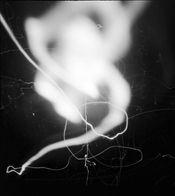
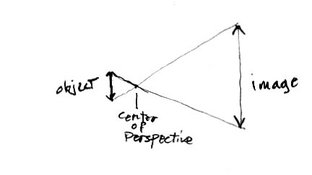
When I read that question, it brought to mind one of the curious things about pinhole. I did a project involving superimposing a light drawn image upon a pinhole image by putting the film back in the holder and drawing in front of the pinhole with a bare light bulb. I was surprised to find that when I got the bulb very close to the camera, the image became blurrier and blurrier the closer I got. The reason for this is that if the object is closer to the pinhole than the film is, the image will be enlarged. Even a very tiny light can be enlarged to cover the entire film area. As the point (this could be any source, in a physical subject or just a point source of light) approaches closer, the resolution will be progressively softened. That is, it will become blurrier and blurrier.

I'm attaching two scans. One, a simple drawing. The other, an image made on 8x10 film using a bare light bulb. Where the bulb image is very small, the line or dot will be made with the light farther away. Where it is enlarged, it is closer to the pinhole than the pinhole is from the film.
 

Attachments

  • bare light drawing.jpg
    bare light drawing.jpg
    100.6 KB · Views: 16
  • projection drawing.jpg
    projection drawing.jpg
    17.6 KB · Views: 18

FotoD

Member
Joined
Dec 15, 2020
Messages
425
Location
EU
Format
Analog
What do people use to make really small apertures? I imagine the needle through a Coke can won't be good enough for the tiniest hole sizes.
 

jda

Subscriber
Joined
Dec 27, 2025
Messages
6
Location
Klamath Falls, OR USA
Format
4x5 Format
Is there a practical limit for how close you can generally get with a pinhole with good results? There are calculators to give the expected image circle and angle of view for various apertures and focal lengths, but I'm wondering if there are other optical limitations. I'm trying to remember... seems I read somewhere once that closer than a certain lens-to-subject distance starts affecting the diffraction, or circle-of-confusion? or...? Anyone doing closeups with a pinhole? Maybe 2:1, or 1:1?

I have just done two image with close ups. It is possible.
From the original post back in 2008 "...seems I read somewhere once that closer than a certain lens-to-subject distance starts affecting the diffraction, or circle-of-confusion? or...? Anyone doing closeups with a pinhole? Maybe 2:1, or 1:1?"

I've been gone for a very long time. And this is an old thread. I wonder whether anyone is still interested.

When I read that question, it brought to mind one of the curious things about pinhole. I did a project involving superimposing a light drawn image upon a pinhole image by putting the film back in the holder and drawing in front of the pinhole with a bare light bulb. I was surprised to find that when I got the bulb very close to the camera, the image became blurrier and blurrier the closer I got. The reason for this is that if the object is closer to the pinhole than the film is, the image will be enlarged. Even a very tiny light can be enlarged to cover the entire film area. As the point (this could be any source, in a physical subject or just a point source of light) approaches closer, the resolution will be progressively softened. That is, it will become blurrier and blurrier.

I'm attaching two scans. One, a simple drawing. The other, an image made on 8x10 film using a bare light bulb. Where the bulb image is very small, the line or dot will be made with the light farther away. Where it is enlarged, it is closer to the pinhole than the pinhole is from the film.

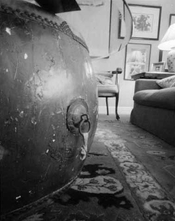
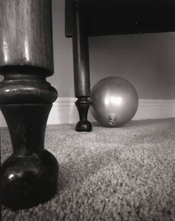
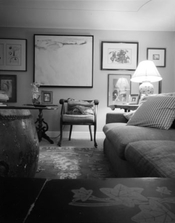
The first two are about 4" at closest point. The third image the camera is sitting on the surface of a black table with a design. The distance from the pinhole to the surface is about 3.5".
 

Attachments

  • 2005 pinhole02a small.jpg
    2005 pinhole02a small.jpg
    35.5 KB · Views: 21
  • OR IA12-07-25 under tv table01POSWP96ppi.jpg
    OR IA12-07-25 under tv table01POSWP96ppi.jpg
    43.2 KB · Views: 18
  • 2005 table pinhole01posWP96ppi.jpg
    2005 table pinhole01posWP96ppi.jpg
    39.9 KB · Views: 22

jda

Subscriber
Joined
Dec 27, 2025
Messages
6
Location
Klamath Falls, OR USA
Format
4x5 Format
What do people use to make really small apertures? I imagine the needle through a Coke can won't be good enough for the tiniest hole sizes.

I use shim stock. If you can find brass material that's the best IMO. Auto parts store or a good hardware store are good sources
 

Larry Bullis

Subscriber
Allowing Ads
Joined
May 23, 2008
Messages
1,265
Location
White Rock, B.C. Canada
Format
Multi Format
I use shim stock. If you can find brass material that's the best IMO. Auto parts store or a good hardware store are good sources

I had a jeweler roll out some pure silver to .003". I have a coil of it about 1cm wide. My process is actually quite labor intensive and fairly complex. It involves using a sewing needle, a pin vice, a somewhat polished anvil, a somewhat polished peen hammer, a set of gauges, and a 50x projection microscope. The gauges are cut from hardwood, sized to 50x the target dimensions so that looking at the image of the hole on the screen, I can see how close to the target dimension it is.

First, I poke a hole. Doesn't really matter how big it is, just so it isn't ridiculously far from the target and it should be a bit larger. Then, I pound the silver with the hole. That expands the metal, closing the hole somewhat, should make it smaller than desired. Then do this back and forth, too big, too small until I get it right. The microscope also helps me insure that the hole is clean. This can take a while, and sometimes I need to start over because it's easy to get a misshapen hole. If there is crud visible in the hole, delicate cleaning with the needle usually works. Maybe compressed air, but it would be easy to blow the whole job away in the wind.

The hole is in the middle of a dome that is formed by the process, much like the jeweler's forming technique "repoussé". One very important result of this process is that the hole is in metal that is extremely thin, much thinner than the original .003". This is far superior to drilled holes, laser or otherwise, because a drilled hole is actually a tube. A short tube, but a tube. This affects the light on a wavelength level. These holes produce absolutely gorgeous diffraction rainbow effects.

The material the hole is made of should be blackened. I've heard of people using paint (!) or black marker, but the best way is to use pure or sterling silver, and then selenium toner. The silver will tarnish naturally over time if exposed to the air, but I don't want to wait so I use toner.

The holes that I make this way produce extremely high quality images. Unless enlarged, they can almost compete with lenses. Of course, a lot of pinhole users would find this objectionable. They think pinhole images should look (at worst) crude and fuzzy. But I love the quality of the drawing that I get with these.

Dominique Stroobant told me that he makes his pinholes by electro etching. We haven't compared our resolutions, but I'm pretty sure they'd match very closely.

 

FotoD

Member
Joined
Dec 15, 2020
Messages
425
Location
EU
Format
Analog
I use shim stock. If you can find brass material that's the best IMO. Auto parts store or a good hardware store are good sources
First, I poke a hole. Doesn't really matter how big it is, just so it isn't ridiculously far from the target and it should be a bit larger. Then, I pound the silver with the hole. That expands the metal, closing the hole somewhat, should make it smaller than desired. Then do this back and forth, too big, too small until I get it right. The microscope also helps me insure that the hole is clean. This can take a while, and sometimes I need to start over because it's easy to get a misshapen hole. If there is crud visible in the hole, delicate cleaning with the needle usually works. Maybe compressed air, but it would be easy to blow the whole job away in the wind.

Thanks guys. That's very interesting!
 

Greg_E2

Member
Allowing Ads
Joined
Sep 19, 2025
Messages
53
Location
Usa
Format
Medium Format
We used to buy electron microscope apertures, but it looks like they may have gotten expensive, or no one breaking down the large quantities into smaller units.
 

jda

Subscriber
Joined
Dec 27, 2025
Messages
6
Location
Klamath Falls, OR USA
Format
4x5 Format
Thanks guys. That's very interesting!

I had a jeweler roll out some pure silver to .003". I have a coil of it about 1cm wide. My process is actually quite labor intensive and fairly complex. It involves using a sewing needle, a pin vice, a somewhat polished anvil, a somewhat polished peen hammer, a set of gauges, and a 50x projection microscope. The gauges are cut from hardwood, sized to 50x the target dimensions so that looking at the image of the hole on the screen, I can see how close to the target dimension it is.

First, I poke a hole. Doesn't really matter how big it is, just so it isn't ridiculously far from the target and it should be a bit larger. Then, I pound the silver with the hole. That expands the metal, closing the hole somewhat, should make it smaller than desired. Then do this back and forth, too big, too small until I get it right. The microscope also helps me insure that the hole is clean. This can take a while, and sometimes I need to start over because it's easy to get a misshapen hole. If there is crud visible in the hole, delicate cleaning with the needle usually works. Maybe compressed air, but it would be easy to blow the whole job away in the wind.

The hole is in the middle of a dome that is formed by the process, much like the jeweler's forming technique "repoussé". One very important result of this process is that the hole is in metal that is extremely thin, much thinner than the original .003". This is far superior to drilled holes, laser or otherwise, because a drilled hole is actually a tube. A short tube, but a tube. This affects the light on a wavelength level. These holes produce absolutely gorgeous diffraction rainbow effects.

The material the hole is made of should be blackened. I've heard of people using paint (!) or black marker, but the best way is to use pure or sterling silver, and then selenium toner. The silver will tarnish naturally over time if exposed to the air, but I don't want to wait so I use toner.

The holes that I make this way produce extremely high quality images. Unless enlarged, they can almost compete with lenses. Of course, a lot of pinhole users would find this objectionable. They think pinhole images should look (at worst) crude and fuzzy. But I love the quality of the drawing that I get with these.

Dominique Stroobant told me that he makes his pinholes by electro etching. We haven't compared our resolutions, but I'm pretty sure they'd match very cl

I had a jeweler roll out some pure silver to .003". I have a coil of it about 1cm wide. My process is actually quite labor intensive and fairly complex. It involves using a sewing needle, a pin vice, a somewhat polished anvil, a somewhat polished peen hammer, a set of gauges, and a 50x projection microscope. The gauges are cut from hardwood, sized to 50x the target dimensions so that looking at the image of the hole on the screen, I can see how close to the target dimension it is.

First, I poke a hole. Doesn't really matter how big it is, just so it isn't ridiculously far from the target and it should be a bit larger. Then, I pound the silver with the hole. That expands the metal, closing the hole somewhat, should make it smaller than desired. Then do this back and forth, too big, too small until I get it right. The microscope also helps me insure that the hole is clean. This can take a while, and sometimes I need to start over because it's easy to get a misshapen hole. If there is crud visible in the hole, delicate cleaning with the needle usually works. Maybe compressed air, but it would be easy to blow the whole job away in the wind.

The hole is in the middle of a dome that is formed by the process, much like the jeweler's forming technique "repoussé". One very important result of this process is that the hole is in metal that is extremely thin, much thinner than the original .003". This is far superior to drilled holes, laser or otherwise, because a drilled hole is actually a tube. A short tube, but a tube. This affects the light on a wavelength level. These holes produce absolutely gorgeous diffraction rainbow effects.

The material the hole is made of should be blackened. I've heard of people using paint (!) or black marker, but the best way is to use pure or sterling silver, and then selenium toner. The silver will tarnish naturally over time if exposed to the air, but I don't want to wait so I use toner.

The holes that I make this way produce extremely high quality images. Unless enlarged, they can almost compete with lenses. Of course, a lot of pinhole users would find this objectionable. They think pinhole images should look (at worst) crude and fuzzy. But I love the quality of the drawing that I get with these.

Dominique Stroobant told me that he makes his pinholes by electro etching. We haven't compared our resolutions, but I'm pretty sure they'd match very closely.

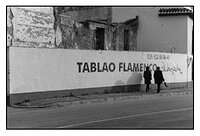
Thanks Larry, that is an amazing process. You make beautiful images.
 
Last edited:

Donald Qualls

Subscriber
Allowing Ads
Joined
Jan 19, 2005
Messages
12,532
Location
North Carolina
Format
Multi Format
One thing to keep in mind is that due to the geometry of the projection, when doing very close images a pinhole significantly smaller than "optimum" as given by pinhole calculators will give sharper results. The optimum is alway trading off geometric sharpness against diffraction, and at macro distances (i.e. image a significant fraction of subject, if not as large or even larger) geometric blur is by far the larger effect, so you can stand more diffraction. My experience is that a hole half the size of the calculated optimum works well for near 1:1 (i.e fill a 35 mm frame with a golf ball). Even smaller will be preferred for images larger than the object.

BTW, I make my holes in .001" brass shim stock, drilled with a fine sewing needle and buffed on the back to remove the burrs. The needle dimples the surface a bit and the buffing thins the edge of the hole even below .001". I blacken the brass with a Magic Marker or Sharpie; the dye adds nothing to any dimension, but greatly reduces reflection.
 

Larry Bullis

Subscriber
Allowing Ads
Joined
May 23, 2008
Messages
1,265
Location
White Rock, B.C. Canada
Format
Multi Format
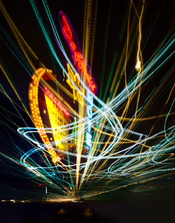
Some of you might remember this one. It was the cover on the first edition of Eric Renner's Pinhole Photography book.

Now that I'm "retired" I'm going back through 60 years of negatives. There's a lot I've totally forgotten, much of it I've never really seen.
 

Attachments

  • Daffodil-Motel-2025ver.jpg
    Daffodil-Motel-2025ver.jpg
    168.4 KB · Views: 12
Photrio.com contains affiliate links to products. We may receive a commission for purchases made through these links.
To read our full affiliate disclosure statement please click Here.

PHOTRIO PARTNERS EQUALLY FUNDING OUR COMMUNITY:


Ilford ADOX Freestyle Photographic Stearman Press Weldon Color Lab Blue Moon Camera & Machine
Top Bottom