• Welcome to Photrio!
    Registration is fast and free. Join today to unlock search, see fewer ads, and access all forum features.
    Click here to sign up

Clarification on Rotary processing of Adox.

Tied to the dock

D
Tied to the dock

  • 3
  • 0
  • 51
Running in the Snow

H
Running in the Snow

  • 1
  • 2
  • 61

Recent Classifieds

Forum statistics

Threads
203,080
Messages
2,849,585
Members
101,648
Latest member
eionaci3
Recent bookmarks
1
If the C-41 process is fully within spec, then the results will be within spec if 3:15 is the development time.

I think that BMbikerider was presenting the same time for continuous and intermittent agitation as an apparent anomaly and I know rather than assume in my case, it appears anomalous. I assume in his case he wonders and know in my case that I wonder why this applies to C41 only?


Any ideas?

Thanks

pentaxuser
 
@mshchem I hear you. I remember not thinking much about getting one, but the thing outperformed my wildest expectations, kicking the JOBO out of the house. My temperature control comment had nothing to do with the TAS per se, just the general observation of uselessness and inconvenience of water baths. Those contraptions are simply not necessary for roll film. In fact, I suspect that most JOBO users have been developing film for years not getting even close to the 100F without even knowing it. You lose far more temperature in a JOBO lift during pouring than via ambient cooling during the short window of 3:15. Well... unless you're developing outside in the winter. My testing was done within 66-72F.

To summarize, here's my list of why the TAS is better than a rotary processor:
  • Better for B&W film because it facilitates intermittent agitation with configurable pauses.
  • Better agitation than a simple rotation.
  • Far more compact and does not require much storage space.
  • Better built. No plastic.
  • Much cheaper.
The JOBO's advantage is the ability to work with larger tanks.

 
@mshchem I hear you. I remember not thinking much about getting one, but the thing outperformed my wildest expectations, kicking the JOBO out of the house. My temperature control comment had nothing to do with the TAS per se, just the general observation of uselessness and inconvenience of water baths. Those contraptions are simply not necessary for roll film. In fact, I suspect that most JOBO users have been developing film for years not getting even close to the 100F without even knowing it. You lose far more temperature in a JOBO lift during pouring than via ambient cooling during the short window of 3:15. Well... unless you're developing outside in the winter. My testing was done within 66-72F.

To summarize, here's my list of why the TAS is better than a rotary processor:
  • Better for B&W film because it facilitates intermittent agitation with configurable pauses.
  • Better agitation than a simple rotation.
  • Far more compact and does not require much storage space.
  • Better built. No plastic.
  • Much cheaper.
The JOBO's advantage is the ability to work with larger tanks.

Your comment about the lift and temperature loss is very valid.

I remember, back in the 80's when I first saw a CPP2, I thought it was a joke, over priced goofy plastic thing.

I have gotten so I really like the things. Most of the equipment I have has been acquired over 5 decades of buying things when people want to get rid of it. One exception is my CPP3, I purchased it new, I wanted one, nothing wrong with my CPP2.

I would welcome a TAS, just can't afford one. I keep my darkroom at constant 20-21 °C, so the TAS would be great for me. Still I can agitate manually. Maybe I just need to start processing by hand again, leave the processors under my sinks šŸ¤” 😊
 
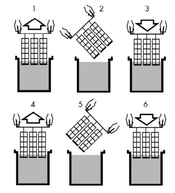
Regarding small tank & reel C41 processing vs rotary, the only thing I could find was this.

https://125px.com/docs/techpubs/kodak/z131_03.pdf

It mentions a sink line which is a manual processing tank with a basket/sheet film holder.

sink line processing.jpg

See page 3-3 for manual agitation.

"Repeat this procedure once every 10 seconds (6 times per minute)."

In commercial C41, the chemistry is agitated either by a gaseous burst (dip & dunk) or by circulation flow (leader card machine).
 
Photrio.com contains affiliate links to products. We may receive a commission for purchases made through these links.
To read our full affiliate disclosure statement please click Here.

PHOTRIO PARTNERS EQUALLY FUNDING OUR COMMUNITY:


Ilford ADOX Freestyle Photographic Stearman Press Weldon Color Lab Blue Moon Camera & Machine
Top Bottom