

• Welcome to Photrio!
    Registration is fast and free. Join today to unlock search, see fewer ads, and access all forum features.
    Click here to sign up
Resource icon

Chemicals and trade names/marks

Horicon Marsh-5

A
Horicon Marsh-5

  • 2
  • 0
  • 73
Millstone, High Water

A
Millstone, High Water

  • sly
  • Dec 17, 2025
  • 7
  • 5
  • 139

Recent Classifieds

Forum statistics

Threads
201,249
Messages
2,821,222
Members
100,621
Latest member
anthonysgevans
Recent bookmarks
0

fdonadio

Member
Allowing Ads
Joined
Jan 15, 2015
Messages
2,129
Location
Berlin, DE
Format
Multi Format
fdonadio submitted a new resource:

(there was a url link here which no longer exists) - A table of commonly used substances for color and B&W processing and their trade names.

After some time gathering information about some trademarked chemicals, I have compiled this little list that might be of use to all of us:

...
Trademark / Trade NameChemicalCAS #
CalgonSodium Hexametaphosphate68915-31-1
Dimezone-S1-Phenyl-4-Methyl-4-Hydroxymethyl-3-Pyrazolidone 13047-13-7
Ecol Elon Metolp-Mehtylaminophenol Sulphate55-55-0

(there was a url link here which no longer exists)
 

Ian Grant

Subscriber
Allowing Ads
Joined
Aug 2, 2004
Messages
23,370
Location
West Midland
Format
Multi Format
To that list add

Kodenol - p-Aminopnhenol Hydrochloride or p-Aminopnhenol Oxalate (Kodak sold both as Kodenol)
Kodinol - Kodak (Kodenol based) Rodinal type Developer
Kodatol - DK20
Kodurol - Glycine
Dolmi - Amidol

Also be aware that Calgon is not always Sodium Hexametaphosphate, what's sold as Calgon today is Sodium Citrate and Carbonic Acid (Sodium Salt). So you need to check what you are actually buying.

Ian
 
OP
OP
fdonadio

fdonadio

Member
Allowing Ads
Joined
Jan 15, 2015
Messages
2,129
Location
Berlin, DE
Format
Multi Format
To that list add

Kodenol - p-Aminopnhenol Hydrochloride or p-Aminopnhenol Oxalate (Kodak sold both as Kodenol)
Kodinol - Kodak (Kodenol based) Rodinal type Developer
Kodatol - DK20
Kodurol - Glycine
Dolmi - Amidol

Also be aware that Calgon is not always Sodium Hexametaphosphate, what's sold as Calgon today is Sodium Citrate and Carbonic Acid (Sodium Salt). So you need to check what you are actually buying.

Ian

Thanks for the extra info, Ian. I will change the table when I am on a computer. Editing BBCode on the iPhone is a PITA.

One simple chemistry question: what is the difference between "Carbonic Acid (Sodium Salt)" and "Sodium Carbonate"?

Also, Glycine and Amidol are also trademarks, right? I remember something about two different compounds called Glycine...
 

Ian Grant

Subscriber
Allowing Ads
Joined
Aug 2, 2004
Messages
23,370
Location
West Midland
Format
Multi Format
One simple chemistry question: what is the difference between "Carbonic Acid (Sodium Salt)" and "Sodium Carbonate"?

That's a good question :D I took that from the current Calgon MSDS, but with a pH of 10 it's not what you want to add to developers as a water softening agent, so Carbonate probably and a way of being obscure :smile:

Also, Glycine and Amidol are also trademarks, right? I remember something about two different compounds called Glycine...

No not trade mark/names as various companies used the names, I have a pre-WWII bottle of Ilford Amidol, which states made by Johnsons (of Hendon), still trading in Stoke on Trent and the oldest Photographic company still trading (although directions have changed) in the world - they supplies Fox Talbot !!!!

Yes Glycine is the the name of two quite different compounds, I have quite a lot of the wrong one - but then it was free. A company I worked for bought everything from a lab that closed mostly for the plasma spectrometer machine but we also had all their chemicals, lab equipment, benches etc. When I took over running it I stripped out all the potential Photo chemistry, that was kilos of Metol, Hydroquinone, Potassium Bromide, Pyrogallol etc, I should add not chemicals we actually used in our own lab.

Ian
 

Photo Engineer

Subscriber
Allowing Ads
Joined
Apr 19, 2005
Messages
29,018
Location
Rochester, NY
Format
Multi Format
Strictly speaking, Carbonic acid Sodium salt and Sodium Carbonate should be identical, but they may be playing loose with the nomenclature. Sodium Carbonate is used in a number of developers as the primary alkali.

Glycin is a photographic developing agent, but Glycine is an essential amino acid in the diet of many species on earth. Don't confuse the two and don't eat either one in pure form.

PE
 
OP
OP
fdonadio

fdonadio

Member
Allowing Ads
Joined
Jan 15, 2015
Messages
2,129
Location
Berlin, DE
Format
Multi Format
When I took over running it I stripped out all the potential Photo chemistry, [...] I should add not chemicals we actually used in our own lab.

I understand that. You took all of it after it was given to you. :smile:

A couple of weeks ago, I met a friend's girlfriend and came to know she works with photochemistry at a university lab. Every month, the university discards expired chemicals and they are offered to the chemists for free. She offered to give me some silver nitrate and whatever else is not banned or dangerous. I already gave her a small list! :D
 
OP
OP
fdonadio

fdonadio

Member
Allowing Ads
Joined
Jan 15, 2015
Messages
2,129
Location
Berlin, DE
Format
Multi Format
There it is... Added Ian's suggestions, except for Kodinol and Kodatol. My idea for this resource is to make it easier for people to find the compounds needed to make photo processing solutions. I also found out about the difference between Kodelon and Kodenol.
 

Alan Johnson

Subscriber
Allowing Ads
Joined
Nov 16, 2004
Messages
3,365
If an old formula specifies "Calgon" I believe this generally refers to sodium hexametaphophate.
The compound sold as Calgon today is often a mixture of zeolites and polycarboxylates so if calgon is specified it is better to use the original raw chemical sodium hexametaphosphate.
 
OP
OP
fdonadio

fdonadio

Member
Allowing Ads
Joined
Jan 15, 2015
Messages
2,129
Location
Berlin, DE
Format
Multi Format
If an old formula specifies "Calgon" I believe [...] it is better to use the original raw chemical sodium hexametaphosphate.

Alan, you are correct. Thanks for catching that.

Makes perfect sense. Does anyone know when Kodak changed Calgon's formula? Maybe I should take that off the table and add a footnote about the change, suggesting Allan's advice.
 

Photo Engineer

Subscriber
Allowing Ads
Joined
Apr 19, 2005
Messages
29,018
Location
Rochester, NY
Format
Multi Format
Kodak had no influence on the change. Calgon was a separate company. Kodak changed to Qadrofos at the same time that Calgon changed their formula.

PE
 
OP
OP
fdonadio

fdonadio

Member
Allowing Ads
Joined
Jan 15, 2015
Messages
2,129
Location
Berlin, DE
Format
Multi Format
Kodak had no influence on the change. Calgon was a separate company. Kodak changed to Qadrofos at the same time that Calgon changed their formula.

PE

Oh! I thought Calgon was a Kodak product.

Well, let's just follow Alan's advice and use Hexametaphosphate, then.
 

Spektrum

Subscriber
Joined
Apr 11, 2025
Messages
115
Location
Poland
Format
35mm
Hi, I know this is an old topic. I am looking through the table of commonly used substances for color and B&W processing and their trade names.

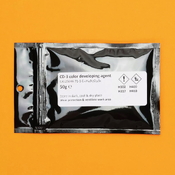
I want to buy Color Developing Agent CD-3. This table specifies the CAS for CD-3 25646-71-3.
On Ebay in Europe, there are currently two sellers selling CD-3. Both in the offer titles CAS 24567-76-8. But one seller in the photo of the packaging has CAS 25646-71-3. See the photo in the attachment. Two different CAS numbers, which means that these are two different chemical substances. Since I could not find an explanation anywhere on the internet, I asked Chat AI. I got an answer but I am not sure if I should trust 100% what it tells me.

...................................................................
Explaining the Difference
24567-76-8 (free base) and 25646-71-3 (hydrochloride) are two different CAS numbers for the same compound in different chemical forms. In photographic practice, both forms can be used, but:
The free base (24567-76-8) is more commonly listed in process specifications such as ECN-2.

The hydrochloride (25646-71-3) is more stable in storage and may be preferred in ready-mixed chemistry.

In Kodak documentation (e.g. for ECN-2 developers) and photographic literature, CD-3 is usually identified by 24567-76-8, confirming that this CAS number is more appropriate in the context of pure CD-3 for photography.
...................................................................

So does your table give the correct CAS number 25646-71-3? If someone has experience with this chemistry, can you tell me if both CAS are suitable for ECN2 developer and can be used interchangeably? The same amount, i.e. 4g per liter?
 

Attachments

  • CD3.jpg
    CD3.jpg
    659.4 KB · Views: 49

koraks

Moderator
Moderator
Allowing Ads
Joined
Nov 29, 2018
Messages
26,144
Location
Europe
Format
Multi Format
If someone has experience with this chemistry, can you tell me if both CAS are suitable for ECN2 developer and can be used interchangeably?
The material pictured in the photo of your post will work for ECN2.

I don't think there's in practice any difference between these two CAS numbers. The functional group is the same and the molecular weight is also equal. So yes, you can substitute weight for weight.

One thing to keep in mind when mixing ECN2 developer is that it may help to follow this procedure:
* Start with ca. 80% of the volume of water you want to end up with (e.g. 800ml when making 1000ml developer).
* Mix in all the ingredients, one by one, waiting until fully dissolved, except the CD3.
* Now mix the CD3 separately in a small amount of water. It's very soluble. I usually use warm water for this. This will yield a very pale magenta solution.
* Add this CD3 solution to your developer. Top up to the final volume.

This method prevents the formation of insoluble/hydrophobic dye globules which can occur if you dump the CD3 powder into the otherwise mixed developer directly.

Welcome to Photrio and have fun with your ECN2 processing!
 

Spektrum

Subscriber
Joined
Apr 11, 2025
Messages
115
Location
Poland
Format
35mm
Thank you very much for your quick and valuable answer. I wonder why I haven't found similar doubts about different CAS numbers anywhere on the internet. I was most concerned about maintaining the correct pH of the solution. After all, the free base will certainly have a different pH than the hydrochloride. Or am I wrong? Thank you for your advice on dissolving the developer components. I am browsing your blog "Koraks Tinkers" with interest. It is a basic source of knowledge about photographic chemistry for me. Keep it up! Thank you again.
 

koraks

Moderator
Moderator
Allowing Ads
Joined
Nov 29, 2018
Messages
26,144
Location
Europe
Format
Multi Format
The note on pH is relevant, and to be honest, I've not really pursued it. All the CD3 I have used so far has fizzed quite briskly when added to an alkaline solution, so I assume they're all acidic (i.e. the hydrochloride). I never really looked into it, but the AI answer you came up with might be the explanation - perhaps the hydrochloride is the more commercially meaningful form. I really couldn't say; perhaps someone else could chime in on this. Either way, I've noticed no problems with the developer I make using this material and I have to admit that I've given up on measuring pH quite some time ago. Instead, I just mix the same recipe fresh for use every time, and rely on consistency more so than on absolute correctness. This seems to work well for me, even though I expect my developer will be slightly off the mark one way or another. That's OK as far as I'm concerned as long as it's consistently (and not too far) off the mark.

Thanks for the kind words about my blog; I'm glad to see it is of use to some.
 

Spektrum

Subscriber
Joined
Apr 11, 2025
Messages
115
Location
Poland
Format
35mm
From both of your answers it appears that you have dealt with (and used) both forms of CD-3 (CAS 25646-71-3 and CAS 24567-76-8). Since I know that you actively make prints using an enlarger and chemicals, your statement that it works well simply reassures me.
Personally, I will probably never get involved in working with color materials and an enlarger. It is too complicated and too expensive for me.
The case is different when it comes to making black and white prints.

I scan my films using a dedicated Reflecta ProScan 10T scanner and the VueScan program (48bit TIFF without any color manipulation). Then, using PhotoShop and the Grain2Pixel plugin, I invert the negative to positive, so I have a lot of possibilities for color correction in post-processing. I can therefore assume that if something works properly for you, it should work perfect for me. Thank you for your good advice and best regards.

EDIT: I read in the comments to your blog post ("Color me purple....") that the CD-3 has a tendency to fizzle. This is a really fantastic blog !
 
Last edited:

koraks

Moderator
Moderator
Allowing Ads
Joined
Nov 29, 2018
Messages
26,144
Location
Europe
Format
Multi Format
From both of your answers it appears that you have dealt with (and used) both forms of CD-3 (CAS 25646-71-3 and CAS 24567-76-8). Since I know that you actively make prints using an enlarger and chemicals, your statement that it works well simply reassures me.
To be frank, it has been impossible for me and I never bothered to verify which species I actually had, but I do know the actual product that you showed and I know 100% that it works for this application. When you buy CD3 (or anything, really) all you have is what the seller tells you about the material. You'd actually have to do chemical analysis to figure what you have and often, that's just not feasible. In this particular case, I figure that we know what we have due to the fizzing reaction, but I'm not certain about that. All I'm certain of is that all the CD3 I've ever used (from several sources, over several years) has always worked pretty much the same for me. So I never really worried about it.

Also, scanning is great. I've just done a series of holiday snaps (several rolls of Vision3 film in ECN2 developer using the exact same CD3 you showed there), scanned and then inkjet printed. It's nice to be able to print in daylight! I might also print a few select images in the darkroom as well. One doesn't exclude the other!

Thanks again for your kind words; it's really appreciated.
 
OP
OP
fdonadio

fdonadio

Member
Allowing Ads
Joined
Jan 15, 2015
Messages
2,129
Location
Berlin, DE
Format
Multi Format
@Spektrum , if you have pH deviations (small ones, I hope), you can correct them. The Kodak official ECN-2 “recipes” advise you to correct the pH using an acid or a base. The recommendations for each bath are right under the table of “ingredients”.
 

fgorga

Member
Joined
Aug 31, 2015
Messages
826
Location
New Hampshire
Format
Multi Format
A little basic (no pun intended) chemistry...

The chemicals you list are two forms of the same compound, differing only by the presence/absence of a hydrochloride acid molecule.

In aqueous solution, both forms of the compound exist in equlibrium with one another. The balance between the two forms is determined by the pH of the solution and can be shifted by adding either a base or an acid to the solution.

For CD-3 (abbreviated 'R' in the figure below) the chemical group involved is the amine (NH2) group.

I have illustrated the chemistry below...

1748724628806.png


If you make a solution starting with the free base, the pH of the final solution will be higher that if you start with the hydrochloride. How different the pH will be depends on many factors, chiefly the concentration of the compound and the identity of the other components of the system. Whether this difference in pH will matter depends on the application.

There is also another factor to consider... the molecular mass. HCl has a molecular mass of 36.46. This difference in mass should be accounted for when substituting one for for the other in a recipe if the same molar concentration of the active ingredient is critical. This, again, may or may not be important depending on the application.
 

Spektrum

Subscriber
Joined
Apr 11, 2025
Messages
115
Location
Poland
Format
35mm
Thank you very much for the very detailed explanation of the differences between these compounds. 👍
 
Photrio.com contains affiliate links to products. We may receive a commission for purchases made through these links.
To read our full affiliate disclosure statement please click Here.

PHOTRIO PARTNERS EQUALLY FUNDING OUR COMMUNITY:


Ilford ADOX Freestyle Photographic Stearman Press Weldon Color Lab Blue Moon Camera & Machine
Top Bottom