
CD4-LC low contrast developer for scanning

Forum statistics

Threads
200,973
Messages
2,817,022
Members
100,466
Latest member
MariaSj
Recent bookmarks
0
OP
OP

Alan Johnson

Subscriber
Allowing Ads
Joined
Nov 16, 2004
Messages
3,350
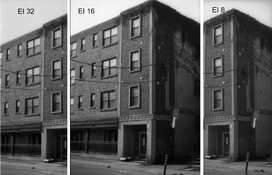
Mixed results with camera shake and low resolution from a hand held 28-90 consumer zoom, with some streaking attributed to 3 min agitation intervals.


The King Mono 50 film itself was OK given 20% less development cf post 72 Sept 15 24.

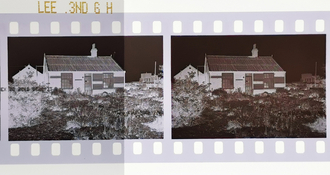
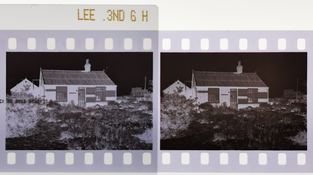
The 2EZS test shows the +2 stops negative has a lighter sky (lower CI) and darker foreground (higher CI) than the normally exposed negative (attachment).


This is consistent with an S-shaped curve for this sound recording film in CD4-LC.
 

Attachments

  • 2EZS no 1.jpg
    2EZS no 1.jpg
    163.1 KB · Views: 55

koraks

Moderator
Moderator
Joined
Nov 29, 2018
Messages
25,832
Location
Europe
Format
Multi Format
Whats especially apperent in that comparison is the difference in the hue of the negative. The one on the right is very warm in tone. Do you recognize this also in the real-life negs? I'd be surprised if a 20% reduction in development time would give such a pronounced difference in hue.
 
OP
OP

Alan Johnson

Subscriber
Allowing Ads
Joined
Nov 16, 2004
Messages
3,350
The difference in hue is partly due to a grey ND filter on top of a brownish negative. The negatives are less brown than they look on screen. I don't think this alters my conclusion that they are the result of an S-curve.
 

Attachments

  • 2EZS 1b-1.jpg
    2EZS 1b-1.jpg
    188.4 KB · Views: 60
OP
OP

Alan Johnson

Subscriber
Allowing Ads
Joined
Nov 16, 2004
Messages
3,350
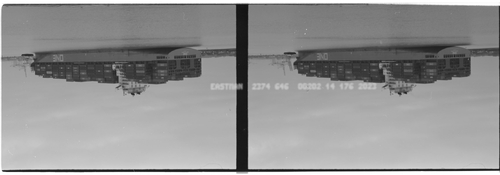
The King Mono 50 film is Eastman 2374 Sound recording film which appears to have been still in production till the recent updating of the Kodak coating machine.
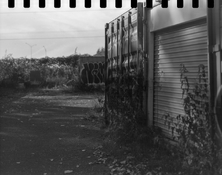
Some pictures may be lost by the manufacturers mark every few frames (attachment).
The resolution of fine detail at box speed 50 is very good.


Attachments

  • King Mono 50 = Eastman 2374.jpg
    King Mono 50 = Eastman 2374.jpg
    397.2 KB · Views: 42
OP
OP

Alan Johnson

Subscriber
Allowing Ads
Joined
Nov 16, 2004
Messages
3,350
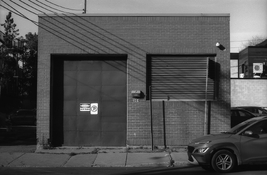
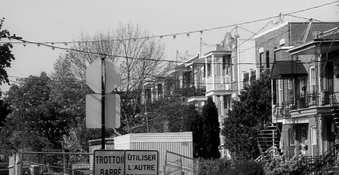
I investigated if Lucky SHD50 might be a substitute for Adox CMS20 II but it appears not. I obtained a result at EI=6 which was slightly underdeveloped using the time for CMS20 II.

Here is CMS20 II EI =20:


And here is Lucky SHD 50 EI=6:


At the very highest magnification on Flickr Pro, with Lucky SHD50 tiny specks are visible which are absent with CMS20 II.
These may not be visible on an optical print of normal proportions.
 
OP
OP

Alan Johnson

Subscriber
Allowing Ads
Joined
Nov 16, 2004
Messages
3,350
I obtained from Chat GPT a possible explanation of these tiny specks at high magnification which have seen with other films as well:
______________________________________________________________________________________________________________________

2. Physical clustering: actual micro-nonuniformity
However, in certain emulsions — especially aerial, microfilm, and ultra-low-ISO stocks — there is genuine physical clustering caused by:

  • Crystal ripening or coagulation during precipitation (larger halide crystal domains form before coating).
  • Incomplete dispersion of silver halide crystals in the gelatin binder.
  • Developer chemistry encouraging localized silver reduction (high acutance or surface developers create tiny metallic silver “islands”).
  • Drying/contraction — fine emulsions can show “micro-mottle,” a faint density pattern from uneven gelatin shrinkage.
This produces real density variations in the emulsion that would persist even if viewed in cross-section under an electron microscope.

So some of the specks you see at 7200 DPI are real topographical differences, not just optical overlap
______________________________________________________________________________________________________________________

Low ISO high resolution films which do NOT show these tiny specks so far found are:
Adox CMS20 II, Eastman 2369=FPP High-Con 2369 and Eastman 2374 =King Mono 50.
 
Last edited:

Raghu Kuvempunagar

Member
Allowing Ads
Joined
Jul 28, 2016
Messages
2,973
Location
India
Format
Multi Format
I investigated if Lucky SHD50 might be a substitute for Adox CMS20 II but it appears not. I obtained a result at EI=6 which was slightly underdeveloped using the time for CMS20 II.


At the very highest magnification on Flickr Pro, with Lucky SHD50 tiny specks are visible which are absent with CMS20 II.
These may not be visible on an optical print of normal proportions.

Thank you Alan for sharing your results. Tiny specks aside, are there manufacturing defects in this film like one finds in Lucky SHD 400? Would this film be well-suited for reversal processing?
 
OP
OP

Alan Johnson

Subscriber
Allowing Ads
Joined
Nov 16, 2004
Messages
3,350
Tiny specks aside, are there manufacturing defects in this film like one finds in Lucky SHD 400? Would this film be well-suited for reversal processing?
I did find some scratches and spots on some frames of SHD 400 but with SHD 50 no defects I have not mentioned above.
However, the core of the bulk roll of SHD 50 only fits on my Computrol loader upside down, which results in the cassettes being loaded with the wrong side of the film facing the lens, easily corrected by re rolling into a second cassette. AI tells me that the SHD 50 bulk roll should load cassettes the right way round with Lloyds bulk loaders, I did not try it.
 

The Ghost

Member
Allowing Ads
Joined
Nov 2, 2025
Messages
11
Location
Canada
Format
35mm
Alan,
I'm also in the process of finding a replacement for CMS 20 (and TechPan) and I'm considering SHD 50 as well.
After tinkering with Adotech IV to develop it (image attached was at EI 16 iirc), I have mixed some CD4-LC today and will attempt development soon. I can confirm that the core loads properly in a Lloyd bulk loader with the emulsion correctly positioned. Did you use 9 minutes in your test shown in post #108?
And I suppose the softness is due to the light coming in from the film base side (fortunately unfixed SHD50 is pretty transparent).

Thank you for publishing your fomula!

-Jason
 

Attachments

  • SHD50_Adotech_1+19.jpg
    SHD50_Adotech_1+19.jpg
    486.6 KB · Views: 37
OP
OP

Alan Johnson

Subscriber
Allowing Ads
Joined
Nov 16, 2004
Messages
3,350
Hi Jason, nice result from Adotech.
Times I use with CD4-LC, post 72, for successive films are:
N=1 9m, 2=9.9m,3=10.9m,4=12m,5=13m,6=14.5m,7=16m,8=17.5m,9=19.3m,10=21.2m all 20C, to be further multiplied by 1.3 for agitation every 3 minutes and corrected for temperature.
However if it seems the negatives are getting a bit on the thin/thick side the next film can be developed more/less.
I re-rolled my Computrol loaded SHD 50 onto a second cassette so it was eventually loaded the correct way round. Thanks for confirming that SHD 50 loads the right way round directly from the Lloyd loader.
Hope to see your results from the SHD 50 in CD4-LC combination.
 

The Ghost

Member
Allowing Ads
Joined
Nov 2, 2025
Messages
11
Location
Canada
Format
35mm
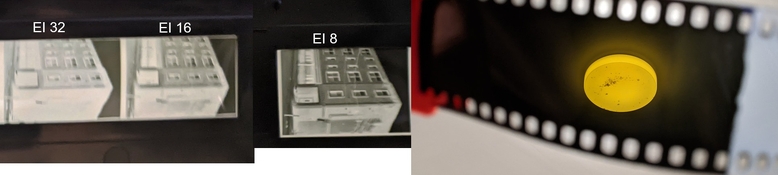
Success! At first I thought the leader part of the film looked slightly thin (see first picture), but in the end the images came out nice. I didn't obtain any softness so I will surmise that what we can observe on post #108 is halation from overexposure at EI 6, which would align the my observation that this is the worst film I've ever used in terms of light piping and light "spreading", and that nothing washes away from the emulsion (probably no antihalation technology whatsoever). I think I will try a base time of 10-11 minutes (with added exhaustion compensation) at EI 16 for the next round and see where I land.

I've also tried with some TechPan that I shot last month at 25. This was a different story; the negative has juuuuust barely enough density that I can recover images from it (see third image). Since this was the second film developed in the batch of dev, it's possible that by only mixing 500mL of dev total - from the start -, more exhaustion compensation could be required to account for less total unoxidized Metol.
 

Attachments

  • SHD50 CD4-LC negative.jpg
    SHD50 CD4-LC negative.jpg
    132.2 KB · Views: 48
  • SHD50 CD4-LC bracketed.jpg
    SHD50 CD4-LC bracketed.jpg
    341.4 KB · Views: 43
  • TechPan CD4-LC 9min.jpg
    TechPan CD4-LC 9min.jpg
    204.1 KB · Views: 47

Raghu Kuvempunagar

Member
Allowing Ads
Joined
Jul 28, 2016
Messages
2,973
Location
India
Format
Multi Format
Success! At first I thought the leader part of the film looked slightly thin (see first picture), but in the end the images came out nice. I didn't obtain any softness so I will surmise that what we can observe on post #108 is halation from overexposure at EI 6, which would align the my observation that this is the worst film I've ever used in terms of light piping and light "spreading", and that nothing washes away from the emulsion (probably no antihalation technology whatsoever). I think I will try a base time of 10-11 minutes (with added exhaustion compensation) at EI 16 for the next round and see where I land.

Congratulations! And thanks for sharing your results and experience. Did you notice any tiny specks in the full resolution scanned negatives similar to what Alan discussed in posts #108 and #109?
 

The Ghost

Member
Allowing Ads
Joined
Nov 2, 2025
Messages
11
Location
Canada
Format
35mm
I'm not seeing any dots or spots on my images. Here's a crop of a shot from the same SHD50 roll:
 

Attachments

  • crop SHD50 CD4-LC_.jpg
    crop SHD50 CD4-LC_.jpg
    557.7 KB · Views: 35

uranylcation

Member
Allowing Ads
Joined
Jan 23, 2024
Messages
60
Location
Salt Lake City
Format
Medium Format
Already ordered the chemicals and would make some once they arrive. Any possibility to replenish the developer? Like replace 100 ml fresh developer for every roll? I use replenished Xtol as my general purpose developer and find it very consistant and economical.
 
OP
OP

Alan Johnson

Subscriber
Allowing Ads
Joined
Nov 16, 2004
Messages
3,350
Any possibility to replenish the developer? Like replace 100 ml fresh developer for every roll? I use replenished Xtol as my general purpose developer and find it very consistant and economical.

I am afraid that question would have to be answered by trial and error, I never tried it.
Even using the method of increasing the time for each film ,rather than stick closely to the suggestions I have made it seems better to judge from each film if the next one should be given a bit longer development.
 

The Ghost

Member
Allowing Ads
Joined
Nov 2, 2025
Messages
11
Location
Canada
Format
35mm
Any possibility to replenish the developer? [...] find it very consistant and economical.
I've entertained the idea of adding fresh metol to the solution every 1 or 2 rolls but don't have the time to try it. A whole 100mL of replenishment would become costly in terms of the amount of CD-4, both monetarily, and environmentally. That's just... a lotta CD-4 to throw out 😅
 
OP
OP

Alan Johnson

Subscriber
Allowing Ads
Joined
Nov 16, 2004
Messages
3,350
A whole 100mL of replenishment would become costly in terms of the amount of CD-4, both monetarily, and environmentally. That's just... a lotta CD-4 to throw out 😅
100ml contains 1,2g of CD-4 which from ebay Axelcolor Italy (50g) costs GBP 1,03 .
Since that would be per film, it's not a cheap developer , replenished or not, yes.
 
Last edited:

The Ghost

Member
Allowing Ads
Joined
Nov 2, 2025
Messages
11
Location
Canada
Format
35mm
Save your pocket money.
Locally to me, 1.2 g of CD-4 is about $3 CAD, hypothetically per roll, to add on top of the rest of the developing cost... Sir I'm just a grad student hahaha, my pocket money is curently going towards getting a couch, and eventually, a CLA for my daily driver SLR (priorities, as they say).

In any case, as someone who believes in using less chemical mass where possible, it occurs to me that "full" replenishing might not be the best avenue here. If the CD-4 is indeed mostly here to have its reaction product bind to the silver and/or silver halide crystals, and plays a secondary role in actual development (which I'm not equipped to prove nor disprove), then supplying only fresh (solid) metol and a touch of alkali to the stock solution while maintaining the existing CD-4 concentration might seem more reasonable, although maybe not easily achievable. Of course the effect of either options have yet to be tested!
 

The Ghost

Member
Allowing Ads
Joined
Nov 2, 2025
Messages
11
Location
Canada
Format
35mm
All good :smile:
I wish I had the resources (mostly time) to test all the variations on replenishing. Hopefully someone can try them and share their results!

-Jason
 
Photrio.com contains affiliate links to products. We may receive a commission for purchases made through these links.
To read our full affiliate disclosure statement please click Here.

PHOTRIO PARTNERS EQUALLY FUNDING OUR COMMUNITY:


Ilford ADOX Freestyle Photographic Stearman Press Weldon Color Lab Blue Moon Camera & Machine
Top Bottom