
• Welcome to Photrio!
    Registration is fast and free. Join today to unlock search, see fewer ads, and access all forum features.
    Click here to sign up

Casket sets, anyone?

Somewhere...

D
Somewhere...

  • 5
  • 2
  • 110
Iriana

H
Iriana

  • 7
  • 1
  • 175

Recent Classifieds

Forum statistics

Threads
202,752
Messages
2,845,114
Members
101,505
Latest member
PeterFFM
Recent bookmarks
6

Ole

Moderator
Subscriber
Allowing Ads
Joined
Sep 9, 2002
Messages
9,245
Location
Bergen, Norway
Format
Large Format
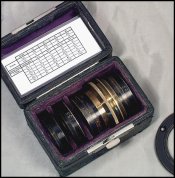
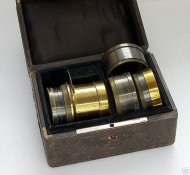
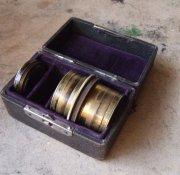
I've started setting up a website for casket sets, since there seems to be very little information about these to be found on the internet - and quite a lot of the missing information is general enough to apply to most sets. And of course some of what can be found is just wrong...

Since many of the users of this forum tend to use old and/or "antiquated" equipment, I figure there must be at least one or two who has a casket set or two? FWIW, I have about eight...

If anyone has pictures shot with (or of) casket sets, or indeed any other information, I would be very happy for anything that can be useful for the website.

Oh - before I forget: The site will be at www.casket-set.com, as soon as I get around to it. :smile:

Thanks for all and any help!
 
Feel free to use anything in my Busch Vademecum thread--

(there was a url link here which no longer exists)
 
Thanks, David!

I now have two of these "Buschian Vademecum-y" casket sets, both with a barrel and 7 cells from 15 to 75cm focal lengths. Neither of them have the corrector plates, and neither has the "Busch" name on them anywhere. But both are Aplanats, and to all practical purposes identical - to each other and the "original".

I've hunted around and got a scan of the original instrucions. Then I set up a simple spreadsheet to calculate apertures and focal lengths disregarding cell spacing and front cell enlargement effects on the virtual aperture - and got exactly the same results! :smile:

This one is from a different casket set, which has one rear cell which seems to have been designed for maximum coma:
Coma.jpg
 
You becoming a mortician in your spare time?:smile:

I was a bit surprised that the domain name was free, I figured someone would have marketed the "King Tut Multiple Casket Burial Set" by now...
 
Ole,
I have a casket set too. However, I think that that it is the barrel plus seven lenses. The lenses are from 15 to 75. Somewhere I might have a picture I took with it.
 
Diane, would that be something similar to this?

Dead Link Removed
 
I have a small casket set with no makers name, although I've seen similar ones sold under the ICA name. I've had it for years but never got around to mounting it on a board and taking it out for a spin.
 

Attachments

  • casket1.jpg
    casket1.jpg
    107.9 KB · Views: 526
That looks a lot like the smaller Busch set for formats, I'm guessing, 4x5" and smaller mainly. I think there's a catalogue on the Camera Eccentric website.
 
I've got one of those too - mine is marked "Meteor", and may have been made by Rodenstock. It's not a Busch set at least, since the lenses are meniscii and not achromats. The difference is visible on the resulting pictures.


Here's another one of mine, the small one that was responsible for the comatose picture of a nice Italian church. :smile:
 

Attachments

  • 6424_3.JPG
    6424_3.JPG
    56.5 KB · Views: 445
ole.
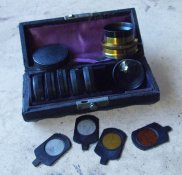
As you know I have this Busch Vademecum. I think one lens is missing as there are only 6 in the set.
on the other hand there are 4 filters. one look orange/yellow - the other dark orange/brownish..
and then two more..

see picture. Fantastic condition.

then I have another without markers name.
 

Attachments

  • DSCF1227.jpg
    DSCF1227.jpg
    62.5 KB · Views: 360
  • DSCF1246.jpg
    DSCF1246.jpg
    62.3 KB · Views: 409
My Busch Vademecum is also missing one cell--the 15cm. The two clear "filters" are to adjust for chemical focus shift with UV sensitive plates. There's an explanation of how to use them in the instruction sheet.
 
Does any one have one where all the lenses are bayonet mount to a common barrel instead of screws? Pics by saturday of my partial set.
 
Do we "lesser educated" have to wait for your website before we get a full explenation on what is a casket set. :smile:
I understand from the pics that it is something like modular lenses you can put together as you wish to create the focallength you want but.........................?????????????
kind regards
 
There's the Staeble Polyplast, where the rear cell is fixed and the front cell is changed through a bayonet mount - is that the one? I have a partial one of those too...
 
Søren,

A "casket set" is a lens kit with several different lens cells which all fit in a common barrel. Since seven different focal cells can be combined in 18 different ways (7 singles, 6 doubles with minimal FL difference and 5 doubles with 2 steps difference), carrying one of these was a lot easier than carrying corresponding "fixed focal length" lenses.

A triple convertible is a lens where front and rear cell can be used alone as well as combined, giving three different focal lengths in one barrel or shutter. If you add a third lens cell and put it all in a nice little box, you would have a six-focal length casket set. The "casket" refers to the box.
 
For sure I will open my "treasure chest" in these days...some photos will arrive soon.
Jim I have three casket sets with bayonet mount:
Meyer Plasmat in Compur shutter.
Staeble Polyplast in Compur shutter
Rodenstock Eikonar in Compur shutter
and one partially because only the back lenses are bayonet mounted and this is a Suter without shutter.
Some others are present and one is a Meyer casket sets for stereo.
Have some patience Ole & CO. I'm a little bit lazy :smile:))
 
Søren,

A "casket set" is a lens kit with several different lens cells which all fit in a common barrel. Since seven different focal cells can be combined in 18 different ways (7 singles, 6 doubles with minimal FL difference and 5 doubles with 2 steps difference), carrying one of these was a lot easier than carrying corresponding "fixed focal length" lenses.

A triple convertible is a lens where front and rear cell can be used alone as well as combined, giving three different focal lengths in one barrel or shutter. If you add a third lens cell and put it all in a nice little box, you would have a six-focal length casket set. The "casket" refers to the box.

So while this seem to be the ansver to uor dreams what are the tradeoffs?
Well I see one in your pic in this thread.
Kind regards
 
That picture isn't fair - I have another one shot with a different rear cell of the same focal length, same front cell, which is perfectly sharp from corner to corner. Unfortunately the box I kept the negatives in leaked light (which you can see at the top of the "comatose" picture), and that negative looks really really bad. :sad:

The tradeoffs are:
Somewhat poorer performance since the cell spacing is fixed for the whole set,
Limited max aperture for the longer lenses,
you need a conversion table for the aperture (except the Polyplast)
Noone has made one for at least 50 years (with the exception of Ron Wisner), so it will be old and most likely uncoated.
 
You can make your own G-claron or Symmar casket set from modern or fairly modern lens cells. The real problem is that nobody makes long focal length cells that fit into the same shutter as the shorter lengths. Most of the cheaply available plasmat series jump into a Copal 3 shutter at 240 (plasmats) or 360 (dialytes) so it is hard to assemble a set with a decent range of focal lengths.

But, with a Copal 1 and the cells from a 150 and a 210 Symmar you can get a lot done. 150 and 240/270 mm G-claron cells give you a bit more range (but with larger gaps).
 
You can make your own G-claron or Symmar casket set from modern or fairly modern lens cells. The real problem is that nobody makes long focal length cells that fit into the same shutter as the shorter lengths. Most of the cheaply available plasmat series jump into a Copal 3 shutter at 240 (plasmats) or 360 (dialytes) so it is hard to assemble a set with a decent range of focal lengths.

But, with a Copal 1 and the cells from a 150 and a 210 Symmar you can get a lot done. 150 and 240/270 mm G-claron cells give you a bit more range (but with larger gaps).

This sounds interesting. I have a 150mm APO symmar so if getting a 210 what can I do with those?

Ole I don't mind lenses being old. on the contrary :smile:
Kind regards
 
Dr. Staeble Polyplast Casket Set

There's the Staeble Polyplast, where the rear cell is fixed and the front cell is changed through a bayonet mount - is that the one? I have a partial one of those too...

I use a Staeble Polyplast set, purchased from Dagor77 a few years ago. It has 105mm, 135mm, 165mm, and 195mm front elements, and 220mm by using the rear element alone. It is set in a tiny little Compound shutter, and the front components bayonet in, each with its own aperture scale on the lens.
It is a wonderful, sharp lens with beautiful bokeh. There is a +1/8" focus shift on stopping down (except the 220mm element is -1/8").
It came in a tiny little box for holding the three unused elements and three screw-in filters. (I don't know where I'm supposed to put the 4th element when using the rear element alone).
 
This sounds interesting. I have a 150mm APO symmar so if getting a 210 what can I do with those?

I don't know how well the single cells of the more modern Symmars perform (-S, Apo, Apo-L). Supposedly the older plain Symmars, which are often labelled "Convertible" have single cells that are better corrected for coma.

A 150 and a 210 Symmar will give you a roughly 180 mm lens if you use one element from each lens. The cells are not fully symmetric (despite the name) so there are in theory four possible combinations which will all have slightly different focal lengths and aberrations. However, because the No. 1 shutter has different front and back threads there are only two combinations which are practical, so there's not so much to test.

The rear cells of the 150 and 210 used alone then give you 265 and 370 mm. The imaging is acceptable, especially if you are using LF for creamy tones rather than edge-to-edge biting sharpness.

Not a bad spread, but there's no way of bodging the equivalent of the older sets' 750 mm cell.
 
Ole,
It is pretty similar to that, but there is no maker's name on it.

That's pretty definite then - I've got another one "pretty similar to that, but there's no maker's name on it". As far as I've been able to determine, Chr. Fr. Winter & Sohn were instrument makers and Fine Cabinet Makers, and didn't make lenses at all. But they made some very beautiful cameras, like the one I bought to get this casket set. I sold it shortly after, since I already had several better ones. :smile:
 
Photrio.com contains affiliate links to products. We may receive a commission for purchases made through these links.
To read our full affiliate disclosure statement please click Here.

PHOTRIO PARTNERS EQUALLY FUNDING OUR COMMUNITY:


Ilford ADOX Freestyle Photographic Stearman Press Weldon Color Lab Blue Moon Camera & Machine
Top Bottom