




Andreas Thaler
Subscriber
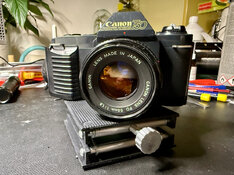
The Canon T50 with FD lens mount was launched in 1983 as the first model in the T-series.
- Designed for beginners, it offers program automatic mode with manual focus and motorized film transport.
- After exposure, the film is rewound into the cartridge manually using a crank.
- It has a built-in vertical focal-plane shutter with metal blades.
- The body is made of high-quality plastic and is solid.
- The camera is heavy, which suggests a high proportion of metal parts inside.
of the popular top-of-the-line T90 model, the T50 is not often seen today.
This is unjustified, because in my opinion it is an elegant electromechanical SLR that is very well made.
As far as I have seen
there are no service/repair projects for the Canon T50 on the web yet.
As with the T90, we will take the lead and take a detailed look at the T50.
- To do this we will remove the mirror box and make comparisons with the Canon T90, which followed in 1986.
- As always, we will perform a complete check with a camera tester,
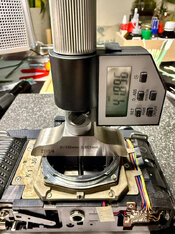
- measure the focal flange distance with a depth micrometer,
- and check the rangefinder system with an autocollimator.
- Where necessary, we clean, lubricate, and adjust.
- Two additional T50s are available as spare parts for any repairs.
All known technical documentation for the Canon T50 is available in its entirety:
- Canon T50 Repair Guide
- SPT Journal SPT Journal, November - December 1984
- C & C Troubleshooting Guide
- Canon T50 user manual
Notes:
- Although the T50 feels heavy in the hand (which suggests a higher proportion of metal in its construction), according to the Canon Repair Guide, the proportion of plastic is high. This means that special care is required when working with solvents, applying oil and grease, and soldering.
- After reviewing the Canon Repair Guide and SPT Journal, no complications are expected when opening and removing the front panel due to its relatively simple construction.
- Since the T50 does not have a B (bulb) shutter setting (for long exposures) but only P (program automatic), a workaround must be used to measure the focal flange distance (described in the repair manual). To do this, the camera is triggered with the lens and eyepiece covered, and the batteries are immediately removed. Since the camera sets a long exposure time due to the darkening, the shutter remains open. The focal flange distance can now be measured through the film window. Once the batteries are installed, the T50 can close the second shutter curtain electronically via a solenoid.
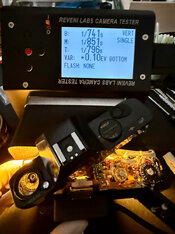
- The shortest shutter speed is 1/1000 second. It is always achieved with the back door open. This allows the camera tester to measure the curtains travel times at this critical shortest shutter speed.
- The first shutter curtain, C1, can be adjusted via the bottom of the T50. C2 can only be adjusted after removing the front panel.
- The automatic exposure can be adjusted via a single trimpot.
- The service procedures for the electronically controlled vertical focal-plane shutter are exceptionally well documented.
- We will thoroughly examine the T50 and assess its condition.
- Since we also want to inspect the interior, we will remove the front panel. This is otherwise only necessary if both shutter curtains need to be adjusted or the mirror box mechanism needs servicing.
I rate the T50’s external condition as B; there are signs of wear but no signs of damage.
Mirror shock absorber and light seals
The mirror shock absorber is like new. There are virtually no light seals; instead, there are light traps on the back door.
Functionality
All camera functions operate as expected; there are no noticeable issues or problems.
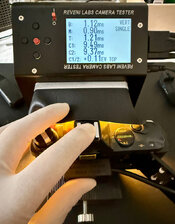
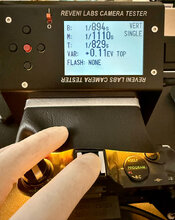
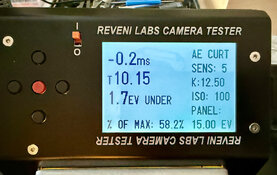
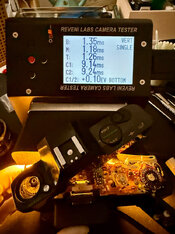
Performance on the camera tester
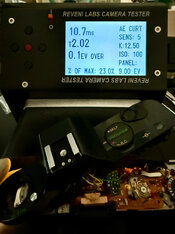
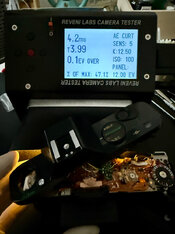
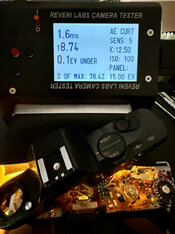
- The curtains travel times differ slightly from one another, but this has only a minimal effect on the uniformity of the film exposure (+0.11 EV at a shutter speed of 1/1000 second).
- The 1/1000 second is formed correctly.
- There is nothing to improve here.
- The program mode exposes at various EV values with approximately -1.5 EV.
- I will try to adjust that.
No abnormalities.
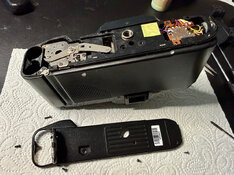
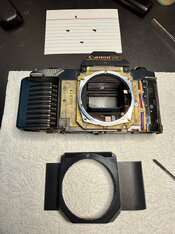
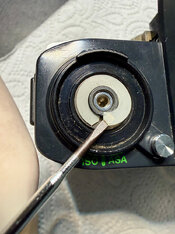
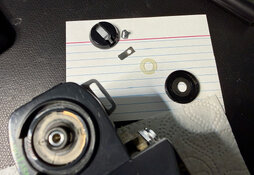
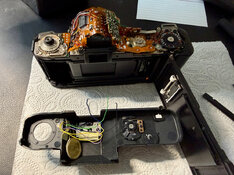
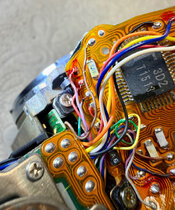
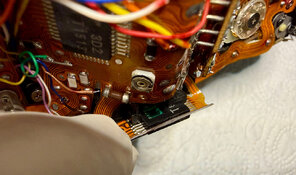
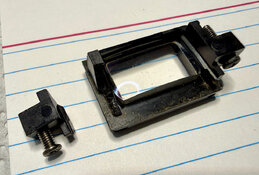
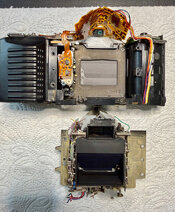
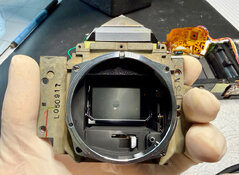
Removing the front plate with mirror box
- The procedure is described step by step in the SPT Journal, November/December 1984. No complications.
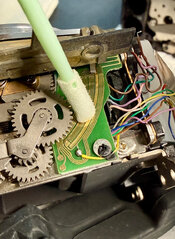
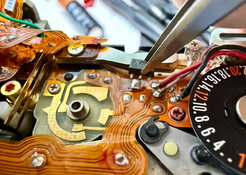
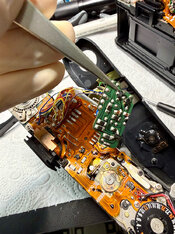
- A few wires need to be desoldered.
- When reassembling, care must be taken not to overtighten the screws in the plastic housing.
- There is a plastic split ring under the ASA dial. Be careful when bending it open so that it does not break.
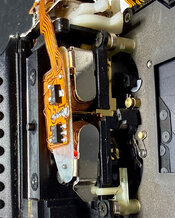
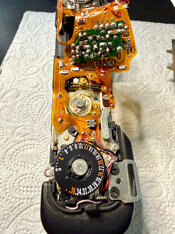
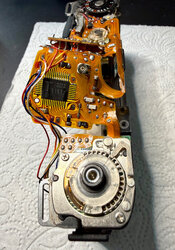
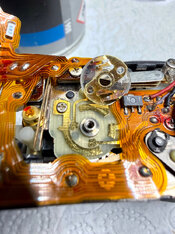
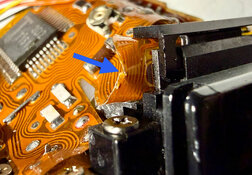
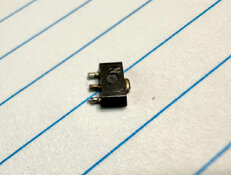
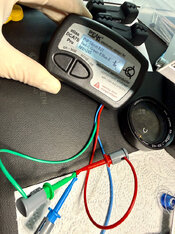
- The T50 has two ICs. IC1 is located behind the eyepiece and contains the silicon photodiode for exposure metering. IC2 is located on the top side of the flexible circuit board (reverse side) and, among other things, converts the analog signal from IC1 into a digital signal. IC2 also calculates the shutter speed and houses the clock generator operating at 58 to 60 kHz.
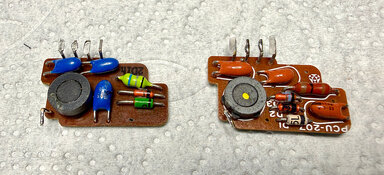
- A DC/DC converter on the top of the board, wind side, provides various supply voltages derived from the two AA batteries, each rated at 1.5 volts.
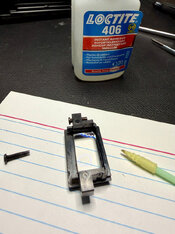
- When removing the eyepiece, I noticed that the plastic mount is broken in one spot. This can be glued back together.
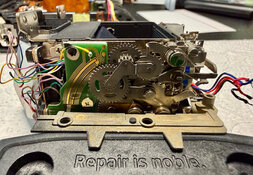
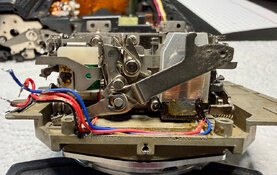
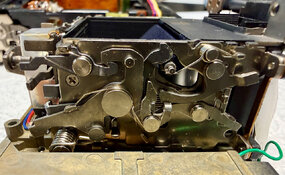
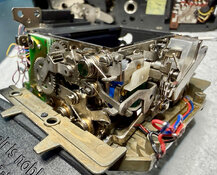
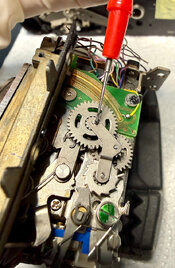
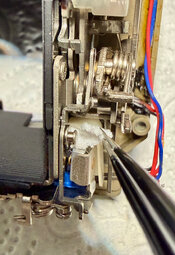
- The mirror box mechanism is solid and of high quality, similar to that of the T90 (especially the aperture control mechanism). Together with the die-cast front plate, this unit accounts for the T50’s considerable weight.
- The housing is made of plastic.
- Two solenoids are visible on the vertical focal-plane shutter.
- Check the mechanical components for proper lubrication.
- Reassembly.
- Measure the focal flange distance using a depth micrometer.
- Adjust the automatic exposure system.
- Check all functions and test on the camera tester.
- Exposing color negative film during a walk through downtown Vienna.
Last edited:



 A word of caution