

• Welcome to Photrio!
    Registration is fast and free. Join today to unlock search, see fewer ads, and access all forum features.
    Click here to sign up

Canon T50: A closer look at service and technology

Tablao Flamenco

A
Tablao Flamenco

  • 1
  • 0
  • 38
Untitled

A
Untitled

  • 1
  • 2
  • 91

Forum statistics

Threads
204,332
Messages
2,867,221
Members
102,225
Latest member
Narsanam
Recent bookmarks
0

Andreas Thaler

Subscriber
Joined
Nov 19, 2017
Messages
5,176
Location
Vienna/Austria
Format
35mm
A.jpg


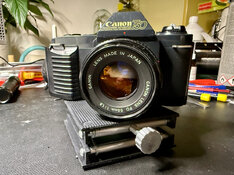
The Canon T50 with FD lens mount was launched in 1983 as the first model in the T-series.
  • Designed for beginners, it offers program automatic mode with manual focus and motorized film transport.
  • After exposure, the film is rewound into the cartridge manually using a crank.
  • It has a built-in vertical focal-plane shutter with metal blades.
  • The body is made of high-quality plastic and is solid.
  • The camera is heavy, which suggests a high proportion of metal parts inside.
In the shadow

of the popular top-of-the-line T90 model, the T50 is not often seen today.

This is unjustified, because in my opinion it is an elegant electromechanical SLR that is very well made.

As far as I have seen

there are no service/repair projects for the Canon T50 on the web yet.

As with the T90, we will take the lead and take a detailed look at the T50.
  • To do this we will remove the mirror box and make comparisons with the Canon T90, which followed in 1986.
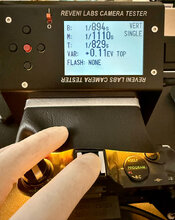
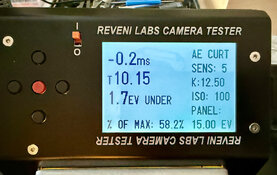
  • As always, we will perform a complete check with a camera tester,
  • measure the focal flange distance with a depth micrometer,
  • and check the rangefinder system with an autocollimator.
  • Where necessary, we clean, lubricate, and adjust.
  • Two additional T50s are available as spare parts for any repairs.
All work based on SPT Journal, Canon Service Manual, and C & C Troubleshooting Guide.

All known technical documentation for the Canon T50 is available in its entirety:
This makes it possible to perform comprehensive work on the T50.

Notes:
  • Although the T50 feels heavy in the hand (which suggests a higher proportion of metal in its construction), according to the Canon Repair Guide, the proportion of plastic is high. This means that special care is required when working with solvents, applying oil and grease, and soldering.
  • After reviewing the Canon Repair Guide and SPT Journal, no complications are expected when opening and removing the front panel due to its relatively simple construction.
  • Since the T50 does not have a B (bulb) shutter setting (for long exposures) but only P (program automatic), a workaround must be used to measure the focal flange distance (described in the repair manual). To do this, the camera is triggered with the lens and eyepiece covered, and the batteries are immediately removed. Since the camera sets a long exposure time due to the darkening, the shutter remains open. The focal flange distance can now be measured through the film window. Once the batteries are installed, the T50 can close the second shutter curtain electronically via a solenoid.
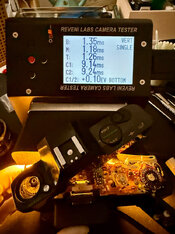
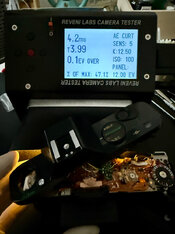
  • The shortest shutter speed is 1/1000 second. It is always achieved with the back door open. This allows the camera tester to measure the curtains travel times at this critical shortest shutter speed.
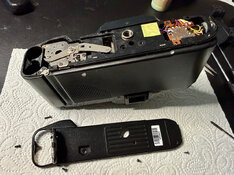
  • The first shutter curtain, C1, can be adjusted via the bottom of the T50. C2 can only be adjusted after removing the front panel.
  • The automatic exposure can be adjusted via a single trimpot.
  • The service procedures for the electronically controlled vertical focal-plane shutter are exceptionally well documented.
  • We will thoroughly examine the T50 and assess its condition.
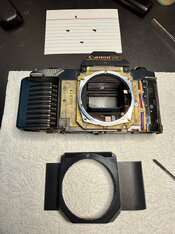
  • Since we also want to inspect the interior, we will remove the front panel. This is otherwise only necessary if both shutter curtains need to be adjusted or the mirror box mechanism needs servicing.
External appearance

I rate the T50’s external condition as B; there are signs of wear but no signs of damage.

Mirror shock absorber and light seals

The mirror shock absorber is like new. There are virtually no light seals; instead, there are light traps on the back door.

Functionality

All camera functions operate as expected; there are no noticeable issues or problems.
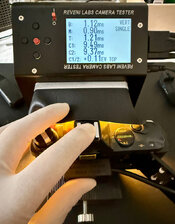
2026-03-23-12.29.22.jpg2026-03-23-12.29.28.jpg2026-03-23-12.29.41.jpg

Performance on the camera tester
  • The curtains travel times differ slightly from one another, but this has only a minimal effect on the uniformity of the film exposure (+0.11 EV at a shutter speed of 1/1000 second).
  • The 1/1000 second is formed correctly.
  • There is nothing to improve here.
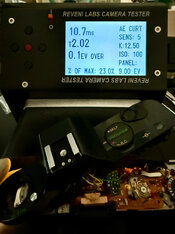
  • The program mode exposes at various EV values with approximately -1.5 EV.
  • I will try to adjust that.
Haptic and acoustic assessment

No abnormalities.
2026-03-23-12.29.49.jpg2026-03-23-12.29.56.jpg2026-03-23-12.30.04.jpg2026-03-23-12.30.10.jpg2026-03-23-12.31.24.jpg2026-03-23-12.31.33.jpg2026-03-23-12.31.58.jpg2026-03-23-12.32.07.jpg2026-03-23-12.32.32.jpg

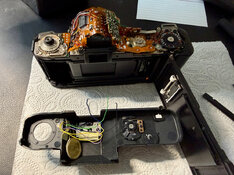
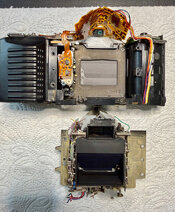
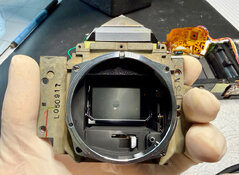
Removing the front plate with mirror box
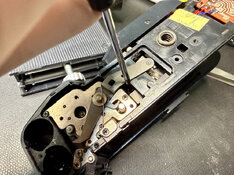
  • The procedure is described step by step in the SPT Journal, November/December 1984. No complications.
  • A few wires need to be desoldered.
  • When reassembling, care must be taken not to overtighten the screws in the plastic housing.
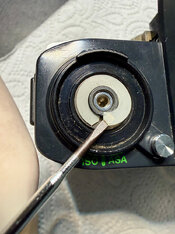
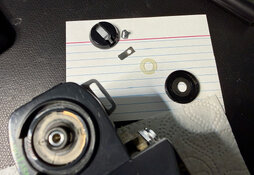
  • There is a plastic split ring under the ASA dial. Be careful when bending it open so that it does not break.
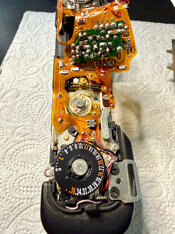
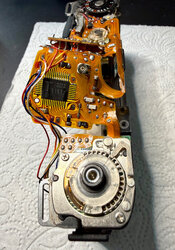
  • The T50 has two ICs. IC1 is located behind the eyepiece and contains the silicon photodiode for exposure metering. IC2 is located on the top side of the flexible circuit board (reverse side) and, among other things, converts the analog signal from IC1 into a digital signal. IC2 also calculates the shutter speed and houses the clock generator operating at 58 to 60 kHz.
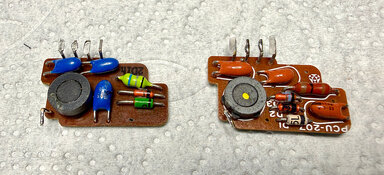
  • A DC/DC converter on the top of the board, wind side, provides various supply voltages derived from the two AA batteries, each rated at 1.5 volts.
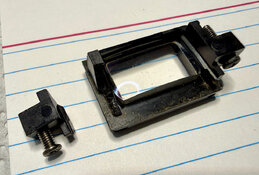
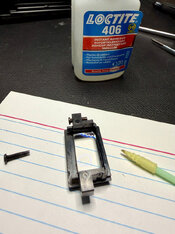
  • When removing the eyepiece, I noticed that the plastic mount is broken in one spot. This can be glued back together.
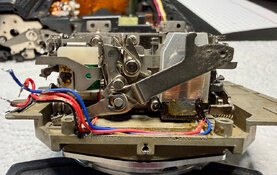
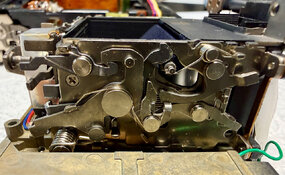
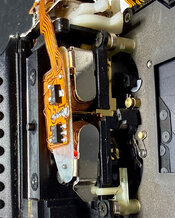
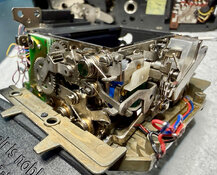
  • The mirror box mechanism is solid and of high quality, similar to that of the T90 (especially the aperture control mechanism). Together with the die-cast front plate, this unit accounts for the T50’s considerable weight.
  • The housing is made of plastic.
  • Two solenoids are visible on the vertical focal-plane shutter.
Next steps
  1. Check the mechanical components for proper lubrication.
  2. Reassembly.
  3. Measure the focal flange distance using a depth micrometer.
  4. Adjust the automatic exposure system.
  5. Check all functions and test on the camera tester.
  6. Exposing color negative film during a walk through downtown Vienna.
 
Last edited:
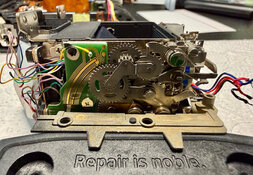
2026-03-23-12.32.45.jpg2026-03-23-12.32.51.jpg2026-03-23-12.33.02.jpg2026-03-23-12.33.09.jpg2026-03-23-12.33.22.jpg2026-03-23-12.33.29.jpg2026-03-23-12.33.34.jpg2026-03-23-16.45.21.jpg2026-03-23-16.45.31.jpg2026-03-23-16.45.36.jpg2026-03-23-16.45.43.jpg

Check the mechanical components for proper lubrication

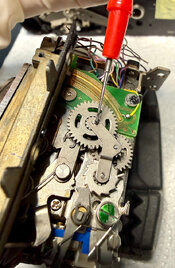
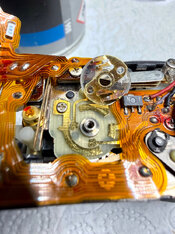
Just as our colleagues who work on mechanical SLRs do, I should also disassemble, clean, lubricate, and reassemble mechanical assemblies in the (electromechanical) T50. This is the only way to ensure that all parts work together seamlessly.

Dirt causes friction, which can slow down the mechanics. In critical systems like the T50’s electromechanical aperture control, this can affect the formation of the aperture.

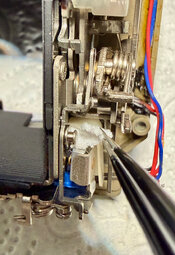
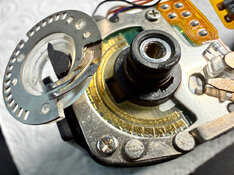
Here, a spring pulls a delicate wiper across a contact plate. This happens in a flash when the camera is triggered. The automatic exposure system stops the wiper when the aperture has reached its target value. Any malfunction in this mechanism must affect the aperture formation.

It is certainly feasible to disassemble the camera’s mechanics. As with the Canon T90, at the mirror box there should be three modules that can be removed and further disassembled. However, I don’t have any instructions for this, and there are numerous strong springs installed. There are also ways to adjust the mechanism. I doubt that I’ll be able to put it all back together so that it works flawlessly.

Therefore, I’m limiting myself to oiling the shafts in the aperture control where the gears turn. I’m also cleaning the aperture solenoid with a small strip of cloth and benzine. Dirty contacts in solenoids are always the prime suspects when an aperture control or shutter isn’t functioning as it should.

The lubrication on the sliding parts of the mechanism is still visible and intact.

2026-03-23-16.45.50.jpg2026-03-23-16.45.55.jpg2026-03-23-16.46.05.jpg

Cleaning contacts

In my experience, the electromechanical SLRs from the 1970s and 1980s are very effective at keeping dust and dirt out of their interiors. It’s almost always clean under the top covers, except for the edges.

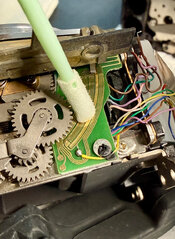
Nevertheless, over the decades, contacts can become contaminated by evaporated lubricants and fine dust, which impairs electrical conductivity and can lead to malfunctions or total failure.

That’s why I clean all accessible contacts with electronics cleaner.

There are also fine switching contacts inside the shutter, but I can only reach them by further disassembling the camera. Therefore, I skip cleaning them, since I have already checked the shutter speed on the camera tester and it is fine.
 
Last edited:
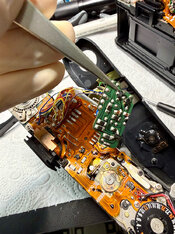
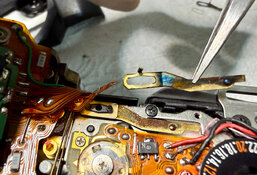
2026-03-23-16.46.13.jpg2026-03-23-16.46.19.jpg

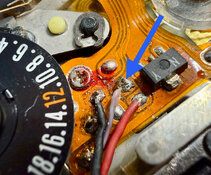
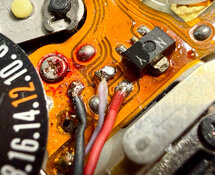
Resoldering a few solder joints that no longer look fresh

Although rare, faulty solder joints can be found in SLRs.

The insulation on the wires may have melted, or the solder joint may be cold—that is, it may not conduct electricity properly.

This can be caused by excessive heat during soldering, soldering for too long, poor workmanship, or corrosion of the solder joint.

Such solder joints can be quickly repaired:
  • Apply flux,
  • unsolder the wire,
  • apply new solder to the area,
  • apply flux again, and
  • solder the wire back on.
  • If the solder joint (when using lead-based solder) has a silvery sheen, the soldering is ok.
Here, I was able to improve a solder joint that didn’t look good.

2026-03-23-16.46.25.jpg2026-03-24-18.34.14.jpg2026-03-23-16.47.37.jpg

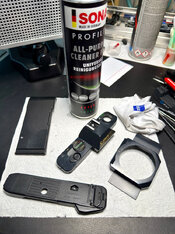
Cleaning plastic covers, glueing the broken eyepiece back together

The most thorough and easiest way to clean the covers is to remove them from the SLR. This allows you to reach every spot and avoids the hassle of cleaning hard-to-reach corners. It also ensures safe wet cleaning, as no liquid can get inside the camera.

However, you must be careful with switches and contacts integrated into the covers to prevent them from getting wet and corroding.

I clean the T50’s covers with plastic cleaning foam and a cloth.

I was able to glue the broken eyepiece back together. The break was clean, and the fracture line was barely visible afterward.

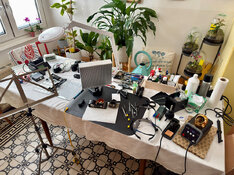
No matter what the project is, the table is always too small 😉

We'll finish our project by following these steps:
  1. Reassembly.
  2. Measure the focal flange distance using a depth micrometer.
  3. Adjust the automatic exposure system.
  4. Check all functions and test on the camera tester.
2026-03-24-18.34.21.jpg2026-03-24-18.34.36.jpg2026-03-24-18.34.44.jpg2026-03-24-18.35.40.jpg2026-03-24-18.35.56.jpg2026-03-24-18.36.04.jpg2026-03-24-18.36.17.jpg2026-03-24-18.36.24.jpg

The workday brought some surprises

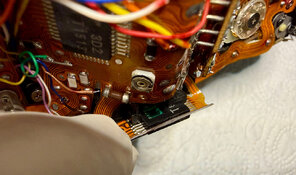
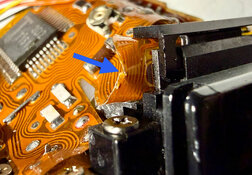
While assembling the T50, I damaged the flexible circuit board next to the eyepiece with the screwdriver. I was able to fix that.

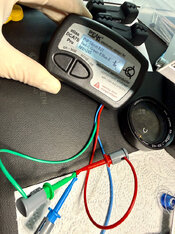
Afterward, I connected the motor’s terminals to my lab power supply to test its function. But the motor didn’t move.

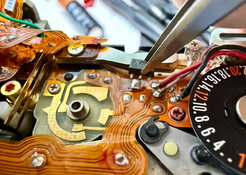
During the subsequent troubleshooting, I noticed that the camera triggers when I press the shutter release button and touch the DC/DC converter with the screwdriver. This behavior didn’t make sense to me, as I couldn’t see any connection here.

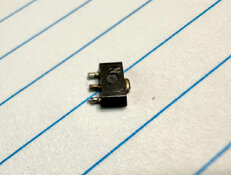
Nevertheless, I replaced a transistor, a switch, and the DC/DC converter, which didn’t solve the problem.

Therefore, I had to give up on this T50.

But that's okay, because we've seen here how the T50 can be disassembled and serviced.

There are always valuable spare parts left over for future projects 🙂
 
Last edited:
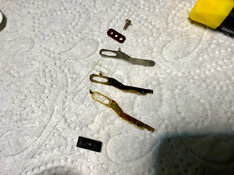
I’m continuing to work on a second T50

whose battery compartment cover was broken, so I replaced it.

I also reinstalled the switch and the DC/DC converter that I had used in the first T50.

2026-03-24-18.36.45.jpg2026-03-24-18.37.14.jpg2026-03-24-18.37.20.jpg

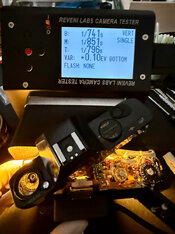
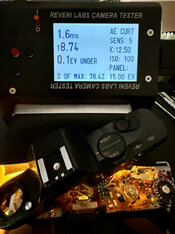
I was able to adjust the curtains travel times, which minimized the exposure error at 1/1000 s.

The shutter speeds are a bit on the slower side.

To correct this, I would have to adjust both shutter curtains, which can only be done by removing the shutter.

It’s not worth the effort.

2026-03-24-18.36.57.jpg2026-03-24-18.37.02.jpg2026-03-24-18.37.08.jpg

The automatic exposure system showed a flawless result on the camera tester.

2026-03-24-18.37.28.jpg

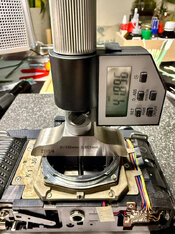
The focal flange distance is perfect. Target: 41.900 mm. Measurement: 41.896 mm.

2026-03-24-18.37.33.jpg

All camera functions seem reasonable.

Conclusion
  • It’s always a shame when an SLR has to be scrapped because a fault can’t be fixed. But this project did provide new insights, and I was able to learn from it. I’ll definitely keep the spare parts.
  • The important thing for this report is to show the individual steps and to get to know the T50 from the inside as well, which I have succeeded in doing.
  • I will continue to study my technical documentation; this mysterious electronic fault is still on my mind.
  • All in all, the T50 is easy to maintain. The internal components are solid, and it’s as easy to use as Canon promised its target audience back then. Load the film, look through the viewfinder, and press the shutter button.
  • A simple yet excellent SLR.
+++

⚠️ A word of caution

Please keep in mind that you’ll be using highly flammable solvents for service work, and their fumes are harmful to your health. Soldering also produces fumes that should not be inhaled. Dangerous high voltages can be present when handling electronics, especially in conjunction with electronic flash units and mains. Therefore, familiarize yourself with the safety regulations beforehand and ensure your safety. Depending on the activity, protective gear may be advisable.

All information provided without guarantee and use at your own risk.
 
Last edited:
Photrio.com contains affiliate links to products. We may receive a commission for purchases made through these links.
To read our full affiliate disclosure statement please click Here.

PHOTRIO PARTNERS EQUALLY FUNDING OUR COMMUNITY:


Ilford ADOX Freestyle Photographic Stearman Press Weldon Color Lab Blue Moon Camera & Machine
Top Bottom