• Welcome to Photrio!
    Registration is fast and free. Join today to unlock search, see fewer ads, and access all forum features.
    Click here to sign up

Canon EF lens mount question - ~200 mm lenses

1972

A
1972

  • 12
  • 7
  • 128

Recent Classifieds

Forum statistics

Threads
202,588
Messages
2,842,784
Members
101,394
Latest member
Marketa
Recent bookmarks
0

dynachrome

Member
Allowing Ads
Joined
Sep 16, 2006
Messages
1,860
Format
35mm
My Canon EF lens mount film camera collection is a modest one. I have a number of Rebel models and mostly used a G. I have a 35-80 III, a 50/2.5 with the Life Size converter, a 50/2.8 Sigma Macro, one of the Cosina-made 100/3.5 Macros and a Tamron 28-200 AF. I think I also have another 90 or 100 macro. I want something sharper at the 200 end but I am not yet serious enough with the EF mount to get an 80-200/2.8 or a 70-200/2.8 or a 200/2.8. When the AF era started, Nikon and Canon and Minolta did not make plain 200/4 non-macro fixed focal length lenses. I also don't know how secure the f/2.8 lenses would be on the plastic mount of a Rebel. Are there any original Canon EF lenses in the 80-200 range that are slower than f/2.8 but sharp at the long end? The same question for third-party lenses in EF mount.
 
Last edited by a moderator:
Thread title and first post tweaked at least in part to avoid confusion with the Canon EF camera which, confusingly, didn't fit Canon EF lenses.
 
Last edited:
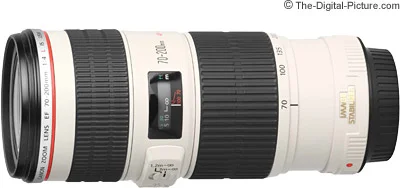
Canon 70-200mm EF f/4 IS USM, both the -I and the -II USM versions, is quite sharp! in fact, higher resolution measurements than the f/2.8 version of that zoom range, as tested by photozon.de
 
FWIW, the lens mount is designated Canon EF, which fit on cameras in the Canon EOS line.
And yes, things could have been done more simply.
 
Sorry for the title confusion. I also have several Canon EF 35mm SLR cameras. I will look into the 70-200/4 lenses. In the interim, I ordered a Nikon F to Canon EOS EF lens mount adapter. A 200/4 'K', AI or AIS Nikkor shouldn't strain the lens mount of an EOS Rebel film camera too much. I know there would be no metering or AF so the combination would not be for action photography.
 
I will look into the 70-200/4 lenses.

You may be able to find the initial 70-200/4 non-IS version for a modest price. I used to have that lens back in the day. It was quite likely the sharpest lens I've ever owned.
The IS version will be easier to hand-hold at somewhat longer shutter speeds. Optically, it will amount to roughly the same. But it'll command a significantly higher price on the second hand market. If you're budget-aware on this purchase, consider the original non-IS version.
 
You may be able to find the initial 70-200/4 non-IS version for a modest price. I used to have that lens back in the day. It was quite likely the sharpest lens I've ever owned.
The IS version will be easier to hand-hold at somewhat longer shutter speeds. Optically, it will amount to roughly the same. But it'll command a significantly higher price on the second hand market. If you're budget-aware on this purchase, consider the original non-IS version.

I bought the 70-200 4L (non IS) when I was shooting only digital. By that time around €450, but prices fluctated quite a bit around that time, due to the rate of the yen. Non IS 2.8 and 4.0 IS where around 1000 and 2.8 IS €1900 or so. All above my budget as high school student. If I remember correct the 4.0 IS was optically a bit better than the 4 non IS but the non IS is as well excellent quality I would say. Maybe I time to take it out again, soon.
 
You may be able to find the initial 70-200/4 non-IS version for a modest price. I used to have that lens back in the day. It was quite likely the sharpest lens I've ever owned.
The IS version will be easier to hand-hold at somewhat longer shutter speeds. Optically, it will amount to roughly the same. But it'll command a significantly higher price on the second hand market. If you're budget-aware on this purchase, consider the original non-IS version.


A few of these slender "white knights" have been seen recently, and at least two not on EOS bodies!
The EF 70-200mm f4/L (non-IS) has been a staple in my EOS kit since late-2003 (bought in Hong Kong). Back then and up until about late-2005 it was often used at weekend water sports at a timeshare resort that I was invested in. Most certainly exceptionally sharp, beautiful crisp contrast and perfectly balanced, unlike the f2.8 version that was fancied by bushwalkers and rock climbers but fell out of vogue for its weight and girth — also the slender lines of the f4 version are a winner for many people.

Here's a definition of modest: a lens is up on fleabay for AUD$700 locally (Alderley, QLD) albeit sans-tripod collar, which I do consider a must-have). [no relation to the seller].
 
If I remember correct the 4.0 IS was optically a bit better than the 4 non IS

I remember the opposite and that the hypothesis was that the moving IS group somehow affected the optimization of the optical design negatively. However, I never attributed much value to this discourse which to me sounded like splitting hairs; AFAIK all Canon 70-200 L lenses are absolutely excellent and leave nothing to desired in terms of optical quality.

also the slender lines of the f4 version are a winner for many people.
It's a more modest lens in terms of bulk and weight; I think that's certainly a relevant matter.
 
The sports photographer for the old Mesa Trib had both the 2.8 and 4.0, she used the 2.8 for indoor events or when she wanted a very shallow depth of field, otherwise she though the F4 was sharper and lighter.
 
Same weight.

1768322420362.png
 
I remember the opposite and that the hypothesis was that the moving IS group somehow affected the optimization of the optical design negatively. However, I never attributed much value to this discourse which to me sounded like splitting hairs; AFAIK all Canon 70-200 L lenses are absolutely excellent and leave nothing to desired in terms of optical quality.


It's a more modest lens in terms of bulk and weight; I think that's certainly a relevant matter.

Actually, old write-ups did support the fact that IS version was optically a bit superior to non-IS predecessor. For example:

"And the 70-200 f/4 IS delivers incredibly in this area. The f/4 IS lens adds 2 elements and 4 groups to the non-IS lens. From what I can see, the additional glass has not adversely affected image quality in any way.​
This lens is extremely sharp wide open and from corner to corner even on a full frame body. There is little improvement when stopping down - the f/4 IS starts out sharp wide open. Impressive performance.​
The non-IS 70-200 f/4 is similarly sharp in the center over the mid and long portion of the focal length range, but the f/4 IS is sharper in the center through 85mm or so and is noticeably sharper in the corners over most of the focal length range. These two lenses are most similar at 200mm. These differences are reduced as the subject distance is increased (the non-IS lens performs more similarly to the IS lens). The f/4 IS and f/2.8 IS 70-200mm L lenses are similarly sharp at identical aperture and focal length settings."​
The subjective opinion expressed by owners of both was often 'the same' in optical performance, however.

One reply does quote both photozone.de testing for both lenses, in which objective tests show superiority of the IS version...
Unfortunately the photozone.de reviews of the non-IS version are no longer available direcly from its current website listing of test reports, and the tests available via the above link use a lower resolution digital sensor camera, so the resolution values are not appropriate to higher resolution sensors; but the relative superiority of the IS version are borne out in the reported lens resolution values.

 
Last edited:
Nth-ing the 70-200/4 IS for a small walk around lens. The 200/2.8 is quite small as well, don't underestimate that it's almost 1.5" shorter than the 70-200s which pushes the weight closer to the camera and helps a lot with handling. There is a Sigma 180mm f/5.6 UC Macro lens that's pretty small, but frankly I wouldn't expect it to be anywhere near as sharp or fast focusing as the Canon lenses. The other 180/200 macros, Canon, Sigma, and Tamron, are all similar sized to a 70-200, at that point you'd likely be better served with the flexibility of a zoom.
... I also don't know how secure the f/2.8 lenses would be on the plastic mount of a Rebel...
Not worth a second thought to determine your lens choice. The plastic lens mount is plenty strong, the primary concern I've seen is wear if you're changing lenses a dozen times a day, every day, as a pro. I've hung a 300/2.8 off a Rebel and it didn't feel any less secure than something like a EOS 650 with a metal mount.
 
I've hung a 300/2.8 off a Rebel

With lenses like that, I think of it more as hanging a Rebel off of the lens!
 
With lenses like that, I think of it more as hanging a Rebel off of the lens!

And yet so many talk about handholding a camera body with long lens as being 'easier' with a certain body shape/weight...the reality is center of balance might be moved a bit along the lens barrel! 🤨
 
I suppose that when my adapter arrives, I can try it with a 200/4 and also with a 180/2.8.
 
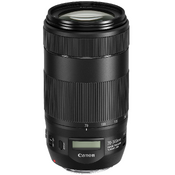
What about Canon EF 70-300mm f/4-5.6 IS USM
 
What about Canon EF 70-300mm f/4-5.6 IS USM

OK for consideration if the longer FL is really needed, but 70-300mm ;enses from Canon are generally noticeably lower quality image than the 70-200mm zooms
 
OK for consideration if the longer FL is really needed, but 70-300mm ;enses from Canon are generally noticeably lower quality image than the 70-200mm zooms


I think it might be a different lens, but in 1995 I owned Canon's first * (70 or 75)~300 f5.6 lens with image stabilisation. Frankly, that was a lousy piece of work: focus was inaccurate, IS rapidly drained a 2CR5 battery of the EOS 5 or 50E; image quality with IS active was pitiful, the operational noise was enough to wake the dead and critically, the lens lacked the nuanced balance and ease of handling that became a trademark with later Canon zooms (besides the L-series which they'd already organised). Probably owned this lens (70-300?) for less than 4 months when it was jettisoned. Following that, I had a term loan (through Canon Professional Services) of a 200mm prime in the period late 1995 to 2004 when in May 2004 the 70-200mm f4L came along. And lived happily ever after...
 
Is the "IS" designation moot when using film anyway? Or have I been operating under a misconception all of these years?

At any rate, I've been pretty happy with this lens so far;

1768495807327.png
1768495807327.png
 
Is the "IS" designation moot when using film anyway?

No, it's not moot at all. IS on Canon lenses stands for Image Stabilization. It refers to a lens group inside the barrel that moves to counteract motion blur. It doesn't care by definition whether the projected image ends up on film or a digital sensor.
 
No, it's not moot at all. IS on Canon lenses stands for Image Stabilization. It refers to a lens group inside the barrel that moves to counteract motion blur. It doesn't care by definition whether the projected image ends up on film or a digital sensor.

Correct. IS works on every EOS camera ever made, I'm using one on my ancient EOS 650, just as as intended.

The EOS system offers a level of compatibility never before seen in the autofocus camera world. The announcement of the EOS system in 1987 was a painful experience for many Canon FD users who suddenly felt orphaned, but almost 40 years later the EOS system still delivers 100% compatibility. Even though the EF mount is now history, EF lenses remain fully compatible with Canon’s latest mirrorless camera mount.
 
No, it's not moot at all. IS on Canon lenses stands for Image Stabilization. It refers to a lens group inside the barrel that moves to counteract motion blur. It doesn't care by definition whether the projected image ends up on film or a digital sensor.

I knew what it is/was, I just didn't remember the introductory marketing hype (gain a stop or two?) and only really paid attention once digital hit its stride so to speak. If my camera doesn't have some type of built-in stabilization, I should get a lens that has it. That type of thinking. I see your point though, why would it matter if the light is hitting film or a sensor. I need to think about what I am typing sometimes.
 
Photrio.com contains affiliate links to products. We may receive a commission for purchases made through these links.
To read our full affiliate disclosure statement please click Here.

PHOTRIO PARTNERS EQUALLY FUNDING OUR COMMUNITY:


Ilford ADOX Freestyle Photographic Stearman Press Weldon Color Lab Blue Moon Camera & Machine
Top Bottom