
-
Welcome to Photrio!Registration is fast and free. Join today to unlock search, see fewer ads, and access all forum features.Click here to sign up
- Home
- Forums
- Analog Workflow Forums (100% Analog/Traditional)
- Analog Equipment
- Medium Format Cameras and Accessories
You are using an out of date browser. It may not display this or other websites correctly.
You should upgrade or use an alternative browser.
You should upgrade or use an alternative browser.
Can other lenses be mounted on 6x6 folders?
-
A
- Thread starter 68degrees
- Start date

Recent Classifieds
-
For Sale 4 vintage 35mm metal film canisters: Ilford, Kodak, Ansco, Adox
- Started by Jon Shiu
-
Sold SOLD! RW Vacuum Fidelity Elite 4x5 (5 units) & 8x10 (4 units) Film Holders
- Started by B.S.Kumar
-
Sold Cable Release Adapters for Leica, Nikon, Yashica, Rollei
- Started by Jon Shiu
-
Free Stoesser Pin Registration Punch
- Started by Roger Thoms
Forum statistics


Large format cameras either have movable bellows, or are designed to mount focusing lenses. I don't know of any folders that are setup that way.
It would depend on the camera and the lens.
Of the folders I have, there doesn't appear to be much standing in the way of swapping lenses beyond the effort of removing them in-tact, and then reseating them in another body at a suitable "Base distance" from the film-plane...
Of the effort involved in checking focus makes me assume that it would be far more practical in most cases to just get a second camera if I wanted a different lens.
Of the folders I have, there doesn't appear to be much standing in the way of swapping lenses beyond the effort of removing them in-tact, and then reseating them in another body at a suitable "Base distance" from the film-plane...
Of the effort involved in checking focus makes me assume that it would be far more practical in most cases to just get a second camera if I wanted a different lens.

The new lens would have to be the same focal length and shimmed to get the focus correct. I've done it, not much fun. It's easier to buy a view camera and a pile of lenses to play with.
Dan Fromm
Member
- Joined
- Mar 23, 2005
- Messages
- 6,973
- Format
- Multi Format
2x3 Graphics fold and can be used with a surprising range of focal lengths. Those with Graflok backs accept 6x6 roll holders.
The 35/4,5 Apo Grandagon, the shortest lens that will cover 2x3, will focus on a Century/2x3 Crown. The longest lens that will work comfortably on a 2x3 Pacemaker Speed Graphic is the 12"/4 TTH Telephoto as supplied for Vinten F.95, Williamson F.134 and AGI F.139 cameras.
The 35/4,5 Apo Grandagon, the shortest lens that will cover 2x3, will focus on a Century/2x3 Crown. The longest lens that will work comfortably on a 2x3 Pacemaker Speed Graphic is the 12"/4 TTH Telephoto as supplied for Vinten F.95, Williamson F.134 and AGI F.139 cameras.
pentaxuser
Member
Sticking strictly to the question, I have never heard of any 6x6 folders where the lens length can be changed. I had thought that they all came with normal lengthe lenses. The pertinent question for the OP may be: Is it possible to get different folders that cover a range of lens lengths i.e. an Agfa Isolette 6x6 with say a normal length lens, a Zeiss Ikon with a wide angle and another camera with long focus?
pentaxuser
pentaxuser

Sirius Glass
Subscriber
I have never seen any folder other than Graflex or Graphics that can change lenses. So if one wants interchange able lenses in medium format one must look at
- Range finders: Mamiya, Fuji, ...
- TLR: Mamiya Cxx or Cxxx
- SLR: Hasselblad, Rollei, Pentax, Practica ...

Some of the pre WWII 9x12 folding plate cameras could take inter-changeable lenses, you can use them with a 6x9 120 Rollex or Rada back, the Rda takes a 6x6 mask as well, so do some Rollex. A Patent Etrui 9x12 is a very small LF camera.
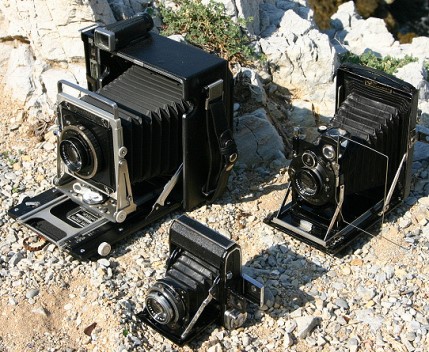
Here's one omine alongside a Crown Graphic an Ikonta 520.
Rodenstock and Zeiss made Wide angle and Telephoto slip on adapter filers. I have one I think 1.5x that turns my 203mm f7.7 Etar into a 304.5mm (it might be 1.7x I know it was too long on my Super Graphic). Zeiss sold them as Proxars for wide angle - there was a 1 & 2, and Distars for telephoto 1.5 and 3 they were designed to fit the 150mm f4.5 and 6.3 Tessars.
So if you found these converter and a 6.5x9 plate camera you might be OK jus use a roll film back
Ian
Here's one omine alongside a Crown Graphic an Ikonta 520.
Rodenstock and Zeiss made Wide angle and Telephoto slip on adapter filers. I have one I think 1.5x that turns my 203mm f7.7 Etar into a 304.5mm (it might be 1.7x I know it was too long on my Super Graphic). Zeiss sold them as Proxars for wide angle - there was a 1 & 2, and Distars for telephoto 1.5 and 3 they were designed to fit the 150mm f4.5 and 6.3 Tessars.
So if you found these converter and a 6.5x9 plate camera you might be OK jus use a roll film back
Ian
- Joined
- Dec 27, 2013
- Messages
- 1,369
- Format
- Medium Format
Voigtlander Bergheil folder came with bayonet mounted lenses.
Didn't come in 6X6 though.
Didn't come in 6X6 though.

darinwc
Subscriber
The plaubel makina was a 6x9 folding camera with 3 different focal length lenses and a removable back. And it was fairly compact for what it was.

Having done a little work on Isolettes and Speedexes, I don't see any reason you couldn't switch between lenses that were available for those models. You could theoretically cannibalize two different Isolettes, even of different versions. For example, say you had an Isolette III with a really nice Synchro-Compur shutter in great condition, but the lens was shot, but you also had an Isolette I with a pristine Apotar 85mm f/4.5. The triplet lenses are quite easy to remove from the shutter and put into a different shutter.
You would at minimum have to re-collimate the focus, which is easy. But the ones I've disassembled had varying numbers and thicknesses of paper shims between the rear of the shutter/lens assembly and the end of the bellows, presumably a more "permanent" calibration done at the factory to match that specific lens with that specific camera's film plane. I'm sure there's some way to get that correct again if you have a mind for optical physics and the patience to source very precise thicknesses of paper to get the right shim.
I expect you could similarly replace a Vario or Pronto shutter on an Isolette I with something nicer like a Compur sourced from a different Isolette, although again you'd need to re-collimate and probably re-shim.
Substituting a lens of the same focal length from a different type of camera (like a Novar or Tessar)... optically it might be possible given the fixed distance between the shutter/lens and the film plane when the bellows are extended. Logistically you'd be talking about a bunch of weird machining or other creative solutions to get the lens properly mounted in front of and behind the shutter and aperture blades.
And using a lens of a different focal length? By the time you got that working, it would be a completely different camera anyway.
You would at minimum have to re-collimate the focus, which is easy. But the ones I've disassembled had varying numbers and thicknesses of paper shims between the rear of the shutter/lens assembly and the end of the bellows, presumably a more "permanent" calibration done at the factory to match that specific lens with that specific camera's film plane. I'm sure there's some way to get that correct again if you have a mind for optical physics and the patience to source very precise thicknesses of paper to get the right shim.
I expect you could similarly replace a Vario or Pronto shutter on an Isolette I with something nicer like a Compur sourced from a different Isolette, although again you'd need to re-collimate and probably re-shim.
Substituting a lens of the same focal length from a different type of camera (like a Novar or Tessar)... optically it might be possible given the fixed distance between the shutter/lens and the film plane when the bellows are extended. Logistically you'd be talking about a bunch of weird machining or other creative solutions to get the lens properly mounted in front of and behind the shutter and aperture blades.
And using a lens of a different focal length? By the time you got that working, it would be a completely different camera anyway.
Dan Fromm
Member
- Joined
- Mar 23, 2005
- Messages
- 6,973
- Format
- Multi Format
They are there to set focus. Lenses have three focal lengths, the focal length the designer intended, the focal length engraved on (usually) the trim ring, and the actual focal length. Actual focal lengths vary somewhat, hence the need to adjust lens-to-film plane distance when the camera is erected.what are the shims for? i saw some shims when i took apart an Argoflex TLR one day? what would be the result if they werent put back in?
Effects of the shims will depend on what the shims are adjusting the spacing of.
If you lose a shim, then odds are you haven't 'ruined!' the lens, but rather it will focus less reliably. - Rather than actually being in focus at five feet on the 5' mark on the focus scale, you might actually be focusing at 8, or 10, or maybe 4 feet.
If the shim was adjusting the spacing between elements, then you might be losing sharpness near the edges, or suffer more chromatic aberrations, or other issues.
The real tricky shims are wedge shaped, and play to very specific alignments - They hold a lens element, that has been rotated to a specific angle around its optical axis, such that it is aligned to a specific plane. If you turn the lens and/or the shim, you'll shift that alignment around.
Building yourself a camera obscura to play with lenses is very much worth the effort if you're interested in learning more about how they work.
If you're willing to learn about fixing and building optical systems, then the worst thing a broken lens is to you is a new lesson in how to fix something... [Or how you probably shouldn't have tried fixing it, but then you have another new lesson to work with...]
If you lose a shim, then odds are you haven't 'ruined!' the lens, but rather it will focus less reliably. - Rather than actually being in focus at five feet on the 5' mark on the focus scale, you might actually be focusing at 8, or 10, or maybe 4 feet.
If the shim was adjusting the spacing between elements, then you might be losing sharpness near the edges, or suffer more chromatic aberrations, or other issues.
The real tricky shims are wedge shaped, and play to very specific alignments - They hold a lens element, that has been rotated to a specific angle around its optical axis, such that it is aligned to a specific plane. If you turn the lens and/or the shim, you'll shift that alignment around.
Building yourself a camera obscura to play with lenses is very much worth the effort if you're interested in learning more about how they work.
If you're willing to learn about fixing and building optical systems, then the worst thing a broken lens is to you is a new lesson in how to fix something... [Or how you probably shouldn't have tried fixing it, but then you have another new lesson to work with...]
Dan Fromm
Member
- Joined
- Mar 23, 2005
- Messages
- 6,973
- Format
- Multi Format
As luckless sort-of wrote, if the lens isn't set to the correct distance from the film plane when the camera is erected the focusing scale will be incorrect. Set focus to a marked distance, plane of best focus will be somewhere else. Since these cameras focus by scale, not through the lens, this is intolerable.and if it is not adjusted what is the result? will it be unable to focus on the film at any focus ring position? will it have less close focus ability? or will it have no infinity focus?
As luckless sort-of wrote, if the lens isn't set to the correct distance from the film plane when the camera is erected the focusing scale will be incorrect. Set focus to a marked distance, plane of best focus will be somewhere else. Since these cameras focus by scale, not through the lens, this is intolerable.
I really shouldn't write posts while waiting for coffee... I can see how my previous comment wasn't super clear on that.
But it is also worth noting that shims which are there purely for adjusting fore/back focus issues, rather than element spacing/alignment shims, are probably the least worrisome, provided the focus adjustment has enough 'extra' throw to make up for the shim's difference.
With most cameras you can pop the back open and set a ground glass on the film plane to compare what you're actually getting with what the scale says - And if it is off then you can usually just keep note of where the 'new' indicator point should be.
Another option is to 'just stop down', and mostly ignore fine focus. I've run into a few photographers who embraced a mindset of "There is always lots of Infinity".
xya
Member
as already said, there were the makinas and they had 6x6 backs as well. the only real 6x6 folder with interchangeable lens I know is the certo super sport dolly. but changing lens in mid roll is quite complicated: you have to rewind the film (which is possible on this camera). there is a built-in notepad to memorize the exposure number already exposed. you could then change the standard lens to a tele lens, re-install your roll, advance it to the number not yet exposed and continue shooting. as I have several of these, I will try to build myself a matching moderate wide-angle and use the plate holder setting (this camera can also take plates) which moves lens unit back for several mm to get my wide angle into focus. not yet done, but maybe possible. for more information on this camera, please have a look at my 120 folder website.
| Photrio.com contains affiliate links to products. We may receive a commission for purchases made through these links. To read our full affiliate disclosure statement please click Here. |
PHOTRIO PARTNERS EQUALLY FUNDING OUR COMMUNITY:  |