Can Moving image be captured on a pinhole?

Recent Classifieds

Forum statistics

Threads
201,050
Messages
2,818,198
Members
100,495
Latest member
gealto2
Recent bookmarks
0

AHiggz

Member
Allowing Ads
Joined
Nov 5, 2025
Messages
15
Location
Falmouth
Format
Analog
Hello!
I recently got given a pinhole play set from the 60s that I’ve been experimenting with.
after many trial and error I have managed to figure it out and honestly just started developing it with caffenol instead of the 60 years out of date developer given in the set And I’ve gotten comfortable with how it works.
However I always have to make things difficult for myself, I am pretty new to all this pinhole stuff but I was hoping to do a project that would require multiple pinholes capturing a moving projection. I know the results would not be a clean crisp image and that’s totally fine as I’m looking for more unusual results but I was wondering if it even possible.
I've tried exposing it to the 8mm projection for about 20 minutes but didn’t get anything at all, is this because it’s just not possible or do you think if I left it long enough, it would have some type of image?
I know the projection is a lot darker than natural light so it would take a while but I’m not sure how long I should try exposing it to the video before I admit defeat.
would changing the pinhole size help in anyway?
or maybe using film rather than light sensitive paper? As they have different light sensitivities?

Honestly I have no clue, and I’m a fine art student trying stupid things but just looking for some answers if anyone has any :smile:
 

Ivo Stunga

Member
Allowing Ads
Joined
Apr 3, 2017
Messages
1,229
Location
Latvia
Format
35mm
You'd get a smeared overblown smudge with sufficiently long exposures.

Doing multiple exposures with static projection - to overlay as many images as you wish - would get you somewhere.

Maybe it's possible to disengage movement for a while, risking overheating the film at the gate...
 

loccdor

Member
Joined
Jan 12, 2024
Messages
2,335
Location
USA
Format
Multi Format
Check the color temperature of the projector bulb and if the paper has red sensitivity.
 

DWThomas

Subscriber
Joined
Jun 13, 2006
Messages
4,621
Location
SE Pennsylvania
Format
Multi Format
I hope you are projecting the image onto a surface ("screen") and not AT the pinhole? The latter would be unworkable.

As noted above, long exposures are required. Even with relatively fast film, exposures of a second or so are fairly normal. That would make it difficult with moving images. Ivo's suggestion of overlaying static frames sounds to be the most likely approach. Most of my pinhole work has me looking for bold and static scenes -- bridges, buildings, landscapes, statues -- things that don't move. I recall one shot of buildings across an expressway in the foreground where the highway looks empty. Even though it was a busy road, the exposure was 14 seconds long and the moving vehicles didn't register.
 

Sirius Glass

Subscriber
Joined
Jan 18, 2007
Messages
50,703
Location
Southern California
Format
Multi Format
The moving object will be blurred or it is a long exposure and the object moves quickly, it may not appear at all or as a ghost.
 

Donald Qualls

Subscriber
Allowing Ads
Joined
Jan 19, 2005
Messages
12,502
Location
North Carolina
Format
Multi Format
I've done pinhole as fast as 1/4 second, hand held, at EI 3000 -- but that was either super-pushed Tri-X or Polaroid 667/Fuji FP3000b -- and it still needed bright sun. I've also done pinhole on that speed film with flash, and that works fine with the correct guide number calculation (AG-1B at about arm's length with the pinhole converted Polaroid 210 and FP3000b).

Either of those methods will record something from even a moving subject. The problems with 8 mm movie film as a subject are that, first, the negative area means the screen isn't very bright, and second, it's only illuminated about 1/3 to 1/2 the time (the rest the projector's shutter is closed while the film is moved to the next frame). Indoor lighting for pinhole typically results in exposed of 30-60 minutes with ISO 100-400 film; with printing paper (effecive ISO around 6) you're looking at literally hours (if you have your film on a loop and the projector doesn't eat it before then).

You could (in theory, at least) use a pinhole to project a single frame or even a running film onto your paper, effectively making a pinhole enlarger. With a light source that won't melt or burn your film, however, that's also likely to run to hours of exposure.
 

grahamp

Subscriber
Allowing Ads
Joined
Mar 2, 2004
Messages
1,759
Location
Vallejo (SF Bay Area)
Format
Multi Format
I think the only pinhole movement image I've made is Boat leaving Richmond marina. There are two basic options for multiple image combination - long exposure, or a long exposure built up from shorter ones. Since pinhole exposures (on film) are something like 7 - 10 stops longer than a lens camera with the same light and film, I am far from sure you will get an image that is recognisable, but I may be missing the intent here.
 

RalphLambrecht

Subscriber
Allowing Ads
Joined
Sep 19, 2003
Messages
14,815
Location
K,Germany
Format
Medium Format
Hello!
I recently got given a pinhole play set from the 60s that I’ve been experimenting with.
after many trial and error I have managed to figure it out and honestly just started developing it with caffenol instead of the 60 years out of date developer given in the set And I’ve gotten comfortable with how it works.
However I always have to make things difficult for myself, I am pretty new to all this pinhole stuff but I was hoping to do a project that would require multiple pinholes capturing a moving projection. I know the results would not be a clean crisp image and that’s totally fine as I’m looking for more unusual results but I was wondering if it even possible.
I've tried exposing it to the 8mm projection for about 20 minutes but didn’t get anything at all, is this because it’s just not possible or do you think if I left it long enough, it would have some type of image?
I know the projection is a lot darker than natural light so it would take a while but I’m not sure how long I should try exposing it to the video before I admit defeat.
would changing the pinhole size help in anyway?
or maybe using film rather than light sensitive paper? As they have different light sensitivities?

Honestly I have no clue, and I’m a fine art student trying stupid things but just looking for some answers if anyone has any :smile:

film ia a lot more sensitive to light than paper.changing the hole size is not recommended because going to a larger hole will make the image fuzzier. A hole size giving you around f/256 will give you optimum sharpness, but will need very long exposure times. you can calculate those using a light meter and assuming f/256. One option might be using one or several strong electronic flashes.However synchronisation may bean issue.
 
  • mshchem
  • Deleted
  • Reason: Wrong place

ezphotolessons

Member
Allowing Ads
Joined
Oct 30, 2025
Messages
94
Location
lalaland
Format
Hybrid
Old astronomers will tell you the legend of hypering film by putting in a bathe of water hydrogen peroxide fumes to make it have an unbelievable iso-speed. maybe you can do that with your paper. or soak in dilute paper developer you use for the printing and and dry it somewhere dark and c if it does the same thing. Caffeinated developer will have little contrast.
 
OP
OP
AHiggz

AHiggz

Member
Allowing Ads
Joined
Nov 5, 2025
Messages
15
Location
Falmouth
Format
Analog
You'd get a smeared overblown smudge with sufficiently long exposures.

Doing multiple exposures with static projection - to overlay as many images as you wish - would get you somewhere.

Maybe it's possible to disengage movement for a while, risking overheating the film at the gate...

Ah okay, I’m not massively fussed on seeing hugely clear images but not sure I want a huge overblown smudge either so perhaps overlaying some static images would help. I'm assuming slowing down the speed the film was playing to its slowest still wouldn’t help much as it’s still not exposed for long enough?
 
OP
OP
AHiggz

AHiggz

Member
Allowing Ads
Joined
Nov 5, 2025
Messages
15
Location
Falmouth
Format
Analog
I hope you are projecting the image onto a surface ("screen") and not AT the pinhole? The latter would be unworkable.

As noted above, long exposures are required. Even with relatively fast film, exposures of a second or so are fairly normal. That would make it difficult with moving images. Ivo's suggestion of overlaying static frames sounds to be the most likely approach. Most of my pinhole work has me looking for bold and static scenes -- bridges, buildings, landscapes, statues -- things that don't move. I recall one shot of buildings across an expressway in the foreground where the highway looks empty. Even though it was a busy road, the exposure was 14 seconds long and the moving vehicles didn't register.

Yeah I’m projecting the film onto a surface :smile: okay, that’s interesting- maybe I’ll try using my slide projector and flicking through different images rather than using a 8mm film. Thanks for the reply!
 

Ivo Stunga

Member
Allowing Ads
Joined
Apr 3, 2017
Messages
1,229
Location
Latvia
Format
35mm
I'm assuming slowing down the speed the film was playing to its slowest still wouldn’t help much as it’s still not exposed for long enough?

Exactly - try this with digital long exposure and see what happens.
 

Jan de Jong

Subscriber
Allowing Ads
Joined
Jul 20, 2022
Messages
104
Location
Germany
Format
Analog
One way to capture motion would be a pinhole camera with a slit scan, so in the camera you would cover the strip of paper or film to expose only a 2 mm wide strip and then pull the film slowly through while exposing continuously, with a stationary camera moving objects would be recorded as still.
let me know if you understand what I mean.
 

grahamp

Subscriber
Allowing Ads
Joined
Mar 2, 2004
Messages
1,759
Location
Vallejo (SF Bay Area)
Format
Multi Format
I suppose one could take a 35mm SLR, mount a pinhole, use a film that gave 1 second exposure (based on the usual longest time exposure, - could be 2 sec) attach an autowinder and get a set of 35mm pinhole frames at some time interval (if the autowinder permits an external timing device). At one second the pinhole image will blur some motion.

Scan and create a short movie sequence. There are two time elements involved - the merging of motion in a frame, and the separation of the frames by some unit of time. Sort of a blend of time exposure and time lapse sequence.
 
OP
OP
AHiggz

AHiggz

Member
Allowing Ads
Joined
Nov 5, 2025
Messages
15
Location
Falmouth
Format
Analog
I've done pinhole as fast as 1/4 second, hand held, at EI 3000 -- but that was either super-pushed Tri-X or Polaroid 667/Fuji FP3000b -- and it still needed bright sun. I've also done pinhole on that speed film with flash, and that works fine with the correct guide number calculation (AG-1B at about arm's length with the pinhole converted Polaroid 210 and FP3000b).

Either of those methods will record something from even a moving subject. The problems with 8 mm movie film as a subject are that, first, the negative area means the screen isn't very bright, and second, it's only illuminated about 1/3 to 1/2 the time (the rest the projector's shutter is closed while the film is moved to the next frame). Indoor lighting for pinhole typically results in exposed of 30-60 minutes with ISO 100-400 film; with printing paper (effecive ISO around 6) you're looking at literally hours (if you have your film on a loop and the projector doesn't eat it before then).

You could (in theory, at least) use a pinhole to project a single frame or even a running film onto your paper, effectively making a pinhole enlarger. With a light source that won't melt or burn your film, however, that's also likely to run to hours of exposure.

Wow thanks so much for replying, this is all very useful stuff for me!
 
OP
OP
AHiggz

AHiggz

Member
Allowing Ads
Joined
Nov 5, 2025
Messages
15
Location
Falmouth
Format
Analog
I think the only pinhole movement image I've made is Boat leaving Richmond marina. There are two basic options for multiple image combination - long exposure, or a long exposure built up from shorter ones. Since pinhole exposures (on film) are something like 7 - 10 stops longer than a lens camera with the same light and film, I am far from sure you will get an image that is recognisable, but I may be missing the intent here.

Wow the boat image is so coo!
My intention isn’t to necessarily have a recognisable image, I’m just trying to figure out a way to get something other than a blob of under or over exposed nothingness hahah- I am expecting abstract results.
thanks for the reply :smile:
 
OP
OP
AHiggz

AHiggz

Member
Allowing Ads
Joined
Nov 5, 2025
Messages
15
Location
Falmouth
Format
Analog
film ia a lot more sensitive to light than paper.changing the hole size is not recommended because going to a larger hole will make the image fuzzier. A hole size giving you around f/256 will give you optimum sharpness, but will need very long exposure times. you can calculate those using a light meter and assuming f/256. One option might be using one or several strong electronic flashes.However synchronisation may bean issue.

Yeah, I’m definitely going to experiment with film rather than paper thanks to everyone’s suggestions. I appreciate your reply!
 
OP
OP
AHiggz

AHiggz

Member
Allowing Ads
Joined
Nov 5, 2025
Messages
15
Location
Falmouth
Format
Analog
Old astronomers will tell you the legend of hypering film by putting in a bathe of water hydrogen peroxide fumes to make it have an unbelievable iso-speed. maybe you can do that with your paper. or soak in dilute paper developer you use for the printing and and dry it somewhere dark and c if it does the same thing. Caffeinated developer will have little contrast.

Ooh okay, that would be interesting to try out! Do you think using a plant developer would also lack contrast similarly to caffeinated?
 
OP
OP
AHiggz

AHiggz

Member
Allowing Ads
Joined
Nov 5, 2025
Messages
15
Location
Falmouth
Format
Analog
One way to capture motion would be a pinhole camera with a slit scan, so in the camera you would cover the strip of paper or film to expose only a 2 mm wide strip and then pull the film slowly through while exposing continuously, with a stationary camera moving objects would be recorded as still.
let me know if you understand what I mean.

Wow this sounds fascinating, I am struggling a bit to imagine what your saying.. would this be used to capture something moving such as a car and you’d move the strip along with it? you've definitely explained it clearly but my brain is just being slow so sorry for asking you to explain it again!
 

cliveh

Subscriber
Allowing Ads
Joined
Oct 9, 2010
Messages
7,688
Format
35mm RF

Can Moving image be captured on a pinhole?​

No.
 
Joined
Nov 3, 2024
Messages
325
Location
Éire; Vic & QLD Aus rota
Format
Medium Format
Credit to your creative, though-provoking brainstorming, but to me, it reads an impossible proposition. The problem is the pinhole camera. A pinhole camera by inherent design photographs at very long exposures. Nothing would be gained by increasing the pinhole size, or even paper negative of film speed — you are governed by the slow speeds which pretty much negate any attempt at animation, if that is what you are touching on.
 

Jan de Jong

Subscriber
Allowing Ads
Joined
Jul 20, 2022
Messages
104
Location
Germany
Format
Analog
Wow this sounds fascinating, I am struggling a bit to imagine what your saying.. would this be used to capture something moving such as a car and you’d move the strip along with it? you've definitely explained it clearly but my brain is just being slow so sorry for asking you to explain it again!

Yes, Slit-scan was used in for example photo finish for horse races. To do it with pinhole you have to keep the distance between the paper or film small like for example 5 to 15 mm. Reducing the distance will gain light because the circle of light is smaller, you suffer some sharpness though but for this purpose it would be ok since by pulling the paper or film during exposure you would get a bigger negative again.

concerning your question on developer, I would first establish a process that works either by your caffenol or normal developer, that would avoid disappointment.
 

koraks

Moderator
Moderator
Joined
Nov 29, 2018
Messages
25,946
Location
Europe
Format
Multi Format
I was hoping to do a project that would require multiple pinholes capturing a moving projection. I know the results would not be a clean crisp image and that’s totally fine as I’m looking for more unusual results but I was wondering if it even possible.
This raises a few practical questions:
What kind of photograph(s) do you have in mind? Something with the subject matter recognizable, but with a good deal of motion blur? Or some kind of soft, fuzzy, unstructured image, a bit like those photographs of waves with a very slow shutter speed, so that the waves start to look like a translucent kind of mist?
What's the nature of the projected video? I can see how this might work if the video is something fairly static; e.g. a very long take of a person talking with their head always in the same position in the frame, or something like surveillance cam footage that's pretty static apart from the moving people/cars etc. In that case, you might be able to capture the basic structure of the image in a photo, while all the motion is lost.

From a practical viewpoint I would start by experimenting with a digital camera and long shutter speeds (it would help if you have a neutral density filter so that you can reduce the amount of light the camera sees, esp. if you experiment with bright projections). This will give you a feeling for what kind of viewing angles and exposure times would work for your idea. Once you've determined that, see if you can translate it to a film/paper-based approach.
 

ezphotolessons

Member
Allowing Ads
Joined
Oct 30, 2025
Messages
94
Location
lalaland
Format
Hybrid
Ooh okay, that would be interesting to try out! Do you think using a plant developer would also lack contrast similarly to caffeinated?
I would not use any plant based or experimental developers, they are too slow to develop the latent image and lack contrast. I would use an active "normal" developer one would use for making photographic prints, like Dektol, Ilford Print Developer or whatever normal developer you use. You will add too many variables to your equation and you will have no idea if the latent image refused to develop-out because of the pre-treatment of the paper or because your "experimental" developer. You want to keep things simple.

Can Moving image be captured on a pinhole?​

No.
This is true if it is being captured on paper whose native speed relative to film is between ISO 1 and 24 depending on the paper, time of day, season and location. I used a 50mm pinhole, TMZ in a 35mm camera and had no problem photographing moving objects. "Hyper speed" photo paper might increase the ISO of the paper, as it did with Astro Photographer's TMAX 400 Glass Plates, but if at all and by how much is the sixty-four-thousand-dollar question since one emulsion is panchromatic and the other isn't. It might take some extra work to not only learn when to expose said paper (the speed may increase slowly and die fast ) and probably require a developer that has the ability to shock-and-awe. When walking through a bog you have to be carful of the critters.
 

Nick Dvoracek

Member
Allowing Ads
Joined
Feb 15, 2018
Messages
69
Location
Oshkosh WI
Format
Pinhole
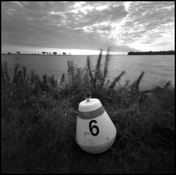
It depends on what you mean by motion. This photograph is at F130 at ISO 400 for probably a second. You can see waves in the bay. It would be easy to get a digital camera to do this with an intervalometer. It's possible to get a very expensive rig to do this advancing film every frame with a large-capacity magazine. Movie cameras are available to do it. By the way, making video with a pinhole is a common practice today.


Attachments

  • bouyno6.jpg
    bouyno6.jpg
    653.8 KB · Views: 20
Photrio.com contains affiliate links to products. We may receive a commission for purchases made through these links.
To read our full affiliate disclosure statement please click Here.

PHOTRIO PARTNERS EQUALLY FUNDING OUR COMMUNITY:


Ilford ADOX Freestyle Photographic Stearman Press Weldon Color Lab Blue Moon Camera & Machine
Top Bottom