• Welcome to Photrio!
    Registration is fast and free. Join today to unlock search, see fewer ads, and access all forum features.
    Click here to sign up

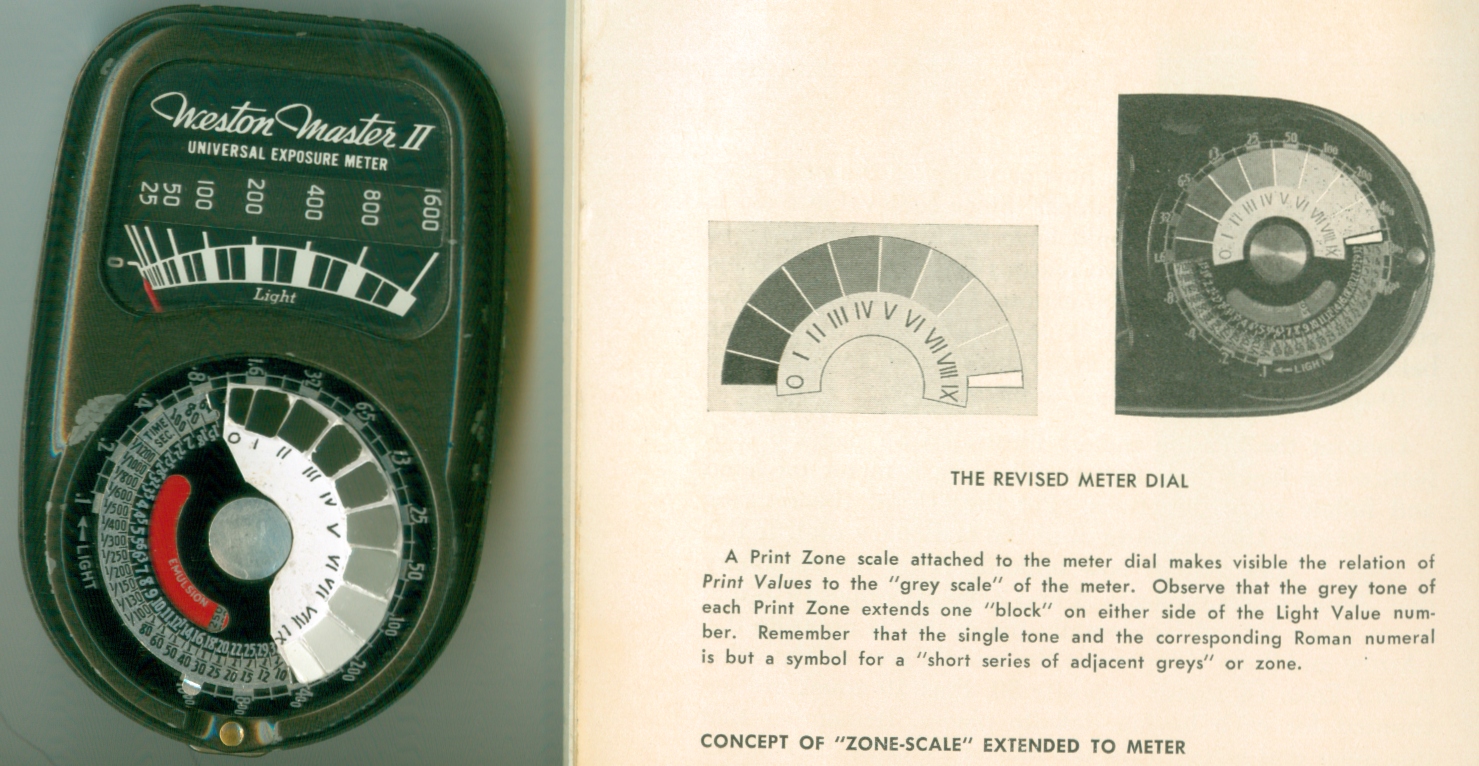
Bought a Weston Master II over the weekend

Recent Classifieds

Forum statistics

Threads
202,878
Messages
2,846,942
Members
101,527
Latest member
Grumps
Recent bookmarks
2
Wow. Weston meters are sure tough. They seem to work under low light also. Amazing old and robust technology.

 
Wow. Weston meters are sure tough. They seem to work under low light also. Amazing old and robust technology.

In their day they were state-of-the-art. My very first meter ca. 1973-4 was a 1930s Weston, which I used with a Kodak 35, Kodachrome, and High-Speed Ektachrome. I still have those transparencies, and that meter did a damn good job when I used it correctly. I still have the meter, too.
The Invercone is a handy accessory, if you find one at a reasonable price grab it.
 
Here's the sticker and the page of Minor White's booklet with a picture of it.

I wasn't paying attention to what I was doing and inadvertently made a Master III sized sticker, so I lose a little precision. But in the end, I think once you start placing Zone I and IX you are leaving the realm of "accuracy" anyway.

masterii.jpg
 
I will have to take out my Weston Master II tomorrow and check how accurate it is. I got it for $5 I think. I checked it before and vaguely remember that it's not bad but not accurate. My question is if I were to calibrate the meter then the number that the pointer is pointing at is the brightness in cd/ft^2 ?
 
The calculator dial got broken off, but calculating the shutter speed and aperture from the meter reading involves only basic math.

Or basic remembering.

The 400 position is f16 in the Sunny 16 rule.


Steve.
 
I have a bunch of meters: a drawer full. At one point I thought it would be fun to collect them. A Weston IV is in the mix, which I don't really use much truth be told. Every now and then I take them all out and compare them to make sure they still work. The Weston is still right on the money compared with two Gossens. I also have an old Zeiss Ikophot which is neat though not sensitive enough in low light. Sometimes it is just fun to use the old stuff. When the old meters stop working, I throw them out. I should really use the Weston more. It is a heck of a lot smaller than the Gossen SBC I prefer.

In the end, the best meter is always your brain, just saying...
 
I also have an Ikophot. It surprises me as it is accurate enough to use with transparency film.


Steve.
 
Steve Smith said 400 = Sunny 16, that's off by 1/3 stop.
Close enough to use Steve's rule of thumb in a pinch.

Steve's rule gives you 1/3 stop more exposure.

Here is how I would use the rule of thumb:

I typically take 1/3 stop off box speed when I select my EI.

I could use Box Speed with Steve's Sunny 16 = 400 equivalent.
---

Found this thread which correlates Weston Speed to ASA...

Two of the links are dead. One of the links works, but shows a chart comparing OLD ASA to Weston.

(there was a url link here which no longer exists)

For my own convenience, I converted to New ASA, maybe this will help.


DIN - New ASA - Weston
9 - 6 - 4
10 - 8 - 5
11 - 10 - 6
12 - 12 - 8
13 - 16 - 10
14 - 20 - 12
15 - 25 - 16
16 - 32 - 20
17 - 40 - 25
18 - 50 - 32
19 - 64 - 40
20 - 80 - 50
21 - 100 - 64
22 - 125 - 80
23 - 160 - 100
24 - 200 - 125
25 - 250 - 160
26 - 320 - 200
27 - 400 - 250
28 - 500 - 320
 
I always thought Weston was 0.8 of ISO (ASA) So Weston 80 for ISO 100.

Set the meter to Weston 80 and at 400 it gives f16 at 1/125

So what is this 'new ASA'? And is it the reason why the ASA settings do not quite correspond with the DIN settings on my Ikophot meter?

EDIT: Actually, it's further out than that. If I set it to DIN 21 it reads ASA 40 on the other side.


Steve.
 
Last edited by a moderator:
Being Merican' is the Weston rating the Metric version of ASA?
 
It's similar in that the numbers double or halve for each stop of sensitivity but the base number is different.

I always thought Weston 80 was equal to ISO/ASA 100 but Bill's post above casts some doubt on it.


Steve.
 
My post isn't completely well researched... I'd be happy to fix it if someone points out a mistake in my table.
 
I can't say if there is a mistake in your table, but what I usually use is here: http://www.jollinger.com/photo/meters/other/speed_table.html

(towards the botton of the page).

And also on page three of Weston's manual: http://jameskbeard.com/Photography/Weston_Manuals/Weston_Ratings.pdf

And here: http://www.westonmeter.org.uk/speeds.htm it is also Weston 80 = ISO 100.

It also states this:
Up to the Master IV the scale on the dial is in cd/ft2 - foot candles, now known as Lumens. After the IV, Weston started to use arbitrary numbers. With the baffle open, the scale is from 0.2 to 50 and with the baffle closed, 25 - 1600. Note the overlap - it's usually best to use the baffle-open in this overlapping area as the meter is more accurate there.

So it should be possible to work out what 400 lumens (cd/ft2) relates to.


Steve.
 
Last edited by a moderator:
The Jollinger table is suspect, different Weston speeds for same DIN between Europe and US?

Well I like the logic Chan Tran wrote in the first post of this thread:

(there was a url link here which no longer exists)

He wrote: "For example, 400 c/ft^2 which is EV15 for ISO100 but dial this value in the built in dial I would get 1/130@f/20 which is EV15 and 2/3. Using Weston rated speed of 80 for ISO100 I would get 1/130@f/18 which is EV15 and 1/3.
It seems to get the correct exposure setting I would have to set the dial for ... 64 instead."

And I wouldn't mind clarification on the EV number for 400 c/ft^2 - I kind of remember from the enlarger-sensitometer thread it's not precisely 15...
 
O.K... I'll do it.

On Wikipedia there is a table of EV at ISO 100 settings to lumens. It gives EV 15 as 4096 cd/m2. Converting from metres to feet gives me 381 cd/ft2.

Very close to my 400 figure (about 95% of it).


Steve.
 
Using Weston rated speed of 80 for ISO100 I would get 1/130@f/18 which is EV15 and 1/3.

If I set my meter to Weston 80 and point the dial at 400, I get f16 at 1/125.


Steve.
 
If I set my meter to Weston 80 and point the dial at 400, I get f16 at 1/125.


Steve.

BINGO.

There's a difference in the dials on Weston US and Weston Europe.

If I set my Weston original, or my Weston II to Weston 80 and point the dial at 400, I get f16 at 1/150.

If I set them to 64, I get f16 at 1/130. If I imagine nudging the dial slightly to the left of 400, I can imagine a reading of 1/125.

So 381 is scientifically accurate, 400 is close. These should agree with Sunny 16. No chart required.
 
BINGO.

There's a difference in the dials on Weston US and Weston Europe.

If I set my Weston original, or my Weston II to Weston 80 and point the dial at 400, I get f16 at 1/150.

If I set them to 64, I get f16 at 1/130. If I imagine nudging the dial slightly to the left of 400, I can imagine a reading of 1/125.

So 381 is scientifically accurate, 400 is close. These should agree with Sunny 16. No chart required.

How do you get 381 for sunny 16?
 
Oh I got it but the sunny 16 isn't EV15@ISO100. It stated that f/16 @ 1/ISO which is f/16@1/100 which is EV14 and 2/3.
 
Sunny 16 states that you use the closest shutter speed to 1/ISO. For ISO 100 this is 1/125.

It seems odd that Weston would have two standards for their own sensitivity scale.


Steve.
 
Sunny 16 states that you use the closest shutter speed to 1/ISO. For ISO 100 this is 1/125.

It seems odd that Weston would have two standards for their own sensitivity scale.


Steve.

But isn't 1/100 is closer and most cameras made in recent years have that shutter speed. Also your figure for 4095 cd/m^2 is for a meter calibrated with K=12.5 which is fine.
 
Sunny 16 states that you use the closest shutter speed to 1/ISO. For ISO 100 this is 1/125.

It seems odd that Weston would have two standards for their own sensitivity scale.


Steve.

Ah, well then we can easily talk about an ISO 125 film and be on the mark.

It is odd that Weston would have two scales, but it coincides with the old confusing charts and our experiments.
 
Ah, well then we can easily talk about an ISO 125 film and be on the mark.

It is odd that Weston would have two scales, but it coincides with the old confusing charts and our experiments.

Not really Bill. But OKay it's close enough.

If we talking about ISO 125 film then the light level for EV15 is less than the 4096 Cd/m^2. The Sunny 16 light level should still be 3251 Cd/m^2.
 
If we talking about ISO 125 film then the light level for EV15 is less than the 4096 Cd/m^2. The Sunny 16 light level should still be 3251 Cd/m^2.

I usually treat ISO 125 film as if it is 100 anyway.

And currently around here, it's dismal f5.6 rather than sunny 16.


Steve.
 
Photrio.com contains affiliate links to products. We may receive a commission for purchases made through these links.
To read our full affiliate disclosure statement please click Here.

PHOTRIO PARTNERS EQUALLY FUNDING OUR COMMUNITY:



Ilford ADOX Freestyle Photographic Stearman Press Weldon Color Lab Blue Moon Camera & Machine
Top Bottom