• Welcome to Photrio!
    Registration is fast and free. Join today to unlock search, see fewer ads, and access all forum features.
    Click here to sign up

Best screen resolution for RAW files

Recent Classifieds

Forum statistics

Threads
202,672
Messages
2,843,888
Members
101,453
Latest member
lubowe
Recent bookmarks
0
I know that and that's why I said I do realize that it's less expensive if I accept the features I don't want on the camera. I accept an LCD on my camera, accept that it does video. accept that it does liveview, to save money
My cameras don't have built in flash or scenes modes but if I accept that I can save even more money.

I have to make similar concessions when buying a digital camera.
 
Used Koraks advice on ETTR with pleasing results…👍

Be aware the ETTR is a methodology for digital exposure of RAW which captures the most digital information in the shadow areas of the scene, while protecting the highlight areas so they are not lost by falling off the histogram. Yet, doing so can record the scene so it is brighter than reality, and if you want to reproduce reality (such as midtone areas show up in your print as midtone, not lighter grey) you need to then compensate the recording and reduce the brightness during postprocessing accordingly.
 
Be aware the ETTR is a methodology for digital exposure of RAW which captures the most digital information in the shadow areas of the scene, while protecting the highlight areas so they are not lost by falling off the histogram. Yet, doing so can record the scene so it is brighter than reality, and if you want to reproduce reality (such as midtone areas show up in your print as midtone, not lighter grey) you need to then compensate the recording and reduce the brightness during postprocessing accordingly.

It’s much harder using the ETTR method without a screen…🥸
 
It’s much harder using the ETTR method without a screen…🥸

I wondered how you managed to employ the technique mentioned by Koraks referenced by you in post 225, shooting with a camera that has neither RAW-to-JPG in order to even compute the histogram from the image, nor a display to view the histogram.
 
I wondered how you managed to employ the technique mentioned by Koraks referenced by you in post 225, shooting with a camera that has neither RAW-to-JPG in order to even compute the histogram from the image, nor a display to view the histogram.

I’m (guessing) pun intended, from shooting film most of my life has a lot to do with it…!🎞️
 
Last edited:
If you shot color transparency, you got good background training!
Don’t want to be negative but transparent.
The experience came from shooting a digital camera that shot like a film camera regardless of the film type…🎞️📷
 
Last edited:
Well, it has served me well in similar situations, so yeah!

Hard to disagree with the proof…🧐

Koraks makes you a better photographer😎
 
Last edited:
Not sure about that, but I'm of course happy if someone finds any use in anything I say.

It’s rare isn’t it…🥸
 
Be aware the ETTR is a methodology for digital exposure of RAW which captures the most digital information in the shadow areas of the scene, while protecting the highlight areas so they are not lost by falling off the histogram. Yet, doing so can record the scene so it is brighter than reality, and if you want to reproduce reality (such as midtone areas show up in your print as midtone, not lighter grey) you need to then compensate the recording and reduce the brightness during postprocessing accordingly.

Is ETTR really necessary today with the large DR ranges in today's modern cameras with the latest editing programs? Is all that work required to squeeze a little more out of the shadow areas?
 
Is ETTR really necessary today with the large DR ranges in today's modern cameras with the latest editing programs? Is all that work required to squeeze a little more out of the shadow areas?

If there are 14 bits to store the RAW data from each sensel today, it is the same bit width now as it was 10-20 years ago...only if more bit width adds bits does the real dynamic range of the digital data carry any more data in a single picture.
Test results have concentrated on the ability to underexpose and recover information in spite of circuit nose...that ability has gotten better...and that has been called 'better dynamic range' But not the inherent data capacity of a shot, which is the rationale behind ETTR. 14-bit width can capture tonal information with 16,384 levels of precision.; 15 bits doubles that number, and provides twice as many levels for a given low light area of the scene, which is what one is trying to accomplish with ETTR...give more bits to the darker areas.
 
If there are 14 bits to store the RAW data from each sensel today, it is the same bit width now as it was 10-20 years ago...only if more bit width adds bits does the real dynamic range of the digital data carry any more data in a single picture.
Test results have concentrated on the ability to underexpose and recover information in spite of circuit nose...that ability has gotten better...and that has been called 'better dynamic range' But not the inherent data capacity of a shot, which is the rationale behind ETTR. 14-bit width can capture tonal information with 16,384 levels of precision.; 15 bits doubles that number, and provides twice as many levels for a given low light area of the scene, which is what one is trying to accomplish with ETTR...give more bits to the darker areas.

But it's dark there. Does it really matter?
 
If there are 14 bits to store the RAW data from each sensel today, it is the same bit width now as it was 10-20 years ago...only if more bit width adds bits does the real dynamic range of the digital data carry any more data in a single picture.
Test results have concentrated on the ability to underexpose and recover information in spite of circuit nose...that ability has gotten better...and that has been called 'better dynamic range' But not the inherent data capacity of a shot, which is the rationale behind ETTR. 14-bit width can capture tonal information with 16,384 levels of precision.; 15 bits doubles that number, and provides twice as many levels for a given low light area of the scene, which is what one is trying to accomplish with ETTR...give more bits to the darker areas.
 

Attachments

  • IMG_7008.jpeg
    IMG_7008.jpeg
    483.6 KB · Views: 63
Which means 14 bits each colour - no difference.
I believe the other two bits relate to amplitude, but there are better informed people here.
 
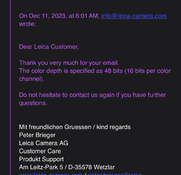
16 bits per color channel in the Leica! We need to understand how the bits are employed differently, to understand what that actually translates to...does 14 v 16bit matter?, if there is a relevant difference in dynamic range between the two. For example, using Leica information...

For the Leica S,
How does the same product have fewer bits of DR (14 vs 16) yet achieve 1 stop wider dynamic range (15), in the same Leica S typ 007 with difference of 2 bits of width?! One needs insider understanding how the 16-bit standard digital word is actually allocated.
 
How does the same product have fewer bits of DR (14 vs 16) yet achieve 1 stop wider dynamic range (15)

There's no inherent relationship between dynamic range and bit 'depth'. Simply put, you can make a bit as wide or as narrow in terms of dynamic range as you want - it's arbitrary.

Also, the fact that a device outputs a nominal 16 bit signal doesn't mean its actual resolution is the same. It's generally lower, sometimes much less so.
 
There's no inherent relationship between dynamic range and bit 'depth'. Simply put, you can make a bit as wide or as narrow in terms of dynamic range as you want - it's arbitrary.

Also, the fact that a device outputs a nominal 16 bit signal doesn't mean its actual resolution is the same. It's generally lower, sometimes much less so.

I fully comprehend the fact that allocating 14 bits as a holder for data is fully dependent on the DR of the input unit...if you have two different units, one with 13-bits of actual differentiable data whlle the other has 14 bits of actual differentiable data, the bucket is identical (14 bits) but the data itself is better from one of the two units. In the case of Canon, we have an entire generation of product, the dSLR of the 2002-2019 period, with increasing DR even though all use the identical 14-bit of data storage allocated, because the sensors and processing circuits got better over time.

My question was how does the SAME PRODUCT description from the same company have two different specifications both for number of bits allocated and in the Dynamic Range?! and in the lower bit count of the two specifications it is stated as having a wider DR? That contradiction itself illustrates the 'take quoted specs with a grain of salt' unless you fully understand the foundation of the claim.
 
Last edited:
16 bits per color channel in the Leica! We need to understand how the bits are employed differently, to understand what that actually translates to...does 14 v 16bit matter?, if there is a relevant difference in dynamic range between the two. For example, using Leica information...

For the Leica S,
How does the same product have fewer bits of DR (14 vs 16) yet achieve 1 stop wider dynamic range (15), in the same Leica S typ 007 with difference of 2 bits of width?! One needs insider understanding how the 16-bit standard digital word is actually allocated.

Looks like you have work to do for the correct answers to those questions…🥸
 
Looks like you have work to do for the correct answers to those questions…🥸

I could find no Leica-provided information on the topic. Lots of speculative discussion by Joe Average and his cousins.
 
I could find no Leica-provided information on the topic. Lots of speculative discussion by Joe Average and his cousins.

You probably have to ask Leica as I did…🧐
 
Photrio.com contains affiliate links to products. We may receive a commission for purchases made through these links.
To read our full affiliate disclosure statement please click Here.

PHOTRIO PARTNERS EQUALLY FUNDING OUR COMMUNITY:


Ilford ADOX Freestyle Photographic Stearman Press Weldon Color Lab Blue Moon Camera & Machine
Top Bottom