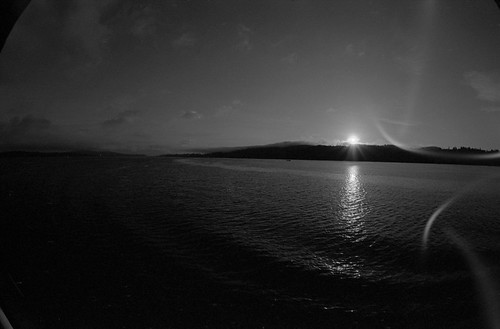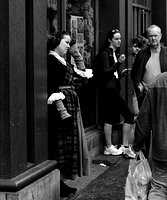
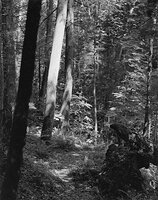

I should just give up photography. I have taken numerous outdoor b&w shots, and have yet to produce a sky even close to any of the three posted by Leighgion. The sky in the first shot is especially nice.
I understand that doing one's own developing can make for a definite advantage. I have yet to try because I do not want to spend time being exposed to chemicals, and I doubt I would even have the time to do it. Taking pictures takes up quite a bit of time.
FilmOnly:
If you look at the first shot posted by Leighgion, you will note a couple of things:
1) the foreground is fairly dark - if I had to guess, I would say that the exposure was chosen to emphasize the patterns in the sky; and
2) it was shot with a very wide lens - so wide, that the corners curve, and the brightness dims out toward the edge of the frame, which also tends to emphasize the patterns in the sky.
I point this out to emphasize that exposure is often the factor that most influences the appearance of the sky. Very often the sky is brighter than the rest of your subject, so it can be easy to overexpose it.
There is one other factor that I haven't seen much reference to. Film is reasonably sensitive to light in the near UV range, and whenever there is a fair amount of dust in the air, there is often a lot of UV scatter. That UV scatter tends to hide detail in skies (where the UV is higher).
I have a suggestion for you - take some cloud pictures. They have an honoured history in the annals of photography.
By cloud pictures, I mean pictures looking up, without any foreground. You should make a point of experimenting with your exposure (the standard meter will suggest an exposure that is one or two stops too dark) and take careful notes of what your meter recommends when it is pointed at the sky, pointed at a subject which includes part of the sky, and what range of exposures you actually used. You could also make the same tests with a UV filter, a polarizer, and some of the coloured (yellow, orange, red and green) filters too.
If possible, try to do this on a day with both blue sky and clouds - a sunny day right after a rain storm is the best for atmospheric dust.
With all the permutations and combinations you could easily use up a couple of 36 exposure rolls, especially if you supplement the shots with some that do show foreground, but if you try a range of combinations, and keep good notes, you may learn a lot.
Have fun.
Matt
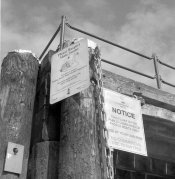
P.S. the following shows lots of detail in the sky, but really that only happened because I adjusted the brightness of this scan to show detail in the pier and the sky, and then burned the signs in heavily:
Attachments
Last edited by a moderator: