
• Welcome to Photrio!
    Registration is fast and free. Join today to unlock search, see fewer ads, and access all forum features.
    Click here to sign up

Bellini E-6 Rotary Times?

The Bee Keeper

A
The Bee Keeper

  • 2
  • 0
  • 41
Old Kodak

H
Old Kodak

  • 3
  • 5
  • 96

Recent Classifieds

Forum statistics

Threads
202,197
Messages
2,837,065
Members
101,192
Latest member
scottanton
Recent bookmarks
0

bags27

Member
Allowing Ads
Joined
Jul 5, 2020
Messages
604
Location
Rhode Island
Format
Medium Format
I haven't used this in a couple of years, and have forgotten the times I've used. The instruction sheet is only for non-rotary.

It's a 6-stage developer, and the two times that matter most, I imagine, are First Developer (6' for first 4 films in non-rotary) and Color Developer (ditto times). I'm guessing around 5:15'in a rotary. Would that be about right? Would bleach also go from the recommended 6' for non-rotary to 5:15?

I'd be developing 2 rolls of 120 at a time, using 500 ml in the Patterson tank.

thanks!
 
Last edited:

Samu

Member
Joined
Jul 4, 2023
Messages
258
Location
Lithuania
Format
35mm
6I6 haven't used this in a couple of years, and have forgotten the times I've used. The instruction sheet is only for non-rotary.

It's a 6-stage developer, and the two times that matter most, I imagine, are First Developer (6' for first 4 films in non-rotary) and Color Developer (ditto times). I'm guessing around 5:15'in a rotary. Would that be about right? Would bleach also go from the recommended 6' for non-rotary to 5:15?

I'd be developing 2 rolls of 120 at a time, using 500 ml in the Patterson tank.

thanks!

Sounds too short. This is just a standard 6 bath chemistry. The "official" reference time is always 6:00, but in practice, slightly longer times are often needed for perfect results. Constant agitation is the norm in all color processes, and no time is needed to be shortened from official times because of rotary processing. Non-constant agitation may require extended times, but in E6, errors are most often due to too low temperature, or exhausted FD, than inadequate agitation. Bleach or fix time needs not to be adjusted, as everything except FD is done until completion in E6. I would suggest starting from 6:00, and probably extending from there. if needed. As you are talking about rotary developing in Paterson tank, the lack of temperature control may be an issue.
 

lamerko

Member
Joined
Oct 27, 2022
Messages
834
Location
Bulgaria
Format
Multi Format
In fact, the critical step is only the first developer. The color developer is "to completion", so letting it run longer there won't be a problem. You can look at the times Jobo provides for their 6-bath chemistry - they, unlike Bellini, give times for rotary processing.
Overall, the process is standard, but there are slight differences in the timings. The issue is that some films require a bit more time in the first developer - Fuji films in particular. And Jobo chemistry is said to be manufactured by Fuji in Japan. That makes sense, and all these small differences start to fall into place.
 
OP
OP

bags27

Member
Allowing Ads
Joined
Jul 5, 2020
Messages
604
Location
Rhode Island
Format
Medium Format
Thanks to you both. That's really helpful.

I should add two qualifiers
1. The times Bellini cites for non-rotary is based on agitation every 30 seconds. So, rotary is a lot more agitation.
2. There is no cooling (well, there's a lot, but it's compensated for), because I'll be using my AGO, which has a tremendously accurate thermometer and adjusts time to falling temperatures. So, if I set it for (say) 6 minutes, it will never finish in just 6 minutes, as AGO will add time as temperature cools. But I do want to set the initial temperature as accurately as possible.
 

mshchem

Subscriber
Allowing Ads
Joined
Nov 26, 2007
Messages
16,251
Location
Iowa City, Iowa USA
Format
Medium Format
2 year old kit?

Ago drift method for temperature/time.

Sounds like a recipe for disaster.

It's all good, it's not like Fujichrome is unavailable or Ektachrome is 20 bucks a roll.

Oh Boy 😱
 
OP
OP

bags27

Member
Allowing Ads
Joined
Jul 5, 2020
Messages
604
Location
Rhode Island
Format
Medium Format
2 year old kit?

Ago drift method for temperature/time.

Sounds like a recipe for disaster.

It's all good, it's not like Fujichrome is unavailable or Ektachrome is 20 bucks a roll.

Oh Boy 😱

I didn't say that the kit was 2 yrs old. I said that I haven't developed E-6 in two years. I wouldn't try an open 2 yr old kit either! :smile:

I've never tried AGO with E-6, but it has proved remarkably accurate both with B&W and C-41. So, yes, it is a new project for me, but, wow, does it work with other chemicals.
 

ChrisGalway

Subscriber
Allowing Ads
Joined
Feb 24, 2022
Messages
575
Location
Ireland
Format
Medium Format
FYI, I use at least 7 mins in the FD for Provia 100f in fresh solution with inversion agitation, in fact usually around 7min30sec, at 38Deg (water bath is around 39.5deg). Of course my thermometers might be inaccurate, or my exposure meter, or the shutter speeds or my agitation not sufficient, but honestly I think all are correct/normal. After >150 films processed over the past 5 years, I've always found a longer FD time is required for Provia 100f.

CD time is to completion, as other have said, not critical.
 
OP
OP

bags27

Member
Allowing Ads
Joined
Jul 5, 2020
Messages
604
Location
Rhode Island
Format
Medium Format
FYI, I use at least 7 mins in the FD for Provia 100f in fresh solution with inversion agitation, in fact usually around 7min30sec, at 38Deg (water bath is around 39.5deg). Of course my thermometers might be inaccurate, or my exposure meter, or the shutter speeds or my agitation not sufficient, but honestly I think all are correct/normal. After >150 films processed over the past 5 years, I've always found a longer FD time is required for Provia 100f.

CD time is to completion, as other have said, not critical.

Thanks so very much, Chris.
 

ChrisGalway

Subscriber
Allowing Ads
Joined
Feb 24, 2022
Messages
575
Location
Ireland
Format
Medium Format
BTW, I'm a cautious person so I would only do a single film the first time!

I would be very interested to know how you get on with the AGO and E6 ... presumably the temperature will drop quite a bit and I wonder how longer than the actual FD time will be compared to the dialled-in time.
 

mshchem

Subscriber
Allowing Ads
Joined
Nov 26, 2007
Messages
16,251
Location
Iowa City, Iowa USA
Format
Medium Format
BTW, I'm a cautious person so I would only do a single film the first time!

I would be very interested to know how you get on with the AGO and E6 ... presumably the temperature will drop quite a bit and I wonder how longer than the actual FD time will be compared to the dialled-in time.

+1
 

lamerko

Member
Joined
Oct 27, 2022
Messages
834
Location
Bulgaria
Format
Multi Format
I've never actually worked with AGO, even though I bought one some time ago and it's still sitting in the box. But I was left with the impression that it can be used vertically, with the tank immersed in a water bath…
 

Samu

Member
Joined
Jul 4, 2023
Messages
258
Location
Lithuania
Format
35mm
Thanks to you both. That's really helpful.

I should add two qualifiers
1. The times Bellini cites for non-rotary is based on agitation every 30 seconds. So, rotary is a lot more agitation.
2. There is no cooling (well, there's a lot, but it's compensated for), because I'll be using my AGO, which has a tremendously accurate thermometer and adjusts time to falling temperatures. So, if I set it for (say) 6 minutes, it will never finish in just 6 minutes, as AGO will add time as temperature cools. But I do want to set the initial temperature as accurately as possible.

Color is not black and white, where it is possible to fully compensate for lower temperature by extending time. In color, this would lead to some issues with color balance. The old trick used much in the old days, was to use hotter chemistry, and experimenting that the required temperature was in the middle during the prescribed time for the volumes needed. AGO just adds time. The difference may be acceptable in shorter processes, such as C-41, but for E-6, the temperature difference is too great, as the solution will cool down quite a bit during 6 minutes. If you must use this system, I would recommend using a bit hotter solution than 38°C. Try with water and empty reels, what the temperature should be in order to get your AGO to run the first developing sequence in exactly 6 minutes. For other steps, this is not an issue, because they are all performed to completion.

Bellini kit is just their commercial E6 developers with starters added. So, these are totally standard chemicals, and the times given to the developer are exactly the same as for Fuji Hunt, or any other standard 6 bath E6 chemistry. And the time is officially 6:00, but with different opinions about the time making the best results. For instance, Kodak documentation suggested longer times for Fuji films, while Fuji Hunt does not. My personal opinion is adding a bit of time for Velvia 50, but not to Velvia 100 or Provia. In hand agitation, I normally use 6:30 for other films than Velvia 50, for which I use 7:00. For rotary agitation with a temperature control, I would suggest 6:15 and 6:45. These times are for fresh developer.
 

mshchem

Subscriber
Allowing Ads
Joined
Nov 26, 2007
Messages
16,251
Location
Iowa City, Iowa USA
Format
Medium Format
1st developer e6 is super critical. With a Jobo I run 6'30" . Some old JoboUSA (like 20+ years old) recommended extending times for Fujifilm to 7'30" ,I tried this with Provia and it blew out the film, at least 1/2 - 1 stop. A test is a good idea.

As Samu mentioned, color is not black and white.
 

Owlch

Member
Allowing Ads
Joined
Nov 11, 2025
Messages
13
Location
Melbourne, Australia
Format
35mm Pan
I'm using AGO as well and what I recommend is to do 40C pre-wets for 2x30s before 1st dev to ensure the working temp is up there. In E-6 the dev time is pretty much doubled compared to C-41 and ECN-2, which means the temp variation is even more challenging. I had good results in both Velvia 50 and 100 using the same kit as yours.
 

mshchem

Subscriber
Allowing Ads
Joined
Nov 26, 2007
Messages
16,251
Location
Iowa City, Iowa USA
Format
Medium Format
Need more information about this. Everyone seems to be latching onto this processor. I would like to hear about how this works.
I use a compensating timer to process black and white prints. Color slides are tricky. Also high temperature black and white film (tropical processing)
Good discussion!!
 

ChrisGalway

Subscriber
Allowing Ads
Joined
Feb 24, 2022
Messages
575
Location
Ireland
Format
Medium Format
Need more information about this. Everyone seems to be latching onto this processor. I would like to hear about how this works.
I use a compensating timer to process black and white prints. Color slides are tricky. Also high temperature black and white film (tropical processing)
Good discussion!!

+1. Really curious to know how the AGO performs doing E6 processing.

One thing is for sure: if you have a process that works for you, I suggest sticking to it rigorously! mshchem says 7min30sec blew out his Provia, but for me it's the perfect time for fresh solution ... so clearly something is different between our overall processes (camera exposure, processing temperature, agitation ... probably lots of other factors!)
 

lamerko

Member
Joined
Oct 27, 2022
Messages
834
Location
Bulgaria
Format
Multi Format
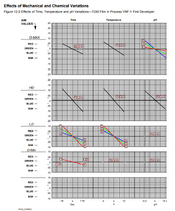
Okay, something amusing. Kodak have published a series of very interesting documents, but unfortunately they still haven't done so for the E-6 process. However, if we look at the VNF-1 process, which should be somewhat close to E-6, we can see what happens when time and temperature are changed. And here's the funny part… in theory, such a compensation by AGO would slightly affect only the red channel at DMIN…
 

Attachments

  • 1770109114219.png
    1770109114219.png
    273 KB · Views: 20

mshchem

Subscriber
Allowing Ads
Joined
Nov 26, 2007
Messages
16,251
Location
Iowa City, Iowa USA
Format
Medium Format
+1. Really curious to know how the AGO performs doing E6 processing.

One thing is for sure: if you have a process that works for you, I suggest sticking to it rigorously! mshchem says 7min30sec blew out his Provia, but for me it's the perfect time for fresh solution ... so clearly something is different between our overall processes (camera exposure, processing temperature, agitation ... probably lots of other factors!)

+1+1+1 ☺️ I use a Jobo and it is about as "agitated" as it gets. I also tend to use one shot so my chemistry is as active as it gets. Note don't ever skip starter if you are using the big individual chemistry designed for commercial equipment.

For years I would have my local lab "develop only" my color negative film, they did a great controlled job. Then I would print myself using a very reliable ancient Kodak Rapid Color processor model 11 with a temperature control heater from Simmon Omega.

E6 was big water tub with aquarium heaters, pain in the A@*
 

ChrisGalway

Subscriber
Allowing Ads
Joined
Feb 24, 2022
Messages
575
Location
Ireland
Format
Medium Format
...
E6 was big water tub with aquarium heaters, pain in the A@*

Well that's what I use, not such a pain once you're into a routine! I process around 25 or so Provia 100f 120 size a year, in batches of 6-8 films, and have never thought it worthwhile to invest in a Jobo ... I would be lucky to get one for around €1000, just can't justify it at present. Hence my vague interest in the AGO.
 

mshchem

Subscriber
Allowing Ads
Joined
Nov 26, 2007
Messages
16,251
Location
Iowa City, Iowa USA
Format
Medium Format
Well that's what I use, not such a pain once you're into a routine! I process around 25 or so Provia 100f 120 size a year, in batches of 6-8 films, and have never thought it worthwhile to invest in a Jobo ... I would be lucky to get one for around €1000, just can't justify it at present. Hence my vague interest in the AGO.

Well done! I have a Phototherm bath and a Jobo tempering box, none of the rotary chaos. I think that's what I may get out and dust off some time.
Jobo made sense for color sheet film photographers and small studios. I got started with Jobo when people were getting rid of stuff for next to nothing 20 years back.
 
OP
OP

bags27

Member
Allowing Ads
Joined
Jul 5, 2020
Messages
604
Location
Rhode Island
Format
Medium Format
I'm using AGO as well and what I recommend is to do 40C pre-wets for 2x30s before 1st dev to ensure the working temp is up there. In E-6 the dev time is pretty much doubled compared to C-41 and ECN-2, which means the temp variation is even more challenging. I had good results in both Velvia 50 and 100 using the same kit as yours.

Thanks so much for this! I'm a bit of a dolt here: does 2x30s mean 2 30 second pre-wet baths.
 
Photrio.com contains affiliate links to products. We may receive a commission for purchases made through these links.
To read our full affiliate disclosure statement please click Here.

PHOTRIO PARTNERS EQUALLY FUNDING OUR COMMUNITY:


Ilford ADOX Freestyle Photographic Stearman Press Weldon Color Lab Blue Moon Camera & Machine
Top Bottom