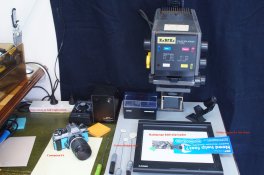
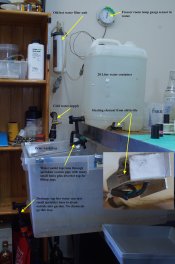
Hi Sam, Like you I have moved on from F2 repairs to mucking around in the darkroom. So here are a few tips and tricks that I adapted to my setup in a basement room that has no easy access to water and drainage. (see attached photos) To solve this first problem I ran in a water pipe and fitted a tap to that. But with no possible connection to drainage I just ran a small pipe out through a joint in the brickwork onto the garden. No chemicals will be going this way as they go into large storage containers for later disposal the environmental way. I have no sink just a large plastic container which catches the run off from the 20 litre water container that is fitted with a water heating element from an old kettle and a drain tap. It is a great setup, nice and compact and does a good job of print washing which is just a made up spray pipe into a shallow tray.
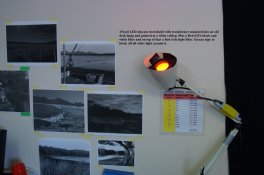
For a Safe light I adapted a standard 15 watt obscure glass downlight to an old desk lamp. This points at a white ceiling. Fitted over the glass is a Red #25a filter plus a Red safe light filter on top with lots of tape around to block the white light leaks. This works very well and I have done a few 7 minute tests using various methods and it seems fine. It is so bright I do switch it off during enlarging so I can see the print better.
Using the enlarger I found an easy way to do test strips is to use a bit of masking tape to hold the strip in place. Then use a large fridge magnet to move across the test strip. It holds down tight to the test strip and this allows one handed testing. I began by using old print paper to mask the test strip till I discovered that light from the enlarger travels right through print paper. Cardboard works well but my fridge magnet is better than that.
"Darkroom Dave" has some good youtube tutorials as do "Borut Peterlin" and "Clyde Butcher". Try a bit of white light flashing of the prints for some radical highlights. I've pulled prints out of the developer at half way and then used an SB24 flash on auto pointed at the white ceiling and put the print back into the developer till it looks just right. Gives an infrared affect. If you can find an old microwave these are good for a quick 10 second blast on wet test strips, they come out near dry and steaming.
Have fun, make lots of mistakes as every day is for learning.
Robin.
View attachment 188160 View attachment 188163View attachment 188164





 .
.

