• Welcome to Photrio!
    Registration is fast and free. Join today to unlock search, see fewer ads, and access all forum features.
    Click here to sign up

Bechers exhibition in London until March 28th '26

Recent Classifieds

Forum statistics

Threads
202,881
Messages
2,847,019
Members
101,528
Latest member
AlanG
Recent bookmarks
0

noodleJam

Member
Allowing Ads
Joined
Sep 24, 2024
Messages
2
Location
NRW, Germany
Format
Medium Format
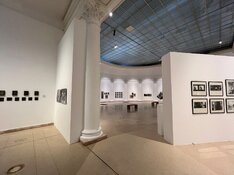
For lovers of the Hilla & Bernd Becher's work, Sprüth & Magers Gallery in Central London are hosting a collection circa 50 original prints.

Having visited a few times last week, it was a wonderful to see the tonality, quality, composition, clarity and beauty of the images.

 
I’ve loved these photographs for decades. Amazing.

But your link to the London show has me ponder something I haven’t really noticed before - the sheer blankness of the skys.

Obviously the Bechers were very careful about the light they shot in, and needless to say the darkroom work is immaculate. So I doubt that blankness is accidental. Midtones are moderate to lower contrast, and so I don’t think they were pushing film to blow out highlights. Maybe? I wonder did they shoot with a filter which would have the opposite effect to a yellow filter on skys? Or just carefully hold back the sky in printing? There is tonality there - a clear separation with the print border. But very little to no cloud.

Maybe someone more technically proficient might have already cracked this?
 
There is tonality there - a clear separation with the print border.
I don't see it. I do see a difference in tone between the matte and the sky.

AFAIK they photographed under very specific conditions - overcast, featureless skies. One big softbox.

I think the choice to have "no sky" was very deliberate and consistently maintained throughout the process. No distractions from the subject - these were typologies of man-made structures, after all. Not of skies, and also not (insofar as I know) intended as 'pretty pictures'. Uniformity was a hard requirement resulting from the core concept behind this body of work and the choice for a featureless sky would have been both practical (it's a relatively common weather condition, so something you could bank on) as well as effective (no distraction).

Btw, I would describe midtone contrast as "rather high", which follows again from the deliberately chosen lighting conditions that flatten out the tonal scale, allowing for everything to be 'brought back' in development and esp. printing without having to become heavy-handed with the burning & dodging or other 'creative' contrast controls. Excessive shadow areas or very brightly lit parts of the structures would of course have been antithetical.
 
Yes it’s completely intentional. And remarkably consistent - to draw on your Softbox analogy these works have a ‘studio’ character.

But practically I don’t they could have achieved that consistency of lighting, over multiple locations (Northern Europe / USA) over several decades with just good meteorology! There has to be some photographic know-how at work too.
 
But practically I don’t they could have achieved that consistency of lighting, over multiple locations (Northern Europe / USA) over several decades with just good meteorology!
I think that's the 'trick' though. Like I said - overcast is a pretty good option to bet on. Sooner or later, it'll happen. Insofar as I know, the Bechers would scout locations and only go out and make images on suitable days - i.e. days (and time of day) with the desired lighting conditions. Undoubtedly they also culled their work to end up with the consistency they were looking for. Keep in mind that this is a hyper-focus on a specific concept that they maintained for decades.

Turn it around - suppose they were doing some kind of magical trickery that allowed them to shoot their subjects on, let's say, partly cloudy days. How would they have made the subject look like it was lit with a massive softbox? Team up with the Christos and borrow some of their blankets? The simple answer is that everything looks like it was lit by a massive softbox because it was shot under a massive softbox - an overcast sky.

This is not about technical trickery. This is about focus, project management, planning and get the f*ing work done!
 
You’re probably right - shoot under the right light for starters. There is a little variety across the work in terms of the light falling on the depicted typology - sometimes a little highlight and shadow, but very minimal. I’ve no doubt there was plenty of culling, re-shooting, and a little darkroom craft too.

I admire the focus over decades, and I think one can only admire the patience, perseverance, and planning involved.

I still think there may have been some photographic Know-how in there. If you knew you wanted blank sky wouldn’t you over expose a little to push mid-tones up the curve? Use a light Cyan filter that would help over-expose any visible blue sky? I think it makes sense and doesn’t diminish the project in the slightest.
 
Look, the approach of the Bechers is well documented in many books, interviews etc. They just waited for the right conditions. Blank sky, constant light, mornings, with as little people in the scene as possible. They apparently use the same film, development etc. over the course of the 3 decades or so that the project spanned.

And yes, of course they emphasized midtones in the process. They probably developed the film a little longer than normal and printed at a relatively high grade.

any visible blue sky?

There wasn't any!!!

Perhaps you should look up some documentation on their work, read an interview here and there. It'll help you understand what was going on. The whole talk about a filter here or there is, sorry to be blunt about it, an insignificant, unimportant and entirely irrelevant sideshow. It's not what this is about in any way.
 
Oh Koraks!

Why resort to impatience and arrogance when I mused aloud about a legitimate aspect of how the work was made, to the OP. I was hardly dogmatic in tone. You decided to respond! You didn’t need to if it irked you.

I’ve been looking at this stuff for decades. I know it backwards and have the books etc. I talked to Benjamin Buchloh about the ‘look’ of Becher prints 30 years ago. I don’t need your tutelage, thanks.

The internet, eh?
 
For those needing a little explanation, a BBC article by by Alistair Sooke nicely explains their process and the influence on their students:

Subject matter and mode of presentation aren’t the only distinctive things about the Bechers’ photographs; a draconian, dispassionate style is a hallmark of their work, too. Influenced by the so-called Neue Sachlichkeit (“New Objectivity”) photography of Germans August Sander and Karl Blossfeldt, they always documented their subjects in a scrupulously objective fashion: shooting from the same height and at the same time of day, and ensuring that nothing but milky, opaque grey sky was visible in the background. They also believed that fine-art photography had to be black-and-white. “Their style is very reduced, very strict,” [Martin] Engler says. “You could call it austere.”

And this is a rather wonderful archive footage of them photographing in Ohio:

 
Last edited:
So you already knew the answer; why did you ask? Why not tell us all how they did it - and, more importantly, explain to us all why the question was supposedly relevant to begin with?

What language! Aren't you supposed to be moderating this forum?

Why the aggression / impatience towards my original enquiry? Your impatient response clearly assumes my enquiry comes from a place of ignorance about their work - that I don't get what the work is about. "Go away and read some books etc"

In my reply I pointed out that I am not ignorant about the work at all, nor that my question arises from ignorance or disdain. I revere the work. None of that contradicts my original gentle enquiry about how the sky is handled in their photographs. How can that be such a testy topic to muse over on a photographers forum? Laughable.

A cursory look at the images of the Gas Tanks on the Spruth Magers website shows that despite the blank sky, in several of the images the ribs of the tank armatures (!) cast vertical shadows onto the sides of the tanks. Some harsher than others. That indicates directional sunlight, albeit maybe with some haze. That's without even digging. The idea that this enquiry is not nuanced but ignorant, and that somehow it should be disparaged on a photographers forum, where people are elsewhere routinely fetishising the process of other photographers (Ansel Adams f.x) is just off.

It's too easy to take offence online. I won't. But please don't shut down an honest and open enquiry. Asserting that there were no blue skys is simply not credible. You weren't there.
 
It really doesn't matter, regardless of how much you press the point. The matter is irrelevant.

That doesn't mean I shut it down - the thread is open and anyone is welcome to respond (and so am I!) You're free to express your interest in the technical minutiae involved in a small part of making this work, and I'm free to express the viewpoint that the answer has no utility.

There's a reason why in all the interviews and books about this body of work you won't be able to find whether or not they used a cyan filter, and weather or not on some shots there was a bleak fraction of sunlight filtering through the cloudbase.

Sometimes, the real answer to the question is in the lack of a clear answer. Again, you're free to ask it anyway, and anyone is free to go into the depths of the spectral sensitivity of the film used etc. I still think it's a silly exercise: regardless of how they did it, what they did was deliberate as they made that explicit. As for the technicalities, we all know at least a couple of ways it could be achieved - so from that angle, there's also very utility (and at worst, a distraction) in the exercise of figuring it out.

As to your question why I don't simply ignore it: you're right to ask. For me, it's perplexing how there's apparently a tendency to look for some kind of technical deus ex machina in work that's so evidently not about technique. Moreover, they've been explicit as to this aspect of the "how", which happens to boil down to something entirely unrelated to gear, so the attempt to dig until we hit upon camera hardware (or other bits of photographic paraphernalia) is downright puzzling.

Even more so, insofar as technique played a role, it was to render it as transparent as physically possible - essentially to remove it from the equation. The makers of these works did this deliberately. In interviews, the Bechers never directed the course of the conversation into the direction of technique - which surely they would have done if they had believed it to be essential. They answered direct questions about it, but for the most part appear to have discussed the heart of the matter, i.e. (my interpretation) an ontological investigation of our constructed environment. How does a filter enter that story? Does the narrative surrounding this work somehow benefit from the observation that somewhere down the line, it involves a cyan filter to blank out the sky? I don't think so.

The reason I pick up the subject (which is not about you personally in any way), is that I recognize this as a systematic characteristic of the discourse of artistic photography among esp. amateur photographers. That I think is interesting. Not the question of the filter or the development or whatever - but the fact that apparently, for some reason, the question is inescapable on a forum like this one.
 
For lovers of the Hilla & Bernd Becher's work, Sprüth & Magers Gallery in Central London are hosting a collection circa 50 original prints.
I was not too keen on this couples images after seeing them online and in books. And most often they were single images.

Well, just a few years ago, my photography degree course took a trip into London to see a few exhibitions, which included a Bailey exhibition at the NPG (National Portrait Gallery) and then onto the Barbican gallery for an exhibition of the Becher's work.

I was totally in awe and my opinion of the couples work changed. For unlike the current exhibition, there was a huge wall covered with their framed work. From memory, about 5 images in height and 20+(?) wide. They looked wonderful! And the skill in producing them so that they looked like they were all taken on the same day, under the same lighting conditions, was amazing.

From that day, I have learnt not to base an opinion of a photographic image solely on only seeing the image on screen or in a book. Images should be viewed 'in the flesh' before any opinion of work should be given.

Terry S
UK
 
It really doesn't matter, regardless of how much you press the point. The matter is irrelevant.

That doesn't mean I shut it down - the thread is open and anyone is welcome to respond (and so am I!) You're free to express your interest in the technical minutiae involved in a small part of making this work, and I'm free to express the viewpoint that the answer has no utility.

There's a reason why in all the interviews and books about this body of work you won't be able to find whether or not they used a cyan filter, and weather or not on some shots there was a bleak fraction of sunlight filtering through the cloudbase.

Sometimes, the real answer to the question is in the lack of a clear answer. Again, you're free to ask it anyway, and anyone is free to go into the depths of the spectral sensitivity of the film used etc. I still think it's a silly exercise: regardless of how they did it, what they did was deliberate as they made that explicit. As for the technicalities, we all know at least a couple of ways it could be achieved - so from that angle, there's also very utility (and at worst, a distraction) in the exercise of figuring it out.

As to your question why I don't simply ignore it: you're right to ask. For me, it's perplexing how there's apparently a tendency to look for some kind of technical deus ex machina in work that's so evidently not about technique. Moreover, they've been explicit as to this aspect of the "how", which happens to boil down to something entirely unrelated to gear, so the attempt to dig until we hit upon camera hardware (or other bits of photographic paraphernalia) is downright puzzling.

Even more so, insofar as technique played a role, it was to render it as transparent as physically possible - essentially to remove it from the equation. The makers of these works did this deliberately. In interviews, the Bechers never directed the course of the conversation into the direction of technique - which surely they would have done if they had believed it to be essential. They answered direct questions about it, but for the most part appear to have discussed the heart of the matter, i.e. (my interpretation) an ontological investigation of our constructed environment. How does a filter enter that story? Does the narrative surrounding this work somehow benefit from the observation that somewhere down the line, it involves a cyan filter to blank out the sky? I don't think so.

The reason I pick up the subject (which is not about you personally in any way), is that I recognize this as a systematic characteristic of the discourse of artistic photography among esp. amateur photographers. That I think is interesting. Not the question of the filter or the development or whatever - but the fact that apparently, for some reason, the question is inescapable on a forum like this one.

It seems my enquiry triggered a response that for you goes far beyond my post. That's okay, although I'm clear that's ultimately got nothing much to do with my original query. I genuinely think its OTT.

I will briefly engage your last response on one point, which I think may be the nub of the issue for you. That's the discussion of 'technical character' of the Becher's work.

I agree, because it's obvious to anyone educated in the history of Conceptual Art & Photography, that the critical reception of the Becher's work does not discuss the technical qualities of the work. There's several reasons for that. The photographs are very purposely subdued, restrained etc and that is a significant influence on the critical reception itself. For example in contrast, take their peers Avedon / Mapplethorpe / Eggleston or more recently the likes of Wall / Crewdson / Sally Mann etc. They are all, in one way or another pictorialists in their approach to photography. They work with mood, composition, narrative and other ideas about picture making and story telling historically derived from painting. Some are more inclined to technical virtuosity than others, but they are all working with the narrative capacity of pictures, made photographically. I think we can agree on that, and also concur that the Becher's take a radically different approach that carefully eschews those widely held expectations around photographic art. Their lineage is really very German - with August Sander and Renger-Patzsch as the key historical precedents. Lewis Baltz et.al would be American peers. Their work also derives from Conceptual Art - what was sometimes characterised as an 'aesthetics of administration.' Their former students - Gursky, Struth et.al are followers of sorts although they seem to have reverted to pictorialism as the prints got bigger.

The Bechers care in defining their work carefully, in interviews, commissioned critical texts etc, was simply the work of the professional artist. I know this, because I am a professional artist, and a professor in the field. That business of critical positioning deserves due respect, and consideration, but it is not a priori the only way to reflect or engage on any artistic practice. You seem to be arguing that because they eschewed the technical in their interviews etc, and encouraged supportive critics to likewise discuss their work as such, therefore the technical cannot be considered in a critical reevaluation of their work. I disagree with you.

There's an interesting pattern here. I mentioned a discussion I had with Buchloh when I was a grad student. He was likewise defensive and uncomfortable discussing the 'look' of the Becher's work, albeit his reaction was the opposite of yours. When I pointed out how carefully 'mundane / subdued' (c 30 years ago!) the images looked, he reacted by proclaiming the care and refined skill that his close friend Hilla Becher took in making her prints. That's undoubtedly so. But there is a level of confusion my enquiry seems to trigger, which I think hinges around a confusion between the works non-pictorialism, and its technical exactitude, as if in order for the work to be non-pictorial, it cannot be acknowledged technically. This stems from an art historical binary between virtuosity and rigour, possibly a legacy of the Baroque. It doesn't map well onto Photography, which has a much broader and more pluralistic range of traditions to draw upon.

As Tessasmall (obviously a younger photographer- a recent graduate) obverses clearly in their post above this one - the prints in person are really impressive. They are hugely technical in their realisation, even as they exude a self-effacing modesty. If you walked into Spruth Magers tomorrow and baldly asked "These look simple. Were they difficult to make?' we all know what the answer would be.

The final irony of this technical phobia around the Bechers work is that their 'subject-matter' is more often than not technical - water towers, blast furnaces, Gas tanks etc. Industrial architecture for the most part. And their photographs are highly technical aesthetically. Any photographer on this forum would see that. Straight verticals, level camera, no vignetting, in focus, correct exposure etc etc etc. I'm not even mentioning the contrast control. So it's simply perverse and a profound misrepresentation of the work, notwithstanding the artists own time-specific claims for their work, to refuse to look at the technical aesthetic of the photographs. In hindsight their positioning is clearly a contre-temps of a moment in time in contemporary art criticism. The very history of photography that the Bechers worked from, is premised in a highly technical conception of photography, rather than an 'artistic' or pictorial conception of photography. They used photography like Carl Andre used fire bricks, or Richard Serra used molten lead. I also have in mind the classic essay by Alan Sekula - "The Body and the Archive" which you likely know, which argues a historical underpinning of photography in the apparatuses of medicalisation, incarceration etc rather than painting. This idea understands the camera principly as an apparatus; a tool used to extend a regime of power, and control.

So why bring up a technical question on this forum (another seeming bugbear of yours)? Well l come to Photrio for wonderful technical insight. I don't choose to show my work here, or for the most part to get into discussions about aesthetics, art history, or the like here. Photography is a wonderfully pluralistic field. I appreciate the plurality of it, and I'm comfortable with that. I like that I can share discussion with photographers working with really different ideas and end goals. Wonderful. I don't come here to learn about things I'm already steeped in in my professional life. There are some blow-hards who think of photography as a largely technical operation (and they are the experts!) but filtering out those guys (and it seems like they are men?) is a cost factored in any time I log onto Photrio. I guess if you are a moderator, that's less optional.

 
Last edited:
Thanks for the thoughtful response and for addressing the concern I rise. We agree that it's on the meta-level and does not refer to the technical question as such, but the reason why it's brought up.

There are two essential points I take from your response that I'd like to address, and interestingly they both point towards a supposed inconsistency that I think is simply not there.

First is the notion that there would be a 'technical phobia' that is at odds with the 'technical virtuosity' of the work. I think we agree that the work of the Bechers is indeed an example of technical virtuosity. But I do not recognize in my concern, nor that of others, a 'technical phobia'. Choosing to shift emphasis in a different (and IMO still more meaningful) direction is not a matter of phobia. It's a matter of acknowledging that the merit of the work is in the total set of artistic choices (technical and otherwise, although the term 'technical' at some point becomes problematic) - and not so much in the question surrounding one particular choice, or limited set of choices.

To clarify - had you asked about filters specifically in relation to the core concept of a typology and the aesthetic or visual requirements on an effective topology, it would have been different. But the simple question "how did they get the sky to blow out to pure white" seems far removed from the essence of the work. Mind you, it had for me also been different if someone had made a thread about this in the B&W forum, referring to the work of the Bechers (perhaps among others, or exclusively). In this particular section of the forum, that deals with announcements of exhibitions, the question seems out of place to me. I'm saying that on private title as my personal opinion, not as a moderator. Again, I don't intervene in that capacity on your question. There's no ground for it. Technically, the question is fine. Within this particular context, it does create friction in my view, as I regard it as representative of a broader pattern of how work is discussed in places like this one.

The second is that you refer to the subject matter of the work of the Bechers as innately technical - which is certainly true for most of their typologies. But I don't see how that directly relates to technical questions about choices like lenses, filters, film etc. If I photograph food, there's no particular reason to choose a Vitamin-C or coffee-based developer to develop the film with. The domain of the subject matter and the domain of the execution are not inherently tightly coupled. They could be, and I think it can be interesting if they are, which certainly is quite common throughout the arts where 'process' and 'product' are linked through connective themes or concepts. But the argument that a question about technical photographic choices just because there happens to be a blast furnace in the picture - I don't know, that sounds like a bit of a stretch to me.

I've said it elsewhere on the forum as well, today: the technical discussion as such can be interesting in its own right. I'm not against it and even enjoy it to an extent. But at the same time, I think it's a bit of a pity that the discussion of work like that of the Bechers so readily devolves into another "did they use Plus-X and was it developed in D76?" Sure, those are concrete issues and therefore probably a lot easier to discuss than the conceptual underpinnings of the work. Yet, the latter is nice to talk about for a change. Especially if someone turns up who apparently has the vocabulary and the insight to do so (although I can imagine that taking your work home may not be a particularly attractive proposition).

Now, for me, this still leaves the potentially interesting question why something like filter choice (or whatever technical choice) would be so relevant to discuss. From your response above, I can't quite make that out if I'm honest and I hope my arguments above make clear why the distance between those issues (technical choice vs. conceptual core of the work) is still quite considerable in my view. If you can convince me otherwise and connect them more firmly, I think that would be fascinating.

Finally, there's of course the possibility to discuss how they made the sky blow out reliably. I think the answer is what I said initially, but if that's unsatisfactory, by all means feel free to explore that further. I think that liberty is implied, but if helps, I'd happily make it explicit.
 
There's an interesting pattern here. I mentioned a discussion I had with Buchloh when I was a grad student. He was likewise defensive and uncomfortable discussing the 'look' of the Becher's work, albeit his reaction was the opposite of yours. When I pointed out how carefully 'mundane / subdued' (c 30 years ago!) the images looked, he reacted by proclaiming the care and refined skill that his close friend Hilla Becher took in making her prints. That's undoubtedly so. But there is a level of confusion my enquiry seems to trigger, which I think hinges around a confusion between the works non-pictorialism, and its technical exactitude, as if in order for the work to be non-pictorial, it cannot be acknowledged technically. This stems from an art historical binary between virtuosity and rigour, possibly a legacy of the Baroque. It doesn't map well onto Photography, which has a much broader and more pluralistic range of traditions to draw upon.

From people who have had fairly significant contact with the Becher's earlier work, the technical execution/ quality of finish apparently fairly rapidly improved over the first 10 years or so.

I am rather reminded of commentary that Richard Benson had written about Paul Strand's printmaking that was essentially to the effect of: when influential people (with, it is implied, relatively little understanding of the practices involved) praised the qualities of Strand's prints, Strand was smart enough to keep his mouth shut and not reveal how straightforwardly they were made.

Regarding the Becher's practices of image-making, there is a monograph kicking around (I think it may be somewhat accessible online) from about 20 years ago or thereabouts that has an essay on their practices and procedures. I recall that the book is by Susan Lange

To summarise: Plaubel 13x18cm cameras (as seen in the linked video), but some work was done with a 'baby' Linhof (6.5x9cm) in more challenging access environments; a comprehensive set of lenses encompassing 90, 115, 150, 165, 180, 210, 300, 360 and sometimes 480 or 600 were carried; film was (then) Agfapan 25 or equivalent very fine-grained stock, but had initially been Agfa's slowest glass plate equivalent (that they continued using until Agfa stopped making them as a regular item); procedurally, sites of interest were often surveyed with a 35mm P&S and transparency film, polaroids and sketches, and from that viewpoints and focal lengths were selected; trips (in a camper van) to make the 13x18 negs were often done depending on the weather delivering the right quality of even sky (which means diffused sunlight rather than overcast - it was more about not having problematic cloud texture - if you've ever photographed in the Rhineland, sometimes you get the sense it's lit by a softbox of pollution); regarding filters, take a look at the linked video above. They weren't above adjusting the landscape (you can see them chopping down a tree in the video) to give the right viewpoint. Prints were on Record Rapid.

In other words, about the only thing out of the ordinary was the persistence in using glass plates, the rest was pretty straightforward stuff (13x18 was about as standard-issue a mid-market professional format as you got in much of western europe at the time), and a process geared to maximise productivity of negatives in what were relatively short available windows of time, and procedurally massively simplified the post-production, especially for what were 2-3x enlargements. There are also ways to essentially knock the sky out & fog back just a hint of even tone in printing.
 
Last edited:
Their preferred film was indeed Agfapan 25. I came across it in a book and have remembered it ever since 😉
 
For lovers of the Hilla & Bernd Becher's work, Sprüth & Magers Gallery in Central London are hosting a collection circa 50 original prints.

Having visited a few times last week, it was a wonderful to see the tonality, quality, composition, clarity and beauty of the images.


I'm surprised. I could never see the art in the Becher work. To me, their work is trite and repetative but then, my opinion is no measure.
 
As Tessasmall (obviously a younger photographer- a recent graduate) obverses clearly in their post above this one - the prints in person are really impressive.
Thank you for thinking that I am a younger photographer. It made my day. :smile: I was in fact a 'mature' student in my early 60's when I did the course. But also thank you for your reply, I have learnt a few more names to look up and educate myself more.

I'm surprised. I could never see the art in the Becher work. To me, their work is trite and repetative but then, my opinion is no measure.
If you read my post above Ralph, you will see that I had similar views to yourself, but upon seeing their work en masse in a gallery setting, my view totally changed to appreciation. That is not to say their work is the kind that I would aspire to, but more on a technical view.

Terry S
UK
 
upon seeing their work en masse in a gallery setting

I can imagine that's the key really, esp. the 'en masse' idea, as these photos really were always intended to be understood in relation to each other. I can very well imagine how the images at an individual basis might come across as boring or unimaginative to some. But for me, the way they're embedded into the society they arose from, as well as the exploration of a research methodology within the realm of the arts is quite compelling to me. I also happen to like the images as such, but I'd almost go so far as to observe that that's a secondary matter.
 
The Bechers are the polar opposite of someone like, e.g. Henri Cartier Bresson.
You have to be immersed in their work - one or just a few photographs won't do much.
Sort of like the difference between a still from a movie and a movie itself.
Ironically, questions about technique may actually be important, because the sameness of the presentation is actually fundamental to the result, and that is demanding of technique.
 
From people who have had fairly significant contact with the Becher's earlier work, the technical execution/ quality of finish apparently fairly rapidly improved over the first 10 years or so.

I am rather reminded of commentary that Richard Benson had written about Paul Strand's printmaking that was essentially to the effect of: when influential people (with, it is implied, relatively little understanding of the practices involved) praised the qualities of Strand's prints, Strand was smart enough to keep his mouth shut and not reveal how straightforwardly they were made.

Regarding the Becher's practices of image-making, there is a monograph kicking around (I think it may be somewhat accessible online) from about 20 years ago or thereabouts that has an essay on their practices and procedures. I recall that the book is by Susan Lange

To summarise: Plaubel 13x18cm cameras (as seen in the linked video), but some work was done with a 'baby' Linhof (6.5x9cm) in more challenging access environments; a comprehensive set of lenses encompassing 90, 115, 150, 165, 180, 210, 300, 360 and sometimes 480 or 600 were carried; film was (then) Agfapan 25 or equivalent very fine-grained stock, but had initially been Agfa's slowest glass plate equivalent (that they continued using until Agfa stopped making them as a regular item); procedurally, sites of interest were often surveyed with a 35mm P&S and transparency film, polaroids and sketches, and from that viewpoints and focal lengths were selected; trips (in a camper van) to make the 13x18 negs were often done depending on the weather delivering the right quality of even sky (which means diffused sunlight rather than overcast - it was more about not having problematic cloud texture - if you've ever photographed in the Rhineland, sometimes you get the sense it's lit by a softbox of pollution); regarding filters, take a look at the linked video above. They weren't above adjusting the landscape (you can see them chopping down a tree in the video) to give the right viewpoint. Prints were on Record Rapid.

In other words, about the only thing out of the ordinary was the persistence in using glass plates, the rest was pretty straightforward stuff (13x18 was about as standard-issue a mid-market professional format as you got in much of western europe at the time), and a process geared to maximise productivity of negatives in what were relatively short available windows of time, and procedurally massively simplified the post-production, especially for what were 2-3x enlargements. There are also ways to essentially knock the sky out & fog back just a hint of even tone in printing.

Lachlan - great information that was probably under my nose somewhere.

It's a 'jesuitical matter' of sorts, as to how they treated the sky. Maybe (as per Koraks) it should remain a mystery, and we are just not meant to know, LOL!

I largely concur with both Koraks (#20) and Matt King (#21) above in my take on the work. But interesting to know how people go about their business, which is all the more impressive when you know how straight forwardly, albeit rigorously, it was made. There are no short-cuts to greatness. 10,000 hours etc.
 
Thanks for the thoughtful response and for addressing the concern I rise. We agree that it's on the meta-level and does not refer to the technical question as such, but the reason why it's brought up.

There are two essential points I take from your response that I'd like to address, and interestingly they both point towards a supposed inconsistency that I think is simply not there.

First is the notion that there would be a 'technical phobia' that is at odds with the 'technical virtuosity' of the work. I think we agree that the work of the Bechers is indeed an example of technical virtuosity. But I do not recognize in my concern, nor that of others, a 'technical phobia'. Choosing to shift emphasis in a different (and IMO still more meaningful) direction is not a matter of phobia. It's a matter of acknowledging that the merit of the work is in the total set of artistic choices (technical and otherwise, although the term 'technical' at some point becomes problematic) - and not so much in the question surrounding one particular choice, or limited set of choices.

To clarify - had you asked about filters specifically in relation to the core concept of a typology and the aesthetic or visual requirements on an effective topology, it would have been different. But the simple question "how did they get the sky to blow out to pure white" seems far removed from the essence of the work. Mind you, it had for me also been different if someone had made a thread about this in the B&W forum, referring to the work of the Bechers (perhaps among others, or exclusively). In this particular section of the forum, that deals with announcements of exhibitions, the question seems out of place to me. I'm saying that on private title as my personal opinion, not as a moderator. Again, I don't intervene in that capacity on your question. There's no ground for it. Technically, the question is fine. Within this particular context, it does create friction in my view, as I regard it as representative of a broader pattern of how work is discussed in places like this one.

The second is that you refer to the subject matter of the work of the Bechers as innately technical - which is certainly true for most of their typologies. But I don't see how that directly relates to technical questions about choices like lenses, filters, film etc. If I photograph food, there's no particular reason to choose a Vitamin-C or coffee-based developer to develop the film with. The domain of the subject matter and the domain of the execution are not inherently tightly coupled. They could be, and I think it can be interesting if they are, which certainly is quite common throughout the arts where 'process' and 'product' are linked through connective themes or concepts. But the argument that a question about technical photographic choices just because there happens to be a blast furnace in the picture - I don't know, that sounds like a bit of a stretch to me.

I've said it elsewhere on the forum as well, today: the technical discussion as such can be interesting in its own right. I'm not against it and even enjoy it to an extent. But at the same time, I think it's a bit of a pity that the discussion of work like that of the Bechers so readily devolves into another "did they use Plus-X and was it developed in D76?" Sure, those are concrete issues and therefore probably a lot easier to discuss than the conceptual underpinnings of the work. Yet, the latter is nice to talk about for a change. Especially if someone turns up who apparently has the vocabulary and the insight to do so (although I can imagine that taking your work home may not be a particularly attractive proposition).

Now, for me, this still leaves the potentially interesting question why something like filter choice (or whatever technical choice) would be so relevant to discuss. From your response above, I can't quite make that out if I'm honest and I hope my arguments above make clear why the distance between those issues (technical choice vs. conceptual core of the work) is still quite considerable in my view. If you can convince me otherwise and connect them more firmly, I think that would be fascinating.

Finally, there's of course the possibility to discuss how they made the sky blow out reliably. I think the answer is what I said initially, but if that's unsatisfactory, by all means feel free to explore that further. I think that liberty is implied, but if helps, I'd happily make it explicit.

Koraks,

Thanks for the thoughtful response. It raises many great questions. that I don't readily have answers for.

In general, I just feel that we can muse over practical aspects of how work is made, without becoming 'gearheads' of 'technicians'. I agree fully that there is a tedious current in photographic discussions that reduces work to a series of technicalities. Oh if only making work were that easy!

On the other hand, artists continuously balance in their work the idealistic and the pragmatic - the macro view, and the micro view, simultaneously. The Bechers knew exactly how they wanted their work discussed in museums, even as they also knew exactly what aperture to use with each lens to achieve the results they wanted. The successful work transcends those polarities of macro and micro.

I suppose the above can pass as a response to your first question.

For your second question, around my assertion of a 'technical' subject matter, and technical approach in the Bechers work. The subject matter chosen, even within the category of what could pass as a typology, is not arbitrary, or convincingly interchangeable with "food' for example. The blast furnaces, and water towers, are photographed precisely because of what they are as technical and historical objects. It wouldn't be the same to make a typology of food, or another category, even apart from the superficial / obvious differences.

So we begin with a subject matter that is tied to the history of industry & technology in Germany, and that is already a very distinct, and charged beginning point. Photography, as a hugely significant technology born of the Industrial Revolution, is inextricably, albeit obtusely tied to that history. I won't overplay the significance of Lachlan's information that they used Plaubel / Linhof / Agfa (and likely German Glass too) - because it's ambiguous, but there are latent ties all over the place between Photography and Industrialisation, in a way that is less pointed with food, flowers, or other 'subject matter'. There is a sense that the photographs do reflect upon the very conditions of their production.

The fact that the Bechers also took a hugely restrained, and consistent approach to making the photographs of said subject-matter just further magnifies the sense that the work has a methodical 'technical character'. Which to conclude, is what my previous response to you was really driving at. I think there is a phobia of sorts within their Art historical reception - which I think is misplaced. There is a sense that if artists are too technical, then it might not be art anymore. The audience for their work in the 60's was an audience that was also far more comfortable looking at Abstract painting than dodgy kitcschy 'realist' painting for example. Hence, there was a sort of anxiety produced by the very quality of technical rigour of the photographs, the reaction being to just 'don't talk about' the technical dimensions. But that was because the primary reception of the work within the Art world is unhelpfully tied to categories from Painting, whereas as I said in the previous post, photography has much broader scope of genres / uses / applications. For me the Becher's work already addresses this anxiety, in that it passes itself off as 'mundane' with the flatness of approach, and blank skies etc. It's only when you see a multiplicity of the images that you start to grasp how perfectly crafted that 'mundane' look is.
 
Photrio.com contains affiliate links to products. We may receive a commission for purchases made through these links.
To read our full affiliate disclosure statement please click Here.

PHOTRIO PARTNERS EQUALLY FUNDING OUR COMMUNITY:


Ilford ADOX Freestyle Photographic Stearman Press Weldon Color Lab Blue Moon Camera & Machine
Top Bottom