
• Welcome to Photrio!
    Registration is fast and free. Join today to unlock search, see fewer ads, and access all forum features.
    Click here to sign up

Bad results with low light photography

Tree with Big Shadows

Tree with Big Shadows

  • 2
  • 0
  • 15
Everal Barn

A
Everal Barn

  • 0
  • 0
  • 17

Forum statistics

Threads
203,449
Messages
2,854,886
Members
101,848
Latest member
DLelandC
Recent bookmarks
2

FlorentE

Member
Allowing Ads
Joined
Oct 24, 2017
Messages
5
Location
France
Format
35mm
Hi!

Going back to Tokyo soon, I would really like to shoot the city at night, to obtain some hazy cyberpunk neon sceneries, Blade Runner style (I know, this sounds a bit cliché but I still want to give it a shot).

Unfortunately, most of my previous attempts gave very poor results : they lack sharpness and usually have very poor colors...
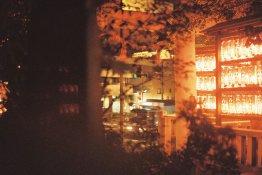
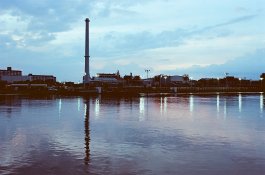
FH010019.JPG
On Zuiko 50/1.8, OM-20, about 5s of exposure, Kodak Portra 800
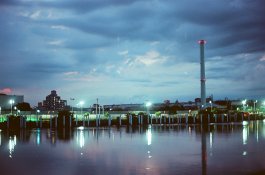
16820011.jpg 16820020.jpg
On Zuiko 28/1.8, OM-20, about 3s of exposure, Fuji Superia 100 (not sure about the model, but sure about the ISO)


My main question is : what seems to be the problem? Is it the exposure time? (I am guessing it arbitrarely and doing a bit of bracketting, since my camera doesn't measure below 1.67 EV with my widest lens). I saw @Sirius Glass link to the jiffy calculator, and will give it a try but I would like to have your opinion on whether the problem comes from the exposure or something else.

Thanks in advance
 
I see nothing wrong with the bottom two pictures. The top one is difficult to get right because of the bright highlights on the right and deep shadows on the left. Too late now but if you were to take the top one again you could either avoid the deep shadow area or if you were close to it then low level fill-in flash might be enough to bring out some detail. Alternatively you could place a graduate ND filter across the lens to where the shadows begin to level out the exposure effect and then increase it a little so you have slightly less bright highlights due to the grad ND and an increased brightness in the shadows due to increased exposure

pentaxuser
 
I rarely use color so I may not be of any help. It appears that the first image looks like the lights were tungsten bulbs and the film is daylight film. With the others You might experiment by making an exposure in daylight and a double exposure after dark.. That might give you more color saturation as well as the lights being on. Be sure to use a tripod and cable release. Someone may be familiar with that technique and give you more specifics on the technique.

http://www.jeffreyglasser.com/
 
The main problem with taking film photographs at night is slow shutter speeds which means you will need a tripod (and a cable release). Then there is another issue when shutter speeds get long and that is reciprocity failure. This means that exposure times become even longer than calculated. Using slow shutter speeds means you will get blur with anything that is moving but sometimes that can be used to creative advantage. To avoid some of these problems you could use a fast colour film of ISO 800 or even 1600. I bought some Fuji Superia 800 last week so you can certainly buy that. I don't know about 1600 availability.

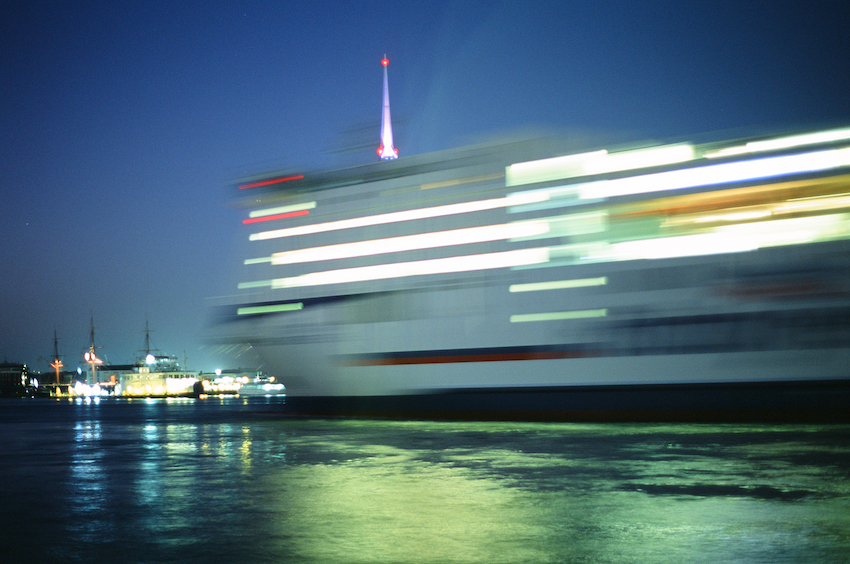
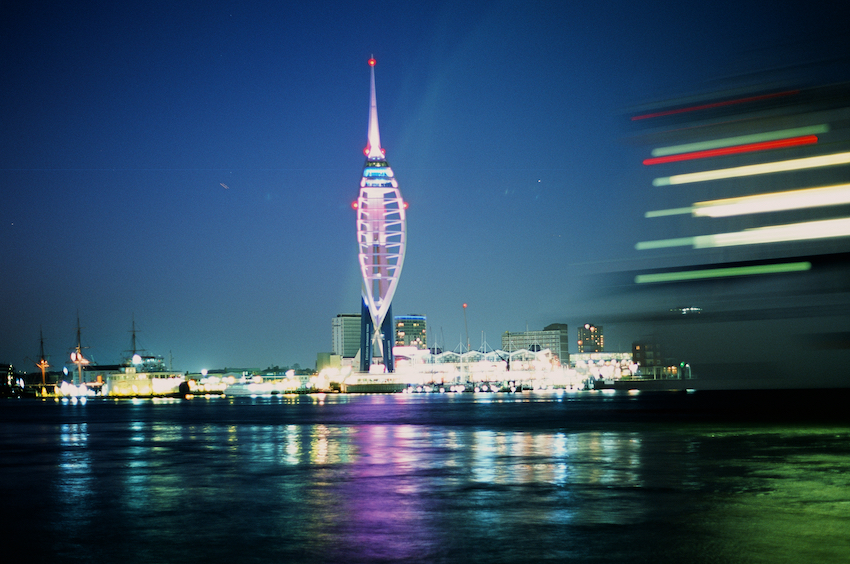
The photos below were on slide film, long exposure with camera on a tripod. The blurred ferry was deliberate as I thought the coloured lights might be interesting.


The other thing you are noticing with colour film is a colour shift under varying levels of light and different types of lighting (daylight, tungsten, fluorescent etc). The human brain tries to maintain "colour constancy" so that objects appear the same colour to us under different types of lighting (https://en.wikipedia.org/wiki/Color_constancy) but colour film does not behave in this way and is usually balanced for daylight.
 
I never tried for bad night photography results, only good results. The best color results I got from using tungsten films, at the time mostly slide films. None tungsten color slide film had reciprocity failure towards red for Kodachrome and towards green for Ektachrome. Both Tungsten Ansco and Kodak Tungsten Ektachrome gave really good results with the proper color balance and no noticeable reciprocity problems.
 
Your absolute best bets are Cinestill 800t, which is just kodak vision film stock minus remjet, or portra 400 with a tungsten filter.
Get a tripod, stop down, bracket. I use a spot meter for night and usually take 5 images of the same scene if it's important to me.
 
I'dd add that a light meter is a valuable tool for night photography. I have a Gossen Luna-lux that has served me very well and it was inexpensive.
 
Try Provia 100F with a nice sturdy tripod, spot meter it and use a cable release or the self timer to take the exposure.
It handles long exposures very well, reciprocity failure does not occur until 128 Seconds.
Keep in mind though Provia is an E-6 Slide ( Dia ) film.
 
ask your lab to boost the contrast and print them down ( darker )
you might have the results you want already .. its just the printer
doesn't know the mood you want to convey.
bonne vacance !
john
 
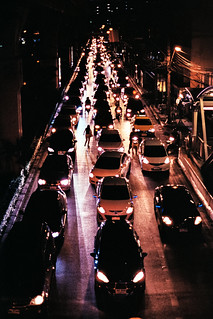
Pretty much whatever film you're shooting, open the lens all the way (f/2.8 or more) and shoot at 1/30s. You will get something decent. Of course at night 800 speed would be more valuable than 400 or 100. I use the same rule when shooting indoors too. Here are some examples I've shot that way:

Portra 400

Bangkok Traffic


Superia 800

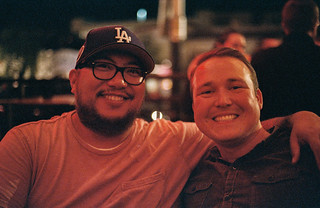
Sherwyn and his buddy John


Velvia 50!

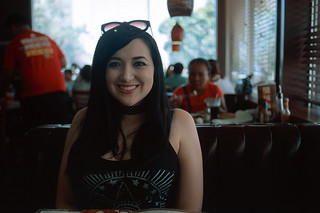
At Breakfast
 
I rarely use color so I may not be of any help. It appears that the first image looks like the lights were tungsten bulbs and the film is daylight film. With the others You might experiment by making an exposure in daylight and a double exposure after dark.. That might give you more color saturation as well as the lights being on. Be sure to use a tripod and cable release. Someone may be familiar with that technique and give you more specifics on the technique.

http://www.jeffreyglasser.com/
I used to do a lot of night shooting and I never found a light meter to be of any use.You can use any film really but I found provia100 and acros the easiest.If you look in lance Keimig's book"Night Photography" there is a table of exposures for a lot of different films which I found very useful
 
I used to do a lot of night shooting and I never found a light meter to be of any use.You can use any film really but I found provia100 and acros the easiest.If you look in lance Keimig's book"Night Photography" there is a table of exposures for a lot of different films which I found very useful


I have been taking available light photography since the early 1960s using Kodachrome, Ektachrome, Anscochrome and several others. All of which have a narrow light range. I never used a light meter because I could not afford one sensitive enough. I always used the Jiffy calculator and never had an exposure problem. The solution has been there since 1963. It works and it is proven. Why are your making your life difficult?
 
It looks to me like exposure is the issue. Generally you will get better results by overexposing and then printing the downward to get dark areas dark but still full of detail. You are starting with not enough detail, and when you try to lighten it up, there's nothing in the shadows to reveal--just grey emptiness. This is most obvious in the blank grey areas on the left in the first photo, but visible to all of them if you know what to look for. The other solution is to print what you have, but do it more in line with the original subject, which was dark, with large expanses of empty solid, pure black. You are trying, to some extent, to make night look like day---lighter than it really was Print down until your black areas are genuinely black..

There's a nice add-on for Chrome browser called Image Histogram. You can use it to show a histogram of web images. Yours stop considerably short of pure black, which means that in these photos there is no black at all--not even in the darkest areas without any detail. Certainly that is not the way night is!

I don't see any particular lack of sharpness. What I do see is a generally blah tonality which you may be interpreting as a general lack of crispness. That lack is more about contrast and snap than resolution.
 
Last edited:
Image 1 is overexposed in the highlights.
Images 2 and 3 look nice to my eye.

Low light photography takes experience, and the best way to get this is to make lots of images and to learn how to set the camera to achieve your creative goals. What have you shot lately?
 
Image 1 is overexposed in the highlights.
Images 2 and 3 look nice to my eye.

Low light photography takes experience, and the best way to get this is to make lots of images and to learn how to set the camera to achieve your creative goals. What have you shot lately?

What he said.
 
Photrio.com contains affiliate links to products. We may receive a commission for purchases made through these links.
To read our full affiliate disclosure statement please click Here.

PHOTRIO PARTNERS EQUALLY FUNDING OUR COMMUNITY:


Ilford ADOX Freestyle Photographic Stearman Press Weldon Color Lab Blue Moon Camera & Machine
Top Bottom