• Welcome to Photrio!
    Registration is fast and free. Join today to unlock search, see fewer ads, and access all forum features.
    Click here to sign up

Azo & 3-D effect - Urban Legend?

Recent Classifieds

Forum statistics

Threads
201,766
Messages
2,829,801
Members
100,934
Latest member
Fablesilence
Recent bookmarks
0

Photo Engineer

Subscriber
Allowing Ads
Joined
Apr 19, 2005
Messages
29,018
Location
Rochester, NY
Format
Multi Format
Azo was once coated on 19 paper stocks shared with other products. The emulsion was also nearly identical to Agfa Lupex and the contact paper made by Fuji.

The characteristic curve was similar to Velite and Velox, as was the image tone. Speeds varied between these products.

It was one contact paper out of 3 and survived more due to its 'fit' in terms of speed and ease of manufacture and keeping. It was therefore a survivor.

Now, if one goes back nearly 50 years, I daresay that you will not find any remarkable claims about Azo, other than its good keeping qualities which was another survival factor. Nor will you see comments about the other paper supports being good for 'depth' when used with other products. In fact, the survival of the support is merely a matter of being easy to produce. Azo used several different combinations of all of these supports during its life.

PE
 

Alex Hawley

Member
Allowing Ads
Joined
Jul 17, 2003
Messages
2,892
Location
Kansas, USA
Format
Large Format
I think the possible causes of 3-D have been examined in a general way. And it appears that there are a few reports of other papers being capable of causing such illusions.

As far as the urban legend part, I think that is still up in the air other than one comment that Azo is a rather unremarkable paper when compared to other papers.

Here's my take on it: Urban legend - yes. Printing on Azo is not the single key to producing a 3D-effect. There are many other factors involved and the type of paper is not the controlling one. The controlling effect most dominated by how the photographer sets the scene with respect to lighting and contrast and dimensional relationships. The second most dominating effect may be using a large format camera. However, this may not hold true when using small and medium formats with close-up macro shots. And as always, the mileage may greatly vary.
 
Last edited by a moderator:

ilya1963

Member
Allowing Ads
Joined
Oct 30, 2004
Messages
676
Format
8x10 Format
When I speak for myself , I only refer to #3 AZO ... The effect is not noticable in #2

These two grades are two different products and produce totaly two different results

#3 when veiwed under direct light source has all kinds of DMAX , I am not technichal but and do not like big words so the way I would describe it would be : the blacks are endless/bulletproof even under a 300 watt lamp, I am sorry that you guys have no idea what I am talking about , but I do not have time or interest to proof this if someone wants to put their time into it and come to see me in Maine , my door is wide open

M/P spent time with me last fall , you can ask them...

But all this discussion about product that you can not get is aboslutly mute , so I am not putting a lot of time into it

If you have a chance to see a DARKLY printed AZO print put it under a light and see it glow ... There is nothing like it with any paper

ILYA
 

Photo Engineer

Subscriber
Allowing Ads
Joined
Apr 19, 2005
Messages
29,018
Location
Rochester, NY
Format
Multi Format
Myself personally, I think that it is due to contact printing LF and ULF negatives. I suspect than any good FB contact paper would work well.

I also think that it has something to do with reciprocity effect changing curve shape slightly, because from the examples that I have seen that were best, they had longer exposure times than used in the EK release test, thereby probably being outside of the release curve envelope. I'm not sure about this latter, as I have not been able to see and test enough to tell.

PE
 

Alex Hawley

Member
Allowing Ads
Joined
Jul 17, 2003
Messages
2,892
Location
Kansas, USA
Format
Large Format
I suspect than any good FB contact paper would work well.

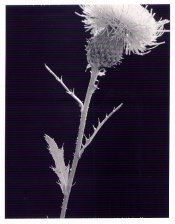
I used to generally agree with all that has been said above about Azo, contact printing and so forth until I took this one. The scan is from the test shot I did on Polaroid Type 664. Please don't try to judge the 3-D effect by this crummy scan, but believe me, on the actual Polaroid print, its there. I also did the full frame 4x5 shot on both Ilford FP4 and Efke 25. Not only that, but I also shot both films with two different lenses; my 12 inch 1940's vintage Commercial Ektar and a much newer Schneider 12 inch Xenar. I see the 3-D effect on all of the prints; polaroid, 4x5 contact, 8x10 enlargement, and 11x14 enlargement, all made on Kodak and Ilford multi-grade papers. So I dunno, the mileage varies greatly, but can be obtained seemingly irregardless of the materials in the mix. For me, that throws it all back to the lighting, contrast, and subject.
 

Attachments

  • thistle664.jpg
    thistle664.jpg
    164.1 KB · Views: 102

gainer

Subscriber
Allowing Ads
Joined
Sep 20, 2002
Messages
3,699
I'm curious. What was the actual diameter of the lens opening? Not the f-stop, but the focal length divided by the f-stop. How does it compare with the width of elements of the picture that define relief? (Of course I'm crazy. You all knew that.)
 

Photo Engineer

Subscriber
Allowing Ads
Joined
Apr 19, 2005
Messages
29,018
Location
Rochester, NY
Format
Multi Format
Alex;

Don't forget that these were all LF camera originals, right? 4x5 will give you both micro and macro contrast scales in one image as I stated above and is probably one of the factors in this.

I see a lot of lines in this particular scan though that confound my interpretation if any is really possible on-screen.

PE
 

Alex Hawley

Member
Allowing Ads
Joined
Jul 17, 2003
Messages
2,892
Location
Kansas, USA
Format
Large Format
I'm curious. What was the actual diameter of the lens opening? Not the f-stop, but the focal length divided by the f-stop. How does it compare with the width of elements of the picture that define relief? (Of course I'm crazy. You all knew that.)

Pat, all of this series was shot with a 24 inch focal length and an indicated f/22. That puts the ration at 24/22 or 1.09 which is 1:1 rounded off. There were two different shutters involved also. The Ektar lens is in an Acme/Ilex 35 (1940s vintage again) and the Xenar was in a modern Copal #3.

Because I no longer have the subject plant, I have to guestimate its dimensions from memory. The stalk was no larger than 1/8 inch, the head was about 2-1/2 inch diameter. The leaves probably about 2 inches long at most.

And, as Ron points out, these were framed and taken with the 4x5 format. The thistle's head was cut off by the smaller Polaroid 664 frame size. The 4x5s show the entire head.

Photo Engineer said:
I see a lot of lines in this particular scan though that confound my interpretation if any is really possible on-screen.

Yeah Ron, that's my crummy scanner. It really sucks when there's a black background.
 

David A. Goldfarb

Moderator
Moderator
Allowing Ads
Joined
Sep 7, 2002
Messages
20,020
Location
Honolulu, HI
Format
Large Format
In this case, Alex, I think the main factor would be the backlighting, which causes the flower to separate nicely from the background, and then the fact that you're looking at a Polaroid with no enlargement or reproduction quality loss enhances the effect created by the lighting.
 

Photo Engineer

Subscriber
Allowing Ads
Joined
Apr 19, 2005
Messages
29,018
Location
Rochester, NY
Format
Multi Format
In this case, Alex, I think the main factor would be the backlighting, which causes the flower to separate nicely from the background, and then the fact that you're looking at a Polaroid with no enlargement or reproduction quality loss enhances the effect created by the lighting.

Interesting. I took the lighting as high, top right and slightly in front of the flower. Maybe just a hair.

PE
 

Alex Hawley

Member
Allowing Ads
Joined
Jul 17, 2003
Messages
2,892
Location
Kansas, USA
Format
Large Format
David, Ron, you're both right. This was done with natural sunlight where the sun was very high and to the right, strongly backlit but with just a small amount of front lighting. And this is the crux of my point - getting the 3-D effect is not dependent on the paper, lens, film or any of that stuff.
 

Jed Freudenthal

Member
Allowing Ads
Joined
Nov 22, 2004
Messages
226
Location
Bilthoven, T
Format
4x5 Format
I used to generally agree with all that has been said above about Azo, contact printing and so forth until I took this one. The scan is from the test shot I did on Polaroid Type 664. Please don't try to judge the 3-D effect by this crummy scan, but believe me, on the actual Polaroid print, its there. I also did the full frame 4x5 shot on both Ilford FP4 and Efke 25. Not only that, but I also shot both films with two different lenses; my 12 inch 1940's vintage Commercial Ektar and a much newer Schneider 12 inch Xenar. I see the 3-D effect on all of the prints; polaroid, 4x5 contact, 8x10 enlargement, and 11x14 enlargement, all made on Kodak and Ilford multi-grade papers. So I dunno, the mileage varies greatly, but can be obtained seemingly irregardless of the materials in the mix. For me, that throws it all back to the lighting, contrast, and subject.

In the example you are showing, the 3-D effect is created by the shadows. If your lighting is OK, and in the exampele it is OK, you can use any photographic procedure. [ in computer games this kind of 3-D is being used]. In the case of landscapes, 3-D has a different origin ( the physics behind it is different), and therefore that will be another story.

Jed
 
Last edited by a moderator:

gainer

Subscriber
Allowing Ads
Joined
Sep 20, 2002
Messages
3,699
The reason I asked about the lens opening is that it is possible for a lens that is wider than the subject to see part of it that cannot be seen from a single point. A little ray tracing will show what I mean. I have only done the imaginary ray tracing, but you can imagine a ray that is tangential to a small round object entering the edge of the lens aperture. It will come from behind the surface you could see from the center of the lens. Such happens with binocular vision when the interocular distance is greater than the width of the object. Each eye sees part of the object that the other cannot see. The brain integrates the two images. It's just a thought.
 

Photo Engineer

Subscriber
Allowing Ads
Joined
Apr 19, 2005
Messages
29,018
Location
Rochester, NY
Format
Multi Format
The reason I asked about the lens opening is that it is possible for a lens that is wider than the subject to see part of it that cannot be seen from a single point. A little ray tracing will show what I mean. I have only done the imaginary ray tracing, but you can imagine a ray that is tangential to a small round object entering the edge of the lens aperture. It will come from behind the surface you could see from the center of the lens. Such happens with binocular vision when the interocular distance is greater than the width of the object. Each eye sees part of the object that the other cannot see. The brain integrates the two images. It's just a thought.

Printed on a flat surface though, this type of imaging has (to my eye) been somewhat distorted. Like using a wide angle lens without barrel distortion in a way.

PE
 

gainer

Subscriber
Allowing Ads
Joined
Sep 20, 2002
Messages
3,699
Any backlighting would be emphasized by a wide lens opening. It would show at edges as a bright outline.
 

Jed Freudenthal

Member
Allowing Ads
Joined
Nov 22, 2004
Messages
226
Location
Bilthoven, T
Format
4x5 Format
Printed on a flat surface though, this type of imaging has (to my eye) been somewhat distorted. Like using a wide angle lens without barrel distortion in a way.

PE

You are right; this type of imaging on a flat surface is a distorted image. The distortion is described with methods used in projective geometry. It has no relation with 3-D effects with subjects nearby. That is determined by the shadows. Students in photography academies had to light and photograph an egg, to learn the tricks that an egg looks like an egg.
3-D in a landscape is different. The natural light is different, because of scattering, the limatation of the quality of the human eye plays a role, etc.

Jed
 

Photo Engineer

Subscriber
Allowing Ads
Joined
Apr 19, 2005
Messages
29,018
Location
Rochester, NY
Format
Multi Format
David, Ron, you're both right. This was done with natural sunlight where the sun was very high and to the right, strongly backlit but with just a small amount of front lighting. And this is the crux of my point - getting the 3-D effect is not dependent on the paper, lens, film or any of that stuff.

Alex, Jed;

My experience would make me agree with both of your comments.

Alex, I would alter your words above slightly as follows "the 3-D effect is not entirely dependent on the paper, lens, film....." as I feel that there are other effects such as I described from Kriss' work and the subjective factors that have been discussed here. Of course your "any of that stuff" takes it in, but the word "entirely" takes the onus off of any one factor and leaves the solution up in the air, as it really must remain. Just a thought. Many good points to ponder though.

PE
 

gainer

Subscriber
Allowing Ads
Joined
Sep 20, 2002
Messages
3,699
I will have to do the experiment. It seems simple. Photograph something narrow, like the stem, with backlighting and see if the lighting wraps around more with a large aperture than with a small. I can get apertures from 1.1" down with my Canon Elan IIe with auto exposure. We will see if the backlighting is preferentially modified by the aperture.

The subject is not flat. You won't get any depth cues copying a flat painting or another photo.

It is interesting to note that hyperfocal distance and angle of acceptance are dependant on pupil diameter, while exposure is dependant on relative aperture. I am referring here to the angle of the cone of light emanating from a point in the scene that enters the pupil. If you want your 35 mm camera to have the same hyperfocal distance as an 8x10 viewer with 305 mm lens set at f/64 it's 50 mm lens will be set at f/10.5. At any setting of the 305 the 50 will have a much shorter exposure for the same depth of field and the same angle of acceptance. At the same exposure time, the 305 will have a larger acceptance angle. I am hypothesizing that the scale effect on perceived depth in a flat photo is due to fact that a large pupil sees more of the sides of things, and that exposures tend to be reckoned so that relative apertures are likely to be the same whether one uses a huge camera or a small one. However small the acceptance angle may be, the tangent of that angle for a 24 inch lens is 3 times that for an 8 inch lens at the same f-stop.
 

Chris Breitenstein

Member
Allowing Ads
Joined
May 29, 2007
Messages
226
Location
Tucson Az
Format
Multi Format
I have seen the 3d effect in the proliferative work of Bret Weston, Michael Smith, and especially Paula Chamlee. I have seen it in numerous silver bromide prints as well.

I don't think this is a property confined strictly to azo. I think its a property of any well crafted print.

Yours;
 
Photrio.com contains affiliate links to products. We may receive a commission for purchases made through these links.
To read our full affiliate disclosure statement please click Here.

PHOTRIO PARTNERS EQUALLY FUNDING OUR COMMUNITY:


Ilford ADOX Freestyle Photographic Stearman Press Weldon Color Lab Blue Moon Camera & Machine
Top Bottom