
• Welcome to Photrio!
    Registration is fast and free. Join today to unlock search, see fewer ads, and access all forum features.
    Click here to sign up

Are We Really Stuck With Ilford MGFB? Where Are the Magic Papers of the Past?

Somewhere...

D
Somewhere...

  • 5
  • 2
  • 103
Iriana

H
Iriana

  • 7
  • 1
  • 166

Recent Classifieds

Forum statistics

Threads
202,750
Messages
2,845,067
Members
101,503
Latest member
Avinash Aggarwal
Recent bookmarks
0
You got it, and the vast majority of them will produce indistinguishable results on most contemporary papers. Relatively extreme changes are required to make practical differences. The tone reproduction, D-max etc. are largely baked into the paper.
Any paper developer from any supplier has:
  • Outstanding shelf life
  • sparkling whites
  • superb separation of mid-tones
  • extremely deep blacks
  • 🤨
 
True.
 
You got it, and the vast majority of them will produce indistinguishable results on most contemporary papers. Relatively extreme changes are required to make practical differences. The tone reproduction, D-max etc. are largely baked into the paper.

I've used Dektol from the Dawn Of Time and recently tried Ansco 130. The differences, while subtle, are definitely there. But the most important thing about 130 is storage and use time. My frequency of mixing stock developer has plummeted.
 
I've used Dektol from the Dawn Of Time and recently tried Ansco 130. The differences, while subtle, are definitely there. But the most important thing about 130 is storage and use time. My frequency of mixing stock developer has plummeted.

I've been using John Wimberley's 130B for about 8 months and like it, but I'd like to slide away from Glycin since its availability is sometimes unknown.
 
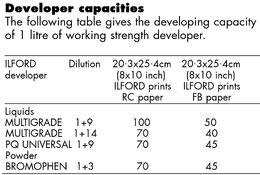
Hardly. You get 10 L of working solution from 1 L of Multigrade (1+9), but 5 L of Bromophen 1+3 makes 20 L of working sol. They cost about the same.

Bromophen's capacity per litre of working solution is 43% less than Multigrade though.
 
I've been using John Wimberley's 130B for about 8 months and like it, but I'd like to slide away from Glycin since its availability is sometimes unknown.

Glycin is not a complicated synthesis. It has one rather nasty component involved (chloroacetic acid), but nothing particularly out of the ordinary for industrial organic synthesis.

What you need to ask yourself is why the major manufacturers very rapidly came to prefer PQ developers (especially given the very long road to achieving efficient Phenidone manufacturing), and ploughed a lot of effort into making modified forms of it.

If Phenidone was still as difficult to make as it had been before the breakthroughs achieved by Ilford's researchers in the 1940s, it would be more fetishized than glycin is today. Levinson and others at Kodak had clearly cracked what glycin was doing back in the 1940s, but it is also equally obvious that as each of the major manufacturers arrived at similar conclusions, they did so while trying to ensure that their competitors would still waste effort on a component that was readily substitutable.
 
Bromophen's capacity per litre of working solution is 43% less than Multigrade though.

Bromophen processes 40 prints (FB) per litre of working solution and Multigrade 50, so Bromophen has 20% less capacity per litre, not 43%. But a Bromophen package makes 20 L of working solution while Multigrade makes 10 L, giving about 800 vs 500 prints total, or roughly 1.6× more capacity overall.
 
The facts on capacity from the Ilford data sheet.
Another point not to be neglected is the price of the developers. Also, powder developers will out last liquid developers in its packaged state.
 

Attachments

  • Screenshot_20260314_222114_Adobe Acrobat.jpg
    Screenshot_20260314_222114_Adobe Acrobat.jpg
    252 KB · Views: 11
Last edited:
I was looking at RC prints, where it is 100 8x10 for Multigrade, 70 Bromophen. 100 /1.43 = 70.
 
Also, powder developers will out last liquid developers.
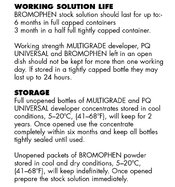
However, once mixed to a stock solution the keeping isn't as good as the liquid concentrate. Ilford says the Bromophen stock solution has a life of 6 months, the working solution life is the same for both.
 
I was looking at RC prints, where it is 100 8x10 for Multigrade, 70 Bromophen. 100 /1.43 = 70.

Ok, I see, but the whole package of Bromophen still processes about 1.4× more RC prints than 1 L of Multigrade concentrate, and they cost roughly the same
 
However, once mixed to a stock solution the keeping isn't as good as the liquid concentrate. Ilford says the Bromophen stock solution has a life of 6 months, the working solution life is the same for both.

Bromophen keeps very well once mixed (and properly stored). I use it all the time. I have been using it for a year and a half after mixing, and it was still straw colored and working fine. In my experience, Multigrade that has been opened for a year or more turns black.
 
What you need to ask yourself is why the major manufacturers very rapidly came to prefer PQ developers

It's actually obvious. In a powder form, glycin has the shortest shelf life of pretty much any developing chemical. Phenidone lasts forever as a powder. Also, glycin tends to result in a pretty murky developer - whereas phenidone results in a clear developer. Manufacturers don't tend to care about working life of a developer. And as long as it does the job properly (which phenidone does), they'll push the thing that ends up being best for them.

You never did answer whether or not you ever even used Ansco 130, by the way. Have you ever actually had any glycin? You sure have a problem with it.

And why is this thread talking about glycin, anyway?
 
It's actually obvious. In a powder form, glycin has the shortest shelf life of pretty much any developing chemical. Phenidone lasts forever as a powder. Also, glycin tends to result in a pretty murky developer - whereas phenidone results in a clear developer. Manufacturers don't tend to care about working life of a developer. And as long as it does the job properly (which phenidone does), they'll push the thing that ends up being best for them.

You never did answer whether or not you ever even used Ansco 130, by the way. Have you ever actually had any glycin? You sure have a problem with it.

And why is this thread talking about glycin, anyway?

130 is nothing special once you understand what is really going on in it. I have had to match prints to ones made with it. It was not difficult. The problem is that the North American market has had very little understanding of anything apart from Dektol for the last 40-50 years. Modified phenidones are where the real import seems to lie, if people want to do the organic synthesis work.

If glycin had any of the mythical properties assigned to it, efforts of the sort applied to synthesising phenidones or evolving PPD into the CD series would have been brought to bear. One of the biggest errors of judgement people make is appending their own lack of aesthetic (and chemical) understanding to many of the scientists involved in a great deal of the research (many of whom had a far clearer understanding of the science/ art linkage than the idea of the 'two cultures' as popularised by Snow) rather than marketing failing to communicate well with end users in either direction. It's the same with many of the papers upthread that people are mythologising into a history that never was, and where their understanding of fine darkroom printing was derived more from offset reproduction than from seeing actual prints, never mind having to match or better them.
 
I've heard that stuck record before. Visual properties are not "mythical". 40 years ago I gave up on Dektol and started mixing my own developers. One thing I learned is that what works best for me can certainly differ paper to paper. But with today's relatively limited specific paper selection, 130 is as close as it comes to an ideal developer for me. I don't care about shelf life. I mix it fresh each session. Reserve glycin powder stays in the freezer.

What worked best for this and that former graded paper is a fun topic to reminisce about - but that's all it is - an archeological discussion at this point in time. My big jar of amidol has been neglected and lonely for quite some time now.
 
An interesting experiment could be to make D-72 with the high amount of KBr present in Ansco 130 to see if that is what makes the difference vs the glycin. Image characteristics, I mean. Not tray life / shelf life. If the reputed longer tray / shelf life and/or higher capacity of Ansco 130 are real, they would have to be due to the presence of glycin - although whether or not it is glycin per se or just the fact there’s more developing agent is unknown.
 
However, once mixed to a stock solution the keeping isn't as good as the liquid concentrate. Ilford says the Bromophen stock solution has a life of 6 months, the working solution life is the same for both.

The data sheet clearly states for MG
"Once opened use the concentrate
completely within six months"

So I don't understand the claim that Bromophen stock solution isn't as good as MG concentrate?
 

Attachments

  • Screenshot_20260315_022853_Adobe Acrobat.jpg
    Screenshot_20260315_022853_Adobe Acrobat.jpg
    325.2 KB · Views: 3
I've had good luck keeping MG concentrate in mylar bags that squash down to exclude and air and I make sure the bag is completely full. I have been able to extend the life of a concentrate that way.

I don't think I would be as successful with a mixed stock solution because of the oxygen that comes in with the water. I have not tried a longevity test though.
 
An interesting experiment could be to make D-72 with the high amount of KBr present in Ansco 130 to see if that is what makes the difference vs the glycin. Image characteristics, I mean. Not tray life / shelf life. If the reputed longer tray / shelf life and/or higher capacity of Ansco 130 are real, they would have to be due to the presence of glycin - although whether or not it is glycin per se or just the fact there’s more developing agent is unknown.

I do this regularly ... turn Dektol into 130
 
Bromophen keeps very well once mixed (and properly stored). I use it all the time. I have been using it for a year and a half after mixing, and it was still straw colored and working fine. In my experience, Multigrade that has been opened for a year or more turns black.

The data sheet clearly states for MG
"Once opened use the concentrate
completely within six months"

If you store the unused MG concentrate “properly” in appropriately-sized bottles with a squirt of butane on top, it keeps perfectly for at least a year. I buy it in the 5 litre size (better economy) and break it down as soon as opened.

I’ve forgotten what this thread was about.
 
Photrio.com contains affiliate links to products. We may receive a commission for purchases made through these links.
To read our full affiliate disclosure statement please click Here.

PHOTRIO PARTNERS EQUALLY FUNDING OUR COMMUNITY:


Ilford ADOX Freestyle Photographic Stearman Press Weldon Color Lab Blue Moon Camera & Machine
Top Bottom