• Welcome to Photrio!
    Registration is fast and free. Join today to unlock search, see fewer ads, and access all forum features.
    Click here to sign up

APX 100 and Kodak D-23?

Forum statistics

Threads
203,248
Messages
2,851,979
Members
101,747
Latest member
Tallphotographer
Recent bookmarks
0

JPD

Member
Allowing Ads
Joined
Mar 24, 2007
Messages
2,179
Location
Sweden
Format
Medium Format
I have nine 35mm rolls of Agfa APX 100 and am looking for a suitable developer for them. I developed one roll in Rodinal 1+50 but didn't like the sandpaper look of the prints. :tongue: I like Rodinal for the 120 and sheet version of this film, though. I didn't like it with D-76 either, something with the mid tones that felt compressed. Agfa-14 (metol, sulphite, carbonate) gives fine but very unsharp grain. Diluting it 1+1 helps a bit.

I'm now thinking about Kodak D-23 1+1 or 1+2. Anyone tried this combination?

What I'm looking for is fine grain, but still enough sharpness (like Plus-X in D-76 1+1).
 
XTOL 1+1.

But I'm very surprised you don't prefer it in Rodinal 1+50. That is a classic combo.
 
XTOL 1+1.

Thanks, but it's too modern for my taste. :wink: Vitamin-C derivates and phenidone is out of the question. :tongue: I'd prefer something containing metol, hydroquinone or catechol (that I keep in my lab).

But I'm very surprised you don't prefer it in Rodinal 1+50. That is a classic combo.

I do like APX 100 in Rodinal, but only larger formats when the grain size isn't as important. :smile:
 
APX 100 in Caffenol-C is hopefully not too modern, results are nice.
 
I'm surprised at the sandpaper look, APX100 in Rodinal gives exceptionally fine grain and razor sharpness, some of the finest 35mm prints I've seen where shot using this combination.

Ian
 
Something is very wrong there because at that size the grain should be invisible with APX100 regardless what film developer is used.

My guess is it's micro-reticulation/grain clumping caused by temperature changes during processing/washing. APX100 like Tmax is an inherently fine grained film.

Ian
 
Oh no.. those images are much much too grainy. I wonder how the negs were agitated. Rodinal doesn't like too much agitation. 30sec of initial agitation and 3 inserts each minute is enough in my opinion.

With APX 100 (@50) and Rodinal 1:50 one should expect to get something like this one: http://decluttr.com/4662544917
 
APX/Rodinal

Use a waterbath to keep all chemistry within half a deg. incl. wash and you will be shocked at the difference.... You might try 1:100, semi-stand...
 
Use a waterbath to keep all chemistry within half a deg. incl. wash and you will be shocked at the difference.... You might try 1:100, semi-stand...

Yes, it's that attention to control that makes all the difference.

You can give two photographers identical cameras, the same film & developer and one can get grainy results the other grain free, and it's all down to total control of the processing.

Ian
 
APX-100 with D-23 may make an interesting combination. D-23 produces grain that looks about like D-76 with maybe even a bit less sharpness. (D-76 is actually a very sharp developer.) But it gives midtone textures that may go very well with APX-100. Rodinal should produce fine but very distinct grain with this film.
 
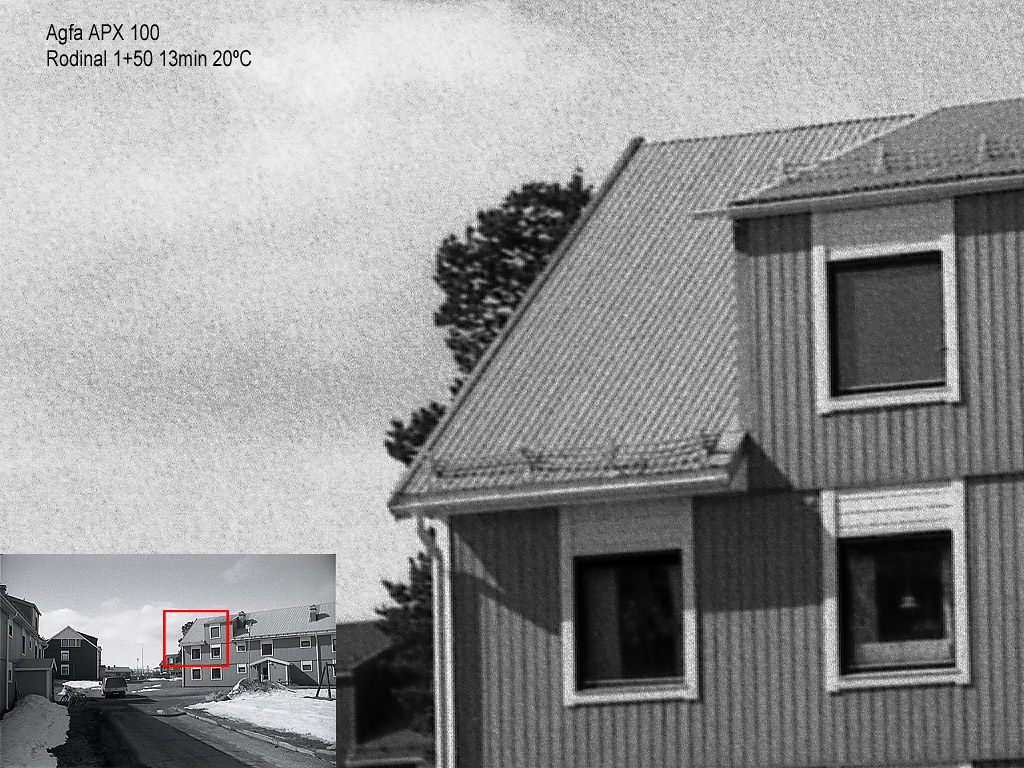
I can't see any reticulation. I kept the same temperature (20ºC) during the whole process (I use the Paterson colour thermometer). I developed for 13 minutes, but maybe agitated too much? 30 sec agitations at the start and then three inversions every half minute. Contrast looks ok.

Here's a scanned negative:

4705709579_4a7324b1e5_b.jpg


I tested the 35mm Heligon C for my Retina IIc. It turned out to be better than expected. :smile:
 
Micro-reticulation is caused by the swelling and shrinking of the emulsion layer caused by temperature changesduring processing, it's also called grain clumping, visually it looks like grain, exactly what you have there. It does not look anything like classical reticulation which is often cracking of the emulsion layer.

Ian
 
APX-100 with D-23 may make an interesting combination. D-23 produces grain that looks about like D-76 with maybe even a bit less sharpness. (D-76 is actually a very sharp developer.) But it gives midtone textures that may go very well with APX-100.

I think I'll try it, and perhaps also Agfa 14 1+2 and Rodinal 1+50 with less agitation. :smile:
 
Is grain clumping really as sensitive as this? Or do I just see more grain than Ian does? Grainless 8x10" enlargements from 35mm APX 100?? Really??

I'll basically answer this way:

No, maybe, no. Subject matter affects the last part as well.

There is absolutely no way people are getting grain clumping with temp deltas of 2C. I'm not even remotely buying it.
 
Are you actually seeing this in the prints themselves or only in the scans? If you've done everything right, as you say, there's no way you're going to see grain like this in a 4x6 print. To me, this looks like a case of over sharpening in post processing.
 
Is grain clumping really as sensitive as this? Or do I just see more grain than Ian does? Grainless 8x10" enlargements from 35mm APX 100?? Really??

This is where I and others totally disagree with Clayne, how sensitive it's difficult to quantify because choice of film and developer throws up too many permutations. Rodinal with it's high pH is more prone to it, but it can and does occur. Some of the German users of APX100 & Rodinal work at lower than normal temperatures because they find that helps prevent this excessive grain, I've always worked at 20°C and not had a problem.

In terms of fine grain APX100 is on a par with Tmax 100 but has better effective film speed, I used both in 35mm in Rodinal and prints are indistinguishable.

Looking at JPD's scan even accepting there's scanning/sharpening artefacts the grain is excessive for that film/developer combination. When I say invisible grain in a 10x8 print I mean not discernible at normal viewing distance but we are talking about a huge difference compared to the posted images.

Yes slight under-exposure or under development and printing at a higher contrast increases the apparent grain but not by this much unless the negatives are painfully thin :D

Read (there was a url link here which no longer exists) about similar problems with Tmax & Xtol. Helen B could tell you where to find the documented evidence of grain clumping occurring unfortunately she no longer posts here.

Ian
 
Last edited by a moderator:
May be way off base here, but I have been using Rollei Retro 100 and developing it in D23 straight for 5 min with a borax (20 Mule Team 15% Sol for 5 mil) with superior results for a long time.... give it a try. Not too much agitation here... Rollei Retro 100 is really Agfa APX 100, I think...

Logan
 
Are you actually seeing this in the prints themselves or only in the scans?

Yes, on the prints. Something is definitely wrong with my process, or AgfaPhoto must have used the 400 emulsion by mistake. Not likely, though...

Heresy! *slap*

Hey! As I wrote, I like the combination for larger formats. This was the first time with the 35mm version! Tried APX 100 at 50ASA in Agfa-8? Another superb combination for acutance and lovely midtones, that SHOULD be a "classic combination". :wink:

May be way off base here, but I have been using Rollei Retro 100 and developing it in D23 straight for 5 min with a borax (20 Mule Team 15% Sol for 5 mil) with superior results for a long time.... give it a try. Not too much agitation here... Rollei Retro 100 is really Agfa APX 100, I think...

Interesting. I might try it. :smile:
 
I've never seen apx look like what you had - even 400. These are full frame uncropped prints?

What grade did you print them at? Seeing as apx is inherently low contrast I wouldn't be surprised if you were printing at higher grades.

Printing at higher grades on VC will start to bring out the grain of the paper emulsion itself. It's possible that that is what were keying in on here.
 
Printing at higher grades on VC will start to bring out the grain of the paper emulsion itself. It's possible that that is what were keying in on here.

Not a chance. Paper grain is very fine, and not subject to enlargement at all. You won't see it no matter how hard the contrast. You will see more apparent grain at higher contrast levels, but it's not from the silver in the paper.
 
I've never seen apx look like what you had - even 400. These are full frame uncropped prints?

What grade did you print them at? Seeing as apx is inherently low contrast I wouldn't be surprised if you were printing at higher grades.

Printing at higher grades on VC will start to bring out the grain of the paper emulsion itself. It's possible that that is what were keying in on here.

Clayne, I appreciate you're sceptical about grain clumping but if I hadn't seen it first hand I probably wouldn't be so sure it can & does occurs, but rarely as significantly.

This is from a discussion of excessive grain with TMY and Xtol

But I have seen the grain you describe – the film was from my batch of film and all my own rolls were fine, my usual developer Xtol (I replenish on a strict basis), only difference was the photographer (he processed his own films). As he used my development tank, developer, fixer etc & development time, & I'd done the light meter readings & told him what exposure, all that differed was the temperature of the processing solutions and washing which he controlled.

I shot 5"x4" TMX & 35mm TMY in my Leica at the same time with perfect results (same developer & times for the TMY), my colleague shot 6x7 on TMY with his Mamiya RB67, I should add I was the subject of his images- and was being photographed making LF images in the landscape, hence the accurate exposures).

His 6x7 negs were perfectly exposed and correct density but printed 10x8 were extremely grainy while my 35mm images had barely visible grain at the same size. The ONLY thing that differed was control over the temperatures of the process after development.

So it does happen. It's easy to assume it's the film developer combination but it seems to be worse with some film/developer combinations.

In this case the excessive grain is very similar and totally contrary to the results that Rodinal should give with APX100.


Ian
 
Ian, you're gonna make me have to test a roll with +-10C variations just to prove it's paranoia more than reality. :smile: Based on his results he had to have been doing something very wrong and/or the pudding is in the print itself.

Frank, it's quite possible I'm completely talking out of my ass there. I was under the assumption, based on my own experience as well, that grain becomes quite exaggerated as VC grade is increased.
 
Photrio.com contains affiliate links to products. We may receive a commission for purchases made through these links.
To read our full affiliate disclosure statement please click Here.

PHOTRIO PARTNERS EQUALLY FUNDING OUR COMMUNITY:


Ilford ADOX Freestyle Photographic Stearman Press Weldon Color Lab Blue Moon Camera & Machine
Top Bottom