
• Welcome to Photrio!
    Registration is fast and free. Join today to unlock search, see fewer ads, and access all forum features.
    Click here to sign up

APX 100 and Kodak D-23?

Recent Classifieds

Forum statistics

Threads
203,242
Messages
2,851,947
Members
101,746
Latest member
Balage
Recent bookmarks
0
There were magazine articles about micro-reticulation/grain clumping in the late 80's and 90's where the writers had done test and shown it occurs. However I think other parameters like the combinations of developer/film, stop bath, fixer and water used all play a part.

There can be very sudden & unexpected changes in tap water temperature where cold water sits in a pipes next to a hot water pipe, or warms inside the pipework in a house, then a huge drop as fresh water is drawn through from underground pipework. It is a problem in my UK darkroom but here in Turkey the water seems to hold steady to less tahn +/- ½° C even on a day like today where it's 39° C outside.

Ian
 
I'm not doubting that it's possible - I'm just doubting that it's serious, wide-spread, or very easy to cause.

Also, consider that the rate of flow through a common household pipe at typical tap water pressures just simply will never provide the ability for something next to a pipe to affect water temperature even minutely once it's running at a constant rate. What *will* affect it though is if you have a typical mixed faucet setup and someone decides to flush a toilet or use a sink, etc. We've all seen this occur.

39C, you can develop C-41 outside Ian, I hope you're not complaining. ;-)
 
Many people I've seen just turn on the cold water tap to wash a film, and I know from recent experience (preparing food & cooking) at my mothers house that the cold water can shoot up in temperature by over 20° C, not dropping back down for perhaps a minute or two, that was why I made the comment. Also last year an APUG member posted a similar problem in his house. So if using running water it's best left running a couple of minutes first.

It's safer not to trust a mixer (faucet) for films unless it's a special temperature control type, I always use a 5 litre measure/jug and wash films using the Ilford system with approx double their recommended number of cycles, so I measure the temperature of each batch of wash water, but usually I'll use the mixer to fill it. The same jug gets used to measure & mix the developer anyway.

Ian
 
Last edited by a moderator:
...Frank, it's quite possible I'm completely talking out of my ass there. I was under the assumption, based on my own experience as well, that grain becomes quite exaggerated as VC grade is increased.

Yes, grain becomes quite exaggerated when using the harder grades of a VC paper, but it has nothing to do with the paper's grain itself. What we call grain is a variation in film density. Even in uniform areas, like skies, the negative will have an average density, at least in a macroscopic level, but go to a smaller scale and there will be a variation in density. Actually, the RMS granularity of films expresses this variation. Now let's take into account the gradation of the paper. When using a hard grade, a small difference in exposure results in great difference in paper density, compared to softer grades. So, a small difference in film density (film grain) can become very obvious, because of that. Grain also isn't a pixel with a fixed value. When using developers like Perceptol, or Microdol-X, grain is softened and this variation is more gradual, as opposed to developers like Rodinal, where this variation can become quite hard (accutance). So, different papers grades and different film developers can give different results.

FWIW, I also think that the images posted by JPD have excessive grain, according to my experience.
 
Ian, you're gonna make me have to test a roll with +-10C variations just to prove it's paranoia more than reality. :smile: Based on his results he had to have been doing something very wrong and/or the pudding is in the print itself.

Try it with +/- 1ºC instead. :smile:

I used a Paterson Colour thermometer to check the temperature of all the solutions plus the wash water. I also moved the film spiral up and down in the tank and shook it a little during washing, to prevent bubbles on the emulsion. So I would have felt if the temperature changed. I also checked the temperature before mixing the photo-flo solution (the water still running), and it still was 20ºC.

I was the only one in the house (the water heater is not shared with other households), so no one else used a tap or took a shower during that time.

So, I'm 90% sure temperature variations isn't the cause.
 
hallo

i use mainly d23 for all films.
i take the d76 times and add 1/4 of the time (12min -> 15min)

im not sooooo exact for the acros i use 15 min.
 
Michael, I very much doubt you'd see grain clumping with a 2° shift in temperatures.

Minimising grain though is about having tightly controlled technique at all stages. Determining your optimum film speed for normal lighting conditions along with the corresponding development time, usually to print onto a typical Grade 2 paper (fixed or VC). Alongside this tight processing helps enormously, I'm lucky here the water is so consistent that I can keep a 25 minute process cycle within +/- 0.5°C with no effort, but in the UK it's harder. In the late 60's early 70's some of the Colour processes required +/- 0.5 °F which is closer to +/- 0.25 °C and I cut my teeth with them :D

There's no one factor that makes one persons negative grainier than others for the same film/developer combination, but there are plenty of 35mm workers who consistently turn out superb high quality, very fine grain, prints and it's their attention to detail at all stages that gives them this lift in quality.

Ian
 
This has been a most interesting discussion and I've enjoyed the posts by Ian and the link to Helen B's post regarding temperature changes. This is a fine example of the value of APUG. You won't find this information elsewhere, or at least not as easily.

I've always tried to keep all my chemicals at 68F/20C during processing, but never paid any attention to the final wash temperature, thinking by that time it didn't make any difference. Always full cold, which during the winter can be quite cold. Me thinks I should clean up my act and try to be more careful with even the final rinse temperature. I've always had some prints with more grain than others for the same film and wondered why.

I wish someone had the time to do some real experiments and shock the hell out of their film in the final wash to see what happens. Maybe rinse one roll at 100F and rinse another in ice water and see what happens. Then do again at 2 or 3 degrees over and under 68F and one at exactly 68F. Then compare all the results.

Dave
 
Dave, there were some more detailed posts about Grain clumping/Micro reticulation 5 or 6 years ago but I can't find them. Some may have been earlier on alt.rec.darkroom or similar. I remember more dialogue with Helen B about the issue which in it's mildest form just looks & is grainer than expexted negatives.

Ian
 
I will ask our technical service what they think...

Simon. ILFORD photo / HARMAN technology Limited :
 
All else aside

All else aside I have read in threads elsewhere here that Rollei Retro 100 is a close match for the agfa product. I use D-23 1:1 for 13min, first minute constant agitation then 5sec/min after and the results are great.
 
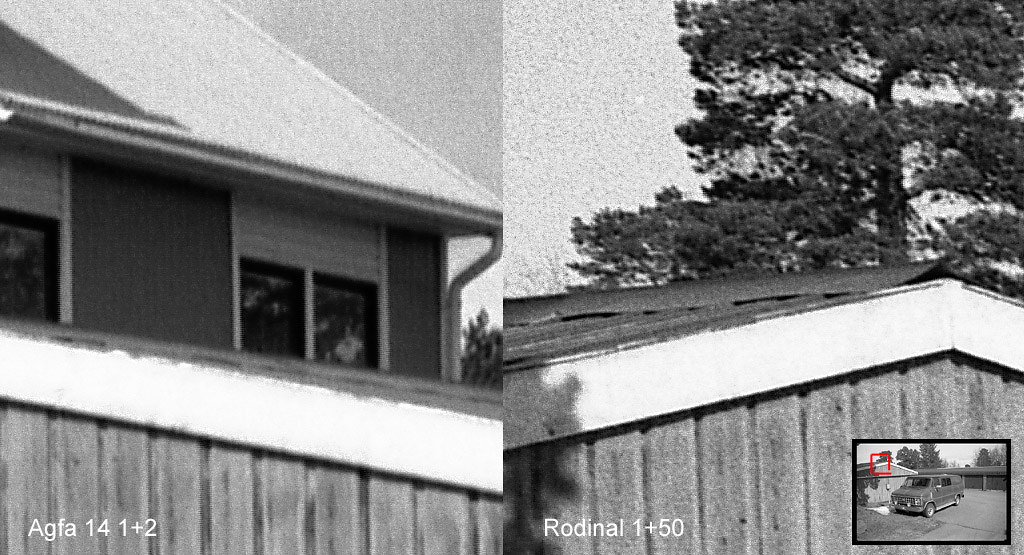
Tried Agfa-14 1+2 to compare with my Rodinal results:

4711177019_c884e22ac4_b.jpg

http://www.flickr.com/photos/19332145@N00/4711177019/sizes/l/

(Agfa-14 1+2, 20 minutes at 20ºC +/- 0,5ºC at most between chemicals. 30 sec. initial agitation and then three gentle inversions every minute).

The light was the same, sunny, but I should have used the same lens and shot from the same angle, but it's just the grain I wanted to see. The crops are of course the same size.

Smaller grain and less acutance.

Perhaps I should try Rodinal again and use the same gentle agitation.
 
Last edited by a moderator:
I will ask our technical service what they think...

Simon. ILFORD photo / HARMAN technology Limited :

Yes, that would be good.

While you may not want to speak about other companies products, I am curious of your position on thermal shock induced "microreticulation" and "grain clumping" in general... with special consideration of the degree and type of hardening given modern films during manufacture.

Unsupported referance* has been made to "microreticulation" and "grain clumping" resulting from "thermal shock" producing a different "fingerprint" from the traditonal "reticulation"... and I speculate that if effort was made to reduce normal reticulation from occuring by the the incorporation of modern hardening agents, someone must have notice that, perhaps, reticulation was not actually eliminated, but that its was, again perhaps, "reduced in serverity" or something like that.

*
(Ian can't find his referances, and both Helen Bach's and oboeaaron's links to some possibly(?) related comments by Silvia Zawadzki and Dick Dickerson are now dead, <at least when I try them....>)

Several years ago, (around the time when Kodak switched over to the new facility) I started noticing a strange sort of "reticulation" when I was processing Tmax in Tmax developer... without rinse temperature controls in place.... The images were obviously "different" when being hung up... they were grainier, and particularly, the film seemed less transparent... (no, not a fixing problem!), I was aware my technique was lax, so I just blamed myself, but the fact was, the film was behaving in a way I was not expecting.

I cannot speculate on the OP grain problem, (Rodinal is not particularily known for it's fine grain :wink:), but the whole issue of modern emulsion hardening, "grain clumping" and "micro-reticulation" needs, I think, some authoritative, professional comment.

I personally have not had this problem with any Ilford/Harman film.
I have seen it with post ca. 2001 Tmax however.

Ray
 
If you didn't like D-76 because of the flat midtones in your particular lighting situation, I think that you will like D-23 even less in the same light. I would try Kodak X-Tol or T-Max developers, or Ilford DD-X.
 
P.S. The Rodinal pic you posted on this page does not look bad. It is, after all, quite an extreme enlargement (over 24x by my quick estimation), and Rodinal does lead to more graininess than most developers.

As for the first Rodinal pix you posted, they do look far more grainy than one would expect. Can you post a pic of those negative frames on a light box? I am curious what the exposure is like.
 
Ray, I can remember sharing a film darkroom in the mid to late 70's with a leading UK commercial/advertising photographer and in the winter the developer (ID-11) in the deep tanks was warmed the rest sat at ambient temperatures often rather cold maybe 5-10°C, as was the wash water, the negatives were always fine we all used FP4, and the print quality was consistently good despite my misgivings about Alan's temperature control back then. (I was also Paterson/Jobo tank processing HP5, C41 & E6 in a different darkroom, there were 4 more darkrooms in the building.

It's very much a some films/some developers and the combinations that seem to cause the issues. There's plenty of evidence that the current Acros has poorer hardening than it's competitors, but the few rolls I've used have been fine.

Like you the Tmax 400 issue I referred to was back around 1999/2000, and as I wrote earlier, it was my from film batch, my developer (replenished Xtol), stop bath, fixer processing equipment, thermometer, and the only difference between excessive grain and excellent fine grain was the person controlling the overall process and in reality the temperatures. I saw the films being processed & agitation was similar to my own.

Because I've shot EFKE/Adox films since the 70's I've always kept a tight control of the whole process cycle and it's temperature, deviate with older EFKE films and you'd watched the emulsion floating in the developer, or sliding off the base :D

It's a pity there's no online archives for Darkroom Techniques and the other magazines who carried similar articles about Micro reticulation/Grain clumping, they pre-date the Internet and home computing, few professionals/workshop leaders etc take it seriously because their own technique's tight enough for them never to see it first hand, or even recognise it if they did.

Ian
 
Michael, if it looks good stop doubting it. You're going to drive yourself crazy.
 
Michael, what you really need to do is see prints first hand that demonstrate the highest qualities achievable with a particular film/developer combination. Only then can you really be objective about your own image quality.

Ian
 
P.S. The Rodinal pic you posted on this page does not look bad. It is, after all, quite an extreme enlargement (over 24x by my quick estimation), and Rodinal does lead to more graininess than most developers.

As for the first Rodinal pix you posted, they do look far more grainy than one would expect. Can you post a pic of those negative frames on a light box? I am curious what the exposure is like.

Perhaps more important, the Agfa 14 example looks very good.
 
Michael, what you really need to do is see prints first hand that demonstrate the highest qualities achievable with a particular film/developer combination. Only then can you really be objective about your own image quality.

Ian

Ian, John Sexton himself told Michael his (Michael) prints looked good enough to him. The risk here is of imparting too much importance on variables that while somewhat important are not deal breakers. Keeping all chemicals within half a degree, while desired, is NOT required nor will it be a deal breaker for the print or the negative.
 
Ian, John Sexton himself told Michael his (Michael) prints looked good enough to him. The risk here is of imparting too much importance on variables that while somewhat important are not deal breakers. Keeping all chemicals within half a degree, while desired, is NOT required nor will it be a deal breaker for the print or the negative.

I guess so. It's true at the Sexton workshop he examined the prints and negatives very closely and thought everything was great. But this thread and everyone's comments have still been very helpful in that it has caused me to further improve my temerature control. Like many others out there I'm the type of person who likes to be as detailed, meticulous and consistent as possible in my technique. Granted, it's usually overkill, but even if this small improvement in temperature stability amounts to nothing visible, it helps me sleep a little better!!

Well michael's already done what I suggest, it's important to know though how your own prints compare to someone like John Sexton's.

Good process control helps eliminate possible areas of risk, and its not difficult so it's taking a lazy option not to remain as close as you can to the starting developer temperature, most mercury/alcohol thermometers aren't capable of more than a degree C either way and that's should be close enough, and is extremely aesy to maintain,

Ian
 
I understand what you're saying, but when you're dealing with people at risk of obsessing over details that may cost them time and their sanity, if it ain't broke don't fix it.
 
It's a pity there's no online archives for Darkroom Techniques and the other magazines who carried similar articles about Micro reticulation/Grain clumping, they pre-date the Internet and home computing, few professionals/workshop leaders etc take it seriously because their own technique's tight enough for them never to see it first hand, or even recognise it if they did.

Ian

Yes, cold as it may sound, but the romance and plain advantage of professional hardcopies of books and magazines is so great, there s still a demand for them, so I would like to see publishers put out free online archive copies... fairly soon after publication. Some people are trying to charge 20+ USD for copies of 1-5 pages and that is crazy.

OTOH, I just finished reading (ok, skimming) a 2000 page book on Mechanical Engineering... free on line. WOW.

Ray
 
Photrio.com contains affiliate links to products. We may receive a commission for purchases made through these links.
To read our full affiliate disclosure statement please click Here.

PHOTRIO PARTNERS EQUALLY FUNDING OUR COMMUNITY:


Ilford ADOX Freestyle Photographic Stearman Press Weldon Color Lab Blue Moon Camera & Machine
Top Bottom