• Welcome to Photrio!
    Registration is fast and free. Join today to unlock search, see fewer ads, and access all forum features.
    Click here to sign up

Any former processing lab people out there?

Forum statistics

Threads
203,439
Messages
2,854,714
Members
101,843
Latest member
digitalsuccess40
Recent bookmarks
0
It’s nice to see this thread I started almost 5 years ago still gets the occasional attention. When it comes to stories about working the labs, I have a few.

It was 1975 and I had just exited my time in the military having spent the past 14 months guarding nukes in Europe, working 24 on/24 off with no breaks. I’d picked up the photography/darkroom passion in the service and when I saw the ad for this lab I figured it was perfect.

I showed up at the camera store that fronted the place and met the color lab manager. He explained that the job was for a film cutter on the midnight shift. That suited me because it was a steady shift as opposed to what I had been working and I could go to school during the day. I said that it sounded good to me and I wanted the job. He sighed and motioned me to follow him into a back hallway.

When we were out of earshot of anyone else, he said “Look, you don’t want this job. It’s boring. It’s just cutting strips of film and putting them into envelopes for 8 hours per night. You’ll hate it and in a few weeks you’ll quit and I’ll have to go through the hiring process again. It’s really a job for a woman because they don’t mind boring jobs but I can’t run an ad that says that.”

I told him that I can do boring because I’d just spent that last 14 months doing boring guarding nukes, either on a gate or in a guard tower. I eventually convinced him and got the job. I cut film for about 8 months and then moved up to a printer position. I was the best film cutter they ever had. They had me on the midnight shift and a young woman on the day shift who would cut what didn’t get finished during the night. I cut everything and she had nothing to do and happily got trained to do color spotting and retouching.

We were a “Kodak Lab” in that we used only Kodak chemicals, paper, and machines. The manager of the lab, the one who had hired me but worked days, had been there for years and ran it like a fiefdom and nepotism abounded. The business had been started years ago and the origainal own had passed away and left it to his daughter. She worked in an office and just let each department manager do their own thing.

Kodak showed up and offered to do an audit to measure what our waste was with the further offer to show us, for free, how to improve our quality and timing. The 24-hours service feature was just starting. She agreed and they came in with special trash cans and all scrap prints and rejects were to be placed in them so Kodak could weigh them and compare that to the paper we bought from them. During those days, individual printer operators would set up their machines and errors abounded. Sometimes entire rolls of paper would come out of the processor completely off in color or exposure or some other avoidable problem.

Near the end of the audit period, the manager got caught hauling the waste paper out to the dumpster to avoid it being weighed. Between that and the results of the audit, which were terrible, I couldn’t believe it, but the owner fired him. There was a big shake up in the lab as his wife left and took a bunch of her friends. My friend who ran the print processor was promoted to manager and I was sent to Kodak school to learn how to do quality control. From then on I came in ahead of the shift (actually they had their hours moved back two hours) and I set up all the machines, ran QC on the processors, and then took over lots of other tasks related to that. In the next year I heard we had reduce the cost of running the lab by over 1 million dollars.

So, I was making $5/hour and I’d talked to my counterparts in other labs and heard they were making $8.50. I asked for a raise to $6.50 and, considering how much we had saved, they could afford it. She gave me a 25 cent/hour hour raise and her reasoning was that some people had worked there longer than I had and they’d be upset if they found out I made more than they did.

Of course, I quit.

I then went and moonlighted for a month at another lab, a new one, set them up on the Kodak QC system and their sales people went after the other lab’s accounts which was easy since they were missing their 24-hour deadlines and the quality had gone down the drain.

I had just finished some schooling then so after that month I left that lab, put my camping gear on my motorcycle and roamed the US and Canada for a few months until I was out of money and returned to start a new career in a completely different area, a career path that took me to retirement.

Ah, those were the days.
 
It’s nice to see this thread I started almost 5 years ago still gets the occasional attention. When it comes to stories about working the labs, I have a few.

Ah, those were the days.

Great story, Vince!
 
My first job was riding a 50 pound bicycle in San Francisco as a bike messenger. I was 19, it was 1979 and for 3 years I rode around The City taking pictures of everyone and everything with my sturdy Canon A1. Then one day I was shooting at some dude and up from the ground came some bubbling...water. It was raining. I went inside to pick up a package and the owner asked me if I wanted to ride for him, on a motorcycle at a custom graphic arts lab.
Yes. Northern Lights Photo did pre-press work, typesetting, photostats, rub-downs, mock-ups and the brightest darkrooms I had ever seen. I moved inside, ditched the bike and made stats for the next 3 years. Stats are a 2-part paper positive, using a paper negative attached to a vacuum plate of a 20x24 copy camera. The vacuum plate holds the negative paper (or film) and closes like an oven door, hinged at the sides so the plate can be horizontal when open. A very dim light over the plate gives a 2 and/or 3rd exposure when making halftones to clean up the highlights (the bump) or open up shadows (the burn). The negative is sandwiched with the positive ceramic-coated paper and fed into a chemical bath through a roller, it cooks a minute and hits the fix and wash tanks. I made posters for my friends of them playing at shows (Mabuhay, Keystone, Omni, The Farm...) for access to backstage.
I put myself through film school at SF State making photocopies at night at ChromaCopy on 2nd St.
Then I went next door to Ziba and was trained by the owner who apprenticed for Ansel Adams. We did larger format commercial transparencies 50x80 up to 100-ish inches that would end up in light boxes at the airport, scarves and jewelry. We printed from 8x10 chromes the owner shot upstairs. Dip and dunk E-6, C-41 and B&W, roller transport for the prints, two 50"set of tanks. I mixed all the chemistry (we had two labs, SF and Berkeley) did control strips and made thousands of portraits of "Shirley". In Berkeley I printed the little stuff, 8x10 up to 16x20 fine art work for pros, and in SF very large stuff, 20" rolls and up. I loved this job very much.
A few more years at Faulkner and Robyn Color spending quality time in the dark alone in a closet with an enlarger, seeing the end coming for miles. It was sad seeing digital put lab after lab out of business. Even Robyn Color who embraced it, and had scanning services before digital cameras became a thing. We had high res scans of medium and large format chromes and negs and printed on a plotter (a really nice one but still an inkjet) but alas. Faulkner had 26 darkrooms, 3 of us printing.
I loved being a lab rat, made some great friends I still have. 22 years. I mean, free film processing and printing was magical. I was shooting 5-20 rolls a week night time, time lapse and long exposure light painting. I still do it but after 25 years as a sparky, I retired. Next up get a skoolie, gut it, make it cozy and go take some pictures.
 
this sounds like a fun thread. Here’s mine:

I met my wife working at a Wolf Camera in St. Louis. She was the lab manager. I was hired in sales. And she couldn’t stand me when we first met (so she says now).
 
this sounds like a fun thread. Here’s mine:

I met my wife working at a Wolf Camera in St. Louis. She was the lab manager. I was hired in sales. And she couldn’t stand me when we first met (so she says now).

Reminds me of the old joke. "Come into the darkroom and see what develops." 🤣
 
My first job was riding a 50 pound bicycle in San Francisco as a bike messenger. I was 19, it was 1979 and for 3 years I rode around The City taking pictures of everyone and everything with my sturdy Canon A1. Then one day I was shooting at some dude and up from the ground came some bubbling...water. It was raining. I went inside to pick up a package and the owner asked me if I wanted to ride for him, on a motorcycle at a custom graphic arts lab.
Yes. Northern Lights Photo did pre-press work, typesetting, photostats, rub-downs, mock-ups and the brightest darkrooms I had ever seen. I moved inside, ditched the bike and made stats for the next 3 years. Stats are a 2-part paper positive, using a paper negative attached to a vacuum plate of a 20x24 copy camera. The vacuum plate holds the negative paper (or film) and closes like an oven door, hinged at the sides so the plate can be horizontal when open. A very dim light over the plate gives a 2 and/or 3rd exposure when making halftones to clean up the highlights (the bump) or open up shadows (the burn). The negative is sandwiched with the positive ceramic-coated paper and fed into a chemical bath through a roller, it cooks a minute and hits the fix and wash tanks. I made posters for my friends of them playing at shows (Mabuhay, Keystone, Omni, The Farm...) for access to backstage.
I put myself through film school at SF State making photocopies at night at ChromaCopy on 2nd St.
Then I went next door to Ziba and was trained by the owner who apprenticed for Ansel Adams. We did larger format commercial transparencies 50x80 up to 100-ish inches that would end up in light boxes at the airport, scarves and jewelry. We printed from 8x10 chromes the owner shot upstairs. Dip and dunk E-6, C-41 and B&W, roller transport for the prints, two 50"set of tanks. I mixed all the chemistry (we had two labs, SF and Berkeley) did control strips and made thousands of portraits of "Shirley". In Berkeley I printed the little stuff, 8x10 up to 16x20 fine art work for pros, and in SF very large stuff, 20" rolls and up. I loved this job very much.
A few more years at Faulkner and Robyn Color spending quality time in the dark alone in a closet with an enlarger, seeing the end coming for miles. It was sad seeing digital put lab after lab out of business. Even Robyn Color who embraced it, and had scanning services before digital cameras became a thing. We had high res scans of medium and large format chromes and negs and printed on a plotter (a really nice one but still an inkjet) but alas. Faulkner had 26 darkrooms, 3 of us printing.
I loved being a lab rat, made some great friends I still have. 22 years. I mean, free film processing and printing was magical. I was shooting 5-20 rolls a week night time, time lapse and long exposure light painting. I still do it but after 25 years as a sparky, I retired. Next up get a skoolie, gut it, make it cozy and go take some pictures.

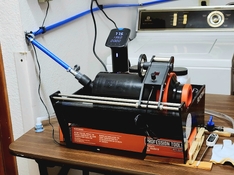
My wife and I owned and ran Horizon Photographic Laboratory in Hayward. We closed the lab in 1980. Earlier in this thread you can find a posting about some of the lab details. At 80, I'm still shooting. At home I have (my wife passed in 2009, or it would have been "we") two Canon large-format printers (24" and 44"), processing for C41, E6, and mainly Delta 100. Temp control and filtered-air drying setup. Shooting with my 501CM and my new 907X with a few XCD and HC lenses, but I can also use all my old glass on the 907X. Digital and analog. Thank you, Mr. Victor for allowing a blend like that. Hope to meet you some day! Bill Bailey
 

Attachments

  • 20240918_191105.jpg
    20240918_191105.jpg
    1.7 MB · Views: 97
I found this website quite by accident while doing a nostalgic search on the web for information on the old C-22 Processing Machine I learned to operate back in 1968. A bit of background: I was a Junior in high school and had just joined the high school camera club. There, I met a guy who taught me how to take action shots during night football games and how 35mm SLR cameras worked (my first!). Prior to that, my first camera was actually a Polaroid self developing camera.

I learned that my new friend worked (after school) at a commercial photo processing lab developing B&W negative film and that they were looking for someone to fill an opening running the C-22 Color Processing machine so I applied and with his recommendation, I got the job.
My job was to load racks with 10 rolls of film both 126 and 135mm for the older guy in the darkroom who then loaded the machine. Of course the film had to be extracted from the 126 cartridges or the 135mm cannisters, hung from clips, unrolled and clipped with weights. The machine would then take the racks, lift them up and lower them into tanks of chemicals one every two minutes. Once the machine moved the racks of film through all of the chemicals, it would move them into a large dryer machine.

Primarily, my job was to remove the customer's film from their envalope, add a number sticker to the envalope and an identical number to the rack behind a spring-loaded clip where the film cartidge of cannister was held and once the rack had all 10 slots filled, move the rack into a box system in the wall of the darkroom. Inside, the technician would take the rack, place it on the machine, strip each film from its cartidge or cannister, hang it on the clip and clip a weight on it.
Later, I learned how to work in the darkroom myself and got quite good at it. I worked at this lab for over 4 years and became the lead tech on that machine when the older guy (mid-60's) I worked with retired. But I was not given the supervisor's title. They hired another older (mid-30's) guy for that position.

The lab I worked for serviced a tri-state area with customers in Iowa, Illinois and Missouri. We had 6 drivers who picked up film from camera shops and drug stores throughout the three states and delivered the negatives and prints back to the customers on a daily basis (excluding Sundays).
During my time working there, I learned alot about the C-22 process (and later the C-41 process) and the machine that processed the film. My work shift was typically from 4PM to midnight depending on the volume of the workload each night and it was not uncommon for me to work 16 hour days right after Christmas and New Years.

Great story! Thank you for showing up here.
 
Stumbled on this thread recently.

Reading the posts brings back a whole lot of memories.

I am Faulkner....that is the son of Don Faulkner who founded and ran Faulkner Color Lab in San Francisco (and Faulkner Photography) since just after world war 2 in the late 50's.

My father mastered B&W and color photography thru the 50's and 60's earning a gazillion amount of awards and trophies. His talents in the darkroom also became apparent as he processed the film and made prints for not only his own clients but for other Bay Area photographers as well. The lab end of the business grew to a point that it was branched off and became an entity unto itself starting in the mid sixties.

As a young kid born in 56, I spent a lot of time in the various photo lab facilities he built. I swept the floor at first, wrapped packages for shipment while working my way thru the various photo wet processes. C22, E4, C41, E6, CP5 or 6, CP3, Cibachrome, Ilfochrome, B&W, all of them. I had pretty good mechanical skills along with extensive electronics education so I morphed into doing repairs and maintenance on all of the equipment....and there was a ton of hardware. Enlargers by every brand, film and paper processors galore, slide mounters, machine printers, slide duplicators, VCNA and PVAC analyzers, copy cameras, animation cameras, digital scanners and digital film recorders, inkjets, a whole host of finishing equipment...laminators, vacuum and hydraulic presses, silver recovery systems, sophisticated ion exchange water recovery systems.....and the list goes on and on.

Thinking back it kind of boggles my mind....this was an equipment intensive industry.

I did a bit of printing in my time but the technology was more my thing.

My dad died in 1992...and I was thrust into being the head of this respected Bay Area icon from that point on.

I often think that in a way, my dad's passing in 92 was kind of a blessing to him. He missed the atomic change (and stress) that digital did to the photolab business....the massive financial decisions needed in deciding how next to evolve one's business, the failure at first for digital to produce true quality...then ultimately as the speed and quality met photo paper levels... (then arguably surpassed) the traditional processes.....the resulting blood-bath that digital did to the traditional labs.

Most of us could see the change coming....not-with-standing Kodaks' advertised stance that digital will never replace film and silver-based processes. Remember...they invented the digital camera! RIP Kodak!

When the Italian 50" Lambda emerged in the early to mid 90's, it was a whole new ball game. That machine (a lazer to photo paper imaging machine) started at $250k and with options got to $350k. The Bay Area grew to having 3 placed early on and from that point on rose to (I think) maybe seven. All the while the internet and FTP (file transfer protocol) was growing at break neck speeds.

In the commercial sector of business....there wasn't enough local business to support this amount of costly equipment infrastructure. I can site numerous ad agency projects where we would bid a rush job using our traditional and digital systems (non Lambda), and would plan the job by keeping our technicians working through the night to ready the job for the local client the next morning. RUSH was a big deal and a good money maker. But with the advance of the internet and Lambda and Fed-ex, the client instead sent the digital file via the web to London, had a lab there produce the product during normal business hours (non rush / non overtime) then sent the final product back to San Francisco via Fed-Ex overnight to the clients doorstep in the morning.

All for less than we (and the local Lamba owners) could do without having to pay overtime.

Im glad my dad didn't have to experience the ultimate death of the industry that he was so involved in.

Today, I reminisce of the earlier years...hell, I think many of the posts on this site that mention our lab in the San Francisco Bay Area probably remember me as that kid growing up in the industry.

I miss the art, the customer contact, and the technicians who i met in the industry, and of course those of you who worked for us. I was simply the grunt who tried to keep things running smoothly, but our staff were the true masters who, like my father, had the passion for artistic perfection, and a gift for visual greatness.

Carry on.

Greg Faulkner
 
Thanks for joining in Greg.
 
Hi, I am going to keep this going. I just found this searching for photo labs of the past.

I started about 1976 doing B/W processing and printing in school for the annual and then was a sports photographer and a special interest photographer for a quarterly newsletter for the school and did the processing and printing for it.

Took quite a few years doing other jobs in the early 80’s then took a photography course at a vocational school. I had a special eye that came naturally on the printing side.
First job around mid 80’s was at a 1hour/custom lab. I did the C-41 and E-6 processing and did custom prints off of a RGB enlarger. Lasted a year and started at one of the custom photo labs in Seattle.

I started as the custom type R printer and had such a good eye on how to do it that I didn’t have to do test strips. I finalized with dodging and burning on from 16” or 20” roll. Ran it onto a Pako processor. Cut and trimmed and shipped out. They got a Cibachrome and did that also.

A few years later I ended up also as the one that opens up the custom dept side of the lab. I ran Shirley’s for all the darkroom enlargers and calibration strips for the processors.
Having to do do Shirley’s for new print emulsions. The print processors were Autopans 80” and 50”. Ended up the one having to maintain the machines. Lasted 5 years then went to California to work doing specialized B/W at a facility using old fashioned rolling 100’ film onto cassettes and processing on a Jobo then scanning them. That lasted 5 years.

Got a job at Faulkner Color Lab processing E-6 and running the pro counter for the second shift. Only lasted a week there. I lived to far and tolls I wasn’t making enough money to make it worthwhile.
Moved back to Seattle and started working at the same place from earlier. I did the same start up and maintenance but now I am doing Murals on a horizontal 10x10 enlarger onto a vacuumed auto easel and a 10x10 smaller set up. That lasted a year or so then we went digital.
I was pretty computer illiterate. But caught on really fast. The problem was it really wasn’t set up right. Photoshop needed a lot of working it the wrong way to make it look good. I ended up calibrating the monitors to look right and the nightmare of spotting scanned images. It was transferred to a Lambda 50” 5 turret printer.
I worked with Fuji, Ilford, Agfa on new print papers and special papers before production. 5 years there.
Went to another Seattle custom lab and did banners on a 12’ ink printer for a few years.
Went to another Seattle custom lab and scanned and printed on a Lambda for a few years.
I basically took full control of all the Autopans, cleaning, repairing, mixing chemicals, changing filters.
Filled in for a tiny bit in Portland doing custom work.
Back to California for the B/W special work again for 8 years.

Now completely out.

I have done work for police, fbi, car manufacturers, hospitals, Boeing, original 8x10 transparency of Marilyn Monroe, experience music project, Jimi Hendrix at Monterey International Pop Festival, Art Wolf, Bill Gates, John Johnson, Corky Trewin, Dale Chihuly, advertising for Genie lifts, Kenworth, Washington Mutual, Car Toys, Toys r Us, Nintendo, Revlon, Wyndham, Weyerhaeuser. Even did some work for a retired photographer for Vogue magazine.
Thanks
 
Last edited by a moderator:
Woo! Let’s keep this old thread going! The first lab I worked in was a one hour place in a mall in the early 90s. We did both c-41 and e-6 in one hour. I was also one of the lab techs at the college darkroom rotating chemicals, tracking equipment etc. Almost moved into the cine processing lab we had. They did B&W reversal 16mm.

Years later when I had graduated I worked at a custom slide duping lab. We specialized in super high quality dupes mostly for stock photographers. We also did enlarged 65mm dupes and/or medium format dupes. The guy that ran it went to extreme lengths to get as high a quality as possible. We used modified Mitchell motion picture cameras in custom rigs bolted directly into the foundation. The 65mm had an extra set of registration pins put into it. They were run at .5 to 1 fps. We were the only people using Kodak’s duping film in 65mm so it had to be ordered 20 1000 foot reels at a time. The 35mm rigs used printing Nikors I think. They were made for cine duping and optical effects. He also had what I have come to believe was a unique lens, a Goertz Imperial Magnar. It was specifically made for 35mm to 65mm duping and cost over $7000 in the late 70s.

I then went to work helping manage a camera store with various Noritsu equipment. I wasn’t involved in lab operations since I was now out selling stuff. I worked there from 97 till 2006. When I started it was all film. By the time I left it was 75% digital. They lasted another 6 years before having to close up all 10 stores. Photofinishing was the real money maker at camera stores and once people stopped printing the business collapsed.

Had a lot of fun over the years working in the industry. It’s amazing how many companies were involved in photography and processing and how almost all of them are gone now.
 
Photrio.com contains affiliate links to products. We may receive a commission for purchases made through these links.
To read our full affiliate disclosure statement please click Here.

PHOTRIO PARTNERS EQUALLY FUNDING OUR COMMUNITY:


Ilford ADOX Freestyle Photographic Stearman Press Weldon Color Lab Blue Moon Camera & Machine
Top Bottom