• Welcome to Photrio!
    Registration is fast and free. Join today to unlock search, see fewer ads, and access all forum features.
    Click here to sign up

Ansco Copper Intensifier - any good?

Man walking.

A
Man walking.

  • 0
  • 0
  • 18
_Z721713-positive.JPG

H
_Z721713-positive.JPG

  • 3
  • 3
  • 113

Recent Classifieds

Forum statistics

Threads
202,002
Messages
2,833,595
Members
101,065
Latest member
canadian_xpress
Recent bookmarks
0

StoneNYC

Member
Allowing Ads
Joined
Aug 5, 2012
Messages
8,345
Location
Antarctica
Format
8x10 Format
Hey guys.

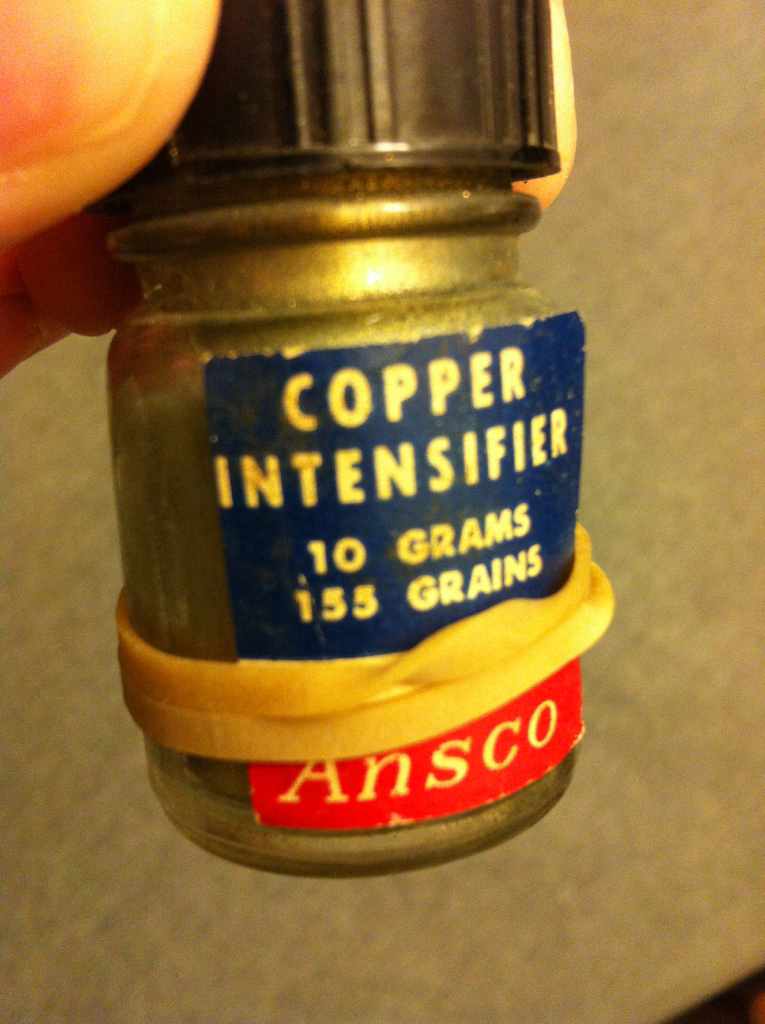
A neighbor who passed away left me this bottle...

Is it any good?

I know (sort of) what it does but what kinds of processing dilutions and instructions are there? I can't find anything clear by google.

Thanks!
udu3umun.jpg


~Stone

Mamiya: 7 II, RZ67 Pro II / Canon: 1V, AE-1, 5DmkII / Kodak: No 1 Pocket Autographic, No 1A Pocket Autographic | Sent w/ iPhone using Tapatalk
 

eddie

Member
Allowing Ads
Joined
Jul 24, 2005
Messages
3,259
Location
Northern Vir
Format
Multi Format
It probably works similarly to chromium intensifier. Do a search on that. Not sure how well it would hold up after a lot of years, but worth a shot on a reject, thin, negative (if you want to see if it works). If I recall correctly, you'll need to bleach it first, and redevelop in a paper developer (Dektol works). More difficult on negatives that used a hardening fixer. Others with more recent experience (or better memories) may be of more help.
 

pentaxuser

Member
Joined
May 9, 2005
Messages
20,366
Location
Daventry, No
Format
35mm
Once you find out what it does you have to use it or even if you aren't quite sure you have to use it. You are honouring the deceased by so doing. He or she honoured you by leaving it to someone whom he/she felt would make use of it

pentaxuser
 
OP
OP
StoneNYC

StoneNYC

Member
Allowing Ads
Joined
Aug 5, 2012
Messages
8,345
Location
Antarctica
Format
8x10 Format
Once you find out what it does you have to use it or even if you aren't quite sure you have to use it. You are honouring the deceased by so doing. He or she honoured you by leaving it to someone whom he/she felt would make use of it

pentaxuser

I believe that as well, It is confusing as I was also left his Nikon gear and Minolta gear, the Minolta gear was taken through the Vietnam War and many Kodachrome's went through it. But I already own Canon gear that is close to my heart and childhood and I don't really shoot a lot of 35mm, so I have thought of selling the Nikon, I feel bad but I would put it towards a TOYO 45A so it's the best I can do to transfer the usage in honor, but I'll keep the Minolta. Does that sound honorable?


~Stone

Mamiya: 7 II, RZ67 Pro II / Canon: 1V, AE-1, 5DmkII / Kodak: No 1 Pocket Autographic, No 1A Pocket Autographic | Sent w/ iPhone using Tapatalk
 

MattKing

Moderator
Moderator
Joined
Apr 24, 2005
Messages
55,303
Location
Delta, BC Canada
Format
Medium Format
Do with it whatever will best assist your photography.

That is the best way of honouring him.

I'm sure that there must be something like filters or other accessories that will work with your equipment - keep and use them in his memory.

It would also be in order to keep something that isn't particularly saleable, but has a real history, as a memento.
 
OP
OP
StoneNYC

StoneNYC

Member
Allowing Ads
Joined
Aug 5, 2012
Messages
8,345
Location
Antarctica
Format
8x10 Format
Do with it whatever will best assist your photography.

That is the best way of honouring him.

I'm sure that there must be something like filters or other accessories that will work with your equipment - keep and use them in his memory.

It would also be in order to keep something that isn't particularly saleable, but has a real history, as a memento.

Thanks, that's why I'm keeping the Minolta :smile:


~Stone

Mamiya: 7 II, RZ67 Pro II / Canon: 1V, AE-1, 5DmkII / Kodak: No 1 Pocket Autographic, No 1A Pocket Autographic | Sent w/ iPhone using Tapatalk
 

nworth

Member
Allowing Ads
Joined
Aug 27, 2005
Messages
2,228
Location
Los Alamos,
Format
Multi Format
Copper toner is a very popular and effective way of getting brown to red-brown tones. Your bottle is small, so it probably doesn't make much, maybe 500 ml (read the instructions on the bottle). The components of copper toners are long lived - copper sulfate, citrate, potassium ferricyanide, maybe ammonium carbonate, maybe something else - so the old bottle may still be good. Copper toner is a direct toner, somewhat related to the iron blue toners. The image is copper ferrocyanide (I think), which is long lasting but not indefinitely stable.
 

pentaxuser

Member
Joined
May 9, 2005
Messages
20,366
Location
Daventry, No
Format
35mm
I had thought the link might get me into the book for those pages but it doesn't seem to. Briefly what does Mr Wilson say on said pages? Is it for instance a film intensifier and not a copper print toner or does it do both?

Thanks

pentaxuser
 

bobwysiwyg

Subscriber
Allowing Ads
Joined
Mar 28, 2008
Messages
1,627
Location
Ann Arbor, M
Format
Multi Format
It did take me to the page (Kindle Fire browser). Preceded by more info. this part might be relevant to your question.

The bromo-iodide of copper intensifier is better in everyway than the uranium, although perhaps a little more expensive and troublesome to make up. But it may be used for bromide papers and lantern slides as well as for negatives. With all it has a toning action just as uranium, and is far more reliable.

Never heard of uranium toner, think I'll pass on that one. :sad:
 

Ian Grant

Subscriber
Allowing Ads
Joined
Aug 2, 2004
Messages
23,417
Location
West Midland
Format
Multi Format
Never heard of uranium toner, think I'll pass on that one. :sad:

I used Uranium toner in my youth and it worked well (and wasn't radiocative), gives a very red negative.

Copper toner/intensifier might work but the resulting negative is unstable. A Chromium intensifier works well but redeveloping in a Pyro staining developer adds even more intensification, I use IT-8 an Ilford print toner ocassionally and that's essentially a chrome based intensifying bleach and a Pyrocatechin re-developer.

Ian
 
OP
OP
StoneNYC

StoneNYC

Member
Allowing Ads
Joined
Aug 5, 2012
Messages
8,345
Location
Antarctica
Format
8x10 Format
I'm getting a lot of mixed messages.

To respond, the bottle doesn't have any instructions, as you can see the label is only held on by the elastic band and it's just the label, there are no instructions on the back.

It seems this can be used on both film and paper? but then staining is mentioned in the comments, is that referring to just with paper? as staining a negative would just cause it to have "fogging" issues no?

Unstable seems to be mentioned a lot as well, does this mean it's sort of no good to use because I'll have some image failure after a brief time and have blank negatives if I use it?

Is it used mostly with already developed films that need intensification, or with adding it to the development step to give some effect, or should I just wait until I do my own printing and use it for that purpose?

That article sort of was beyond me, it wasn't very clear to me in that I don't mix my own chems so I don't know what the other components mentioned are for or even where to obtain them and the article sort of lost me in describing the color, are they talking about the color of the solution or the film staining or what?

Plates are also mentioned, so is this for wet plate work?

Sorry it's just a little bit confusing for me, as I said I don't mix my own chems, I buy store bought stuff like Rodinal, and I don't do wet plate nor my own printing YET so should I just save it for that time and then re-visit this? Or is there some advantage to normal B&W negatives?

Thanks guys!
 

eddie

Member
Allowing Ads
Joined
Jul 24, 2005
Messages
3,259
Location
Northern Vir
Format
Multi Format
Stone- I think the wet plate reference is because the book was written in 1909.

While it may work as a toner, I think it's primarily meant as a negative intensifier. Give it a try with a processed neg you have which needs intensification.

* Forgot to mention that chromium involves a bleach step. My guess is this does, too. And, then, redevelopment. Ian recommends a pyro developer. I seem to recall using dektol when I did it, but it was probably about 30 years ago, and only a couple of times, so I may be misremembering. *
 
Last edited by a moderator:
OP
OP
StoneNYC

StoneNYC

Member
Allowing Ads
Joined
Aug 5, 2012
Messages
8,345
Location
Antarctica
Format
8x10 Format
Stone- I think the wet plate reference is because the book was written in 1909.

While it may work as a toner, I think it's primarily meant as a negative intensifier. Give it a try with a processed neg you have which needs intensification.

* Forgot to mention that chromium involves a bleach step. My guess is this does, too. And, then, redevelopment. Ian recommends a pyro developer. I seem to recall using dektol when I did it, but it was probably about 30 years ago, and only a couple of times, so I may be misremembering. *

Hmm, I've never done a secondary step, I actually have never done a bleach step independently, I don't even know which kind of beach to use (since there seem to be different kinds) but I'll definitely look into it. Thanks.
 

mr rusty

Member
Joined
Sep 7, 2009
Messages
827
Location
lancashire,
Format
Medium Format
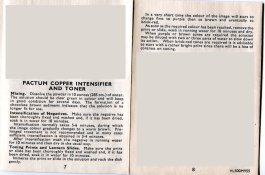
Hi Stone. Here's the instructions for Johnsons Pactum copper intensifier and toner. I inherited a single packet of this, and I haven't tried it yet. I guess it's probably similar stuff. My packet weighs 15g and is a terracotta coloured powder.

pactum_copper_instructions.jpg
 
OP
OP
StoneNYC

StoneNYC

Member
Allowing Ads
Joined
Aug 5, 2012
Messages
8,345
Location
Antarctica
Format
8x10 Format
Hi Stone. Here's the instructions for Johnsons Pactum copper intensifier and toner. I inherited a single packet of this, and I haven't tried it yet. I guess it's probably similar stuff. My packet weighs 15g and is a terracotta coloured powder.

View attachment 65542

Thanks, those are much simpler instructions and understandable. However there's no mention of bleaching which everyone else seems to have mentioned here, and also it mentions that you can do it by visible inspection with no mention of whether you are using a red safelight or daylight view, or some other color safelight, do you know? It also says just to use this chemistry and makes no mention of mixing it with anything else. If this is true why have others mentioned that it needs to be mixed with normal developer after a bleaching step? Again thanks this seems fairly straightforward, if it had been posted first, but because of the other mentions of additional instructions I'm curious which is more on target. Thanks!
 

eddie

Member
Allowing Ads
Joined
Jul 24, 2005
Messages
3,259
Location
Northern Vir
Format
Multi Format
Stone- Based on the instructions Mr. Rusty posted, it doesn't look like redevelopment is needed. Negative intensification can be done with lights on.
Do you have negatives which could use some intensification? If so, I wouldn't rely on the old copper you have. When I've needed a slight boost, I've used selenium at about 1:4. I think Photographer's Formulary sells a chromium intensifier, too.
Bleach/redevelopment in sepia probably gives the most increase.
 
OP
OP
StoneNYC

StoneNYC

Member
Allowing Ads
Joined
Aug 5, 2012
Messages
8,345
Location
Antarctica
Format
8x10 Format
Stone- Based on the instructions Mr. Rusty posted, it doesn't look like redevelopment is needed. Negative intensification can be done with lights on.
Do you have negatives which could use some intensification? If so, I wouldn't rely on the old copper you have. When I've needed a slight boost, I've used selenium at about 1:4. I think Photographer's Formulary sells a chromium intensifier, too.

Well I'm sure I have a test image that I can start with that isn't important and so I can test this old stuff on it. So... my question is... being really dumb... or rather, ignorant of photography ... when someone says a negative is thin vs dense... is it opposite speak? as in, like because it's a negative and not a positive, when someone says dense, do they mean the negative looks very dark (which would make it over exposed in a positive) or does dense actually mean that when printed as a positive the image would be dark?

So is intensifier for making thin negatives thicker making a lighter image, and reducer for making dark negatives that look black to be thinned out so the image is darker? Hope i'm making sense.
 

Rudeofus

Member
Joined
Aug 13, 2009
Messages
5,119
Location
EU
Format
Medium Format
Copper toner/intensifier might work but the resulting negative is unstable.
I think copper intensifier is a completely different animal than copper toner. Copper intensifier appears to be mostly Copper II Bromide which works as a rehalogenating bleach. After bleaching one can intensify in Silver Nitrate, or some staining developer. There is nothing inherently unstable about the resulting negatives.

Assuming that the mysterious bottle indeed contains CuBr2 I would assume it still works and can be used.
 

MattKing

Moderator
Moderator
Joined
Apr 24, 2005
Messages
55,303
Location
Delta, BC Canada
Format
Medium Format
Well I'm sure I have a test image that I can start with that isn't important and so I can test this old stuff on it. So... my question is... being really dumb... or rather, ignorant of photography ... when someone says a negative is thin vs dense... is it opposite speak? as in, like because it's a negative and not a positive, when someone says dense, do they mean the negative looks very dark (which would make it over exposed in a positive) or does dense actually mean that when printed as a positive the image would be dark?

So is intensifier for making thin negatives thicker making a lighter image, and reducer for making dark negatives that look black to be thinned out so the image is darker? Hope i'm making sense.

Yep - you use intensifier to make an underdeveloped negative "thicker", so it will print with brighter highlights, while still giving dark and detailed shadows in the print.

And you use reducer to thin out a negative, so it will print with darker shadows when the highlights look good in the print.

No opposites involved though - intensifier makes the negative itself look thicker (less transparent), while reducer makes the negative itself look thinner (more transparent).
 

Prof_Pixel

Member
Allowing Ads
Joined
Feb 17, 2012
Messages
1,917
Location
Penfield, NY
Format
35mm
Doing some Google searching for 'copper intensifier' turns up many different types/formulas/approaches. However, Google searching for "Ansco copper intensifier" shows it was $5 a package in 1960 and 'that you simply disolved the power in water and it was ready to use'.

Sadly, for copyright reasons the articles are shown only in a brief 'snippet' form. It would take a trip to a library to read the full articles.
 
OP
OP
StoneNYC

StoneNYC

Member
Allowing Ads
Joined
Aug 5, 2012
Messages
8,345
Location
Antarctica
Format
8x10 Format
Doing some Google searching for 'copper intensifier' turns up many different types/formulas/approaches. However, Google searching for "Ansco copper intensifier" shows it was $5 a package in 1960 and 'that you simply disolved the power in water and it was ready to use'.

Sadly, for copyright reasons the articles are shown only in a brief 'snippet' form. It would take a trip to a library to read the full articles.

Thanks I Did the same search and because of all the results I was confused that's why I asked, I'm glad you saw the Ansco specific one. At least it's "ready to use" haha


~Stone

Mamiya: 7 II, RZ67 Pro II / Canon: 1V, AE-1, 5DmkII / Kodak: No 1 Pocket Autographic, No 1A Pocket Autographic | Sent w/ iPhone using Tapatalk
 
OP
OP
StoneNYC

StoneNYC

Member
Allowing Ads
Joined
Aug 5, 2012
Messages
8,345
Location
Antarctica
Format
8x10 Format
Yep - you use intensifier to make an underdeveloped negative "thicker", so it will print with brighter highlights, while still giving dark and detailed shadows in the print.

And you use reducer to thin out a negative, so it will print with darker shadows when the highlights look good in the print.

No opposites involved though - intensifier makes the negative itself look thicker (less transparent), while reducer makes the negative itself look thinner (more transparent).

Thanks Matt,

That was clear, appreciate it.


~Stone

Mamiya: 7 II, RZ67 Pro II / Canon: 1V, AE-1, 5DmkII / Kodak: No 1 Pocket Autographic, No 1A Pocket Autographic | Sent w/ iPhone using Tapatalk
 
Photrio.com contains affiliate links to products. We may receive a commission for purchases made through these links.
To read our full affiliate disclosure statement please click Here.

PHOTRIO PARTNERS EQUALLY FUNDING OUR COMMUNITY:


Ilford ADOX Freestyle Photographic Stearman Press Weldon Color Lab Blue Moon Camera & Machine
Top Bottom