
• Welcome to Photrio!
    Registration is fast and free. Join today to unlock search, see fewer ads, and access all forum features.
    Click here to sign up

Another Caffenol question, also applies for chemistry in general

Chose vue

A
Chose vue

  • 0
  • 0
  • 23
Chose vue

A
Chose vue

  • 0
  • 0
  • 30

Recent Classifieds

Forum statistics

Threads
202,108
Messages
2,835,194
Members
101,119
Latest member
Photrizen
Recent bookmarks
0

Athiril

Subscriber
Allowing Ads
Joined
Feb 6, 2009
Messages
3,062
Location
Tokyo
Format
Medium Format
If you are going to be buying a restrainer other than iodized salt then potassium or sodium bromide is a better choice. Since so little iodide is required it would be hard to measure for most people. The only time I have seen a requirement for potassium iodide is for the Beutler formula where 25 ml of a 0.001% solution is added to 1 liter of the concentrate.

It's easy to measure by volume, you make up an x% solution dilute that and then dilute that result too, ala homeopathy.


0.45 x 150 ug = 67.5 ug


67.5µg of Iodine. 88.3µg of Potassium Iodide.
 

Gerald C Koch

Member
Allowing Ads
Joined
Jul 12, 2010
Messages
8,131
Location
Southern USA
Format
Multi Format
i think many of the coffee companies use dichloromethane as their preferred decaf method, the swiss water process, while it doesn't leave chemical residue that burns off
during the roast, it is more expensive, and the coffee "flavor" is reduced.
i don't know for sure, but maybe the coffee companies use arabica coffees
for their decaf-instant so it is more flavorful, seeing the decaf-process
robs coffee of taste. ( and cheap robusta beans are usually used as a filler )...
and more arabica beans = more cost/more expensive coffee.

while i am probably wrong, and it is only a guess, it seems that might be a reason
why decaf instant isn't recommended ... ( the wrong kind of beans )

I think you are right that decaf uses more arabica beans. Hence less caffeic acid.

Some years ago there was some worry about using chlorinated hydrocarbons. Many of them like trichloroethane are classed as carcingens. I assumed that manufactorers switched to a safer process. One method uses ethyl acetate which is reasonably non-toxic. However, you are right some manufacturers do use dichloromethane. I would avoid drinking any coffee made from this process.
 
Last edited by a moderator:

Athiril

Subscriber
Allowing Ads
Joined
Feb 6, 2009
Messages
3,062
Location
Tokyo
Format
Medium Format
Some years ago there was some worry about using chlorinated hydrocarbons. Many of them are classed as carcingens. I assumed that manufactorers switched to the swiss process.

Unfortunately there is this concept of what's best vs what's best (for business).
 

Gerald C Koch

Member
Allowing Ads
Joined
Jul 12, 2010
Messages
8,131
Location
Southern USA
Format
Multi Format

removed account4

Subscriber
Allowing Ads
Joined
Jun 21, 2003
Messages
29,832
Format
Hybrid
I think you are right that decaf uses more arabica beans. Hence less caffeic acid.

Some years ago there was some worry about using chlorinated hydrocarbons. Many of them like trichloroethane are classed as carcingens. I assumed that manufactorers switched to a safer process. One method uses ethyl acetate which is reasonably non-toxic. However, you are right some manufacturers do use dichloromethane. I would avoid drinking any coffee made from this process.


they used to tell us that whatever residue was left on the beans
burned off and left no trace after 200ºF and the coffee roasted
at temperatures 400ºF .. or something like that
( sorry i don't have the numbers in front of me )

while swiss water processed beans might be "better" the
coffee made from that never tasted very good ... it was almost like
a gap between when you should be tasting the coffee .... and when you tasted it.

hopefully ethyl acetate leaves a full flavored roast ... as you can tell im not a fan
of swp...

i don't drink much decaf, and neither does my film :smile:
 
OP
OP

Top-Cat

Member
Allowing Ads
Joined
May 5, 2009
Messages
119
Format
35mm
As a response to the question of what coffee I'm using. I'm using the cheapest kind of instant coffee I could find. And I bought the iodized salt to try for my next attempt seeing as KBr is hard to come by.
And it doesn't say anything about being a decaf version so I assume it's regular coffee (actually tried a cup of it yesterday and it sure tasted like regular coffee all though really bad... I can usually feel it if it's a kind of coffee with high caffeine levels - and this one sure felt like it)
 
Last edited by a moderator:

Ezzie

Member
Allowing Ads
Joined
Feb 22, 2010
Messages
429
Location
Sande i Vest
Format
Multi Format
I´m not a chemist either, but have tried my hand at Caffenol over the last year, and maybe 60-70 rolls of film (Acros, Efke 100, TMX, TMY-2, HP5+, Neopan 400, RR 400, Delta 400, GP3, ERA 100 etc) in all of Reinhold´s recipes, and quite a few variants of my own making. I´ve had one film which didn´t come out too well, all others more than satisfactory. Its my developer of choice. As John says, its not the cheapest, but boy is it the most fun. Its all up to you. The sense of achievement when you get it right is that much more than with a commercial offering. And the results are not at all bad. In fact I´m more than satisfied.
 

Monito

Member
Allowing Ads
Joined
May 16, 2011
Messages
335
Location
Nova Scotia,
Format
Multi Format
For sodium chloride, potassium bromide, and potassium iodide the amount that produces a restraining action is very approximately proportional to the ratio of the solubility products of the silver salts.

[Ag+][Cl-] = 1.7 x 10 -10
[Ag+][Br-] = 4.0 x 10 -13
[Ag+][I-] = 0.94 x 10 -16

You will notice that the solubility products form a decreasing series where each SP is roughly 1/1000 of the previous one. Thus in a developer where 2 g of potassium bromide is used the same restrainer activity could be achieved using 1/1000 of that amount of potassium iodide, or 2 mg. The amount of sodium chloride required however would be 2000 grams! So you can see that using 20 g/l of sodium chloride would have only a very, very slight restraining effect.

Now iodized salt is another matter as its restraining effect comes from any sodium iodide present in the salt.

If 2 g of KBr is the standard, then that would supply 2.0 g / (39.10 + 79.90) gmole-1 = 0.0168 moles of Br- ions. If Br- and I- ions have an equivalency going by the solubility products given above it leads to 0.94 x 10^-16 / 4.0 x 10^-13 = 0.000235 as the ratio of Iodine ions that have the same effectiveness. So 0.0168 moles x 0.000235 = 3.95 x 10^-6 moles of I- ion needed. KI is 39.0 + 126.9 g / mole = 165.9 g/mole. Multiplying 3.95 x 10^-6 mole x 165.9 g/mole = 6.552 x 10 -4 grams = 655 micrograms.

You may be able to get Potassium Iodide (KI) from your pharmacist as SSKI: Saturated Solution Potassium Iodide.

You can get the dry salt off ebay for about ~$20 for 100g.

As may be, but do you have a microgram scale? Diluting a saturated solution might be a more accurate way for the average darkroom worker.
 

Gerald C Koch

Member
Allowing Ads
Joined
Jul 12, 2010
Messages
8,131
Location
Southern USA
Format
Multi Format
For sodium chloride, potassium bromide, and potassium iodide the amount that produces a restraining action is very approximately proportional to the ratio of the solubility products of the silver salts.

I said nothing about having to solve the SP equations, only that the ratios of the amounts is very approximately proportional to the ratios of the solubility products. Hence the progression 2000, 2, 0.002. This appears in Mason "Photographic Processing Chemistry", p 37.
 
Last edited by a moderator:

Monito

Member
Allowing Ads
Joined
May 16, 2011
Messages
335
Location
Nova Scotia,
Format
Multi Format
For sodium chloride, potassium bromide, and potassium iodide the amount that produces a restraining action is very approximately proportional to the ratio of the solubility products of the silver salts. I said nothing about having to solve the SP equations, only that the ratios of the amounts is very approximately proportional to the ratios of the solubility products. Hence the progression 2000, 2, 0.002. This appears in Mason "Photographic Processing Chemistry", p 37.

Yes?

It occurs to me that one could make one's own saturated solution from dry or crystalline KI, so buying the salt from eBay might be the most economic after all.
 

Photo Engineer

Subscriber
Allowing Ads
Joined
Apr 19, 2005
Messages
29,018
Location
Rochester, NY
Format
Multi Format
Gerry is correct!

It should be added that these salts are Silver Haalide solvents and so also dissolve Silver Halide in inverse proportion to their SPs. Therefore at 2000 g/l of NaCl (if you could do that) it would be a fixer as well as a potential restrainer. At 2 g/l NaBr is just a restrainer, and KI is a very potent restrainer.

Also, this can be projected into organic antifoggants which also have SPs with Silver Halide, and thus Benzotraizole is approximately equal to 10x its weight in NaBr and Phenyl Mercapto Tetrazol is equal to about 10x its weight in KI. These are indeed good antifoggants. And remember, what I say in this paragraph is approximate and varies from emulsion to emulsion.

PE
 

Gerald C Koch

Member
Allowing Ads
Joined
Jul 12, 2010
Messages
8,131
Location
Southern USA
Format
Multi Format
The classic method to prepare very dilute solutions is by serial dilution. For example, take an easily weighed amount of chemical, say 10 g, and dissolve it in 1 liter of water. This gives a 1% solution. Then take 100 ml of this solution and add it to 900 ml of water. Now you have a 0.1% solution. Keep doing this until you reach the concentration you require.
 

tony lockerbie

Member
Allowing Ads
Joined
Feb 16, 2006
Messages
2,349
Location
Merimbula NSW Australia
Format
Multi Format
John, I always thought that Ansco 130 was a paper developer, wouldn't that be too active for film? I'm always drinking my coffee, never makes it to the dev. tank!
 

Photo Engineer

Subscriber
Allowing Ads
Joined
Apr 19, 2005
Messages
29,018
Location
Rochester, NY
Format
Multi Format
Very good advice Gerry, but needing one warning.

KI will not keep well in solution (about 1 - 2 months) and NaI is so unstable it is not even sold OTC.

PE
 

removed account4

Subscriber
Allowing Ads
Joined
Jun 21, 2003
Messages
29,832
Format
Hybrid
John, I always thought that Ansco 130 was a paper developer, wouldn't that be too active for film? I'm always drinking my coffee, never makes it to the dev. tank!

hi tony ...

yup, ansco 130 is sold as a print developer ... but it works great with film too!

many years ago i was broke, and used a can of "gaf universal developer"
that was on a window sill where i was living ...and it was wonderful, and i was
pretty upset when i ran out ---
i was told by someone that it was actually renamed ansco 130, so back in about 2000 i began to use 130 diluted 1:6 as my film developer as if it was gaf universal ( even though i knew it wasn't the same stuff )
it gives a nice crisp negative, great with aged/expired film ( not much if any fog )
i have been pretty happy with it ...
... i learned a few months ago from a friend what the formula for gaf universal was
and it actually was nearly the same thing as ansco 130 :smile:
dumb luck i guess !
i use it now in small amounts to take the edge off and smooth-out my caffenol-c

YMMV :smile:

john
 

Athiril

Subscriber
Allowing Ads
Joined
Feb 6, 2009
Messages
3,062
Location
Tokyo
Format
Medium Format
If 2 g of KBr is the standard, then that would supply 2.0 g / (39.10 + 79.90) gmole-1 = 0.0168 moles of Br- ions. If Br- and I- ions have an equivalency going by the solubility products given above it leads to 0.94 x 10^-16 / 4.0 x 10^-13 = 0.000235 as the ratio of Iodine ions that have the same effectiveness. So 0.0168 moles x 0.000235 = 3.95 x 10^-6 moles of I- ion needed. KI is 39.0 + 126.9 g / mole = 165.9 g/mole. Multiplying 3.95 x 10^-6 mole x 165.9 g/mole = 6.552 x 10 -4 grams = 655 micrograms.


As may be, but do you have a microgram scale? Diluting a saturated solution might be a more accurate way for the average darkroom worker.

I can accurately measure 100mg at a time. But regardless of that, you simply need to measure what you can. Add it to solution, dilute that solution, and dilute that solution again and use x mL of that.
 

Athiril

Subscriber
Allowing Ads
Joined
Feb 6, 2009
Messages
3,062
Location
Tokyo
Format
Medium Format
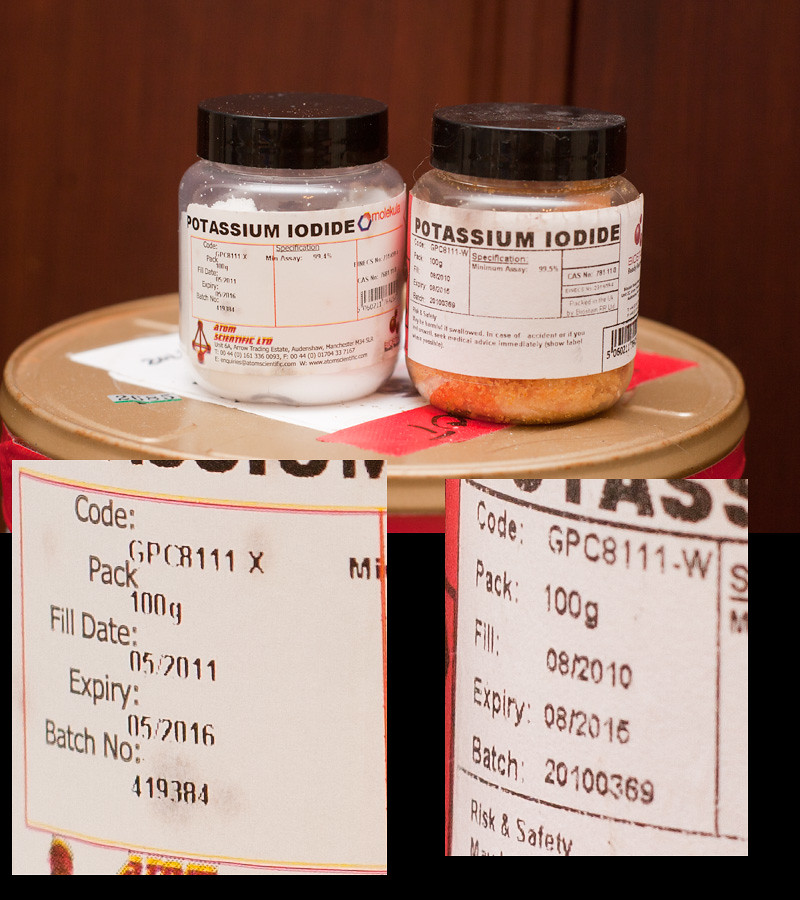
the yellowed KI is older there has been some small amount of oxidation.. moisture and atmospheric air contribute to it.
 

Photo Engineer

Subscriber
Allowing Ads
Joined
Apr 19, 2005
Messages
29,018
Location
Rochester, NY
Format
Multi Format
I keep my KI tightly sealed and in black, light proof bottles. This helps somewhat.

The yellow KI is probably bad. It is contaminated with oxidation products such as Periodates and also with Iodine.

PE
 

Athiril

Subscriber
Allowing Ads
Joined
Feb 6, 2009
Messages
3,062
Location
Tokyo
Format
Medium Format
Still useful for preparation of elemental iodine :smile:
 
OP
OP

Top-Cat

Member
Allowing Ads
Joined
May 5, 2009
Messages
119
Format
35mm
Tried the other recipe here (http://www.digitaltruth.com/data/caffenol.php) with the iodized salt, got slightly darker than I wanted, maybe I should have cut the development time by two minutes - otherwise good results.

Still think I'll stick to Xtol as a main developer for when I want the best results though, but it might be fun to try it out as a paper developer considering the natural sepia tone of caffenol.
 
Photrio.com contains affiliate links to products. We may receive a commission for purchases made through these links.
To read our full affiliate disclosure statement please click Here.

PHOTRIO PARTNERS EQUALLY FUNDING OUR COMMUNITY:


Ilford ADOX Freestyle Photographic Stearman Press Weldon Color Lab Blue Moon Camera & Machine
Top Bottom