
• Welcome to Photrio!
    Registration is fast and free. Join today to unlock search, see fewer ads, and access all forum features.
    Click here to sign up

An Experement

Somewhere...

D
Somewhere...

  • 5
  • 2
  • 106
Iriana

H
Iriana

  • 7
  • 1
  • 171

Recent Classifieds

Forum statistics

Threads
202,751
Messages
2,845,079
Members
101,505
Latest member
PeterFFM
Recent bookmarks
0
Hi PE and All,
My first water solubility tests indicate that niether formalin nor glyoxyl will cause a film of the kuraray polymer to become insoluble in Hot water. Both films eventualy dissolved, totaly. But the dried film, and the emulsion, are very hard on the gl;ass plate. Very difficult to scratch the surface or remove the film from the glass. I know at least one emulsion maker who makes gelatin plates, and never uses hardener.
Bill
 
Lost in this all is the fact that nothing here seems to supply a means of hardening the polymer, but it does appear to have some properties that allow adhesion to the glass. Will it work on film support?

PE

perhaps an interlayer of polydimethylsiloxane (polyvinylacetate) between the support and the silanized PVA could work?
I can tell from first-hand experience that styrofoam (or another non-cellulose but porous material) could be easily glued together with PVA or PVAc wood glue
maybe the subbed support has just the right surface texture.....
 
Hi T-Grain,
Not to be arbitrarily negative, but why would you want to do that? The point of attaching silane groups to the PVA polymer is for good adhesion to glass. It realy dose work, and has been used for that purpose in all sorts of industrial application for many decades. As for PE's question about adhesion to film, IDK, and will let someone else find out. I live and breath glass. I wish that the entire planet and everything in it could be glass, and, like my heart,easily broken.:D
 
Kirk,
Beavis and Butthead???!!!. I realy would have expected better from you. At leat South Park, which is "High Brow" compared to B&B. Seriously," Dude"!

Bill
 
Hi T-Grain,
Not to be arbitrarily negative, but why would you want to do that? The point of attaching silane groups to the PVA polymer is for good adhesion to glass. It realy dose work, and has been used for that purpose in all sorts of industrial application for many decades. As for PE's question about adhesion to film, IDK, and will let someone else find out. I live and breath glass. I wish that the entire planet and everything in it could be glass, and, like my heart,easily broken.:D

I was referring to PE's question about adhesion on film (where there's no silanol groups, but acetate etc. instead). And maybe such a layer could provide good adhesion for the silanol modified PVA (emulsion).
 
T-grain,
Thanks for the clarification.
Everyone,
Last night, I poured 11 plates. They are not dry yet ( humid here). But I did run a fogging test,on glass, yesterday. That looks good. Hopefuly, I will take some shots tomorow and post them here.
Bill
 
Dental Organo-Silane

All this is way above me. I am a dentist and use silane as a coupling agent to coat porcelain restorations prior to bonding them to teeth with resin cements to enhance the bond. Using it with the emulsion to coat glass plates is probably works in a similar fashion. As a dental product silane is over $50 for 12ml.

Just thought this may be of interest.

http://www.jeffreyglasser.com/

I have seen these kits on ebay. Do you hapen to know, what is the functionality of the organic site?
Bill
 
Results

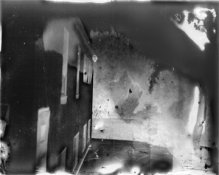
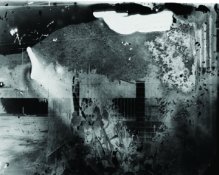
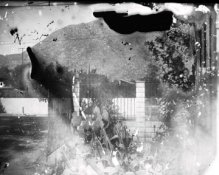
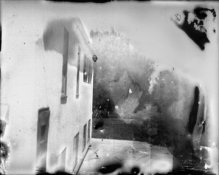
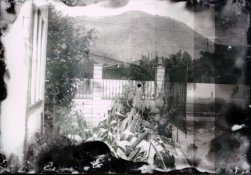
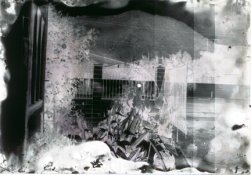
Hello to all, Everyone is gonna laugh at me because the scans of my plates are so uglt. But the plates themselves look much better. To coat the plates I used a 250 micron wire coating rod. This produced a wet coating 10mils thick. That is too much. I'll be getting a new rod that will lay down 7-8 mils. But it ain't here yet. Most of the obvious flaws, gaps in coating etc., are do to my clumsiness with wet plates and an IR monocle. Makes everything look thurther away than it is.. I have attached two negatives and the formula wth procedure. The actual plates, either just dryed or processed, are very glossy and hard. They remind me of obsidien. The are difficult to scratch and impossible to gough I am gonna make a new batch, just like this one, and use Denise Ross's coating well and a coating rod to try to get a wet thickness of about 7 mills.
Note that I wash the dried plates, not the emulsion,as PVA will not set up at cold temperatures, like gelaten (think: murdered cow,mother of baby calves:wink:
Bill
 

Attachments

  • 6-27- 1 copy.jpg
    6-27- 1 copy.jpg
    78.9 KB · Views: 172
  • 6-25 -27-2.jpg
    6-25 -27-2.jpg
    714.4 KB · Views: 176
  • 6-27-11-larger batch PDF.pdf
    101.2 KB · Views: 246
I forgot to mention that this is a fast emulsion, I grossly over-exposed several plates, befor I arived at f22 for 1 second, in bright miday sunlight..
Bill
 
I forgot to mention that this is a fast emulsion, I grossly over-exposed several plates, befor I arived at f22 for 1 second, in bright miday sunlight..
Bill

Well, that brings hand held shooting in the picture, 1/128th of a second at F2 :laugh:

The coatings are messy, but they look promising. Well, what do I have to tell, with zero experience coating plates...

Anyway, I hope you don't mind, but I took the liberty to "turn your negatives into positives" (with a thanks to MurrayMinchin here on APUG for making me see this differently, see the (there was a url link here which no longer exists)), as I was curious to see a bit better what was there.

6-25 -27-2_inverted.jpg6-27- 1 copy_inverted.jpg
 
Bill, there is nothing to laugh about your results. They really look promising!
As for the PVA, once dried-hardened, and when you soak the plates in the chemistry for processing, do they swell considerably (visibly)?
How long does it take to dry the plates once processed (I know there are many factors)?
thanks for sharing!
 
T-grain,
Here is a big difference between this emulsion and every gelatin emulsion that I have worked with. The PVA emulsion stays hard through all cold-water processes. I had no problem when I washed the dry panels in cold water for 3 hours. The one exception is at some corners and edges, where the film was so thick that it had not dried fully. I have always been a putz with a coating rod, even in daylight. Under IR I am worse. But flat dry areas do not buge.
After I removed the plates from the final rinse, I left them alone for 2 hours. But I think that an evenly coated plate would be dry in less than an hour.
Bill
 
Another Batch of Experimental Emulsion

Hello to All,
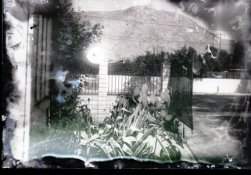
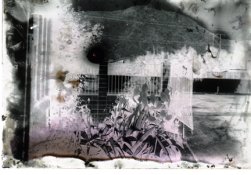
I have evaluated another batch of emulsion based on Kuraray R 1130 instead of gelatin
The two changes in the emulsion were: A reduced polymer leval. This batch of R 1130 is 14% instead of 23% in the last emulsion. B) NH4I instead of KI
All glass plates were coted with emulsion using a modified glass frame and a #40 wire coating rod;Wet thickness 8 mils; Dryed 24 hours; washed for 3 hours;dryed overnight
I have a dewetting problen. As of now the emulsion contains no surfactant or alcohol. Tonight, I will coat more plates with this emulsion + surfactant. I am convinced that this is a dewetting issue and not an issue of frilling or lifting of emulsion.
Pre- soak- 10 minutes
D-19- 9 minutes
Stop-Dillute acetic acid
Fix - 10% Sodium Thiosulfate, 10 minutes
Note that there are :whistling: red flowers arouned 10:30 o'clock.
Final rinse-1 houer
 

Attachments

  • Untitled-4 copy.jpg
    Untitled-4 copy.jpg
    135.7 KB · Views: 141
  • Untitled-4.jpg
    Untitled-4.jpg
    135.4 KB · Views: 139
  • Untitled-5 copy.jpg
    Untitled-5 copy.jpg
    143.5 KB · Views: 146
  • Untitled-5.jpg
    Untitled-5.jpg
    143.4 KB · Views: 133
Colior sensitivity of Experimental Emulsion

Hello to All,
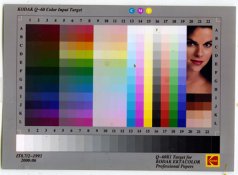
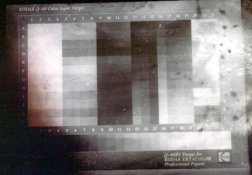
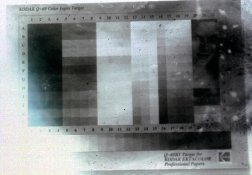
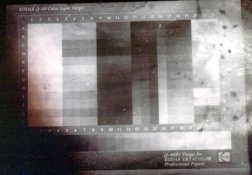
I wish to make an emulsion suitable for color separation work. I took a shot of a Kodak chart in mid-day clear sunshine. Bellows factor was 2.3;F11;one second exposure. Developed as usual.
 

Attachments

  • Untitled-6.jpg
    Untitled-6.jpg
    125 KB · Views: 134
  • Untitled-7 copy.jpg
    Untitled-7 copy.jpg
    149.9 KB · Views: 141
  • Untitled-7.jpg
    Untitled-7.jpg
    149.5 KB · Views: 141
  • Untitled-8.jpg
    Untitled-8.jpg
    150.8 KB · Views: 145
Bill;

Your blue speed is way above red. Green is in the middle kinda. In fact, the blue is greatly overexposed I think, compared to the other two.

PE
 
PE,
Do you think that simply uping the dye adition would sufice? I mean, with a fresh batch, not just adding dye to the existing batch..
Bill
 
Yes, it probably would hellp, but remember that sensitizing dyes are also antifoggants and you can therefore lose blue speed and overall contrast.

Nice job with those polymers Bill.

PE
 
These balances look really, really close, Bill. I'll have to borrow those night vision goggles of yours and give it a try with gelatin!

Your gray scale looks good (accounting for the variations in density with your coating) and on the second column from the left, at the bottom, the relative values of the magenta and blue look very close. If I had to identify one area that needed work, it might be the greens, but really excellent all-in-all. Congrats! Once you get a coating protocol that is manageable in dead darkness, you'll have it made :smile:.
 
Thanks Denise,
I have read the latest entries on the "Really Large Plates" thread here. I wonder how you controle wet thickness. As I understand it. You position the glass plate in the middle of 4 frame plates, then just cathetor on the emulsion,in the Center, and let it flow out. Are the frame plates higher than the emulsion plate?
All - Triton X-100 appears to eliminate the dewetting of the emulsion on clean glass. I drop for 250g emulsion. This sufactant appears to me to be very effective for PVA based emulsion.
Bill
 
Bill,

With a gelatin emulsion, the thickness is controlled by the play between emulsion temp (i.e. viscosity) and the gap distance between the individual plates and dam bars around the perimeter of the plate line-up. I've always used dam bars that are the same thickness as the plates and been fine. The plates are at room temp and by the time the emulsion has spread over the plate and off the edges it has started setting up. I've been getting perfectly even coatings. But...I've been coating formats that are close to square. Michael (studiocarter) is coating elongated rectangles. He's made his dam bars just a tad thicker so that he can pour the emulsion at one end of a plate and then use a straightedge -- riding on the guide bars on each side of the plate -- to push the emulsion down the length of the plate.

Since you aren't working with gelatin, the system might need further tweaking for you. First, your emulsion doesn't 'set up'; it dries, right? What is the viscosity? Is it like cream (that's how I'd describe coating viscosity gelatin emulsions) or like Elmers glue? Either way, I can see that you'd like to have your guide bars thicker than the plates, but also instead of just lining up the plates, you'lll need the thicker glass between them, in effect surrounding each plate, so that your emulsion is dammed at an equal level on all sides. Hope that makes sense.

d
 
Just for reference, one layer of Scotch Tape is about 2.5 mils and of course 2 layers is 5 mils. It does wear fast, but it can give good results providing a gap for coating.

PE
 
Hi Bill,

Really nice seeing you making progress with your experiments.

I know this is not 100% relevant to your work and this thread, but I would like to point out a link to a book I recently discovered. It is a book about coatings applied to photographs. Although this is not like your light sensitive emulsion, since we're talking coating layers applied as protective top layer to developed photos (from the daguerreotype to modern day plastic lamination), the (conservation) research in the book seems very interesting and may give some ideas or be fun to read in the context of your current work:

I referenced it in this thread:
(there was a url link here which no longer exists)

Don't forget to have a look at the linked PDF "sneak preview" of one of the chapters as provided by the Albertina Museum. This PDF also contains the Contents section of the book, so you get a better idea of what the book is about.

Marco
 
Ron,
That a good tip. It would depend on whether or not you needed a higher-than-the-plate dam (for stopping and set-up, or stopping and drying purposes) but if you just needed a higher surface for the straightedge to ride on, tape would be a dandy way to have just one set of guide bars around.

You can also tape the ends of the straightedge (or puddle pusher type glass rod), of course. Again, depends on the list of emulsion-specific and/or format-specific requirements for the edging glass.

*******************
Marco,
Thanks for that link! I saw it when you first posted and I ordered the book. Very much looking forward to reading it.
d
 
Last edited by a moderator:
Photrio.com contains affiliate links to products. We may receive a commission for purchases made through these links.
To read our full affiliate disclosure statement please click Here.

PHOTRIO PARTNERS EQUALLY FUNDING OUR COMMUNITY:


Ilford ADOX Freestyle Photographic Stearman Press Weldon Color Lab Blue Moon Camera & Machine
Top Bottom