
• Welcome to Photrio!
    Registration is fast and free. Join today to unlock search, see fewer ads, and access all forum features.
    Click here to sign up

Alkali Fixers - The Myths & Legends

Tied to the dock

D
Tied to the dock

  • 3
  • 0
  • 49
Running in the Snow

H
Running in the Snow

  • 1
  • 1
  • 60

Recent Classifieds

Forum statistics

Threads
203,080
Messages
2,849,574
Members
101,647
Latest member
jamess
Recent bookmarks
2
There was a product made by Kodak for negative and positive prints. It was called Ektaflex and had the designation "R" or "C" for reversal or neg pos. My prints here are still in pretty good shape. I worked on the project and have many prints comparing Ektacolor 30 paper, Ektaflex, Ektachrome paper and Ciba/Ilfochrome.

PE
 
This is exactly the reason why Ilford lost out, they came under the control of the Air Ministery during WWII and were forced to drop much of their research, particularly into colour emulsions, but also Phenidone.

A measure of just how much that set them back is it was only in the early 50's that Phenidone came into use, despite the research being done in the late 30's.

Ian

The BIOS reports after the war were no sterling example of scientific inquiry either with gaps and errors all over the place. And, Ilford never got back into color with any degree of effort from what we know.

As for the Phenidone, it had its own problems albeit it was a good advance. Dimezone and Dimezone-S are far better.

PE
 
The Type-R Ektaflex took an machine for processing, if I remember. The nice thing about the Afga product was that a simple tray was all that was needed to process the paper.
 
I don't remember the name of it, but I used to use htis product. All the prints I made with it in the 80s have turned yellow a bit...

Anyway, it was not plain water used to process it. It was about 10% sodium hydroxide! That's quite a big difference from plain water.
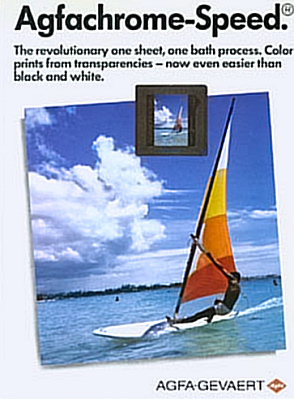
I think that was Agfachrome-Speed (?) print material. I think it was available for prints from slides or negatives, and the developer was very caustic as Kirk recalls. Agfa supplied the gloves with the trial kit. I got a tiny hole in a glove for tray processing and my finger stung for hours. I think it may have also come with some potassium bromide (?) or another additive for some contrast control.

Lee
 
Agfachrome-Speed. That's it! I don't remember it being for negs. And the use of "chrome" in the name implies slide only.
 
Agfachrome-Speed. That's it! I don't remember it being for negs. And the use of "chrome" in the name implies slide only.
I only used the reversal material, but PE recalls there being a material for prints from negatives as well: (there was a url link here which no longer exists) So I defer to his greater knowledge, being involved directly with the market at the time.

After recalling the name, I found this section of a book on the material: http://books.google.com/books?id=x6...icSuBQ&sa=X&oi=book_result&ct=result&resnum=4 It doesn't mention an Agfa color process from negatives that equates to Agfachrome-Speed.

And where I used the term 'developer' for Agfachrome-Speed, replace it with 'activator' for accuracy.

Lee
 
Last edited by a moderator:
Yes, my post referred to in Lee's post is correct. The Kodak and Agfa products could work using the same activator which was just concentrated alkali. They both used very similar chemistry, but the Kodak product used a 2 sheet donor and reciever. The Agfa material made a print with a dark back and a normal front image area (actually reversed as seen in the diagram) but the Kodak product made a normal print on normal appearing paper. Kodak material also could make transparencies, but IDK if they ever sold that on the market.

All 3 products, Agfa and Kodak R and C were quite similar in method of functioning.

PE
 
I still believe the Agfa product was for slides only. It had no reciever sheet as the Kodak one did, hence the machine needed for the Kodak and only a tray needed for the Agfa. I have the Darkroom magazine that reviewed this product in 1984 if more clarification is needed. Anyway, we're a bit far from fixer myths or legends!
 
Have to agree with Kirk, I'm fairly certain it was only ever a Reversal Dye diffusion process and that no negative version was available.

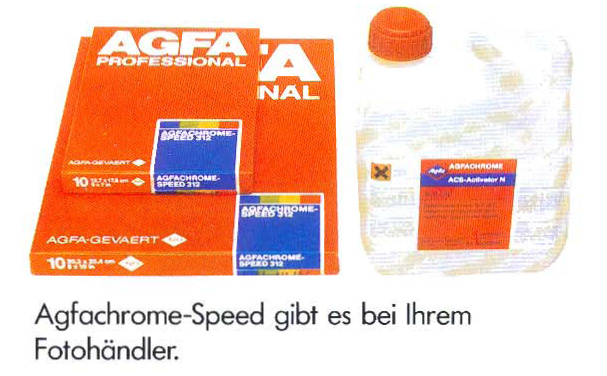
I've got a PDF of the Patents somewhere and also a German PDF data-sheet, but this might ring a few bells :D

agfachrome-speed.jpg


agfachrome-speed2.jpg


Ian
 
I said that in my post. The Kodak product used 2 sheets and made both negative and positive prints, depending on which donor you used. The Agfa material only used 1 sheet which made prints from slides. There were 2 Kodak donors and 1 type of reciever and 1 type of activator. Since it was alkali alone, Agfa could use it.

The Kodak prints were white on the back and had an image on the front. The Agfa product was dark on the front and had an image on the back or support side. The dyes diffused in 2 directions in the Agfa product, out into the activator and inward to the reflective surface. The Kodak product diffused in one direction only, to the reciever sheet.

PE
 
But were these color processes archival? I think not. One point of Haist's process was long-term stability; another was cool, blue-black tones, then as now not easy to achieve in a high quality printing paper.
 
Bill;

The Ektaflex prints were about the quality of a Ciba/Ilford print, as they used similar Azo dyes. They did have some image smear IIRC due to the low molecular weight of the dyes. IDK about the Agfa product.

The thermally processed materials were surprisingly stable, but Grant ran all of the stability tests, not me, so all I have are his comments and my observations. Some of my processed materials lasted for at least 20 years.

PE
 
Photrio.com contains affiliate links to products. We may receive a commission for purchases made through these links.
To read our full affiliate disclosure statement please click Here.

PHOTRIO PARTNERS EQUALLY FUNDING OUR COMMUNITY:


Ilford ADOX Freestyle Photographic Stearman Press Weldon Color Lab Blue Moon Camera & Machine
Top Bottom