
• Welcome to Photrio!
    Registration is fast and free. Join today to unlock search, see fewer ads, and access all forum features.
    Click here to sign up

Airbell Experiment

PenStocks

A
PenStocks

  • 0
  • 0
  • 9
Landed Here

H
Landed Here

  • 3
  • 2
  • 38

Recent Classifieds

Forum statistics

Threads
201,832
Messages
2,830,842
Members
100,977
Latest member
Gorrunyo
Recent bookmarks
0

bvy

Member
Allowing Ads
Joined
Jul 22, 2009
Messages
3,285
Location
Pittsburgh
Format
Multi Format
I've stopped all my black and white film development until I get a handle on my airbell problem. One airbell is too many. I decided to do some tests and thought I would share my results here. My goal isn't to show that method A is better than B, or that you should never do C. I'm trying to solve the problem as it relates to my own workflow. Still, I was fairly methodical in my testing and thought the results might be useful or at least interesting to others here.

Film: Fuji Neopan 100 Acros (120), exp. 2017
Camera: Yashica Mat 124G
Exposure: 12 shots in succession of overcast midday sky (1/60, f4)
Developer: HC-110, dilution E (1+48), 68F
Tank: Small Paterson Universal Tank (one 120 reel capacity); reel is new, used less than five times.
Agitation: Eight initial (slow) inversions over first 30 seconds; four inversions over 10 seconds every minute. Each cycle was followed by a single rap on the bottom of the tank a few seconds after settling.
Development Time: 8:00

Stop, fix and rinse as usual (details on request).

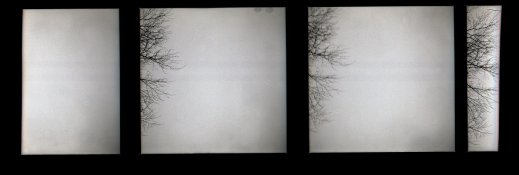
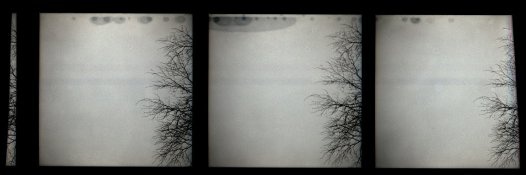
In the darkroom, I clipped the film into four strips of three frames each and developed each as follows:

1: Control (my regular procedure, described above, which is giving me airbells)
2: Altered agitation by introducing six more forceful raps on the bottom of the tank after agitating.
3: Altered development by introducing a prewash -- 600ml of plain water for three minutes. Gentle agitation at :30 and 1:30.
4: Altered developer by adding "a few drops" (0.5ml) of PhotoFlo.

Scans of the clips are shown below.

A few more notes. I mixed 2500ml of developer working solution all at once, so nothing could really be attributed to differences in the developer. It was mixed just prior to the tests which were done in succession over a few hours. 600ml of developer was used for each test. Also, in each case, I backed the undeveloped film with an exposed piece of film on the reel to simulate being developed as part of an entire roll.

The results: As expected, my regular development produced airbells badly. More vigorous rapping of the tank decreased them significantly but not entirely. Prewashing was the greatest surprise, as I thought this would be the ticket. Instead it seems to have compounded the problem, and it's the worst looking of the four tests. I might redo this test with more water, constant agitation, and/or a change of water.

The PhotoFlo test is interesting too. It does seem to alleviate the problem, and I think with the more vigorous tank rapping, it might have eliminated it completely. My preference would be to use something recommended for this purpose (I've since ordered Edwal LFN), but PhotoFlo was all I had on hand at the time, and I wanted to see if such an agent had any effect at all. Also interesting is that this strip has a different color cast than the others (see the last scan where a frame from each clip was scanned in one pass).

I know I'm juggling a lot here. There are some variables I can't keep perfectly constant (e.g. the force of the tank raps). Further, the occurrence and amount of airbells that will appear are "chaotic." The results are really only conclusive if airbells appear -- meaning if they don't appear, there's the chance that I just got lucky. So take all of this with a grain of salt.

Conclusion: More forceful rapping will certainly be the baseline of my next round of tests and any developing I do in the future. But here, it didn't completely eliminate the problem all by itself. I plan to try it in conjunction with the Edwal LFN and maybe a longer initial agitation (60 seconds).

ETA: The contrast of the scans were heavily boosted to show the airbells. The bands along the middle of the frames are also scanner related.

 

Attachments

  • 1 - control.jpg
    1 - control.jpg
    143.2 KB · Views: 271
  • 2 - aggressive rapping.jpg
    2 - aggressive rapping.jpg
    150.1 KB · Views: 266
  • 3 - prewash.jpg
    3 - prewash.jpg
    175.4 KB · Views: 230
  • 4 - photoflo.jpg
    4 - photoflo.jpg
    136.2 KB · Views: 260
  • img900 - comparison.jpg
    img900 - comparison.jpg
    203.8 KB · Views: 257

trythis

Member
Allowing Ads
Joined
Sep 26, 2013
Messages
1,208
Location
St Louis
Format
35mm
I have never had air bells as you have in your scans using metal reels or Paterson style reels. I always wack the container's bottom edge on the sink sideways and give a little side to side jiggle to encourage the bubbles to go on up.
I wonder if there is something about the water where you live that is different?


Sent with typotalk
 

Arvee

Member
Allowing Ads
Joined
Aug 23, 2006
Messages
976
Location
Great Basin
Format
Multi Format
It appears your developer is foaming. I have, in 50 years of developing B/W film, gotten an airbell or two but nothing like what I am seeing here. Do you do your final rinse with photoflo in the tank with the film still on the reel? Patterson tanks/reels tend to retain photoflo and if you are not thoroughly scrubbing tank and reel between rolls, you could be foaming your developer.

I use a separate pyrex measuring cup for photoflo and gently see-saw the film through the solution so as not to contaminate the tank/reels.

I would run an experiment using your normal work flow with developer but no film. I would be opening the tank at various intervals and observing what the surface of the developer looks like during processing. I suspect you will find the developer is foaming, most likely from retained photoflo residue that is present on the tank walls and reel.
 
Last edited by a moderator:

Sirius Glass

Subscriber
Joined
Jan 18, 2007
Messages
50,814
Location
Southern California
Format
Multi Format
Rapping the tank each time a new chemical has been added and using PhotoFlo should clear up your problem.
 

Gerald C Koch

Member
Allowing Ads
Joined
Jul 12, 2010
Messages
8,131
Location
Southern USA
Format
Multi Format
The simplest solution to your problem is to get a stainless steel tank and reel. Why continue to experience apprehension every time you develop a roll of film. A tank is not expensive new and even cheaper when used. With regard to 35mm reels I would recommend getting new ones. The slightest misalignment can make it impossible to load correctly. Unscrupulous people will sell damaged ones.
 
Last edited by a moderator:

Sirius Glass

Subscriber
Joined
Jan 18, 2007
Messages
50,814
Location
Southern California
Format
Multi Format
The simplest solution to your problem is to get a stainless steel tank and reel. Why continue to experience apprehension every time you develop a roll of film.

With Hewes reels.
 

Photo Engineer

Subscriber
Allowing Ads
Joined
Apr 19, 2005
Messages
29,018
Location
Rochester, NY
Format
Multi Format
Your prewet experiment shows lack of development along the edges. Are you sure you used the same amount in each experiment? This should not have happened in any of the above!

PE
 

Jim Jones

Member
Allowing Ads
Joined
Jan 16, 2006
Messages
3,740
Location
Chillicothe MO
Format
Multi Format
I used cheap SS reels and tanks, a Photoflo prewash diluted much more than Kodak recommended, and rapped the tank sharply during prewash and development, and rarely had airbells. Bent reels can be straightened by analyzing just where they are bent.
 

Kirks518

Member
Allowing Ads
Joined
Oct 5, 2013
Messages
1,494
Location
Flori-DUH
Format
Multi Format
You say above that you used 600ml of developer. Paterson tanks say to use 500 ml for 120/220 rolls. I personally use about 625-650 ml. 500 ml will cover the roll and about 1/8th inch, which IMO, can cause air bells if the developer is foaming during agitation. You may want to try increasing your developer volume.

As far as what you have above, 3 of the 4 (1,2,3) are alterations in the actual developing stage, but #4 only has to do with the final washing, so it wouldn't have any effect on air bells if they are occurring during the developing stage. Air bells are a result of improper developer contact with the film, so it can't be changed with any changes in steps after the developer.

With that said, how do you dry your film? Do you squeegee either with a squeegee or between your fingers after the final wash? If not, I think what we're seeing may be related to that (water spots/hard water deposits, etc.), but I would also expect it throughout the frame/film, and not just along one edge.

As PE pointed out, your prewash shows a lack of development along the same edge as the air bells, which really makes me think you're not using enough developer. The Paterson instructions call for use of the agitator stick and only one inversion per minute (which I don't think anyone does only one inversion per minute), which I would consider a gentle agitation method that would most likely not cause heavy foaming of the developer. But, like most of us, you do 4x the amount of inversions then what Paterson says to do (I do 5 inversions every 30 seconds in most cases), so I don't think the minimal 500ml covers the film well enough for real life usage.

I'd bump up your volume, and see how that goes. I'd also squeegee the film when ready to hang, either with a clean squeegee, your fingers, or a clean soft sponge, or whatever your preferred method may be. I also would give it 2 or 3 raps (not just one) after each agitation.
 

Kirks518

Member
Allowing Ads
Joined
Oct 5, 2013
Messages
1,494
Location
Flori-DUH
Format
Multi Format
One other thing...

If it is a foaming & volume issue, agitations every minute allow the air bubble to do it's dastardly deed twice as long as agitation every 30 seconds. Something to think about.

And one more thing...

I'm seeing a line of underdevelopment in the control (#1) as well as #3, which really makes me think you're not using enough developer.
 

Sirius Glass

Subscriber
Joined
Jan 18, 2007
Messages
50,814
Location
Southern California
Format
Multi Format
You need more developer et al. I do five inversions every 30 seconds.
 
OP
OP
bvy

bvy

Member
Allowing Ads
Joined
Jul 22, 2009
Messages
3,285
Location
Pittsburgh
Format
Multi Format
Thanks for the responses. I'll add a few things:
- Developer, fix and final rinse are all mixed with distilled water.
- I'll look into the foaming issue -- I do do the final rinse on the reels. But like I said, this is a brand new reel, and I always wash my reels with hot water (~140F) within minutes after removing the film. Always. Still, I'll check it out.
- Not ready to go stainless steel unless all else fails.
- Yes, I used the same amount of developer with each experiment -- 600ml. The prewash was with 600ml of water. The Paterson tank calls for 500ml for one 120 roll which, I think, is insufficient. 600ml appears to provide good coverage. I may try a test with increased volume, but I fear the agitation may suffer if the tank is too full.
- Kirk, #4 does not have to do with the final wash. I added PhotoFlo to the developer. Also, I don't touch wet film as a rule. My PhotoFlo is mixed with distilled water, left to soak for about two minutes, then hung to dry. I do shake as much excess as possible from the loaded reels before hanging the film.
- Also, Kirk, yes, I'm considering more frequent agitation -- especially during the critical first few minutes.
 

MattKing

Moderator
Moderator
Allowing Ads
Joined
Apr 24, 2005
Messages
55,191
Location
Delta, BC Canada
Format
Medium Format
You say you are using a brand new reel.

Did you have the same problem with the old reel?

When I agitate, I ensure that the eveloper "tumbles" over the film - I expect to hear it. You need to make sure that there is enough empty space above the developer to permit that.

Have you tried using a toothbrush to scrub the reel?

Is there any chance the reel is riding up the centre core?

Which Universal tank? The older System 4, or the newer Super System 4?
 

MattKing

Moderator
Moderator
Allowing Ads
Joined
Apr 24, 2005
Messages
55,191
Location
Delta, BC Canada
Format
Medium Format
In addition, try using less developer. Try 550 ml.

Fnally, can you determine if the airbells are at the top of the reel, or sticking at the bottom?
 

Terry Christian

Member
Allowing Ads
Joined
Dec 2, 2011
Messages
693
Location
Memphis, TN
Format
35mm
Riffing off what MattKing said:
1. If you are developing one reel in a two-reel tank, be sure that the reel to be developed is at the bottom and that you have an empty reel on top so that the developing reel doesn't ride up the column.
2. Afterward, be sure you are rinsing your tanks and reels well with hot water, to eliminate any wetting agent residue that could be foaming up your developer. You only need a couple of drops of Photo-Flo concentrate per reel developed.
3. Try to strike a happy medium with agitation. Don't treat it with kid gloves, but at the same time it's not a cocktail shaker. The goal is to make sure you are thoroughly reconfiguring up the used and unused developer so as to definitely expose the film to fresh developer with every agitation. A little force -- to assist gravity in the agitation and to ensure any air bubbles are definitely dislodged -- is a good thing.
 

Gerald C Koch

Member
Allowing Ads
Joined
Jul 12, 2010
Messages
8,131
Location
Southern USA
Format
Multi Format
I used cheap SS reels and tanks, a Photoflo prewash diluted much more than Kodak recommended, and rapped the tank sharply during prewash and development, and rarely had airbells. Bent reels can be straightened by analyzing just where they are bent.

Personally I have never had any success with trying to straighten out a bent reel no matter how carefully I tried.
 

piu58

Member
Allowing Ads
Joined
May 29, 2006
Messages
1,545
Location
Leipzig, Germany
Format
Medium Format
You will never get airbells if you work with continuous agitation as I do. You have tho shorten the developing time by around 20%. Even if the developer is foaming, that doesn't matter.
 

Ashfaque

Member
Allowing Ads
Joined
May 4, 2013
Messages
382
Location
Bangladesh & UK
Format
35mm
This may not applicable in your case since you're not using Jobo tank and your problem is about air bells. In Jobo, the final wetting agent step, as per instructions, needs to be done outside the tank and reel. See more info here: (there was a url link here which no longer exists)

Bests,
Ashfaque

PS: One more vote for Hewes reel. :smile:
 
Last edited by a moderator:

BetterSense

Member
Allowing Ads
Joined
Aug 16, 2008
Messages
3,151
Location
North Caroli
Format
35mm
It seems to me that Acros is particularly susceptible to bubbles at the edges. I took a trip where I shot Acros and TMY. Most of the Acros had the bubble marks at the edge while the Kodak did not. I have never seen these edge bubble marks on any other film. I googled "acros xtol uneven" and got results which made me suspect this combo is susceptible to these problems. Just goes to show, never try something new without testing. I use SS tanks and minimal, indifferent agitation. I will start rapping the tank and I think that will take care of it.
 

Sirius Glass

Subscriber
Joined
Jan 18, 2007
Messages
50,814
Location
Southern California
Format
Multi Format
Riffing off what MattKing said:
1. If you are developing one reel in a two-reel tank, be sure that the reel to be developed is at the bottom and that you have an empty reel on top so that the developing reel doesn't ride up the column.

Very important
 

Photo Engineer

Subscriber
Allowing Ads
Joined
Apr 19, 2005
Messages
29,018
Location
Rochester, NY
Format
Multi Format
From all of our comments, you should know that you have one or more serious problems with your processing, and it causes more defects than air bells. I suggest that you go over your process in detail to insure that everything is right, and that you are not missing an essential detail.

PE
 
OP
OP
bvy

bvy

Member
Allowing Ads
Joined
Jul 22, 2009
Messages
3,285
Location
Pittsburgh
Format
Multi Format
You say you are using a brand new reel.
Did you have the same problem with the old reel?
When I agitate, I ensure that the eveloper "tumbles" over the film - I expect to hear it. You need to make sure that there is enough empty space above the developer to permit that.
Have you tried using a toothbrush to scrub the reel?
Is there any chance the reel is riding up the centre core?
Which Universal tank? The older System 4, or the newer Super System 4?
In addition, try using less developer. Try 550 ml.
Fnally, can you determine if the airbells are at the top of the reel, or sticking at the bottom?
I have three reels -- one brand new, two older ones. The problem isn't unique to any one reel. I do "brush" the reels occasionally.

It's the newer Super System 4 tank. There's not much room for the reel to ride up the core. Even so, if I push the reel into place with the funnel (the highest position up the core that the reel can sit) there's plenty of coverage.

The airbells are always at the top.

Riffing off what MattKing said:
1. If you are developing one reel in a two-reel tank, be sure that the reel to be developed is at the bottom and that you have an empty reel on top so that the developing reel doesn't ride up the column.
2. Afterward, be sure you are rinsing your tanks and reels well with hot water, to eliminate any wetting agent residue that could be foaming up your developer. You only need a couple of drops of Photo-Flo concentrate per reel developed.
3. Try to strike a happy medium with agitation. Don't treat it with kid gloves, but at the same time it's not a cocktail shaker. The goal is to make sure you are thoroughly reconfiguring up the used and unused developer so as to definitely expose the film to fresh developer with every agitation. A little force -- to assist gravity in the agitation and to ensure any air bubbles are definitely dislodged -- is a good thing.

Check, check and check. No room for an empty reel; see my comment to Matt.

You will never get airbells if you work with continuous agitation as I do. You have tho shorten the developing time by around 20%. Even if the developer is foaming, that doesn't matter.

I've considered this and I'm still considering it. HC-110 is my developer of choice, and given its high activity, I've heard it's not a good match for continuous agitation. Still...
 

Peltigera

Member
Allowing Ads
Joined
Mar 11, 2012
Messages
902
Location
Lincoln, UK
Format
Multi Format
I would try going exactly to the instructions. If the makers of the tank say 500 ml, USE 500 ml - they will have checked it is right before they said. Look at the developer's fact sheet and use the agitation THEY say - they will have checked it is right. So on with stop bath and fixer, wash process and all.

When we had intractable problems on a production line in the factory we always reset everything to standard settings and worked our way to ideal from there.
 
Photrio.com contains affiliate links to products. We may receive a commission for purchases made through these links.
To read our full affiliate disclosure statement please click Here.

PHOTRIO PARTNERS EQUALLY FUNDING OUR COMMUNITY:


Ilford ADOX Freestyle Photographic Stearman Press Weldon Color Lab Blue Moon Camera & Machine
Top Bottom