
I've stopped all my black and white film development until I get a handle on my airbell problem. One airbell is too many. I decided to do some tests and thought I would share my results here. My goal isn't to show that method A is better than B, or that you should never do C. I'm trying to solve the problem as it relates to my own workflow. Still, I was fairly methodical in my testing and thought the results might be useful or at least interesting to others here.
Film: Fuji Neopan 100 Acros (120), exp. 2017
Camera: Yashica Mat 124G
Exposure: 12 shots in succession of overcast midday sky (1/60, f4)
Developer: HC-110, dilution E (1+48), 68F
Tank: Small Paterson Universal Tank (one 120 reel capacity); reel is new, used less than five times.
Agitation: Eight initial (slow) inversions over first 30 seconds; four inversions over 10 seconds every minute. Each cycle was followed by a single rap on the bottom of the tank a few seconds after settling.
Development Time: 8:00
Stop, fix and rinse as usual (details on request).
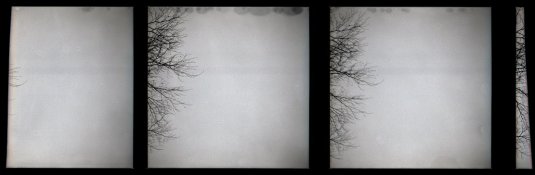
In the darkroom, I clipped the film into four strips of three frames each and developed each as follows:
1: Control (my regular procedure, described above, which is giving me airbells)
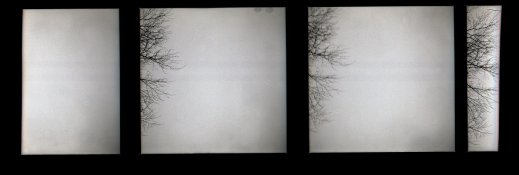
2: Altered agitation by introducing six more forceful raps on the bottom of the tank after agitating.
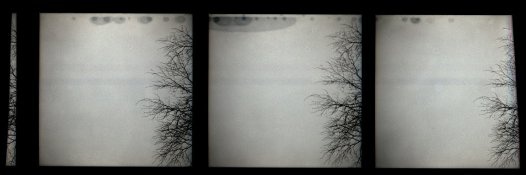
3: Altered development by introducing a prewash -- 600ml of plain water for three minutes. Gentle agitation at :30 and 1:30.
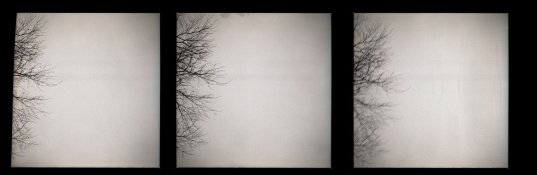
4: Altered developer by adding "a few drops" (0.5ml) of PhotoFlo.
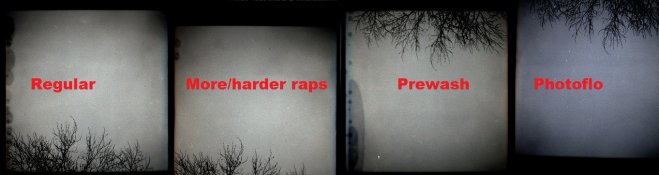
Scans of the clips are shown below.
A few more notes. I mixed 2500ml of developer working solution all at once, so nothing could really be attributed to differences in the developer. It was mixed just prior to the tests which were done in succession over a few hours. 600ml of developer was used for each test. Also, in each case, I backed the undeveloped film with an exposed piece of film on the reel to simulate being developed as part of an entire roll.
The results: As expected, my regular development produced airbells badly. More vigorous rapping of the tank decreased them significantly but not entirely. Prewashing was the greatest surprise, as I thought this would be the ticket. Instead it seems to have compounded the problem, and it's the worst looking of the four tests. I might redo this test with more water, constant agitation, and/or a change of water.
The PhotoFlo test is interesting too. It does seem to alleviate the problem, and I think with the more vigorous tank rapping, it might have eliminated it completely. My preference would be to use something recommended for this purpose (I've since ordered Edwal LFN), but PhotoFlo was all I had on hand at the time, and I wanted to see if such an agent had any effect at all. Also interesting is that this strip has a different color cast than the others (see the last scan where a frame from each clip was scanned in one pass).
I know I'm juggling a lot here. There are some variables I can't keep perfectly constant (e.g. the force of the tank raps). Further, the occurrence and amount of airbells that will appear are "chaotic." The results are really only conclusive if airbells appear -- meaning if they don't appear, there's the chance that I just got lucky. So take all of this with a grain of salt.
Conclusion: More forceful rapping will certainly be the baseline of my next round of tests and any developing I do in the future. But here, it didn't completely eliminate the problem all by itself. I plan to try it in conjunction with the Edwal LFN and maybe a longer initial agitation (60 seconds).
ETA: The contrast of the scans were heavily boosted to show the airbells. The bands along the middle of the frames are also scanner related.
Film: Fuji Neopan 100 Acros (120), exp. 2017
Camera: Yashica Mat 124G
Exposure: 12 shots in succession of overcast midday sky (1/60, f4)
Developer: HC-110, dilution E (1+48), 68F
Tank: Small Paterson Universal Tank (one 120 reel capacity); reel is new, used less than five times.
Agitation: Eight initial (slow) inversions over first 30 seconds; four inversions over 10 seconds every minute. Each cycle was followed by a single rap on the bottom of the tank a few seconds after settling.
Development Time: 8:00
Stop, fix and rinse as usual (details on request).
In the darkroom, I clipped the film into four strips of three frames each and developed each as follows:
1: Control (my regular procedure, described above, which is giving me airbells)
2: Altered agitation by introducing six more forceful raps on the bottom of the tank after agitating.
3: Altered development by introducing a prewash -- 600ml of plain water for three minutes. Gentle agitation at :30 and 1:30.
4: Altered developer by adding "a few drops" (0.5ml) of PhotoFlo.
Scans of the clips are shown below.
A few more notes. I mixed 2500ml of developer working solution all at once, so nothing could really be attributed to differences in the developer. It was mixed just prior to the tests which were done in succession over a few hours. 600ml of developer was used for each test. Also, in each case, I backed the undeveloped film with an exposed piece of film on the reel to simulate being developed as part of an entire roll.
The results: As expected, my regular development produced airbells badly. More vigorous rapping of the tank decreased them significantly but not entirely. Prewashing was the greatest surprise, as I thought this would be the ticket. Instead it seems to have compounded the problem, and it's the worst looking of the four tests. I might redo this test with more water, constant agitation, and/or a change of water.
The PhotoFlo test is interesting too. It does seem to alleviate the problem, and I think with the more vigorous tank rapping, it might have eliminated it completely. My preference would be to use something recommended for this purpose (I've since ordered Edwal LFN), but PhotoFlo was all I had on hand at the time, and I wanted to see if such an agent had any effect at all. Also interesting is that this strip has a different color cast than the others (see the last scan where a frame from each clip was scanned in one pass).
I know I'm juggling a lot here. There are some variables I can't keep perfectly constant (e.g. the force of the tank raps). Further, the occurrence and amount of airbells that will appear are "chaotic." The results are really only conclusive if airbells appear -- meaning if they don't appear, there's the chance that I just got lucky. So take all of this with a grain of salt.
Conclusion: More forceful rapping will certainly be the baseline of my next round of tests and any developing I do in the future. But here, it didn't completely eliminate the problem all by itself. I plan to try it in conjunction with the Edwal LFN and maybe a longer initial agitation (60 seconds).
ETA: The contrast of the scans were heavily boosted to show the airbells. The bands along the middle of the frames are also scanner related.