
-
Welcome to Photrio!Registration is fast and free. Join today to unlock search, see fewer ads, and access all forum features.Click here to sign up
You are using an out of date browser. It may not display this or other websites correctly.
You should upgrade or use an alternative browser.
You should upgrade or use an alternative browser.
Airbell Experiment
-
A
- Thread starter bvy
- Start date


Recent Classifieds
-
For Sale Stainless Developing Tank with 2 35mm Reels, Japan
- Started by Jon Shiu
-
For Sale Kodak Medalist II camera case
- Started by campy51
-
Want to Buy Lomo UPB-1 - 16mm cine film processing tank
- Started by blee1996
-
For Sale Really Right Stuff RRS BH-55 Ball Head
- Started by samuelphoto
-
For Sale Gitzo GT3532LS Systematic Series 3 Carbon Fiber Tripod
- Started by samuelphoto
Forum statistics

Try tap water.
Also, try filtered water.
Also, try de-ionized water.
I'm thinking that using distilled water may be at least part of the problem.
Also, try filtered water.
Also, try de-ionized water.
I'm thinking that using distilled water may be at least part of the problem.
OP
OP

I started a long time ago with the recommended 500ml and had more problems than when I increased the volume to 600ml. If the reel rides up the core at all, it will be out of the solution. This can be checked visibly. If the tank doesn't sit perfectly level, a top edge will be unevenly developed. I can't imagine that decreasing the working solution by 100ml will have a positive effect on reducing foam or airbells.I would try going exactly to the instructions. If the makers of the tank say 500 ml, USE 500 ml - they will have checked it is right before they said.
Why on earth are you adding photo-flow to developer and if you use it in the wash you are probably adding residue to your next development. Take it out of the equation completely.
Because adding PhotoFlo to developer is not a totally unheard of approach to dealing with airbells, and I wanted to try it for myself. It's not something I dreamed up. Actually, the Edwal product comes more recommended for this purpose than PhotoFlo, and if I move in this direction, it won't be with PhotoFlo.
OP
OP
I would run an experiment using your normal work flow with developer but no film. I would be opening the tank at various intervals and observing what the surface of the developer looks like during processing. I suspect you will find the developer is foaming, most likely from retained photoflo residue that is present on the tank walls and reel.
I did as you described. See attached photo. The developer (HC-110) was mixed from distilled water and syrup in a clean mixing vessel. This is after the initial agitation, though I suspect the foam was there before that. What I don't understand is that if I perform the same test with plain water, there's absolutely no foam. A few bubbles (literally two or three) appear on the reel, and they respond to a light tap. But nothing like this.
The foam shown here disappeared on its own after about 30 seconds.
Attachments
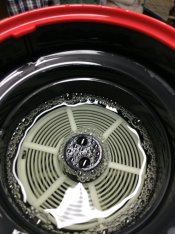
I did as you described. See attached photo. The developer (HC-110) was mixed from distilled water and syrup in a clean mixing vessel. This is after the initial agitation, though I suspect the foam was there before that. What I don't understand is that if I perform the same test with plain water, there's absolutely no foam. A few bubbles (literally two or three) appear on the reel, and they respond to a light tap. But nothing like this.
The foam shown here disappeared on its own after about 30 seconds.
Try the same experiment after mixing the developer with tap water.

- Joined
- Oct 9, 2010
- Messages
- 7,869
- Format
- 35mm RF
The developer (HC-110) was mixed from distilled water and syrup
Syrup?

Have you tried with a completely full tank?
When using hand tanks I don't leave any air space.
When using hand tanks I don't leave any air space.

If you fill the tank, then you have trouble agitating!
You have to leave some space, but cover the reel. If you see foam like that in the photo, then something is wrong! If you get uneven development, then something is wrong!
If you don't know what syrup is in this context, then something is wrong!
PE
You have to leave some space, but cover the reel. If you see foam like that in the photo, then something is wrong! If you get uneven development, then something is wrong!
If you don't know what syrup is in this context, then something is wrong!
PE
OP
OP
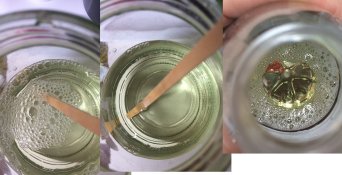
Here is HC-110, roughly dilution E, made from bottled drinking water and prepared in an applesauce jar that my wife opened and emptied this morning. It was washed only with very hot water. I used a new, disposable wooden stick to mix the developer. Developer was made from a capful of syrup and about 300ml of water. The first picture is the mix right after stirring. The second is after about two minutes of settling. The third is right after it's been poured back into the water bottle. I want to conclude that HC-110 is foamy stuff -- at least in this dilution.
Attachments
Last edited by a moderator:
Certainly would create the kind of negs you're getting!

Sirius Glass
Subscriber
bvy, bottled drinking water has added minerals, that should not make a difference however I thought that you wrote that you were using distilled water.
That does not look normal.
PE
PE
OP
OP
bvy, bottled drinking water has added minerals, that should not make a difference however I thought that you wrote that you were using distilled water.
I was. Someone suggested that I try something other than the distilled water I've been using. I could repeat the experiment with tap water, but I'm not expecting any difference.
If you fill the tank, then you have trouble agitating!
Maybe I'm just lucky but I haven't had a result that would indicate a problem so don't understand why that would be true.
Why? What would keep the liquids from circulating?
I use HC-110 dil E in a replenishment regime. When I pour it back into the container after developing film it foams quite a bit, but the foam bubbles soon collapse.
There is always some sign of bubbles when the developer is poured or agitated. The important thing is that they soon collapse into solution.
In all my years of using HC-110 - both one shot and replenished - I can think of one roll only that showed problems with air bells.
There is always some sign of bubbles when the developer is poured or agitated. The important thing is that they soon collapse into solution.
In all my years of using HC-110 - both one shot and replenished - I can think of one roll only that showed problems with air bells.
If you fill the tank, then you have trouble agitating!
You have to leave some space, but cover the reel.
The Paterson Super System 4 tanks have a built in large air space between the funnel and the lid. 600 ml won't come close to filling that up.
The older Paterson System 4 tanks were different.

I want to conclude that HC-110 is foamy stuff -- at least in this dilution.
I have used lots of HC-110 over the years and have never noticed that it is prone to foaming. Kodak designed HC-110 for machine processing where foaming would be a serious problem. I would assume that the formula was designed with the problem in mind.
Last edited by a moderator:
Is this version of HC110 from Tetenal? Made in Germany?
Post #20 is the only one that got it right.
We've been through this before:
I strongly suggest that, in order to maintain your sanity, you either use a rotary processor or a different brand of roll film. Inversion agitation of 120 Acros is, in my opinion, impossible to accomplish without some minimum number of air bells, regardless of developer or reel type used. I've tried them all, including Paterson, Kindermann and Hewes tanks/reels as well as Perceptol, Ilfotec HC and ID-11. Even two pre-rinses in sequence won't eliminate the spots. Also, that collection of air bells at the top is what keeps things less developed there, not any lack of developer. Paraphrasing the bumper sticker that I liked best among all those observed while commuting 100 miles per day round trip for 33 years:
We've been through this before:
(there was a url link here which no longer exists)
I strongly suggest that, in order to maintain your sanity, you either use a rotary processor or a different brand of roll film. Inversion agitation of 120 Acros is, in my opinion, impossible to accomplish without some minimum number of air bells, regardless of developer or reel type used. I've tried them all, including Paterson, Kindermann and Hewes tanks/reels as well as Perceptol, Ilfotec HC and ID-11. Even two pre-rinses in sequence won't eliminate the spots. Also, that collection of air bells at the top is what keeps things less developed there, not any lack of developer. Paraphrasing the bumper sticker that I liked best among all those observed while commuting 100 miles per day round trip for 33 years:
"You'll feel much better when you give up hope."
OP
OP
It's Kodak branded though it does say Made in Germany. Expiration is 4/2016. The 1 liter container is still about 3/4 full.Is this version of HC110 from Tetenal? Made in Germany?
OP
OP
Post #20 is the only one that got it right.
We've been through this before:
(there was a url link here which no longer exists)
I strongly suggest that, in order to maintain your sanity, you either use a rotary processor or a different brand of roll film. Inversion agitation of 120 Acros is, in my opinion, impossible to accomplish without some minimum number of air bells, regardless of developer or reel type used. I've tried them all, including Paterson, Kindermann and Hewes tanks/reels as well as Perceptol, Ilfotec HC and ID-11. Even two pre-rinses in sequence won't eliminate the spots. Also, that collection of air bells at the top is what keeps things less developed there, not any lack of developer. Paraphrasing the bumper sticker that I liked best among all those observed while commuting 100 miles per day round trip for 33 years:
"You'll feel much better when you give up hope."
I initially threw this idea out, but since it's come up again, it's prompted me to go back through my notes and scans. My 120 shooting (black and white) has been either Tri-X or Acros -- and I can't find a single instance of Tri-X with this airbell/foam problem. I do find it on Acros even back when I was developing it in D-76. I wonder if the two (Acros + HC-110) just aren't an ideal combination.
Nope. It's Acros, irrespective of developer. You're still exhibiting hope. Give it up and enjoy freedom....I wonder if the two (Acros + HC-110) just aren't an ideal combination.

If it's Acros, how do explain the foam bvy experienced with developer only in the applesauce jar? I say developer.
I don't even attempt to explain it; it's a red herring....how do explain the foam bvy experienced with developer only in the applesauce jar?...
The root cause of this problem is Acros. Different developers produce varying degrees of foaming, regardless of which film they're acting on. There's an inherent characteristic of Acros which prevents those foam bubbles, however numerous, from leaving its surface when gravity is the only force motivating them to do so. With 35mm Acros, the "latched" bubbles end up in the sprocket area, so there's no real problem. With 120 Acros, no matter the measures taken, one can minimize but never completely eliminate bubble-caused circular underdeveloped spots.
In rotary agitation, where motion is mechanically driven, the bubbles are continuously dislodged from Acros' surface and don't cause an issue. I've never achieved satisfactorily (to me) even development of 120 black and white negatives using a Jobo processor; I've tried Jobo 1500 and 2500 reels/tanks as well as the Jobo/Hewes 1500 reel, using both a CPE2+ and CPA/CPP2+. Therefore, I only process 120 film (never Acros) using inversion agitation in small tanks.
Acros has several unique characteristics, including its spectral sensitivity and freedom from reciprocity failure. The way I use it is in its 4x5 form, developing the sheets in Jobo Expert drums. Perfectly even results with no air bell defects.

Last edited by a moderator:
Maybe I'm just lucky but I haven't had a result that would indicate a problem so don't understand why that would be true.
Why? What would keep the liquids from circulating?
A capped container filled with liquid will allow no circulation. Therefore, agitation results in nearly zero exchange of chemicals. There must be some movement of the liquid and / or the reel to accomplish this.
PE
| Photrio.com contains affiliate links to products. We may receive a commission for purchases made through these links. To read our full affiliate disclosure statement please click Here. |
PHOTRIO PARTNERS EQUALLY FUNDING OUR COMMUNITY:  |