• Welcome to Photrio!
    Registration is fast and free. Join today to unlock search, see fewer ads, and access all forum features.
    Click here to sign up

Advice on enlarger lenses

Forum statistics

Threads
203,120
Messages
2,850,091
Members
101,680
Latest member
QGolden
Recent bookmarks
1
Wollensak’s Enlarging Raptar f4.5 lenses are the four-element Tessar design, but the Enlarging Pro Raptar lenses are six-element Plasmats and can usually be found at a reasonable price.

View attachment 248059

the pro line are hard to find, I dont think I even seen a 50mm 4.0 for sale. I have the 162 pro but my Wollensak 50, 75, 90 and 135 are all 4 element. I have Rodenstock 6 element 2.8 50mm, nice lens, it is on my LP670 with color head. I use the Wollensak lens on my D3, but use a Vivitar 150 or Rodenstock 135 when printing 4X7. The 75mm for 6X6, the 90 for 6X7 , a Kodak 100 for 6X9 unless I'm printing 5X7 in which case I use the Wollensak 135.
 
at 16 X 20 the 6 element lens are clearly shaper.

Possibly, when wide open the six elements lenses were better in the corners, but as the lenses are stopped two or three stops results should be more equal.

_____

One of the most important factors is using an enlarging lens optimized for the magnification were are to work with. In the Rodenstock range we have old Rodagon R and D (old R = reproduction, new D = duplication). Then we have the no "letter" Rodagons. The we have Rogagon N for big prints and finally the Rodagon G for murals. Four variants, each one for a particular magnification range.

_____

An excellent performer is the APO-EL-Nikkor. This is an scarce and expensive lens, not much seen at Ebay. A Known user is Christopher Burkett which is also a known perfectionist, he uses the 360mm variant to print giant ilfochromes from 8x10" Velvia slides shot with an APO Tele-Xenar 800 mounted on a C1 camera. This is a refined top-notch workflow, no doubt.
 
In addition to all the above, two other things worth thinking about:
1) some enlarging lenses offer convenience features like illuminated aperture settings and apertures that can be set to a particular limit - great for moving back and forth between the working aperture and your wide open composing and focusing aperture; and
2) if you will be working with multiple formats, it is useful to stay within a particular line of lenses, because it is more likely that you will see consistency across the line with respect to contrast and operation. If you print colour, the rendition of colour is also more likely to be consistent within the same line.
That being said, I work with a veritable menagerie of lenses, and am quite happy doing so.
 
Those convenience features likely will be more important for the average darkroom worker than some differences at the MTF (at least for lenses of the same class as gaussian vs. gaussian).
 
Why is it that the Nikkor 63mm is no mentioned here, other than price.

Years ago, I remember reading some reviews of this lens, by professional photographers of note, that this was an ideal lens for 35mm, and I have been looking for one, off and on since.

I would appreciate it if a few readers here can opine on that particular lens, and it's use on the Leitz Valloy II, ect.

Cheers.
 
Why is it that the Nikkor 63mm is no mentioned here, other than price.

Years ago, I remember reading some reviews of this lens, by professional photographers of note, that this was an ideal lens for 35mm, and I have been looking for one, off and on since.

I would appreciate it if a few readers here can opine on that particular lens, and it's use on the Leitz Valloy II, ect.

Cheers.

Using a focal that's slightly longer than the one covering the format has some performance advantage, specially in the corners. The drawback is that the head to easel distance is larger, so a particular enlarger would be able to enlarge less before having to project on the wall.

Also that longer focal will have less fall-off. This is not good or bad becuase the fall-off on the paper corrects fall-off in the taking. So if the negative has fall-off then better using a shorter focal having the compensating fall-off. If the negative has no fall-off then a longer focal not having fall-off may be more suitable, if wanting a uniform exposure on the paper.
 
Any of the reputable enlarging lenses from Rodenstock (Rodagon), El-Nikkor or Schneider (Companon, Companon-S) will give excellent results.

Make sure you get the right focal length for the negative format; 50mm for 35mm negs, 90-100mm for the 6x7 negs (the El-Nikkor 80mm is the shorter exception here).

Most of these are available used for not much. Apo lenses are top-of-the-line and the best performers, but are usually much more expensive. The quality increase at the sizes you plan on printing would be negligible. Do avoid the cheapie three-element enlarging lenses.

Have fun,

Doremus
+1
 
Why is it that the Nikkor 63mm is no mentioned here, other than price.

Years ago, I remember reading some reviews of this lens, by professional photographers of note, that this was an ideal lens for 35mm, and I have been looking for one, off and on since.

I would appreciate it if a few readers here can opine on that particular lens, and it's use on the Leitz Valloy II, ect.

Cheers.
I use the 63mm for 35mm negs, but I do not print larger than 8x12 in that format, so the 63mm is fine as far as enlarger head height. I can't speak to the Leitz, however, sorry. I bought mine years ago because i generally use a slightly longer lens than the one usually "specified" (i.e. 105mm for 6x7). I do own a 50mm, however, should I need it.
 
There aren't a lot of modern 63mm enlarging lenses out there - 127 film isn't high volume any more!
 
There aren't a lot of modern 63mm enlarging lenses out there - 127 film isn't high volume any more!


I've just used the same lens I use for 120 for 127 without given it a second thought, even though I have lenses from 25mm, for 16mm, on up, for the other formats to 5'x7'.

Odd, sometimes, the little gaps in our knowledge as to the why's and what fors of our kit.

IMO

Cheers, Be Safe, and Godspeed to all.
 
Last edited:
The 63 El Nikkor was designed for 35mm format. Longer than the "normal" 50mm will give more even illumination toward the corners. Nikon's flagship lens for 35mm was the 105 Apo El Nikkor, which cost twenty times as much, and was too heavy for most amateur enlargers anyway. But it could be used for MF too. Total overkill for most printing purposes.
 
Last edited:
The 63 El Nikkor was designed for 35mm format.

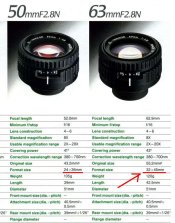
Originally the 63mm lens recommended format was 32x45mm, not 24x36mm , in more recent catalogs is recommended for 24x36mm for obvious reasons. (some formats were mostly defunct)

el.JPG

https://galerie-photo.com/manuels/el-nikkor-enlarging-lenses.pdf
 
They were just basing that on the diagonal of the film, as an ordinary convention. Going somewhat longer is almost always advisable unless column height is too restrictive to allow that option.
 
They were just basing that on the diagonal of the film, as an ordinary convention. Going somewhat longer is almost always advisable unless column height is too restrictive to allow that option.

Yes... the poor man's Rodagon-N !!!
 
I rarely print 35mm film, and have plenty of column height with the L138, so tend to use the 105 Apo Rodagon N for 35mm work too.
 
So after much hunting I've come across the following, to decide from within my price range:

For printing 35mm:
Rodenstock 40mm f/4 Rodagon-WA
Nikon El-Nikkor 50mm/2.8
Rodenstock Rodagon 50mm F5.6
RODENSTOCK APO RODAGON 2,8 50mm
RODENSTOCK ROGONAR 2,8 50mm
Leica Focotar 2 50 50mm 4,5

For printing 6x7:
Nikon EL - Nikkor N 80mm 1:5.6
Nikon EL-Nikkor 105mm f/5.6
Schneider Componon S 100mm f5, 6
Rodenstock Rodagon 105 mm f 5.6
Rodenstock Rogonar-S 105mm 1:4.5
RODENSTOCK 135mm RODAGON F/5,6
Nikon EL-Nikkor 5.6/135mm
Rodenstock Rodagon 150mm f5,6

Also can the Nikon EL-Nikkor 105mm f/5.6 be used for 35mm and 6x7? (Going off what Ctein said?)
 
Last edited:
So after much hunting I've come across the following, to decide from within my price range:

For printing 35mm:
Rodenstock 40mm f/4 Rodagon-WA
Rodenstock Rodagon 50mm F5.6
RODENSTOCK APO RODAGON 2,8 50mm
RODENSTOCK ROGONAR 2,8 50mm
Leica Focotar 2 50 50mm 4,5

For printing 6x7:
Nikon EL - Nikkor N 80mm 1:5.6
Nikon EL-Nikkor 105mm f/5.6
Schneider Componon S 100mm f5, 6
Rodenstock Rodagon 105 mm f 5.6
Rodenstock Rogonar-S 105mm 1:4.5
RODENSTOCK 135mm RODAGON F/5,6
Nikon EL-Nikkor 5.6/135mm
Rodenstock Rodagon 150mm f5,6

Also can the Nikon EL-Nikkor 105mm f/5.6 be used for 35mm and 6x7? (Going off what Ctein said?)

I'm surprised not to see the Nikon El-Nikkor 50mm/2.8 on the 35mm list. Those can be had for very reasonable prices.
 
Also can the Nikon EL-Nikkor 105mm f/5.6 be used for 35mm and 6x7? (Going off what Ctein said?)

Yes, you can... but for 35mm the largest print your enlarger will be able to make woul be the half size than the one you would make with the 50mm. Anyway you may tilt the enlarger's head to print on the wall, for unlimited


So after much hunting I've come across the following, to decide from within my price range:


For printing 35mm:


Nikon El-Nikkor 50mm/2.8 , personally, I've no doubt here.


For printing 6x7:

Nikon EL-Nikkor 105mm f/5.6
Schneider Componon S 100mm f5, 6
Rodenstock Rodagon 105 mm f 5.6
 
Photrio.com contains affiliate links to products. We may receive a commission for purchases made through these links.
To read our full affiliate disclosure statement please click Here.

PHOTRIO PARTNERS EQUALLY FUNDING OUR COMMUNITY:


Ilford ADOX Freestyle Photographic Stearman Press Weldon Color Lab Blue Moon Camera & Machine
Top Bottom