If you have a rangefinder or a TLR, it is a lot easier to use than an SLR.
The R72 is the filter I used with the Rollei near IR film a few years ago.
The procedure is as follows:
1) most scenes are illuminated by a wide spectrum of light. We can see the light in the visible part of the spectrum, while the film is sensitive to that light, light into the UV end of the spectrum, and some light that is in the near IR part of the spectrum;
2) our meters aren't really sensitive in the near IR part of the spectrum;
3) the film is a lot more sensitive to visible and UV light than it is to the near IR light;
4) the R72 blocks out most of the visible and UV, while it passes the near IR;
5) the reason that the meters assist us is that there is a rough correlation between the amount of visible light and the near IR light in the scene. The recommendations to take readings using EIs of 3 or 6 arise from the fact that the near IR light is about 6 or 7 stops less intense then the visual light that accompanies it;
6) that correlation is strongest near noon, and when you are photographing things like foliage, which tend to reflect a fair amount of near IR light;
7) you cannot really see how your shots are going to turn out until you get some experience with trying it;
8) don't forget to take into account subject movement

.
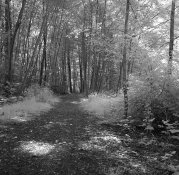
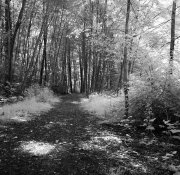
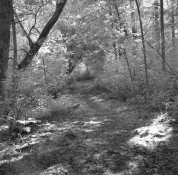
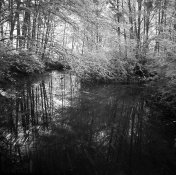
Here are a few of my first experiments (note the movement of the water surface).