• Welcome to Photrio!
    Registration is fast and free. Join today to unlock search, see fewer ads, and access all forum features.
    Click here to sign up

A Jobo Issue- A Stalling Motor.

Recent Classifieds

Forum statistics

Threads
203,386
Messages
2,853,788
Members
101,814
Latest member
Dirtdiver
Recent bookmarks
1

Gatsby1923

Member
Allowing Ads
Joined
Jan 15, 2006
Messages
243
Location
Holyoke, MA
Format
Multi Format
Here is another Jobo question. The motor on my CPE-2 Stalls. If it is under no load it seems OK. I put on a film tank it will stay fine for the first 3 or 4 minutes, then slow down and stall. I'll turn off the motor for a few minutes, turn it back on and it will run fine again for 2 or 3 minutes then stall. I am using the correct tank rollers and not over filling the tank. The stalling seems to be interdependent of when the machine reverses. Before I go tearing the thing apart what am I looking for? Do you think some 3 in 1 oil is all it needs, or is this a major issue? I do know the machine was sitting for many years before I became it's new owner.

Dave M
 
A wild guess, but it sounds like a resistor failed and a capacitor is charging up completely. Since the capacitor does not discharge, the motor stalls.
 
The motor probably needs cleaning out, it'll be full of dust caked into dried-up grease and the like. Degrease it all, make sure the brushes are in good condition and carefully place a drop of machine oil ONLY in the shaft bearings. Perhaps some grease on gears, that is all. Your stalling is probably temperature-induced due to the motor being overloaded by the gunk in it. Try running it with the case off and see if the motor and/or control electronics gets hot; my guess is that they both do.

Mine (well, a CPP-2) has a similar problem with the pump - it required disassembly and cleaning after being stored for a couple of years because it was completely seized.

Sirius, with all due respect, bollocks :wink: This is not the snubber-network failure. There is nothing like you describe in the DC circuitry that drives the motor.
 
polyglot, I used the words wild guess. I was a shot in the dark. Lighten up. Watch the bollocks, you seem to be stepping into it.
 
Jobo suggests regular lubrication to prevent this type of problem. There was even a report of the type of lubricant needed to be best for this motor and drive shaft.

I believe it was in the Journal of Rotary Processing published by Jobo.

PE
 
Thanks, I pulled the thing apart. Let's just say the engineering in the machine is very "Germanic." I pulled out the motor which is fully sealed and dropped some 3in1 around where the shaft goes through the transmission, hoping to get some to seep in... No Dice... I did see a large hole in the top of the motor but I don't think there are any bearings in there. Well I am done for the night. I'll play with it more tomorrow.
 
Does it come to a stop when the "claw" switch is about to change the direction?
 
photo3.jpg
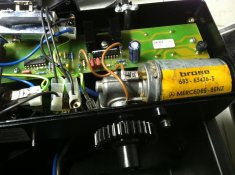
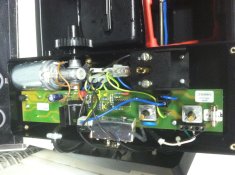
That's what the inards of the machine look like. There is no "claw" but when it stalls it makes that motor is stuck hum. It also happens indipendant of the machine reversing.
 
View attachment 50298
That's what the inards of the machine look like. There is no "claw" but when it stalls it makes that motor is stuck hum. It also happens indipendant of the machine reversing.

That hum you hear is the transformer being overloaded because the stalled motor is pulling loads of current. The slower a motor goes, the more current it draws; at stall, the current is limited only by the (very small) series resistance of the windings and the series resistance in the transformer. Leaving it powered like that will make things very hot and you stand a good chance of blowing something.

The fact that it hums like that means that the controller is successfully applying power to the motor; your fault is almost-certainly not electrical unless it's a short inside the motor. You're going to have to replace or disassemble & repair the motor, sorry. My money is on gunk in the worm-drive gearbox that you can see on the end of the motor.
 
I pulled the motor apart, cleaned it out best I could, oiled the shaft, and re-assembled. Ran smoother than ever before. I then put a tank on, and was simulating a film processing cycle. 7 minutes in it stalled again, but with less warning. Tomorrow I will hook the motor directly into a 12V power supply. My CPE-2 Plus seems to have a switch on a circuit board that reverses the motor rather than a mechanical method and I noticed a random heat sink was VERY hot.
If the motor fails when powered on a power supply I know it's the motor and I can replace it.
If the motor runs I know it's the circuitry and I will just directly power it. Won't reverse any more but I can live with that.
 
If the heatsink (presumably the one by the brown wires; I think it's the transistor for controlling motor speed/direction and I think it does reversals based on a timer unlike the CPP2 which has a "claw foot" that switches every 2 revs) is very hot, that still probably indicates a motor-drag fault. Given that you got some improvement by cleaning, you can probably get it all they way to nominal operation by further cleaning and careful lubrication. If the transistor there is a MOSFET (quite likely), increasing temperature will increase its on-resistance, which in turn will generate more heat, etc, until it all stalls. Can you read the part number on that transistor? It might be possible to replace it with a more-modern version (FETs have advanced a long way in the last 10 years) that doesn't get as hot and gives the motor a little more torque.

If you get a high-current power supply and plug it into the motor, the motor will run despite the drag but it too will become quite hot due to the increased current draw. Whether the motor stalls or not depends on the current capacity of the supply you choose to test with, so it's not really much of a test unless you also measure the current. It's stalling with its normal power supply because the drag is becoming so large that the supply can't provide enough current to keep it turning.
 
There is a Bosch model number on the motor. It's the headrest motor for a Mercedes Benz W124. I just picked one up on eBay. So yes the rumors are true. Jobo used Mercedes Benz parts.
Once I get the part and hook everything up I'll let you all know how it goes.
 
No problem, Bosch Part Number 0 390 206 692 Mercedes-Benz Part Number 003 820 21 42 I'll let every one know if it works once the part comes in. I am also going to relube that motor one more time using something a little thicker than 3in1 oil.
 
No problem, Bosch Part Number 0 390 206 692 Mercedes-Benz Part Number 003 820 21 42 I'll let every one know if it works once the part comes in. I am also going to relube that motor one more time using something a little thicker than 3in1 oil.

Very interesting. Is this the motor of the CPE-2? Is it the same of the other Jobo processors?
For instance I have a Jobo CPP-2. If I had to buy a new motor would the abovementioned one work for me?

Did Jobo change motors during the course of the life of one single model (e.g. is it possible to find CPP-2 with different motors)?

Would there be any problem in using this motor in any Jobo processor regardless of which was the original one?

Thanks to anybody who can contribute an answer

Fabrizio
 
As i see this motor model, it should fit the CPE2+ (as well as ATL1000\1500), but has a different shaft. Lets see if the OP can use the existing shaft with the motor he ordered.

CPE2 has a different motor then the CPE2+
Both are different then the motors in CPP\CPA machines, which had 4 motors used over time.
The first 3 being interchangeable and the latest one needs different electronics then those used in the first 3 production runs.
 
Thanks krifartida.
Do you (or anybody else) know if there is anywhere a source whereby one can know, given a certain Jobo model and serial number, which is the motor to buy, with catalogue part number?

I would consider buying a spare motor "just in case", while they are available.

Fabrizio

PS Maybe I could ask Jobo to send me such a list for posting here. Or, even better, some site owner might invite Jobo to join the conversation.
 
Jobo has published literature on the model #s on the machine and the correlation with at least 2 of these motors.

The upgrades were made to prevent motor stalling and burnout with the series 3000 drums.

PE
 
CPP\CPA SN ith 4 digits, first run, SM ith 5 digits up to 19999 (CPA has slightly different numbers for this run) second run, motor was upgraded to double bearing
20000-21999 stringer motor
22000 and up New motor and DC boards, with conical shaft,

All first three runs use the same part number and are interchangeable. The latest one needs a complete board refit.
 
Thanks for all the help and I hope this thread helps some one else in the future. The Mercedes Benz headrest motor was a drop in fit. All I needed to do is remove a bracket that was bolted to the motor base and de-solder the leads to the motor. I don't know if it would work for any one else's machine but it worked for me.
photo41.JPG

Dave M.
 
`Appears to be running fine now. Not sure why cleaning and re-lubing the old motor failed. Everything looked good inside. My best guess is a bad bearing surface as the rear of the motor was getting toasty hot.
 
Photrio.com contains affiliate links to products. We may receive a commission for purchases made through these links.
To read our full affiliate disclosure statement please click Here.

PHOTRIO PARTNERS EQUALLY FUNDING OUR COMMUNITY:


Ilford ADOX Freestyle Photographic Stearman Press Weldon Color Lab Blue Moon Camera & Machine
Top Bottom